Quantum: Google’s AI agents made calculations up to 290 times cheaper, what’s the point?
There still isn't a quantum computer big enough to perform the calculations that really interest chemists. And yet Google has just made these calculations up to 290 times cheaper. On paper. With teams of AI agents meeting in conference every four hours, and a mathematical checker that refused the slightest false idea. Yes, this is where we are: AIs optimizing programs for machines that don't exist yet.
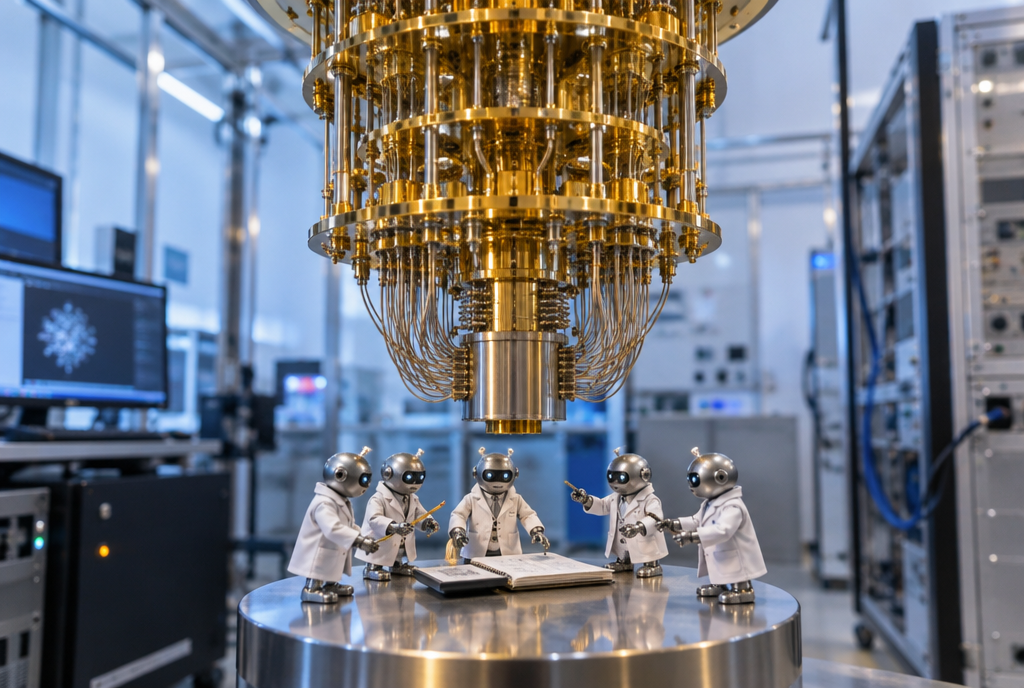
The most serious conference in the world, and not a single croissant at the buffet
The announcement dates back to November 23, on the Google DeepMind blog, together with Google's quantum team. And unlike quite a few announcements of this kind, this one comes with proof. Literally.
First, why it's useful
Let's start with what speaks to me the most. In your liver, there's a family of enzymes, cytochromes P450, that break down most of the medicines you swallow. You may already have read on a leaflet that you shouldn't take a certain medicine with grapefruit juice? It's because of them: grapefruit blocks one of these enzymes, and the medicine builds up in the blood. Understanding exactly how these enzymes work, at the atomic level, would help design better-dosed medicines and predict their bad combinations.
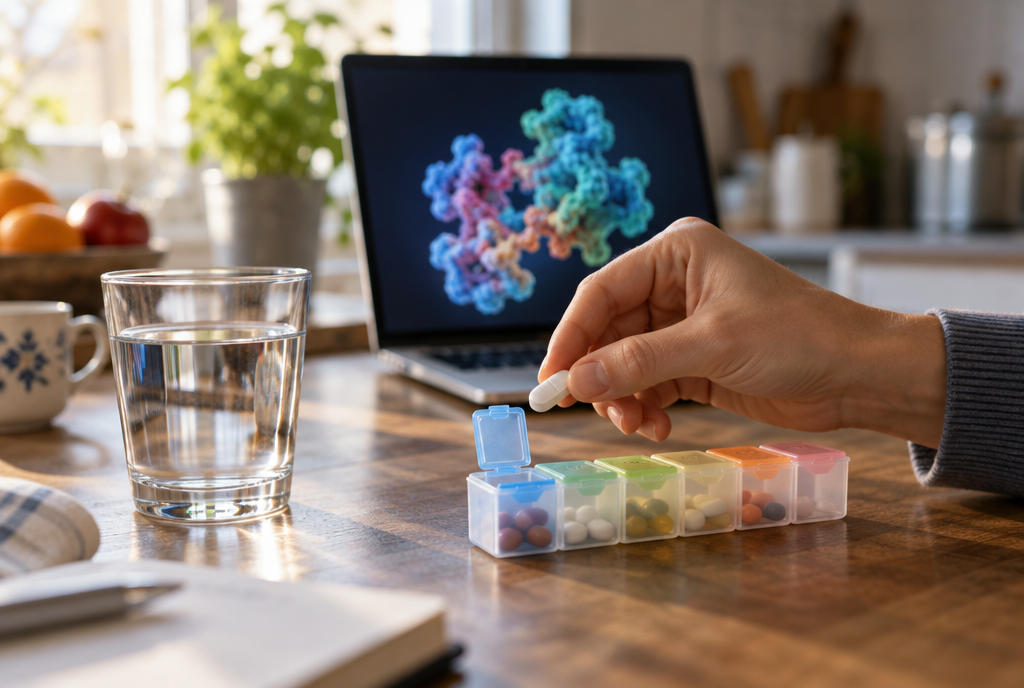
Your liver takes apart this little morning pill with enzymes that even our best computers can't simulate
The problem is that simulating these molecules goes far beyond what our classical computers can do, even the biggest ones. The electrons in them follow the rules of quantum physics, and that's precisely where a quantum computer should shine. If you want to understand what a qubit is without having studied physics, I tried explaining it four days ago with Google's computer winning the impossible game.
Same logic for the study's other big subject: laser fusion, where giant lasers compress a tiny grain of hydrogen until it lights up like a little sun. Simulating what happens in the fuel is still a calculation beyond the reach of today's machines.
The real problem: recipes that are far too demanding
A quantum algorithm is a recipe. It says which operations to perform, in what order, on how many qubits. And today, the known recipes for these molecules require thousands of "corrected" qubits, meaning protected against errors, which no machine yet knows how to line up in such large numbers.
There are therefore two ways to bring closer the day when these calculations become possible. Build bigger machines, which thousands of engineers are working on. Or make the recipes less demanding. That's where DeepMind unleashed its agents.
Teams of agents, and an unforgiving checker
For each problem, several teams of agents running on Gemini 4, independent from one another, searched for improvements. Every four hours, agents from each team met in a virtual "conference" to compare their ideas and debate them. Like real researchers, minus the coffee.
But the key point is the checker. A quantum circuit of this size can't be tested: too big for a classical computer, too big for today's small quantum processors. So every idea had to be proved with Lean, software that checks a mathematical proof line by line and rejects anything that isn't perfectly rigorous. A false idea, even a brilliant one, even a convincing one, didn't get through. Only proven ideas made it into the shared notebook.
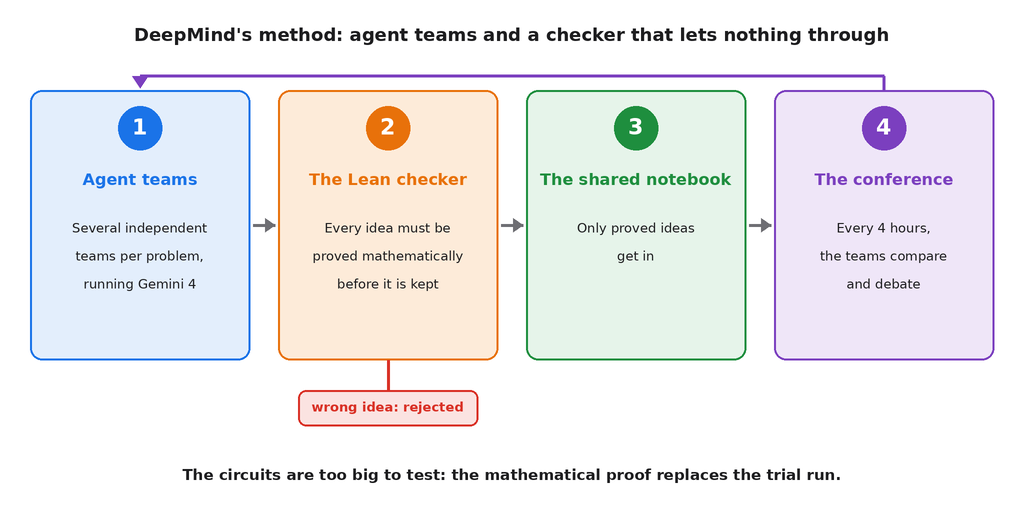
The Lean checker is the maths teacher who never gives half a mark
That's exactly what's missing from most AIs: a safeguard that can't be fooled by a well-worded answer. We'd already seen Google's agents check a proof from 1974 on their own with the same tool. Here, they don't check anymore: they invent, and Lean checks behind them.
The results, and they're pretty hefty
For laser fusion, the calculation becomes 11.8 times less costly. For a molecule sensitive to light, 8 times. For the P450 enzyme, 2.5 times. For a version of Grover's algorithm, which is used to search for an element in a jumbled list (like finding a number in a phone book randomly shuffled), 2.57 times. And for a small routine called “arcsin”, which is used to load numbers into a quantum computer and which loads of other algorithms use, the gain is... 290 times.
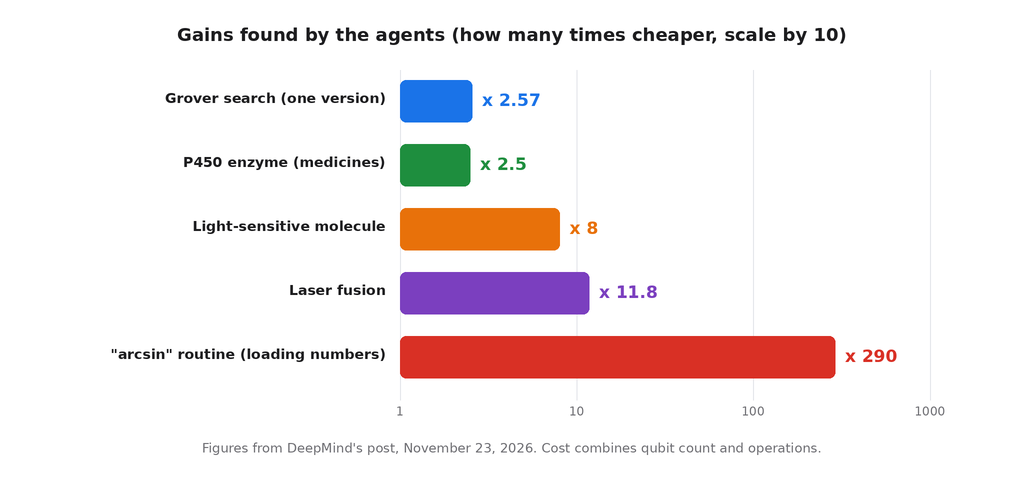
When a small routine that everyone uses becomes 290 times cheaper, the whole floor above benefits
290 times. On a basic building block. It's a bit like someone finding a way to screw in a screw 290 times faster: all the flat-pack furniture in the world suddenly gets assembled much faster. One honest clarification: the scientific paper gives slightly different figures from the blog post (11 instead of 11.8 for fusion, for example), I used the ones from the post.
The memory gain is just as striking. For fusion, the number of corrected qubits needed drops from 5,650 to 4,338. For the P450 enzyme, from 481 to 333.
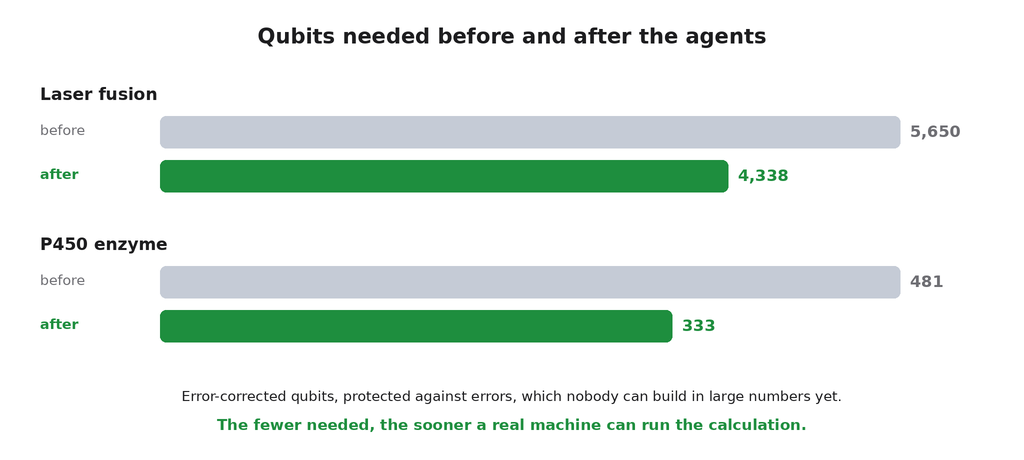
A third fewer qubits for the enzyme means just as much machine we won't need to build
And everything is public: the Lean library for quantum algorithms, the problem statements and the verified solutions are on DeepMind's GitHub. Any researcher can check. I love it.
So, when is it happening?
Not tomorrow, and DeepMind says so itself. Even with the reductions, these calculations still require more resources than the first error-corrected quantum computers are expected to offer. No date is given for running these circuits on a real machine. Ten years? Twenty? Maybe never for some of them. I'm not going to sell you a drug designed by a quantum computer for 2028.
But there's a precedent that makes me optimistic. In 1994, Peter Shor published a quantum algorithm capable of breaking the encryption that protects your online payments. For years, estimates said it would take a billion qubits. Then, through a succession of improved recipes, researchers got down to around twenty million in 2019, then below one million in 2025. The machines hadn't grown by that much: it was the recipes that had slimmed down. And the deadline moved closer by several decades.
This is exactly what this work does, but with agents that speed up the cooking. The authors sum it up in one sentence: AI research verified by proof “compresses work that once took years of manual design.” What I like is the balance: AI suggests, imagines, debates, and a proof checker immune to smooth talk makes the call. If all AIs worked with a teacher like Lean behind them, we would have far fewer hallucinations. And maybe, one day, a slightly shorter medication leaflet. We can dream!
Sources
- Google DeepMind, 23 November 2026: finding faster quantum algorithms with agents and formal verification (in English)
- arXiv 2611.09822: discovering formally verified quantum programs with AI (in English)
- GitHub, Google DeepMind: the Lean library, the problems and the verified solutions (in English)
- The Next Web: DeepMind's agents found cheaper quantum algorithms, and proved them (in English)
Article written with the help of Claude Code, reviewed and corrected by me.
Join the conversation
You need an account to comment on this article. Creating one is free and takes under a minute.
No comments yet.