Quantum: Google's computer wins an impossible game, and what good is that?
Google's quantum computer has just won at a game that nobody can win every time. Neither you, nor me, nor the biggest computer on the planet: the best we can do is 8 games out of 9. Google's machine, it has won more than 98 out of 100! It's been published since Wednesday, November 19, on the cover of the journal Science, one of the most prestigious scientific journals in the world. The game is called the magic square, and it fits on a scrap of paper.

Two players, a wall between them, and a grid to fill in without talking to each other
The rules of the game
You take a 3 by 3 grid, and put crosses in it. Only two rules. Each row must have an even number of crosses: zero or two. Each column must have an odd number of crosses: one or three. That's it. Simpler than a waiting-room magazine sudoku, and yet...
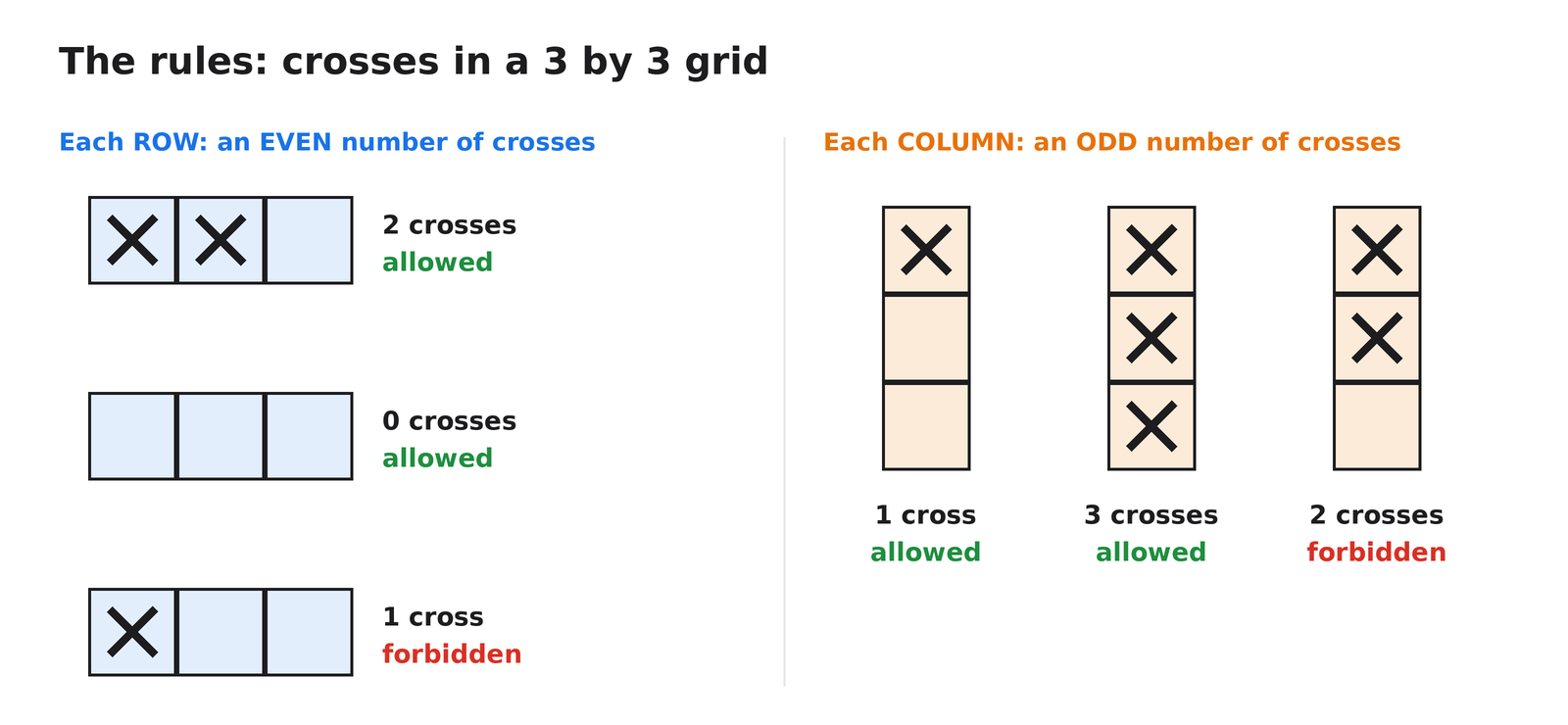
The rows want 0 or 2 crosses, the columns 1 or 3
Why nobody can do it
Try it on a scrap of paper, I'll wait. You'll see: when all the rows are right, there's always one column that doesn't work. It's not bad luck, it's math. The three rows together necessarily have an even number of crosses. The three columns should have an odd number of them. Yet they are the same crosses! The perfect grid doesn't exist.
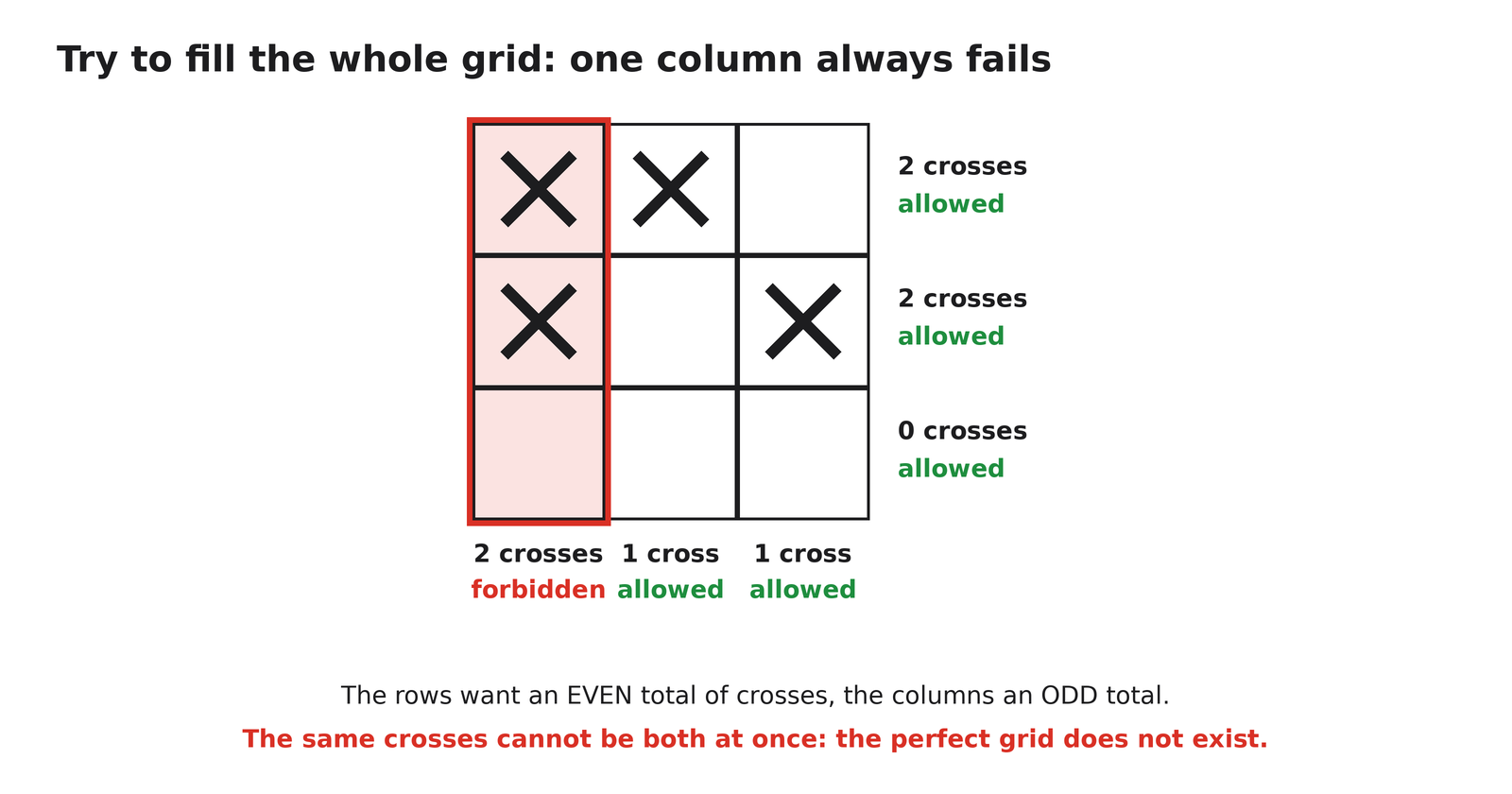
All three rows are good, but the first column has two crosses: missed it
The two-player game, with a wall in the middle
Now, we play as two: Alice and Bob (in physics, the players are always called Alice and Bob, it's a tradition). A wall separates them, they can't talk to each other. Alice gets a random row, Bob a random column. Each fills in only theirs, following their rule. They win if they have put the same thing in the cell where their row and column intersect.
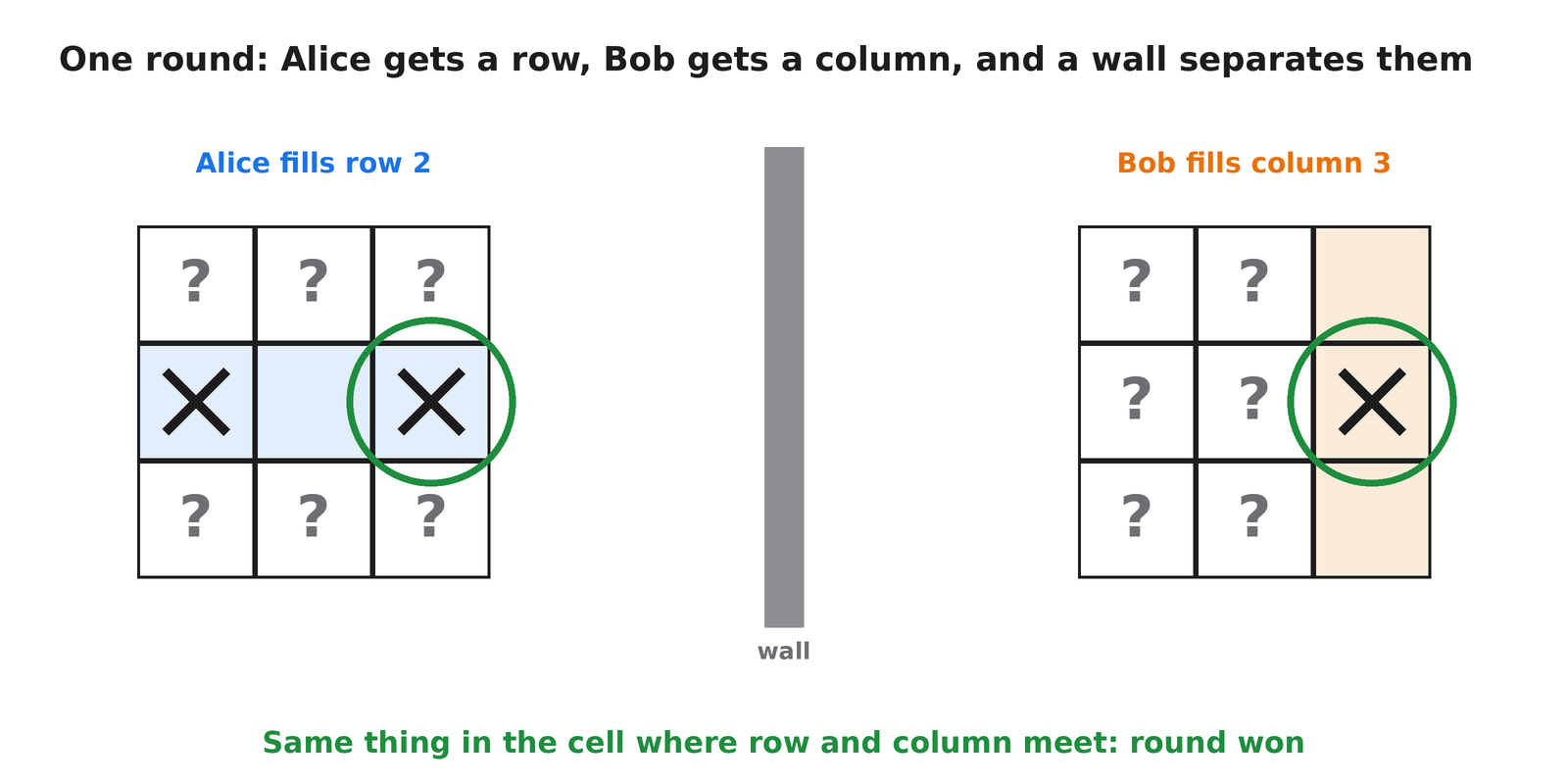
Alice and Bob both put a cross in the shared cell: won
Before playing, they can agree on a strategy, for example memorizing a grid. But every grid has one square that doesn't work. Of the 9 possible combinations, there is always one where they lose. The best possible score is therefore 8 games out of 9, or 88.9%. Nobody can do better. Nobody... except a quantum computer.
The trick of the twin qubits
A quantum computer doesn't calculate with bits like your PC, but with qubits. And we know how to make “entangled” qubits: twins prepared together which, even when separated, give linked answers when we measure them. No message passes from one to the other. That's just how quantum physics works, and nothing in our everyday world knows how to imitate it.

Two entangled qubits: each on their own side, but their answers are linked
So Google gave Alice and Bob twin qubits on its Willow quantum chip. With that, theory says you can win every time. They played the 9 versions of the game, 100,000 times each. Result, according to the article published by Google: 98.3% of games won. One game lost out of 60, instead of one out of 9.
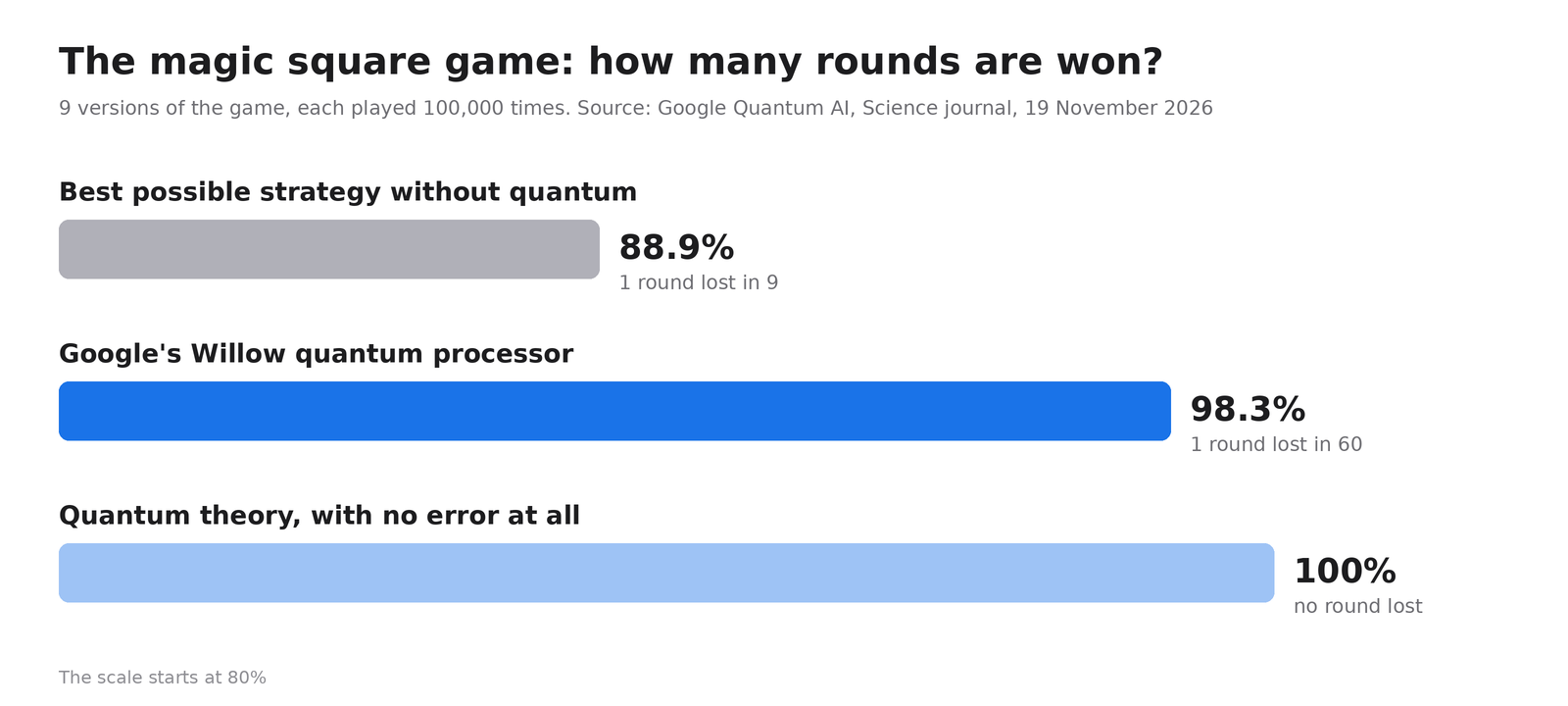
Willow doesn't reach 100%: the machine's small errors still cost one game out of 60
Why not 100%? Because qubits are very fragile objects, the slightest disturbance sends them off track. But 98.3% against a maximum of 88.9% without quantum, that's proof that the machine is doing something impossible for a normal computer.
The answer doesn't exist before the question
And that's where it gets mind-bending. If Alice and Bob won with normal objects, there would have to be a perfect grid hidden somewhere, already filled in, and each of them would read their answer from it. But this grid doesn't exist, as we've seen. The only explanation is that the qubits don't have an answer written in advance: it is decided at the moment the question is asked. Physicists call this “contextuality”. A barbaric name for an idea that's simple to say, and frankly hard to swallow.
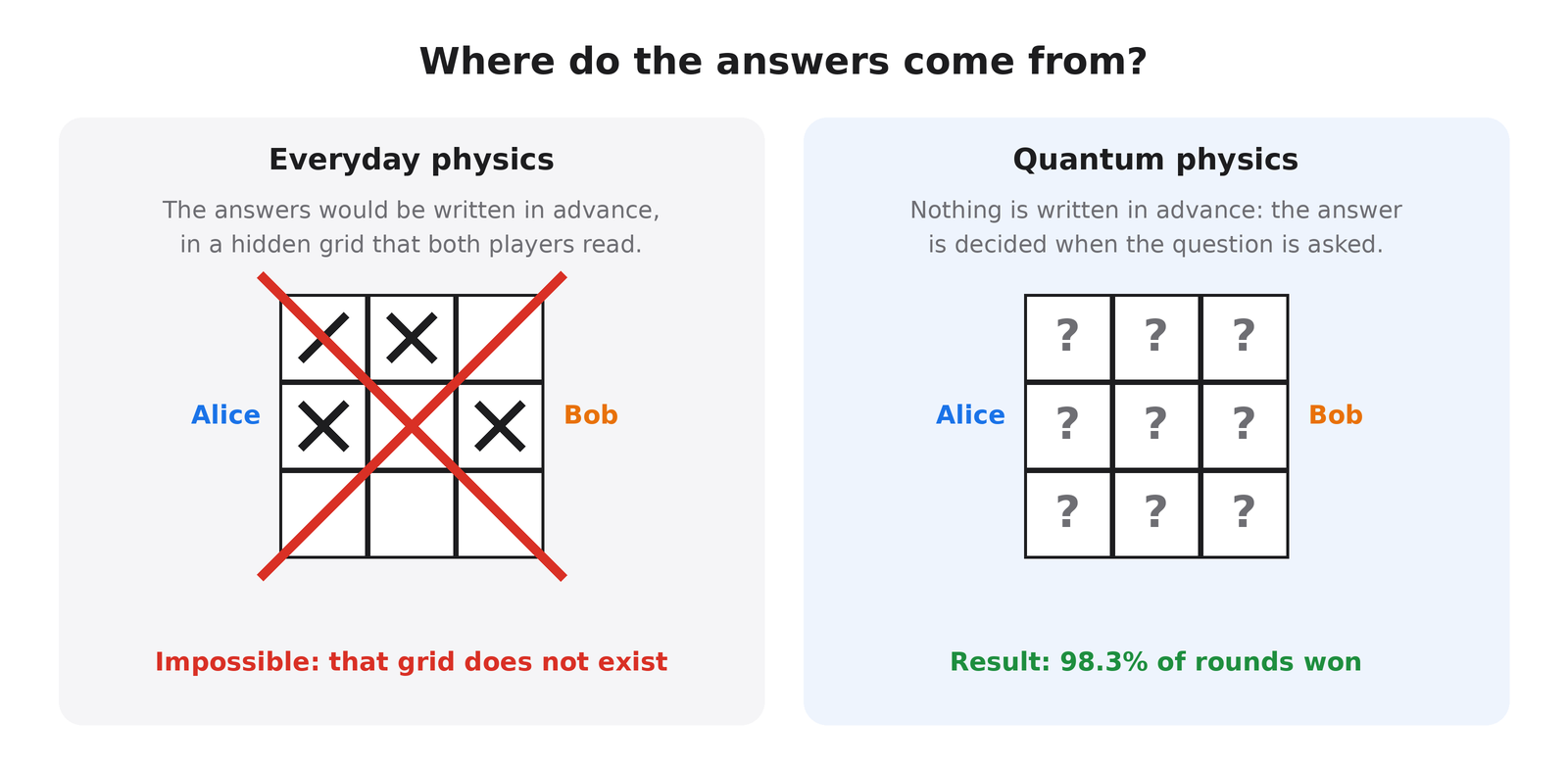
Without quantum, you would need an impossible grid. With it, the answers are decided at the moment of playing
Researchers think that it's precisely this property that gives quantum computers their edge on certain calculations. Google also links it to “magic states”, qubits prepared in a very particular way, which future reliable quantum computers will need for their most difficult calculations. Magical, quantum, contextual... you get the feeling that physicists are more comfortable with equations than with christening names!
Okay, and what does that change for you?
Today? Nothing. Your phone won't be any faster tomorrow morning, and neither will your internet box. But Google has just made an honest measuring stick for quantum computers. The 88.9% and the 100% are fixed by physics, they will never move. The closer a machine gets to 100%, the better it is, and nobody can cheat on the score. These tests even detected small errors in the chip that the usual tests didn't see.

A height chart doesn't cheat: the previous mark stays where it is
Concretely, that means two things. The next time a company announces in the newspaper a "revolutionary" quantum computer, there will be a simple test to check it without taking the press release at its word. And one day, the machines that will simulate a molecule for a new drug, or the material for a better battery for your car, will have to be adjusted to the millimeter: you can only adjust properly what you know how to measure. When? Nobody gives a serious date. Ten years, more, maybe never for some uses.
It reminds me of the meter. Before the Revolution, every region of France had its own measurements, and checking that a merchant wasn't cheating you was an obstacle course. In 1799, a platinum standard meter was deposited in Paris, and everyone was able to compare with the same ruler. Google is offering something like the standard meter for quantum computers. A standard doesn't make anyone dream. But without it, no honest trade!
So Alice and Bob found a way to agree 98 times out of 100 without speaking to each other, with a wall between them. I know team meetings, with a whiteboard and three hours of discussion, that don't manage to get that score!
Sources
- Google Research, November 19, 2026: a game you can only win with a quantum computer (in English)
- Google, November 19, 2026: one of the deepest properties of quantum mechanics tested at scale (in English)
- Science: Google Quantum AI's scientific article on contextuality (in English)
- Quantum Zeitgeist, November 20, 2026: Google demonstrates contextuality at scale (in English)
Article written with the help of Claude Code, proofread and corrected by me.
Join the conversation
You need an account to comment on this article. Creating one is free and takes under a minute.
No comments yet.