There is one thing you cannot see in Quobly's announcement, and yet it is the whole story. On September 16, the Grenoble-based company announced that it had successfully carried out three basic quantum operations on one single chip. Interesting, but not unheard of: teams have been doing it for years, in laboratories, on machines that look like lab prototypes.
The difference is where this chip came from. It was manufactured in Crolles, in the facilities of STMicroelectronics, on a production line for 300-millimeter wafers. The one used to make chips for cars and consumer electronics. Not in a lab with researchers bent over a one-off contraption: in a factory that has been producing at volume for years.
This may be the most important news in quantum computing in September, and I am going to try to explain why, without jargon.
What they managed to fit onto a single chip
A quantum computer needs three basic actions, and this part is unavoidable: write information into a qubit, read what it contains, and make two qubits work together. Quobly announces all three on the same chip, which means that reading, computing and chaining are no longer three pieces made separately and then glued back together by hand.
A qubit, to give you some context, is the quantum equivalent of the bit on your USB key. Except that where a bit is 0 or 1, a qubit can be in a mixture of both at the same time. That is where all the hoped-for power comes from, and also all the fragility: the slightest exchange of heat with the outside erases the information. Hence the fact that they are kept alive at a few thousandths of a degree above absolute zero, colder than the space between the stars.
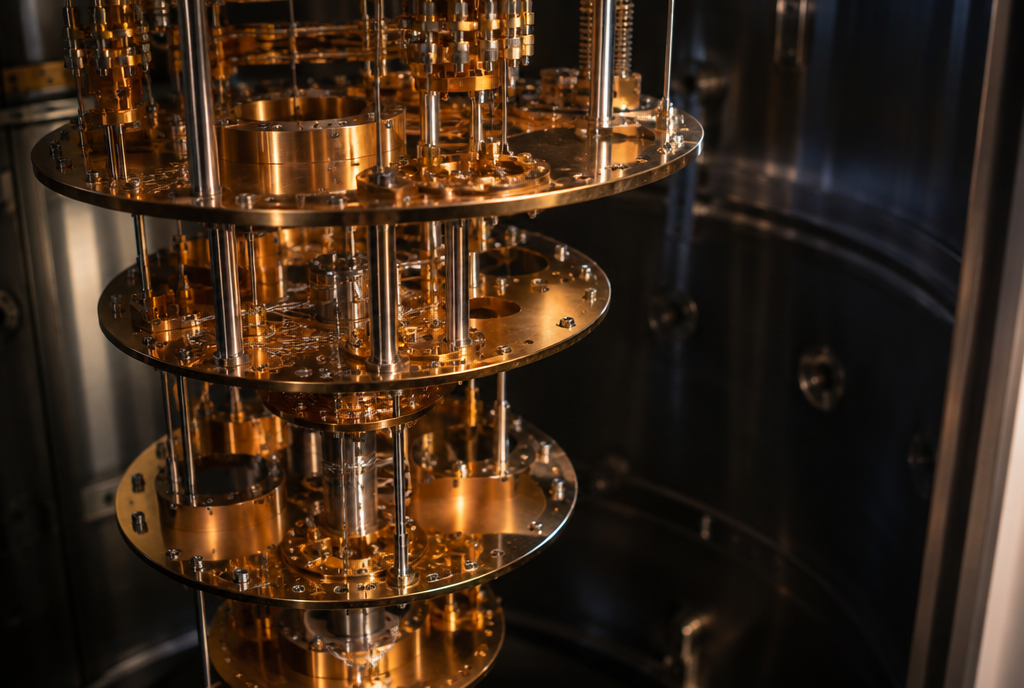
A few thousandths of a degree above absolute zero, and the room must absolutely not warm up
The chip in question combines two technologies that are written in black and white in the press release, and these two words are worth translating. The first is “FD-SOI”, a type of transistor that STMicroelectronics already mass-produces for low-power chips. The second is silicon-28, a purified version of silicon from which an isotope has been removed, meaning a variant of the same atom, which has the unfortunate habit of carrying a miniature magnet and disturbing the qubits. In other words, quantum computing is not being done next to the conventional semiconductor industry: it is using the conventional industry while purifying it where necessary.
Why silicon is the bet that matters
There are several families of quantum computers, and they are nothing alike. Teams are working on atoms trapped by lasers in a vacuum, which results in setups several meters long. Others are working on cooled superconductors, the big golden pot you have already seen in photos. And a few days ago, Fujitsu presented a quantum processor made from diamond, a very different bet and a serious one too.
Silicon has a simple and decisive advantage: the whole world knows how to make it. Decades of work, thousands of engineers, factories that are already running and producing billions of chips a year. If a quantum computer can be made with the same machines, we suddenly inherit this entire industry, its yields and its prices. That is the argument summed up by Quobly's chairman of the scientific council, Daniel Loss: the real question is not whether you can make one qubit, it is whether you can make millions of identical ones, and “reproducing it wafer after wafer, that is the task”.
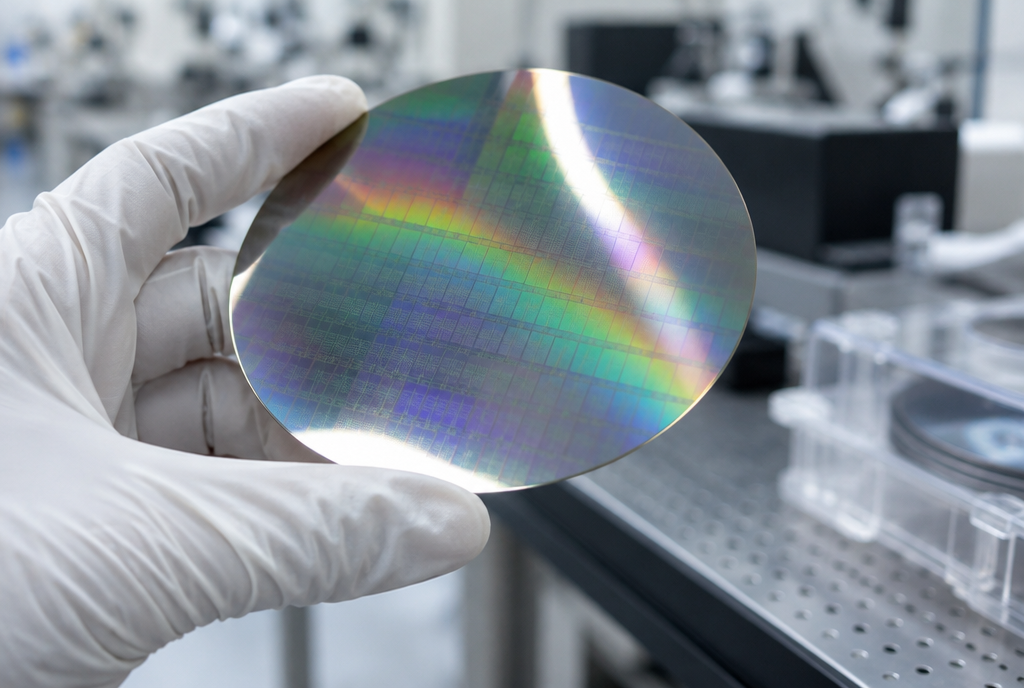
A silicon wafer coming off a normal production line, the one that already makes the chips in your car
This isn't a minor communication nuance. A single successful chip in a laboratory is a demonstration. The same chip produced by the thousands on an existing line is the only known way to arrive at a machine that stands on its own for something other than experiments.
What is missing, and there is a lot missing
The press release gives no figures on fidelity, no qubit lifetimes, no exact temperature. It announces that the measurements will be published later. It's a milestone announcement, not a measurable result, and I prefer to say so rather than let people believe it's a breakthrough.
The background information, on the other hand, is public. Quobly has existed since 2022, employs more than a hundred people, raised €115 million in June, and announces a goal of one million qubits by 2032, with initial cloud access planned for partners by the end of 2026. The important word in that sentence is 2032, and even then: one million qubits is a goal displayed by a company, it's not a date guaranteed by anyone.
There is a physical reason for this caution, and it has been discussed for a long time. I wrote a few weeks ago that the problem with a quantum computer isn't really its qubits, but everything that has to be put around them to control them, especially the number of cables that have to go down into the cold. Going from a handful of qubits to one million isn't solved with a finer soldering iron. It's solved by putting the control on the chip itself, and that's exactly what Quobly says it has co-integrated with the control electronics. That's where today's good news is: not in the number of qubits, in the fact that the control is in the same block.
Concretely, what does that change for you?
I'm going to give the real answer before the examples, because a reader who feels like he's being taken for a sucker doesn't come back. Today, at your place, absolutely nothing. Not in your phone, not in your router, not in your car. Quantum computing will never replace your computer because it's very bad at everything a computer does well: displaying an image, keeping a file, remembering a password. It is only useful for a very narrow family of problems.
Which one? The kind where you have to try a gigantic number of combinations to find the right one. We come across this kind of problem every day without knowing it, and there are three that affect a normal family life.
The first is the chemistry of medicines. Simulating how a molecule folds and attaches itself to a target is a problem of combinations, and that's what costs the most and takes the most time in the search for a treatment. A quantum computer doesn't heal anyone, but it could say "don't make that molecule" much faster than it currently can.

Find the right molecule instead of making them one by one: years of lab work saved, if the machine delivers on its promises
The second is the battery. Finding a material that stores more energy without heating up is the same kind of chemical puzzle, and that's what still holds back family electric cars on long journeys. The third is more prosaic: organizing delivery rounds, nurses' schedules or traffic lights in a city is also combinatorics on a very large scale.
And the timeline, honestly, is ten years, fifteen years, or never. The first quantum computer capable of beating a classical computer on a problem useful to anyone other than a researcher does not exist yet, and nobody serious gives a date. We're at the point where the machine exists on the lab bench and where the question becomes industrial, meaning boring: will the same chip come out identical from the production line next week, and the week after?
That's exactly the path the transistor took. In 1947, it was a laboratory setup shown to visitors, and it took fifteen years before it ended up in a living-room radio. The laser, which appeared in 1960, was treated for years as a solution in search of a problem, and here it is in supermarket checkout lanes and in the fiber bringing you this page. Nobody ever wrote "watch out, this is going to change everything" about those two at the time, and they changed everything anyway. The only solid thing I can say about quantum computing is that today it's exactly in the same place, with very serious people at the controls and decades of work ahead of them.
What it changes for you right away fits in one line: a quantum chip manufactured in an ordinary factory is one more reason to think that the bill isn't going to stay at lab scale. We'll see about the rest.
Join the conversation
You need an account to comment on this article. Creating one is free and takes under a minute.
No comments yet.