The real problem with quantum computers wasn't the qubits, but the cables
On July 29, HRL Laboratories presented in Nature a quantum processor capable of operating itself. It has 18 silicon qubits. A qubit is the basic unit of quantum information. Most importantly, all the electronics that control them are housed with them in the fridge.
Presented this way, one might think it's just an engineering detail. Yet, it is the wall that everyone has been hitting against for the past ten years.
No one ever talks to you about the cables
When you see a quantum computer in a photo, you see a beautiful golden object that looks like an upside-down chandelier. What the photo doesn't show is that this chandelier is almost entirely made up of cables.
The principle is simple. The quantum chip lives at the very bottom, a few millikelvins above absolute zero. The instruments that give it orders remain in the room, in racks at room temperature. Between the two, you need wires. Lots of wires. And each qubit demands its own.
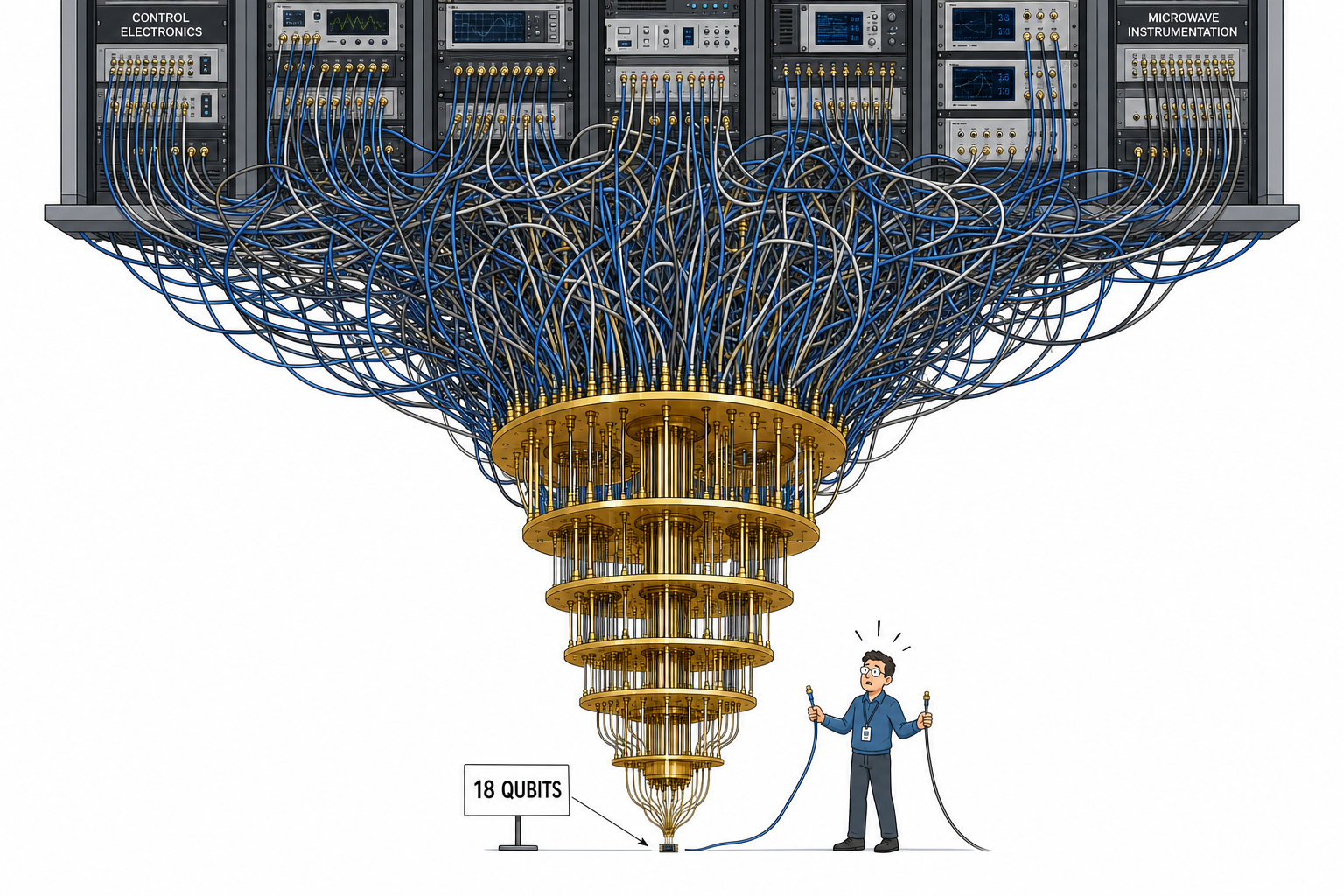
The chip is the little thing at the bottom. The rest is extension cord.
The numbers are brutal. According to a study on scaling quantum machines, the cryostat of a 150-qubit processor costs 5 million dollars. The cryostat is the fridge that keeps the chip at very low temperature. Of that 5 million, 4 million goes to the wiring. The fridge costs less than the wires that go inside it.
And the price isn't even the real problem. Each cable carries heat. It starts from a room at 20 degrees and goes down to a zone that must remain two millikelvins above absolute zero. Multiply these cables by a few thousand and the fridge can no longer keep up.
However, to obtain a truly useful machine, you need about a million physical qubits. These are the real qubits, those that exist on the chip. A million qubits represent a million sets of cables. They won't fit in the room. And even if they did, the heat carried would prevent the system from staying cold. It's the only computer in the world whose main problem is the extension cord.
What HRL did: moving the conductor into the fridge
The idea can be summed up in one sentence. Instead of controlling the qubits from instrument racks installed in the room, HRL placed the control chip in the fridge, one floor above the qubits.
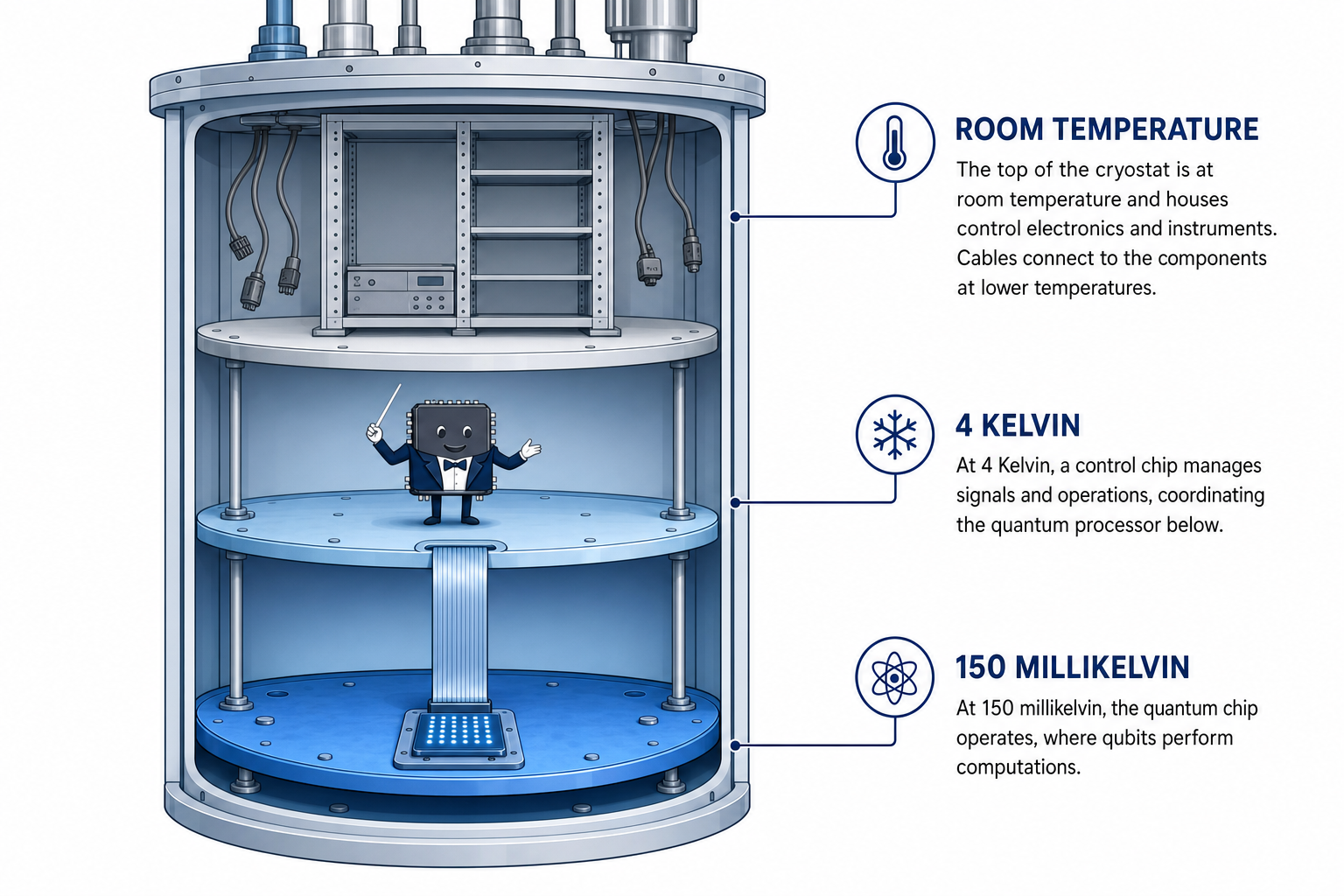
The conductor has gone down into the pit. The musicians can finally hear him without delay.
In detail, the system has three levels.
- At the very bottom, at 150 millikelvins, is the quantum chip. It contains 18 qubits cut from a grid of 54 quantum boxes, tiny structures that confine electrons. The whole thing is etched onto 200-millimeter silicon-germanium wafers, with production lines that are completely standard.
- Just above, at 4 kelvins, is the controller. This chip with 70 million transistors, etched in 130 nanometers, produces all the signals sent to the qubits. It consumes less than 3.5 watts, which is about as much as a nightlight.
- Between the two runs a flat ribbon of 296 tracks in niobium on polyimide. It is superconducting, allowing it to carry current without resistance under these conditions. It lets through less than 10 microwatts of heat. That’s almost nothing.
Error correction works in a closed loop, directly in the cold. The system measures errors, then adjusts its commands without asking for the opinion of an ambient temperature instrument. The round-trip disappears. Latency, that is to say the delay caused by this trip, disappears with it.
The numbers, because that's where it happens
A quantum operation regularly produces an error. It all depends on the frequency of these errors. Below a certain threshold, the system can detect and correct them quickly enough to remain reliable. Above this threshold, errors accumulate and the calculation collapses.
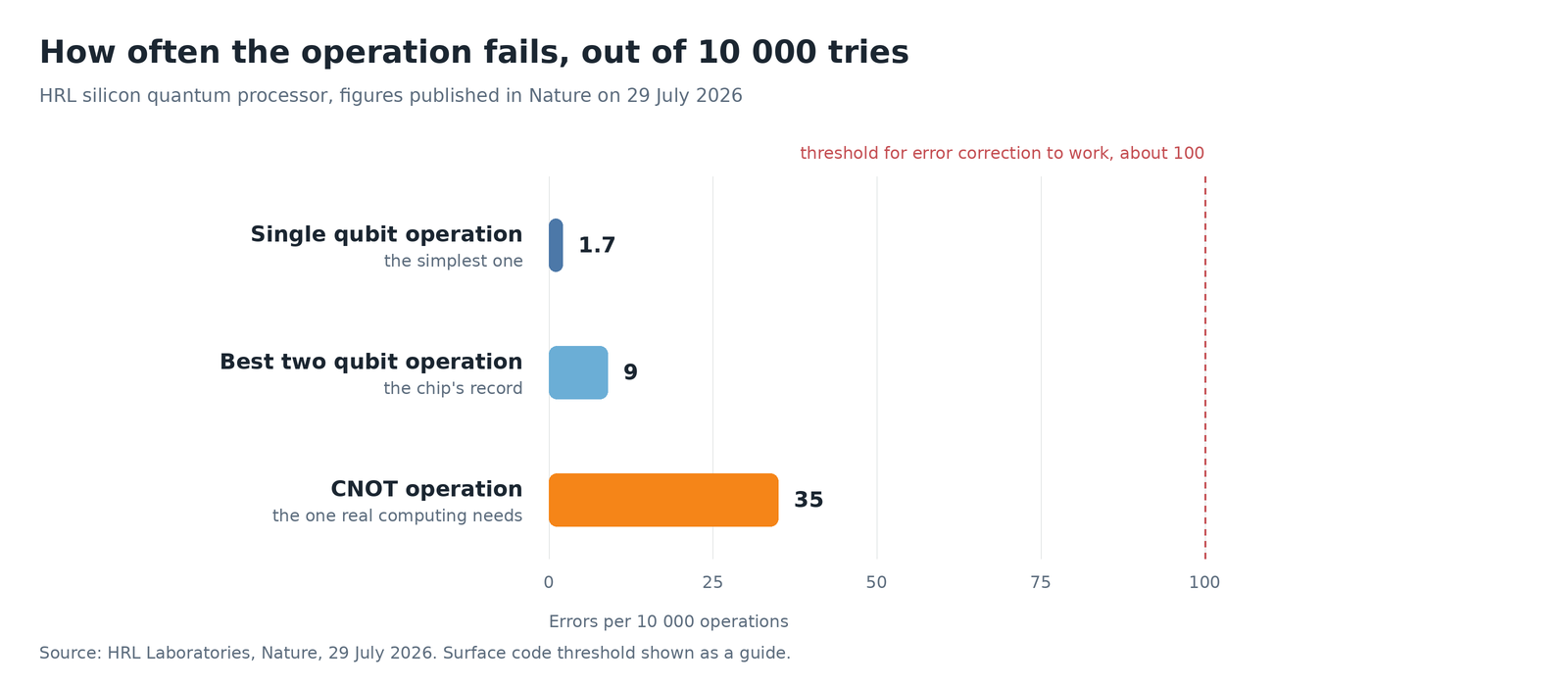
The three bars are below the red line. That's all you need to remember.
Two other results deserve to be mentioned. With a distance-5 repetition code, which spreads the information to detect errors, the error rate decreases by a factor of 4.7 when HRL adds qubits. This may seem trivial. Yet, this is the very principle of quantum error correction. Until now, adding qubits mainly added errors. With a detection code using four qubits, the team also maintains a fidelity of 95 percent on two logical qubits over three consecutive measurement rounds. Fidelity here measures the reliability of the result. A logical qubit is information protected by several physical qubits.
HRL also announces command errors ten times lower than in all previous demonstrations, with operations lasting less than a microsecond. On this specific point, it is no longer a simple improvement. We are changing categories.
Specifically, what does this change for you
Nothing tonight. Absolutely nothing. Your PC will never become quantum, nor will your internet box, and no one will put a fridge at 150 millikelvins in your living room. A quantum computer is not a classical computer that is just faster. It is a machine designed to perform three or four very specific types of calculations that nothing else can do.
These three or four uses, however, directly concern you.

On the left, today. On the right, the idea. Between the two, there are still 999,982 qubits missing.
1. The medications you take
Today, finding a molecule involves synthesizing thousands, then testing them one by one. It is long and expensive. This is also why a medication takes ten years to reach the pharmacy. Precisely simulating the reaction between two molecules requires a calculation that overwhelms a classical computer. A quantum machine, however, would be comfortable with this type of problem.
2. Your car battery
Same story. To develop the chemistry of a battery, prototypes are made, and then they are observed aging for months. Simulating the reaction instead of testing it would allow for the design of cheaper and more durable batteries, without going through twenty years of trial and error in the lab.
3. Your bank's padlock
This one is less cheerful. The small padlock displayed by your browser relies on a calculation that no classical computer can reverse in a reasonable time. A sufficiently large quantum machine, however, could. This is why banks and browsers are already discreetly migrating to new encryption methods. This is happening without you, and that's a good thing. But it is indeed this research that puts pressure on the timeline.
And when is it?
Honestly, no one knows. We are talking about 18 qubits here, while about a million are needed. Ten years, twenty years, or never: all three answers are defensible today.
A previous merit nonetheless deserves the detour, as it concerns exactly the same problem. In the 1950s, computers were wired by hand, wire by wire, by workers. The number of solder joints limited the size of machines long before physics. The solution was not a faster component. It was the integrated circuit, which eliminated much of the wiring by grouping components on the same silicon wafer. This is the same gesture that HRL has just reproduced, seventy years later, with another technology.
What I think about it
The detail I find most delightful is the engraving at 130 nanometers. This fineness dates back to the very beginning of the 2000s. While the entire industry struggles to go below 2 nanometers, HRL has deliberately brought back a technology from the Pentium 4 era. I do not know their exact reasoning, but at 4 kelvins the constraint is no longer density, it is heat and predictability. And there, an old proven engraving beats a fine engraving. The race for fineness is not always the right race.
The other amusing detail is the timing. On July 23, IBM announces the acquisition of HRL from Boeing and General Motors. Eight days later, the article appears in Nature. You won't make me believe that IBM hadn't read it before signing. IBM has built its entire quantum program on another technology. The company has therefore just acquired a second option, with a team that knows how to manufacture its chips on conventional production lines.
However, I still have a reservation, and it is significant. With 18 qubits, this machine remains tiny. The ribbon has 296 tracks for these 18 qubits. The problem of the number of wires is therefore not solved. HRL has mainly reduced the heat carried and the signal travel time. It is a step, not the entire staircase. But no one had yet climbed this step.
Join the conversation
You need an account to comment on this article. Creating one is free and takes under a minute.
No comments yet.