Take a piece of diamond smaller than a grain of salt, slip a tin atom inside it, place the whole thing on a chip that carries light, and you get a quantum processor. That's what Fujitsu presented on September 8, together with Delft University of Technology, its QuTech institute and the University of Tokyo. The prototype has been built, it works, and it is already accessible remotely to researchers.
The diamond isn't there to look pretty in the photo. It's the material they chose, and there's a reason we'll get to in a minute.
What they built, concretely: a diamond crystal containing a single tin atom, placed on a circuit that guides light, exactly as an electronic circuit guides current. The diamond was thinned down to a few hundred nanometers, then glued onto a support. Light enters through a fiber, travels through guides carved into alumina, and comes out at detectors capable of counting photons one by one.
Why tin? Because the same family of devices had been using nitrogen until now, and tin does two things better. It emits about ten times more photons, so it's ten times easier to read. And its structure makes it much less sensitive to the electrical noise hanging around it. That sensitivity is the nightmare of everyone trying to keep quantum information alive for more than a few microseconds.
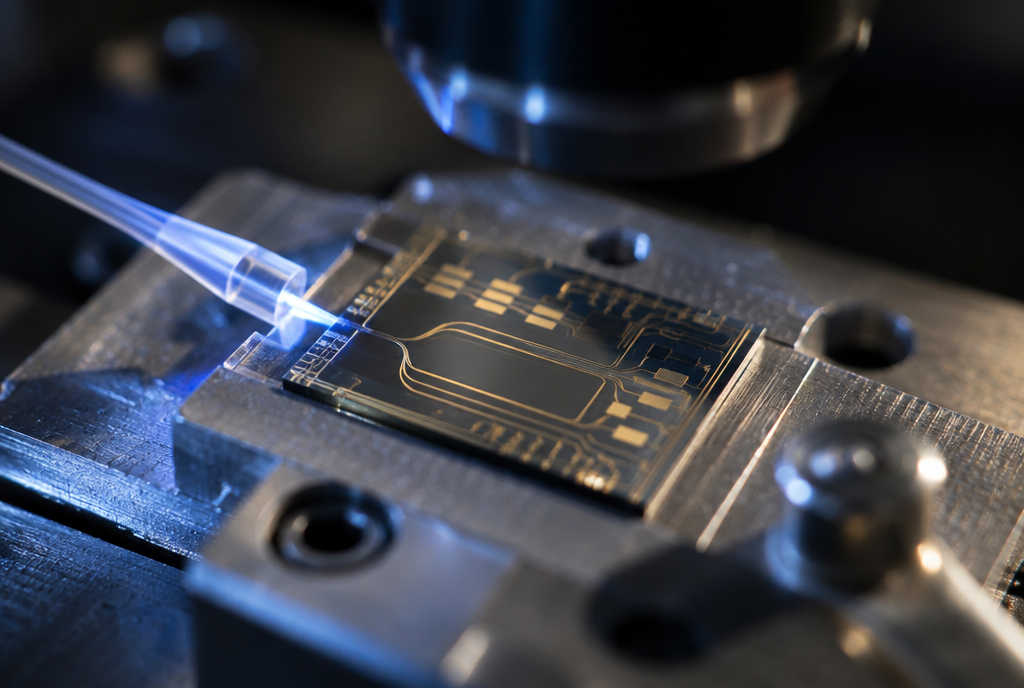
A tin atom, a light guide, and detectors that count photons one by one
The durations, now, because that's the measurement that really matters. The information lasts for more than a second in the electron spins, and more than a minute in carbon-13 nuclei that serve as local memory. A minute, in this field, isn't good, it's enormous. Most competing machines count in microseconds, or millionths of a second.
But the real news in this announcement isn't there. It lies in a number that makes nobody dream: 1.55 kelvin.
One kelvin is one degree Celsius shifted by 273.15. So 1.55 kelvin comes to about -271.6 degrees. Nobody lives in there, and yet that's a mild temperature in the world of quantum computing. Superconducting processors, the ones from IBM and Google, have to go down to around 15 millikelvins, or a hundred times lower. A device that works at 1.55 K is satisfied with a much simpler refrigerator than the one needed to reach 15 millikelvins: fewer cooling stages, fewer parts, a much more modest machine room and electricity bill.
I've been telling you this story for a while and it's starting to form a logical sequence. I wrote last month that a quantum computer wasn't getting stuck on its qubits but on its cables: every qubit you add requires its own wire, and those wires bring heat into the coldest fridge in the world. Then a few weeks ago, IBM connected two fridges together to get around the problem. The diamond approach attacks the same wall from the other end: instead of converting microwave signals into light to get out of the fridge, light circulates from the start.
What's missing, and it needs to be said clearly: the researchers have demonstrated no optical connection between several modules. They built one module, just one, and they know how to read it. Everything else is a plan.
That plan has dates, and they're company figures, not published results. A multi-module prototype in 2027. 250 logical qubits by fiscal year 2030. And 1,000 logical qubits by fiscal year 2035. A logical qubit, to put it simply, is a qubit that doesn't make mistakes: several fragile ones are assembled to obtain a single reliable one, and that ratio decides everything.
Fujitsu also specifies that its superconducting roadmap, the one targeting more than 10,000 physical qubits, will be optically connected to these diamond modules. In other words, the two technologies aren't opposed, they're supposed to plug into each other. And the prototype is already accessible remotely through the company's hybrid quantum computing platform, which means a researcher can request time on it without leaving their desk.
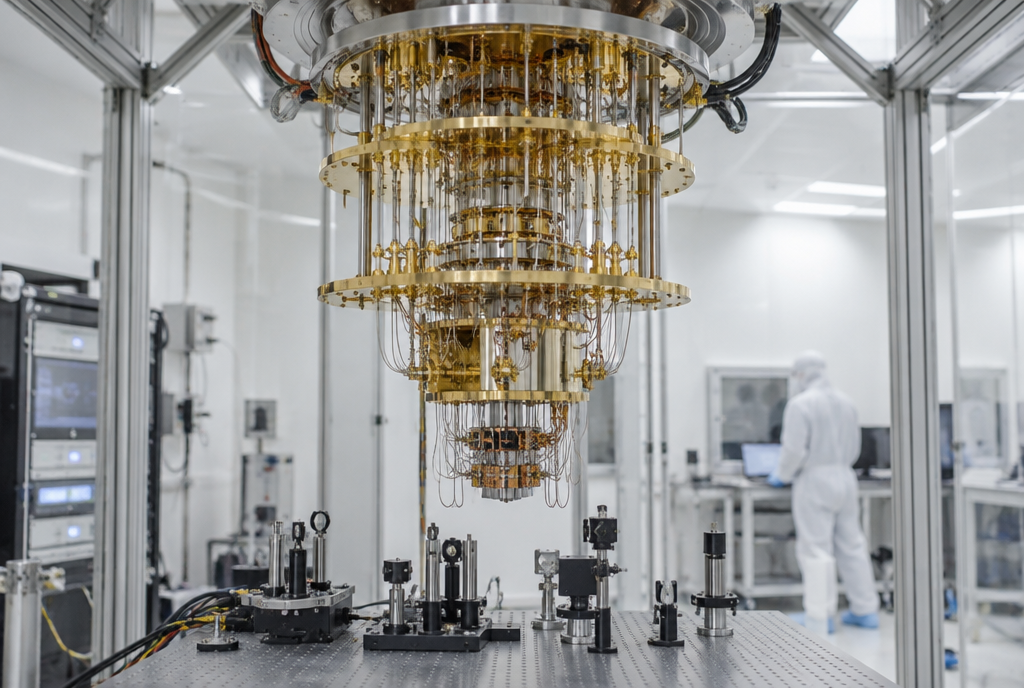
The golden chandelier is the refrigerator. This one goes down to 15 millikelvins, the diamond is content with 1.55 kelvin
So what does this actually change for you?
Not much this year, let's be honest right away. A quantum computer won't run your email, and this one won't replace anything in your home. What changes is what these machines will be able to calculate when they get bigger, because they are used to simulate things that classical electronics can't simulate at all.
Three examples you can relate to without needing a degree. Better battery chemistry means your electric car charges faster and goes farther, or your phone lasts two days instead of one. A better way of making fertilizer means improving the industrial process that consumes the most gas in the world after steel production: several percent of global consumption, and a molecule better understood would bring part of that bill down. And better calculation of delivery routes means the supermarket truck comes by once instead of twice.
The timeline, honestly: ten years, fifteen years, or never. The 250 logical qubits announced for 2030 are a company's promise, not a fact, and the history of quantum computing is full of delayed promises. If someone sells you a quantum machine for next year, the question to ask them fits on one line: how many logical qubits, and verified by whom?
There's one comparison that amuses me every time. The laser was invented in 1960, and for years, the people who talked about it most seriously said it was a solution in search of a problem. Today, there's one in your supermarket checkout, one in the fiber that brings you this page, and one in the machine that etched your phone's chip. Nobody was wrong, everyone was just very slow.
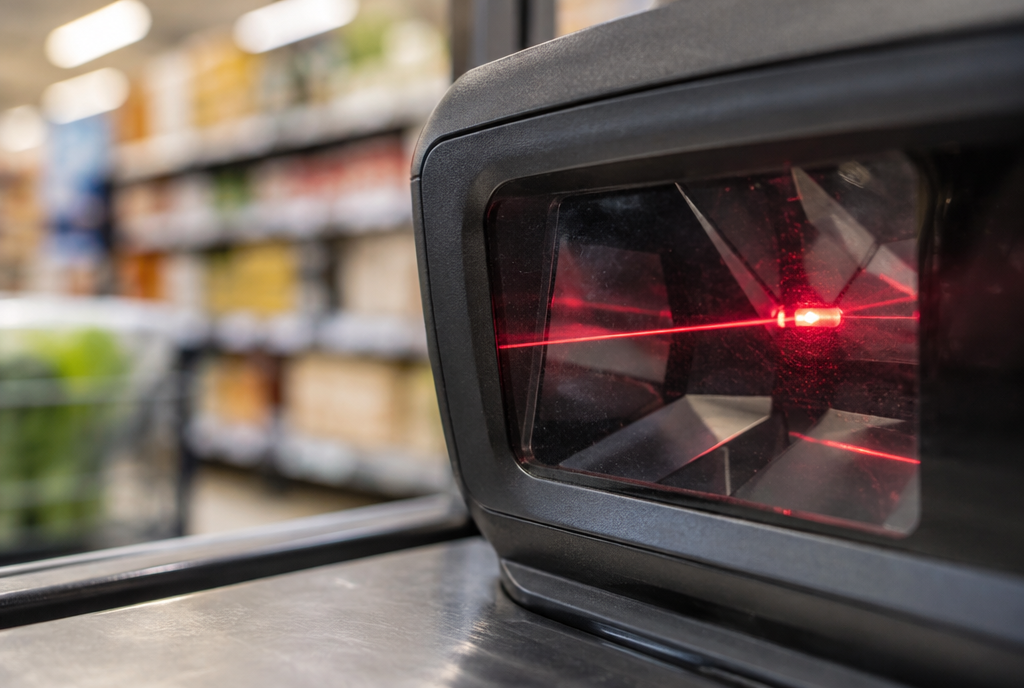
The laser was a solution without a problem in 1960. It has been scanning your shopping since
Happy reading to you. And the next time the cashier runs your shopping past the little red beam, remember that this laser spent twenty years being an answer without a question. The diamond may have the same future. Except that it already shines.
Join the conversation
You need an account to comment on this article. Creating one is free and takes under a minute.
No comments yet.