IBM hooked two fridges together. This is the step quantum was missing.
IBM connected two fridges together. That's the step quantum computing was missing.
So here's what a quantum computer looks like, because everyone talks about them and almost nobody has seen one. It's not a tower under a desk. It's a chandelier. A real one, in golden copper, hanging upside down, with levels that get smaller and smaller, hundreds of cables hanging down, and the chip right at the bottom, at the tip. The whole thing is enclosed in a cylinder that makes noise and cools it down.
On August 19, IBM announced that it had taken two of these things, connected them to each other, and cooled them together as if they formed a single one. Put that way, it's plumbing. It's also what has been holding everything else back for years.
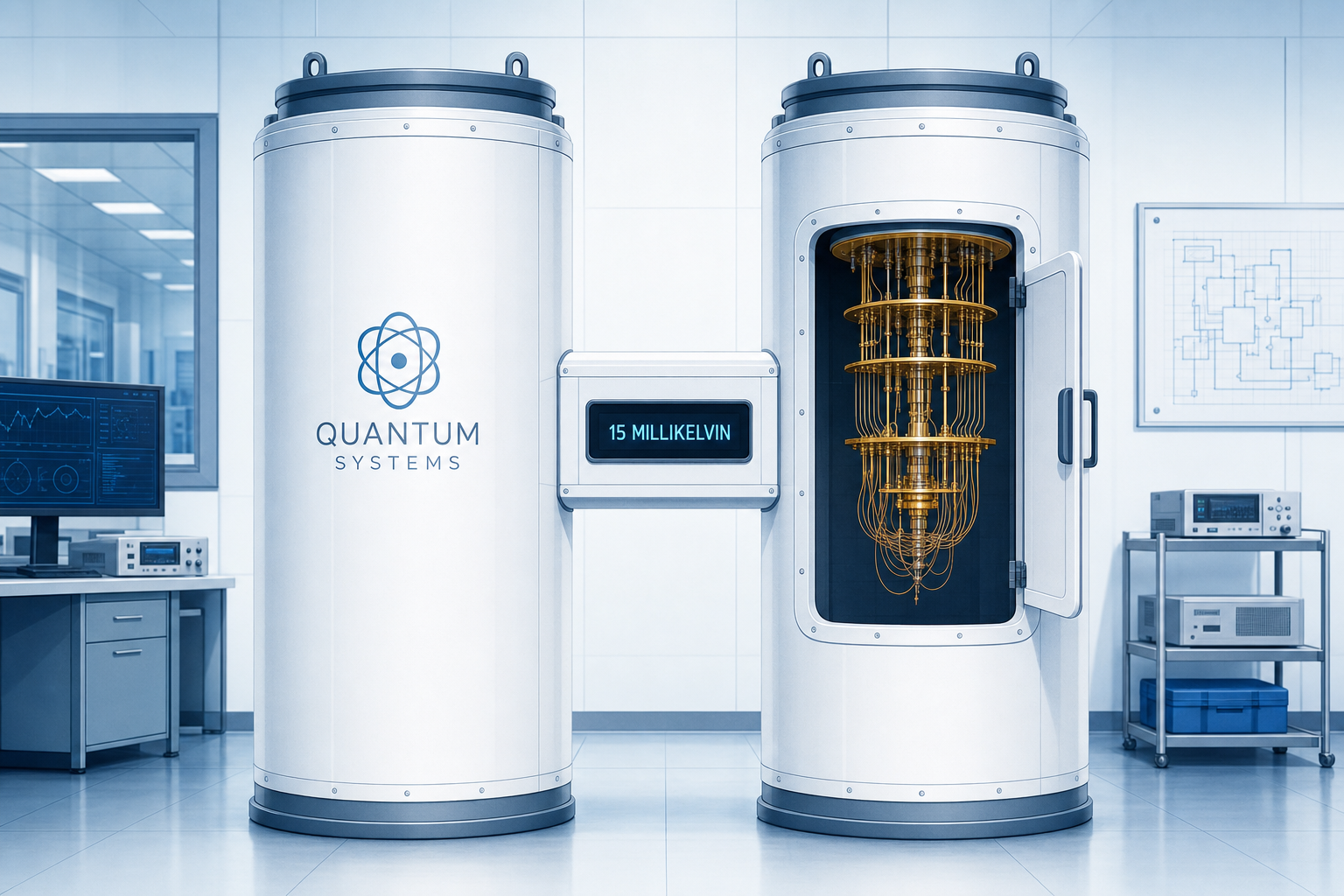
Two eight-foot boxes that now make up a single cold environment. Absolute glamour.
The cold comes first, because the numbers are ridiculous
A qubit is the quantum equivalent of the 0 and 1 in your computer, except that it can hold both states at once as long as you don't look at it. That's what gives it its power, and that's also what makes it impossible to live with: the slightest vibration, the slightest stray photon, the slightest bit of heat, and it loses its state. They say it decoheres. In plain English, it forgets.
To keep it stable, you have to put it in the cold. Not freezer cold, which is minus twenty. Not outer-space cold, which is minus 270 degrees. IBM says it went below 15 millikelvins across its two-module system, which, according to its own calculation, makes it more than 180 times colder than deep space.
180 times colder than the interstellar void. In a room in upstate New York. And it took less than five days to bring the block down to 4 kelvins before completing the descent.
The real problem was never the qubits
This is the part nobody sees coming. We imagine that the quantum race is about the number of qubits, like a megapixel race. The wall is somewhere else. I wrote two and a half weeks ago that the real problem was the cables, and today's news hits exactly the same spot.
Every qubit needs wires. Wires to talk to it, wires to listen to it, wires that have to pass through all the layers of cold without bringing heat back with them. Multiply that by a thousand qubits, then by ten thousand. At some point you no longer have the physical space to run the cables, and above all you can no longer build the fridge bigger, because a fridge of this kind has a maximum size beyond which it no longer gets cold enough.
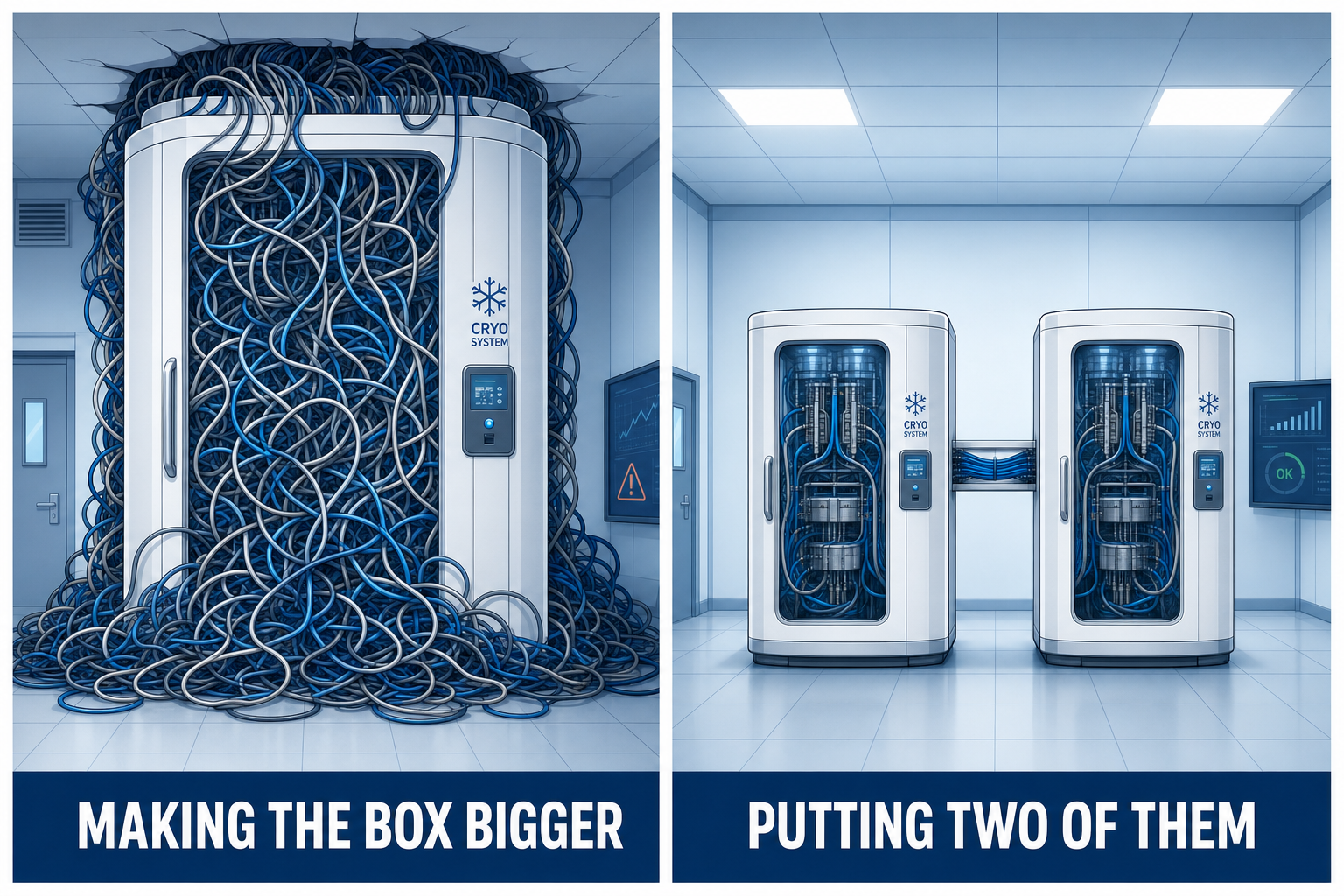
On the left, we make the box bigger until it stops working. On the right, we stop and use two of them.
So the question wasn't "how do we make more qubits", but "how do we get out of the box". And IBM's answer is so simple it almost makes you laugh: we stop making the box bigger, use several of them and connect them.
What they actually did
Two cryogenic modules, meaning two extreme-cooling enclosures, were joined to form a single cold environment. The whole thing is more than two meters forty high and just as wide. Each module offers twelve times more room for wiring than the company's most widespread quantum machines.
Twelve times. This isn't a marginal gain, it's a move.
And for two chips located in two different boxes to work together, IBM uses what they call L-couplers, links that allow separate chips to share information and behave like a single machine. It's the difference between two computers side by side and two computers on a network.
And now, an IBM story from 1956
On September 13, 1956, the same company delivered the first commercial hard drive in history, the RAMAC. Five megabytes. Enough to store a single photo from your phone, and not even the best one. The machine weighed more than a ton, you needed a forklift to move it, and it traveled by cargo plane. The whole thing fit in a room nine meters by fifteen.
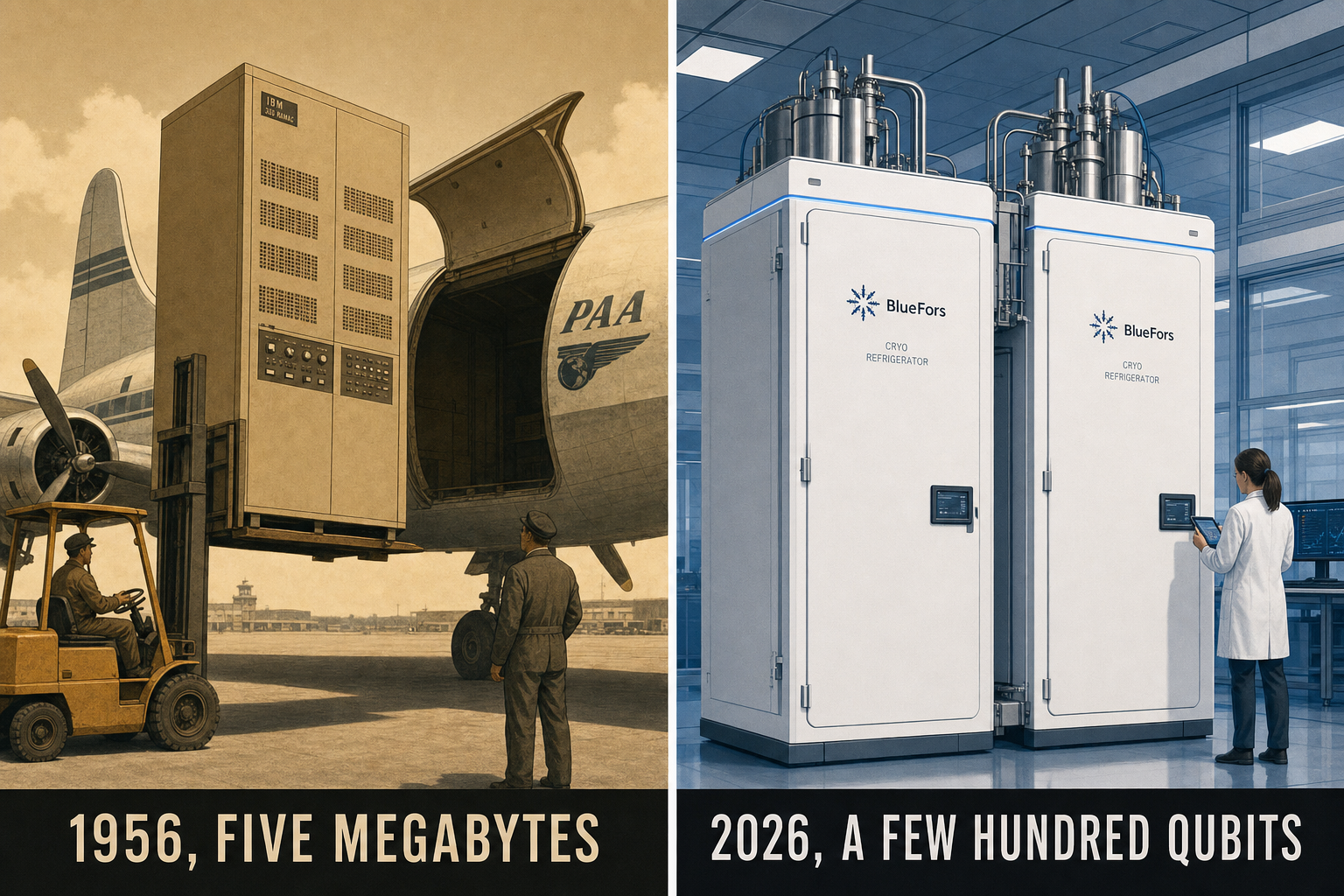
1956: one ton for five megabytes. Today: two meters forty for a few hundred qubits. We know how the story ends.
Nobody, in 1956, bought a RAMAC for the home. Nobody needed one, and nobody could have. What happened next is that the thing shrank for seventy years until it ended up in your pocket, a thousand times bigger and a million times cheaper.
I'm not saying that the quantum computer will take the same path, nobody knows that. I'm saying that we've already seen the photo of two two-meter-forty crates hooked up together in a lab, and it has never meant "it will never work". It means "this is where we are".
The dates, and you have to take them for what they are
IBM is announcing two milestones. In 2027, connecting several processors to obtain a machine with at least a thousand programmable qubits. In 2029, delivering Starling, presented as the first fault-tolerant quantum computer.
Fault-tolerant, what does that mean? That the machine corrects itself along the way. Today a qubit gets things wrong so often that dozens, even hundreds, have to be sacrificed just to obtain a single one that's reliable. Until we have that, we have a laboratory experiment. When we have it, we have a machine.
Now, the necessary precaution: 2027 and 2029 are company targets, not facts. IBM is the one announcing them, on its own schedule, with its own money. In this sector, dates slip. What hasn't slipped is the August 19 press release: two fridges were indeed hooked up and cooled together, that's done.
Okay, and what does that change for you?
Nothing. Really nothing, and I'd rather tell you right away than sell you a dream.
A quantum computer won't make your PC faster, won't make your games run better, and will never be used to open your browser. It's not a more powerful computer, it's a computer that knows how to do a different job. It's useless at everything your machine does well, and it's good at a handful of very specific problems where you have to try a monstrous number of combinations.
Those problems, on the other hand, affect your everyday life indirectly.
Medicine: designing a molecule today means trying thousands of combinations in the lab for years. Correctly simulating the behavior of molecules is exactly the kind of calculation these machines should excel at. A treatment that arrives three years earlier, that's something a family notices.
Batteries: same thing. The chemistry of a car or phone battery is still being figured out largely by trial and error. Simulating it better means gaining range and lifespan without changing factories.
Fertilizers: producing nitrogen for agriculture today consumes about two percent of all the energy produced on this planet, using a process dating back to 1909. Finding something better, that would show up in the price of your groceries.
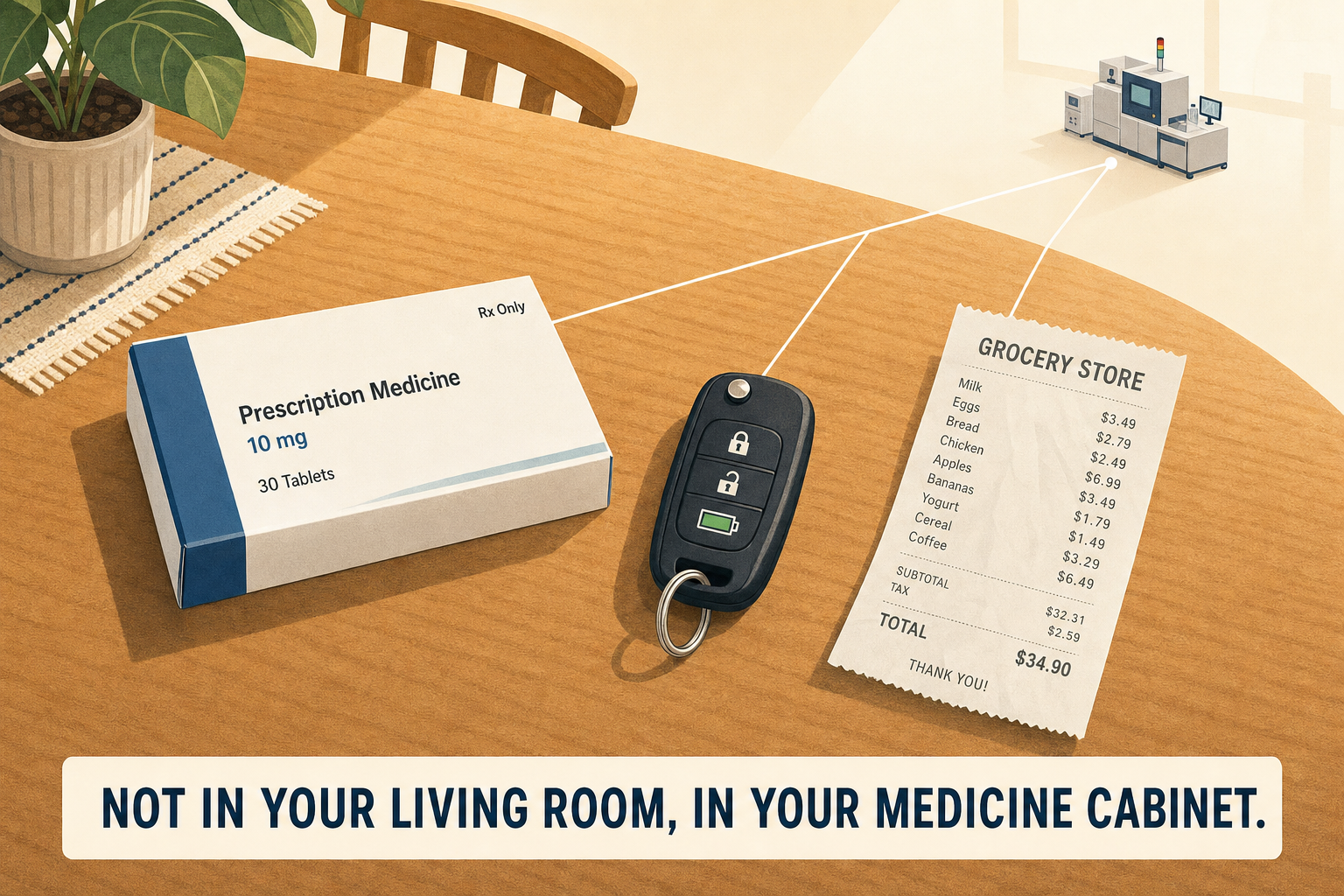
That's where it ends up, if it ends up anywhere. Not in your living room, in your pharmacy.
And the honest timeline, now. If everything goes the way IBM hopes, the first self-correcting machine arrives in 2029. Between a machine that exists and a medicine in your medicine cabinet, you have to count the years of research behind it, the trials, the authorizations. So we're talking about the late 2030s in the best-case scenario. Maybe later. Maybe never for some of these promises, because that's also how this works.
What I take away from it
What I like about this announcement is precisely that it's not spectacular. There's no qubit record, no rigged demonstration, no supposed "supremacy". There are two metal crates that we've managed to hook up together and bring down to the same low temperature, and that's the kind of problem you don't solve with a press conference.
It's always the plumbing that decides. Planes didn't take off thanks to bigger engines, they took off when we learned how to make wings. And there, we've just made a wing.
What I'd really like is to still be around the day someone writes an article making fun of these two two-meter-forty crates, with the same machine sitting on their desk. We'll talk about it again in 2060!
Sources
- IBM : IBM Connects Its First Modular Cryogenic Systems in Milestone Toward Fault-Tolerant Quantum Computing, press release of August 19, 2026
- IBM Quantum: the technical note on the modular cryogenic architecture
- The Quantum Insider : IBM Connects Two Modular Cryogenic Systems
- Computer History Museum : 1956, First commercial hard disk drive shipped, for the RAMAC
Join the conversation
You need an account to comment on this article. Creating one is free and takes under a minute.
No comments yet.