A small company wants to take Nvidia’s place. Its first customer just put in $700 million.
A small company wants to take Nvidia's place. Its first customer has just put $700 million into it.
On Tuesday, a five-year-old American company called Etched received $700 million from a group of investors, based on a company valuation of $21 billion.
And the person who led the deal, the one who put in the biggest chunk, is its very first customer. He bought the machine. He installed it at his place. He watched it run for a month. Convinced, he pulled out his checkbook and bam, $700 million.
Who wouldn't dream of creating something that immediately convinces their first customer to invest directly in the project?
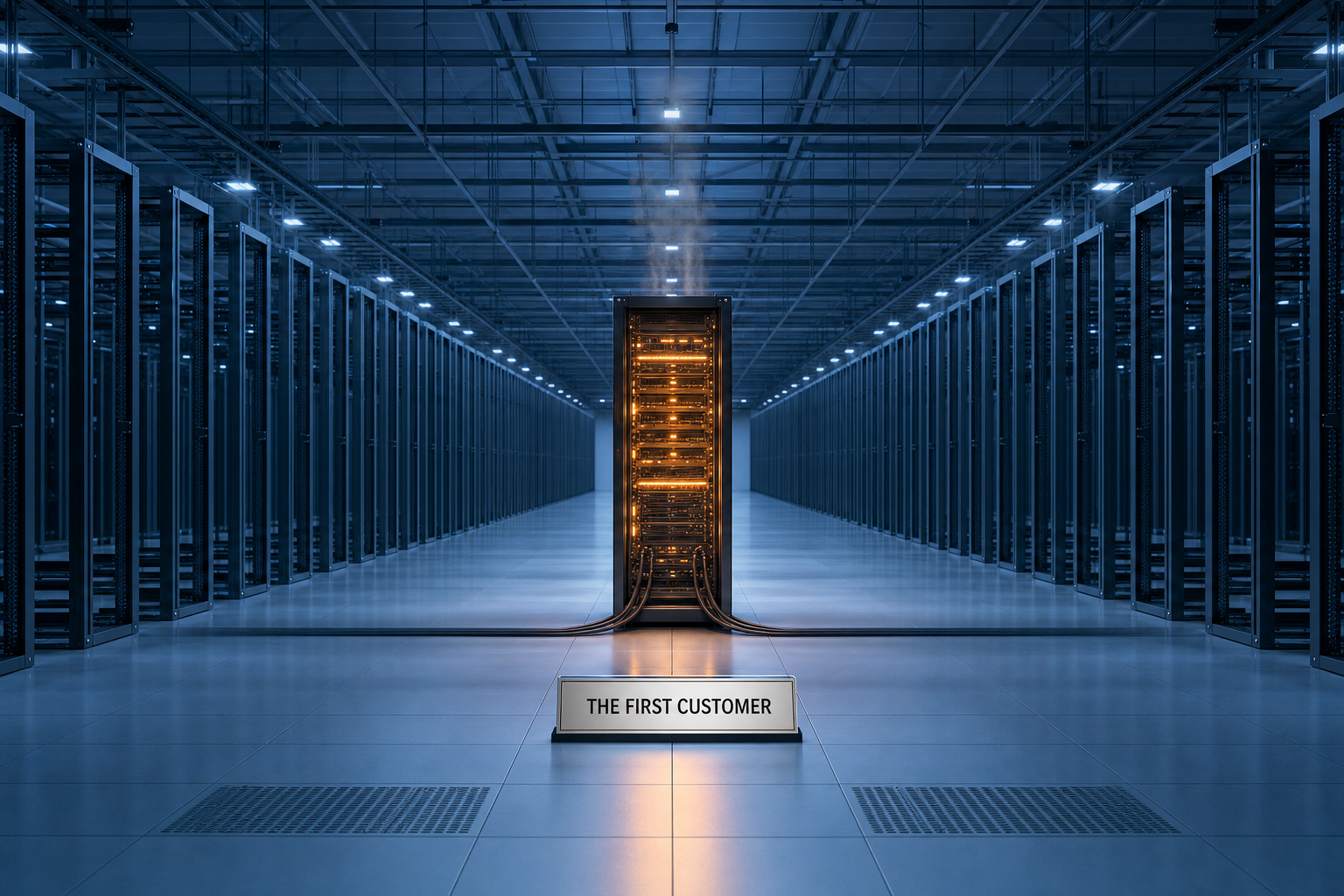
The first machine out of the factory, the first customer: “I’ll take it!”
But what exactly did this company do to achieve such success?
The customer is called Jane Street. It’s a trading firm: a group of people whose job is to calculate faster than everyone else so they can buy and resell before anyone else. They don’t get sentimental with a supplier, and if a machine fails to deliver on its promises, they unplug it.
They tested the hardware. They bought the first rack to come out of the factory and plugged it into their own server room last month. Then they put $700 million into the company that makes it.
Everyone running AI buys their chips from the same place, Nvidia, for lack of any other serious option. Now, for the first time, a demanding customer tried another supplier, kept it, and instead of politely saying “not bad,” invested half a billion dollars in it.
One delicious detail while we’re at it: the previous funding round, in July, was backed by Nvidia. Nvidia therefore put money into a company whose business is to take away its market. You can call that either vision or an insurance policy.
An AI chip that only knows how to do one thing: AI
We still need to understand what makes this chip special. And it’s simpler than it seems.
What runs in data centers today are NVIDIA graphics cards. These processors were originally designed to display video games, and people realized they were excellent for AI because they know how to perform tons of small calculations at the same time.
A graphics card can do lots of things: 3D, video, simulation, AI. It’s a Swiss Army knife. It does everything adequately, and its circuits contain all sorts of components that AI never uses. It isn’t the most optimized thing for AI.
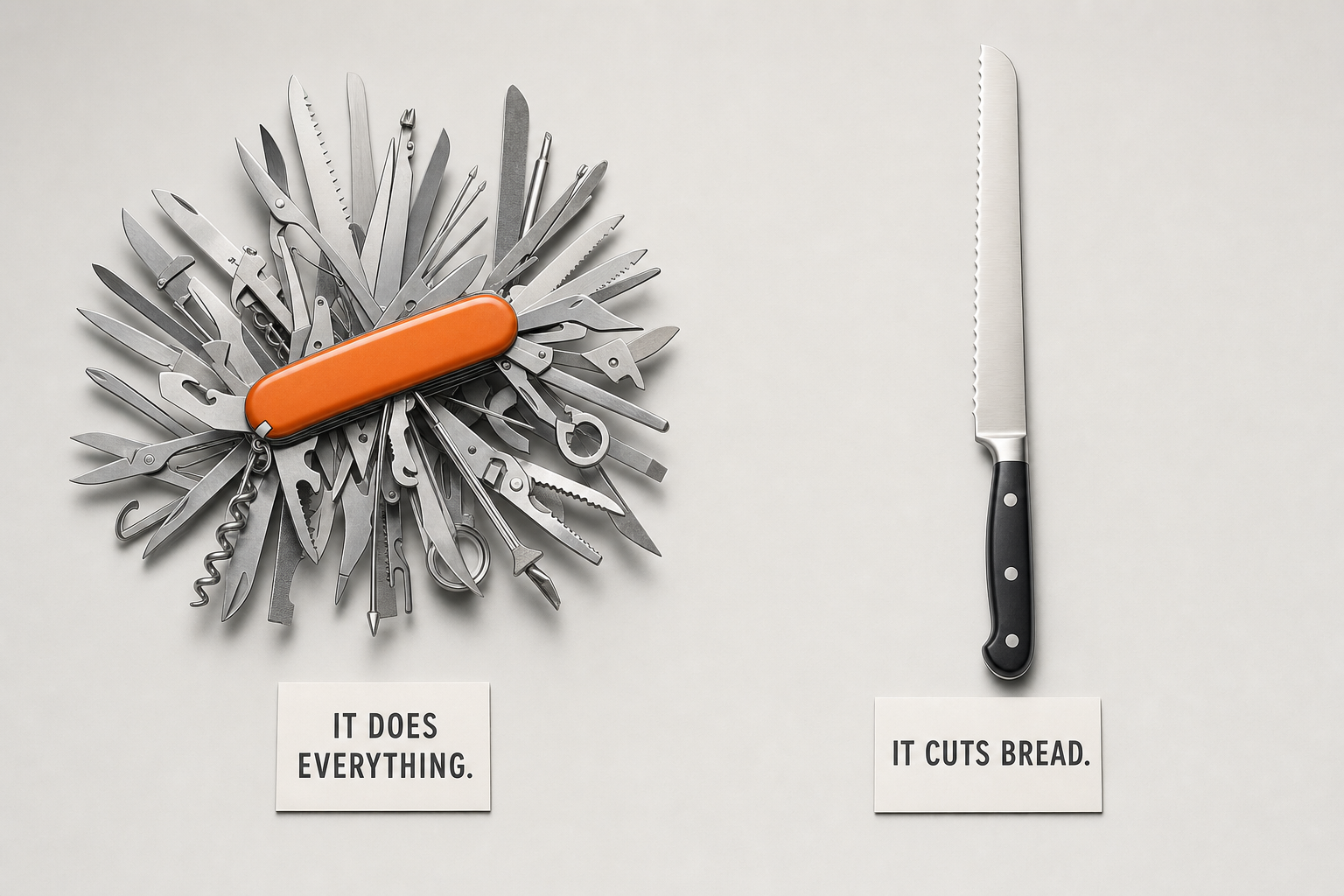
On the left, what Nvidia offers. On the right, what Etched sells.
Etched made the opposite bet: a chip that only knows how to do one thing, run an AI model at lightning speed, and to hell with everything else. It would be incapable of displaying your Windows desktop or launching your favorite Nintendo game emulator, "Princess Peechy & The Banana". It handles an AI model, and not at just any speed.
Only one technical figure has been published, so I’ll stick to that. When several chips work together on the same answer, they spend their time telling each other where they are, and these back-and-forth exchanges are pure downtime. Etched built its own wiring for this, and claims 700 milliseconds where competing chips require 4,000.
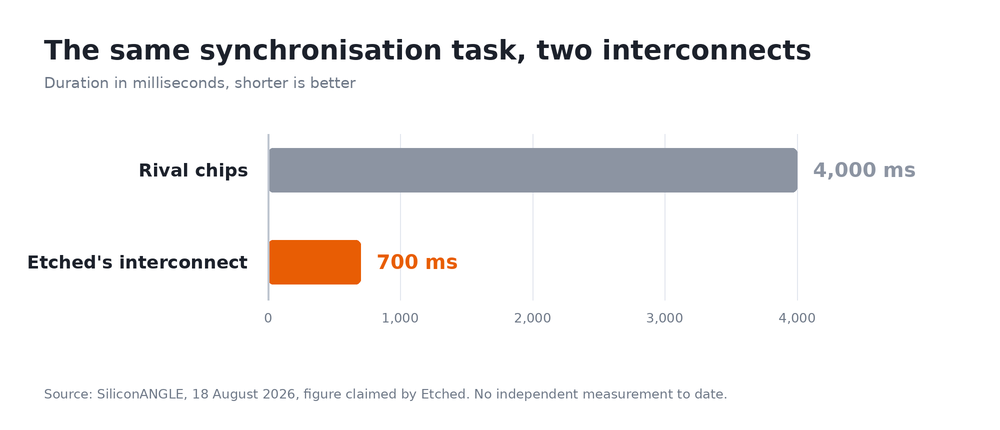
Three seconds and three-tenths less downtime, on an operation that repeats all day long.
Almost six times faster, then, on this specific point. Still, keep in mind that this is a figure announced by the manufacturer, and no outside party has gone to verify it.
It may not look like much, but believe me, six times less time wasted on an operation that repeats all day long is significant.
Obviously, we are only at the very beginning of what AI can produce today through graphics cards. It is only natural that more and more competitors will emerge offering solutions designed solely for AI, which will exceed all expectations in terms of speed and become increasingly compact, to the point of one day ending up inside a personal computer. I wrote a few days ago about how OpenAI placed its model on a chip as large as a plate to make it run up to fourteen times faster. Same idea, different path.
It's not the first time, and we know how it ends
Computing has already played out this scenario twice.
In the 1990s, the main processor calculated the images in games. Then came cards that could do nothing but draw triangles at tremendous speed, and old-timers will remember the 3DFX cards. A specialist gadget, people said at the time. Today, the company that has made the most of that gamble is called Nvidia.
Same story with bitcoin mining. The first miners used their graphics cards, then chips incapable of doing anything other than that particular calculation arrived, and within eighteen months no one was mining any other way.
The lesson is always the same: the general-purpose option wins as long as the need keeps changing; the specialist wins as soon as the need becomes fixed. So the whole question is whether today's AI has stabilized. And honestly, I have no idea, and neither does anyone else. Etched in silicon means etched for good: if models change shape in two years, an overly specialized chip becomes an outrageously expensive paperweight.
What does it change for you, who will never buy this machine
Nothing right away. Maybe a major change in two or three years, and here's why.
Every time you ask an assistant a question, a machine somewhere consumes electricity to answer you. Today, that bill is paid by investors, not by you: that's why most of these services are free or almost free, and that won't last forever. The day the books have to be balanced, either you pay more, or the cost price will have fallen in the meantime.
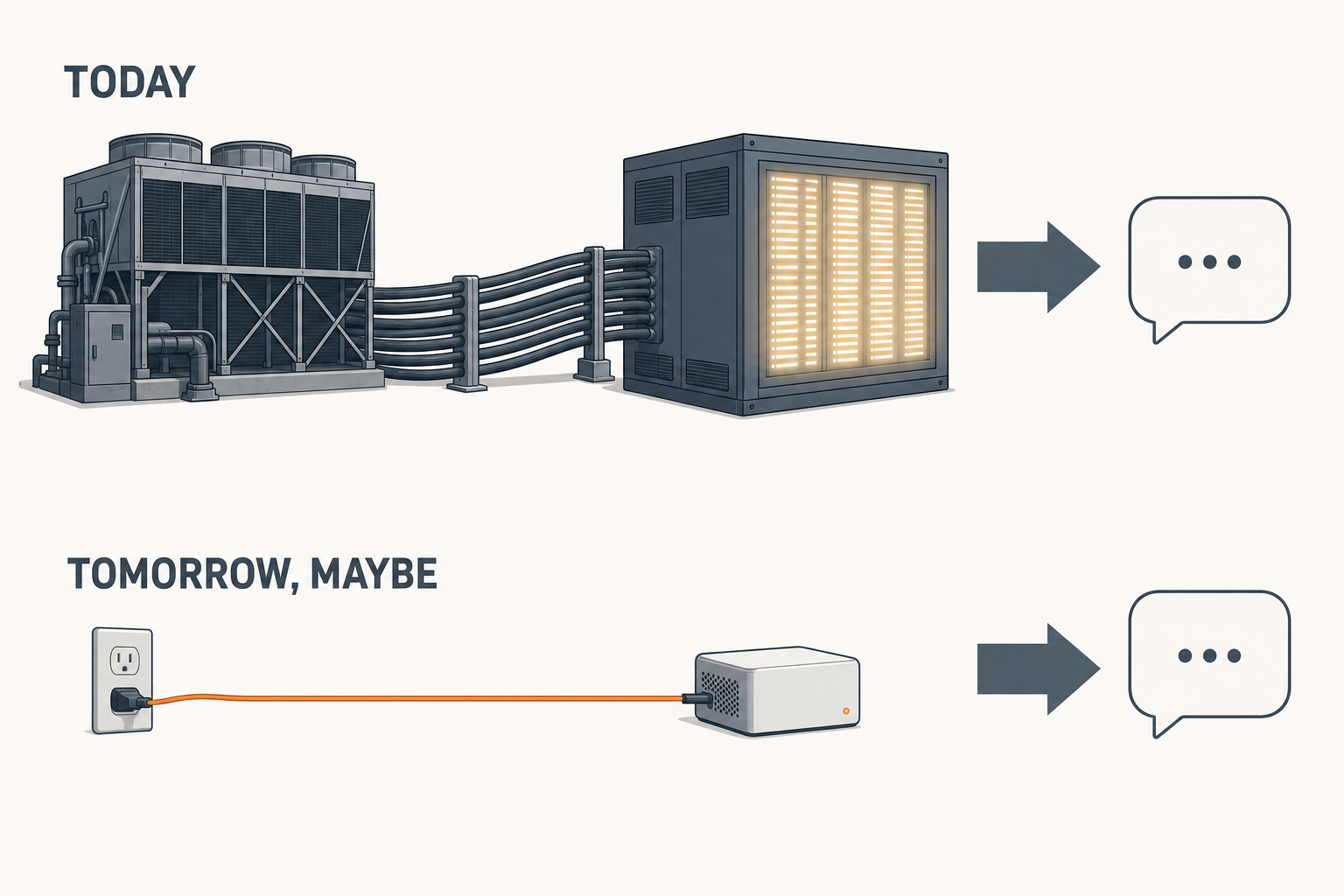
Same question, same answer, two electricity bills. That's the whole issue.
Specialized hardware does exactly that: the same answer with less electricity and fewer machines. It matters for your future bill, and it also matters for what these data centers consume, which is a real issue and not some environmentalist whim. A calculation that requires half as much electricity means half as many power plants behind it.
And there's a subtler effect, but one that becomes apparent quickly when it arrives: features that are too expensive to offer today become affordable to offer tomorrow. The smart photo editing on your phone, automatic subtitling for your videos, proofreading your emails. None of that is held back by the intelligence of the models. It is held back by the cost of computation.
The timeline, without sugarcoating it: it took Etched three years to deliver its first rack, by its own CEO's admission. Allow two to three years before this kind of chip carries enough weight to affect a price you pay. And there's a real chance it may never happen, if the major players catch up using their own silicon.
What I think
A company valued at twenty-one billion for a single rack delivered is obviously unreasonable. It's not a price, it's a bet on what computing will be like in five years, placed by people who can more than afford to be wrong.
But I like the story for another reason, completely separate from the figure. For the past three years, everything that matters in this sector has been played out through billion-dollar moves between four or five players who have exactly the same cards in their hands. And here are people who set out in 2021 with the stubborn idea of etching something nobody wanted, who took three years to produce a single machine, and a serious customer who plugged it in and said yes. It's still a fine profession!
Today, I still run AI through APIs or subscriptions with Claude or OpenAI, but I really want to be able, one day, to have my own model running on my own machine at lightning speed, without paying for anything other than the device itself once, a hardware AI card, and then that's it. In any case, new technologies are moving forward, and I would be delighted if one day everything could be local at home, with AI at maximum intelligence.
Join the conversation
You need an account to comment on this article. Creating one is free and takes under a minute.
No comments yet.