OpenAI put its model on a chip as big as a dinner plate. Result: up to fourteen times faster.
OpenAI put its model on a chip as big as a plate. Result: up to fourteen times faster.
Yesterday, OpenAI opened a new tier in its developer interface. Its name: Ultrafast. A tier is a service plan: same product, different machine behind it. The model doesn't change. It's still gpt-5.6-sol, with the same answers and the same intelligence. Only the machine running it is different. And it can go up to fourteen times faster.
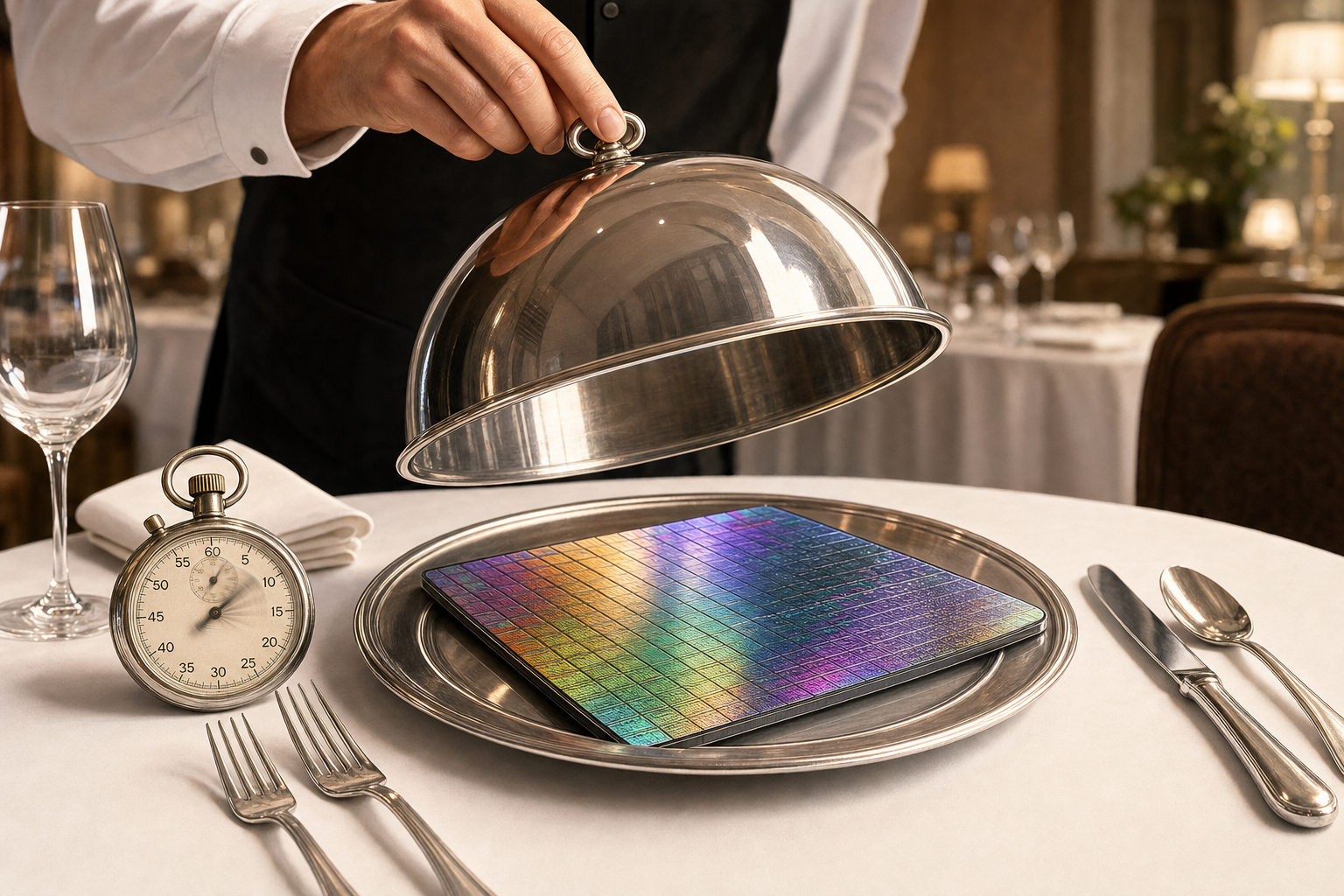
The dish of the day measures 21 centimeters on each side and costs the price of a car. The wine list doesn't display any prices either.
Here's an example given by the company, because percentages mean nothing to anyone. The same request consists of generating a financial dashboard, twice, with the same model.
Standard    12 min 20 s
Ultrafast    1 min 50 s
Twelve minutes is the time it takes to go get a coffee, then come back having forgotten what you wanted to do. One minute and fifty seconds is the time it takes to stay in your chair. It's not the same job.
Why your AI spits out words by the drop
A quick detour into mechanics. This is where it gets interesting.
A model writes one token at a time. A token is a piece of a word. Count roughly three tokens for every two words. To produce each token, the machine has to reread all the model's weights, meaning the hundreds of gigabytes of numbers that make up the thing. It does this for one piece of a word, then starts again for the next one.
On a graphics card, these weights don't fit inside the chip. They're stored in memory placed next to it. The machine therefore has to go fetch them constantly. Result: your 30,000-euro card spends most of its time not calculating, but making trips back and forth to the fridge.
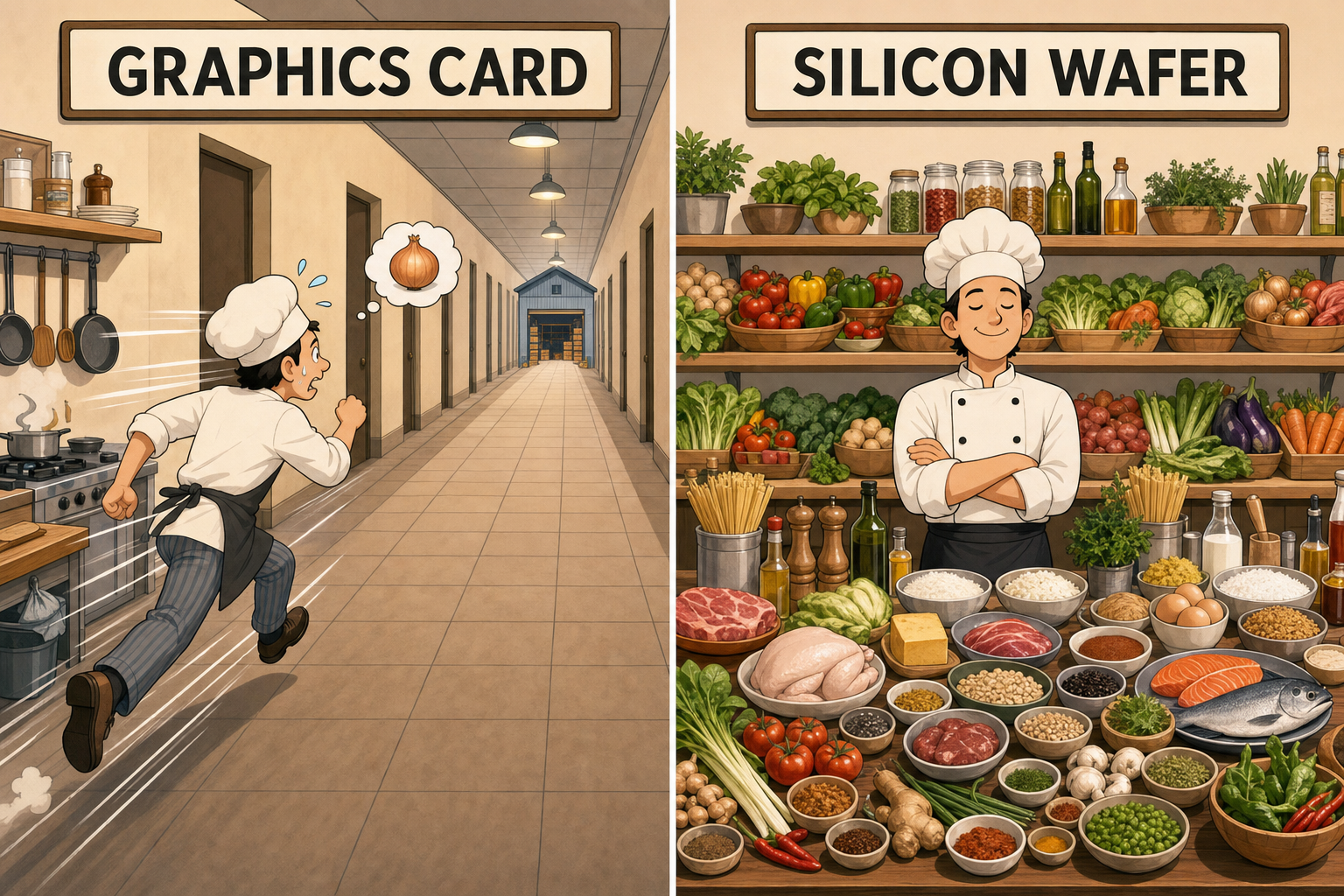
On the left, today's kitchen. The cook is excellent. He just spends his life in the corridor.
It's counterintuitive, so a lot of people get the subject wrong. The bottleneck, meaning what slows down the whole system, isn't computing power. It's the pipe that brings the data to the computing units. You can put a three-star chef in the kitchen. If he has to cross the warehouse for every onion, you'll still have to wait.
A chip as big as a plate
That's where the idea from Cerebras, which makes the hardware used by this new tier, comes from. Instead of cutting the silicon wafer into small chips, the company keeps it whole. The processor is therefore 21.5 centimeters on each side. It covers 46,225 mm² and contains 4,000 billion transistors as well as 900,000 cores. An Nvidia H100 chip, the sector's benchmark, measures 814 mm². It's fifty-seven times smaller.
The point isn't to make a huge chip for the fun of it. This surface makes it possible to place 44 GB of ultra-fast memory directly on the chip. The model's weights therefore stay on the worktop. No more trips back and forth to the fridge. No more corridor. No more warehouse.
Cerebras announces an internal bandwidth of 21 petabytes per second, compared with around 3.35 terabytes per second for the memory of an H100. I'll put an honest caveat in right away: these two figures aren't measured in the same way. The first adds up the exchanges between 900,000 cores and their nearby memory. The second measures an external bus, meaning the connection to the memory. So don't retain the exact ratio. Retain the order of magnitude. We're no longer playing in the same plumbing league.
Personally, what amuses me most about this whole story is that this bet was seen as an engineer's whim. A chip the size of a plate seemed impossible to produce without defects, impossible to cool and impossible to sell. Ten years later, it is running OpenAI's model.
No, it's not the wafer you saw going around
A photo circulated widely, and it may confuse you. It confused me too. It shows Sam Altman, all smiles, holding a silicon wafer with a man in a suit. But it's not the one we're talking about here.

On June 24, Sam Altman and Hock Tan, Broadcom's boss, present OpenAI's in-house chip. Photo OpenAI and Broadcom. This wafer, for its part, goes under the guillotine.
This photo dates from June 24. The man on the right is Hock Tan, Broadcom's boss. What they are holding is called Jalapeño. It is the first chip designed by OpenAI, manufactured with Broadcom, then assembled into racks by Celestica. A rack is a large cabinet that brings the machines together. Nine months passed between the first pencil stroke and sending the plans to the foundry. For this kind of beast, that's very fast.
Now, look closely at the wafer. Do you see the grid and the hundreds of little rectangles? Each rectangle corresponds to a chip. This wafer is therefore going to be cut up. This is how processors have been made for fifty years: the chips are etched, cut up, sorted, and then the ones that are defective are thrown away.
That's why it's not the same thing. Cerebras starts with a similar round wafer, but chooses not to cut it up. Same piece of silicon at the start, opposite decision at the finish. The photo shows individual chips. This article is about a wafer used whole.
Three bets at the same time
That said, this photo tells another interesting story about OpenAI. The strategy looks like that of a careful family man: multiply the solutions so as not to depend on anyone.
If you count, OpenAI is pursuing three hardware bets in parallel. The first is to rent Nvidia cards, like everyone else. This costs a lot and leaves the company at the mercy of a single supplier. The second is to make its own chip with Broadcom, the one in the photo. Its deployment is planned by the end of the year, at gigawatt scale. Microsoft would take 40%, and one of OpenAI's code models is already running on it in a trial version. The third bet, launched yesterday, is to rent pure speed from Cerebras for situations where waiting time becomes the real problem.
As for Jalapeño's energy efficiency, the company says "significantly better than what exists". No figure, no technical report. You know my position on this kind of formula: we note it, then wait for the evidence.
The figures announced, and the ones I believe
The Ultrafast tier goes up to 750 tokens generated per second. For comparison, a human reader reads about 250 words per minute, or four words per second. Here, we reach 560 words per second. The model therefore writes about one hundred and thirty times faster than you read.
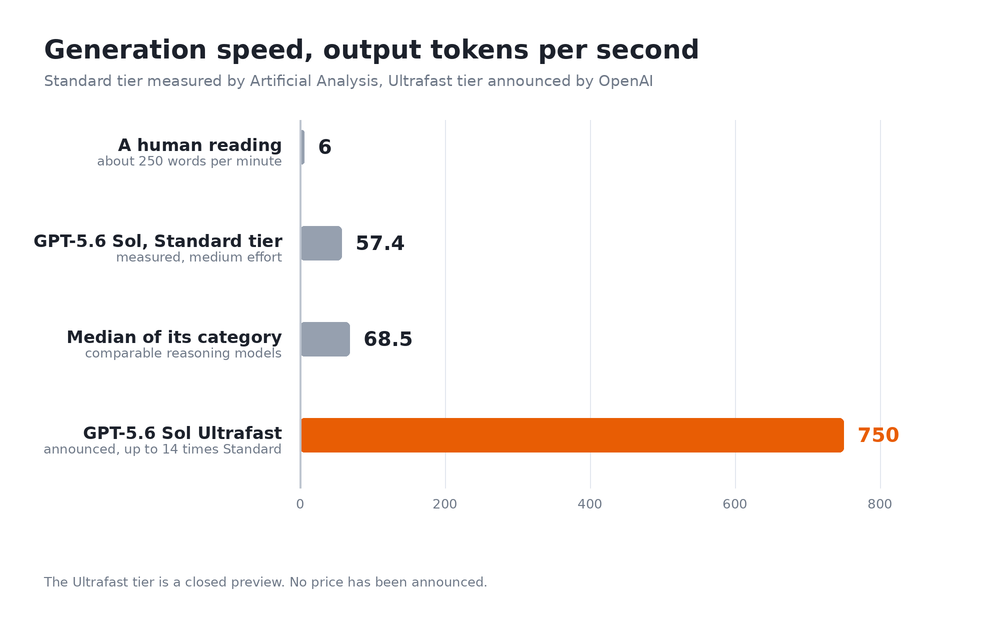
The orange bar comes from the seller. The gray ones were measured by someone else. That counts.
The figure of 57 tokens per second for the normal tier does not come from OpenAI. It comes from Artificial Analysis, which continuously measures the performance of the available models. And that works out well: 750 divided by 57 gives 13. The announced "up to 14 times" therefore holds up.
For the rest, you have to read the fine print. Cerebras also claims to be eleven times faster than Fable 5 and five times faster than Opus 4.8 in fast mode. The company says it also completed a supposedly difficult exam in 11 h 11, compared with 78 h 27. These are its measurements, carried out in its conditions and with its hardware. I'm not saying they're false. I'm saying Cerebras is not an independent referee.
The most interesting figure is also the most modest. Across a series of professional tasks, the total gain, from the beginning to the end of the work, falls to 5.6 times. That makes sense. An agent that works doesn't spend its life writing. It compiles code, waits for the network and reruns tests. The model can answer in the blink of an eye. If compilation takes two minutes, it will still take two minutes.
The price is missing, and that's not a detail
Ah yes, the price. There isn't one.
Not "it's high". Not "it will be announced next month". Nothing. No price, no general availability date, no indication of the cost. This is a closed preview, reserved for a handful of customers. The names mentioned are Jane Street, Podium, Basis and Rogo. The others can join a waiting list. And all of this remains limited to the developer interface. Nothing in ChatGPT.

When the menu doesn't show the prices, it's never to give you a pleasant surprise.
To give you an idea of the scale, the same model, in the standard tier, costs $5 per million input tokens and $30 in output. The input tokens correspond to what we send to the model. The output ones correspond to its response. As for an entire silicon wafer etched at TSMC, it isn't exactly a spare part found on sale. Are we going to pay twice as much for this speed? Five times as much? Will the service be reserved for people who do millisecond trading?
I have no idea, and that's precisely the problem. A speed you can't afford, that's called a demo.
Concretely, what does it change for you
If you don't code and you've never opened a developer interface, the question is legitimate. Here's what's at stake.
Imagine the voice assistant in the kitchen. You ask it to convert grams into spoonfuls, and it takes two seconds to answer. Those two seconds are enough for nobody to use it. We'd still rather take out the phone. Same problem with the customer service of an online shop that waits twenty seconds before each answer: you close the tab. Same thing for live translation during the holidays. With a delay, it's a gadget. Without a delay, it becomes a conversation.
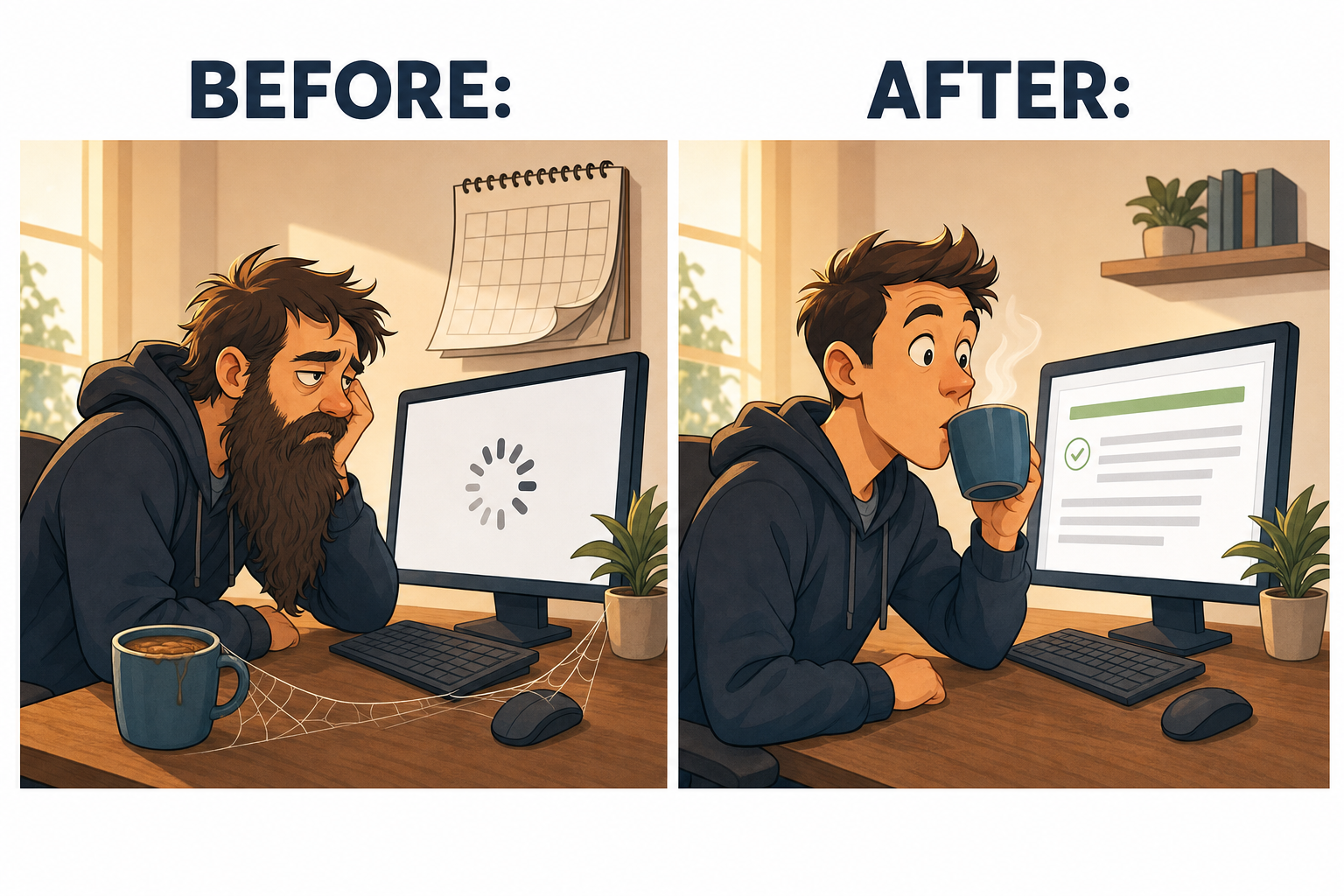
The cold coffee, the cobweb and the beard: the real cost of artificial intelligence in 2026.
Now, let's talk about the timeline, without sugarcoating it. Today, it changes nothing for you. Zero. This is a closed preview, with no price, tested by four companies and accessible through a tool you'll probably never open. The service may become mainstream next year. It may also remain a luxury product for trading floors, or disappear if the relationship between price and speed doesn't hold up.
The comparison that seems most fitting to me is the move from a 56k modem to ADSL. On paper, we had only made the same web faster. In practice, nobody watched online videos in 2000. It wasn't a matter of taste. The wait was unbearable. Speed didn't just improve an existing use. It created another one, then YouTube arrived five years later. It's the same bet here. And it may very well fail.
What I think about it
I work with coding assistants every day. What nobody measures in these announcements is the effect of waiting on your brain. Twenty seconds is nothing on paper. Except that in twenty seconds, you look at your emails. And you don't come back.
One of OpenAI's researchers sums it up better than I ever could: "it finishes before I even get the chance to move on to something else". There. The real subject isn't speed. It's attention. A tool that responds while you're still focused on it is a tool you use. A tool that responds after your coffee is a tool you work around.
Well, let's not go too fast either. Without a price, without a date and without independent measurement, all we have for now is a nice promise and a pretty wafer. But if this speed becomes normal, we'll laugh when we think back to the time when we watched a cursor spin while a machine finished its sentence. A bit like the sound of the modem.
Join the conversation
You need an account to comment on this article. Creating one is free and takes under a minute.
No comments yet.