What is the future of a developer with AI?
I might as well start with the unpleasant part. I've been in the business for twenty-five years. I've worked with .NET, a development platform, with SQL, the language used to query databases, and on applications that run in production for people who have no desire to know how any of this works. For the past year, the tool I use every day has been coding faster than me. It makes fewer mistakes on tricky edge cases and regularly introduces me to technologies I had never heard of.
I could pretend otherwise. It wouldn't help. And that's not the interesting part.

“Seniors” with no more “juniors” at the base of the pyramid?
The interesting part is the question that every company is asking itself today: why would I still hire a junior?
The problem with “Junior” developers
When I started, we gave the beginner a small function that added two variables and returned a result. Obviously, it wasn't for the value of the code produced. It was so they would screw up on an edge case, spend two hours on it and remember it fifteen years later.
Today, the machine writes that function in three seconds. It even adds unit tests, which automatically check that every part of the code works, and error handling. So, why hire a junior? To have them type “do this for me, do that for me”? And if they no longer do anything themselves, how do they gain experience?
The funniest thing is that the person who puts this question most clearly is neither a unionist nor a professor. It's Matt Garman, the head of AWS, in August 2025. He talks about executives who want to replace their juniors with AI:
How is this going to work, in ten years, when no one will have learned anything? Where will the experienced seniors be?
When the guy selling the shovels explains that digging everywhere is a bad idea, it's worth stopping for two minutes.
The numbers don't look good
This isn't the impression of an old developer who keeps going on about the same thing. The phenomenon has been measured by several independent sources.
Indeed Hiring Lab published an analysis of the American market on July 23 last year. Over one year, offers aimed at senior profiles increased by 14.7%, while those aimed at beginners fell by 7.5%. Across all sectors, around 14% of offers are looking for a senior. In software development, that share reaches 69.3%.
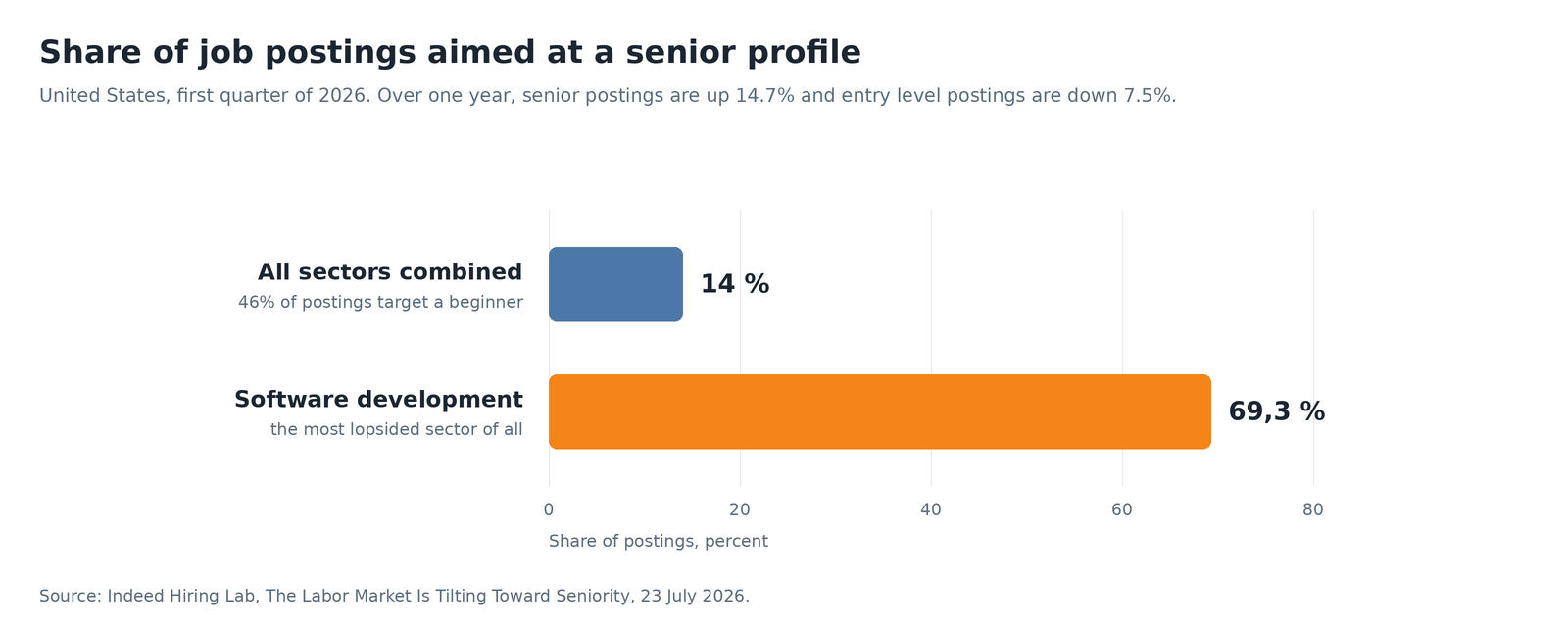
Our profession isn't one case among others. It's the extreme case.
Two thirds of the entry points into the profession therefore aren't really entry points. They are reserved for those who are already inside.
The team at Stanford following this subject reaches the same conclusion by another route. It analyzes payroll data from millions of American employees. Since the end of 2022, employment among 22 to 25-year-olds has fallen by 16% in the jobs most exposed to AI. Meanwhile, that of experienced workers remains stable or increases, within the same companies. Their latest update, published in June, shows that the movement is continuing.
On the hiring side, the firm SignalFire measures a 65% drop in entry-level hiring at large technology companies since 2019. Recent graduates now account for around 7% of hires. In startups, it's less than 6%.

The ladder is still there. It's the first rung that has disappeared.
The figure that completely turns the question around
Here is the result that forced me to rethink my reasoning.
A study that has since become a classic was conducted by Erik Brynjolfsson and two colleagues, then published in the Quarterly Journal of Economics. It focuses on the customer service department of a Fortune 500 software publisher: 5,179 people and three million conversations. Real work, then. Not a laboratory exercise.
Overall result: 14% more cases resolved per hour. But the detail is much more telling. Beginners gain 34%. The more experienced gain almost nothing.
Read that result carefully. AI does not make the junior useless. It makes them better. It recovers some of the best people's knowledge and passes it on to those who do not have it yet. It's even the most effective use we know of for it.
So, where is the problem? It does not come from the junior's ability to produce. It comes from the reason why a company agrees to pay them while they learn. These are two different questions. That's where all the confusion lies.
A company did not hire a beginner because they produced a lot. It hired them because that was the only known way to turn them into a senior. A senior cannot be bought retail. That reasoning held up as long as training remained an unavoidable cost. It collapses as soon as work can be produced without it.
What a senior really is, and why that gets lost
A senior is not someone who knows more syntax. Since 2023, everyone has syntax in their pocket with AI.
A senior is someone who has refined their judgment by making mistakes. Often. On real systems, with real consequences and, preferably, on a Friday night. They know that this query will last six months before falling over, because they've already seen it fall over. They also know that you don't put this change into production just before the holidays. You don't learn this knowledge from a book. It accumulates through mistakes.
AI does not eliminate learning to code. It eliminates the period during which you can still make mistakes without causing too much damage. And that's much more serious than a few fewer jobs.
This isn't just an intuition. A review published in Cognitive Research: Principles and Implications in 2024 concludes that automated assistance can accelerate the loss of skills among experts and slow their acquisition among beginners. The worst part is that the person does not necessarily realize it. A case study published in the Journal of the AIS describes the same vicious circle in an accounting firm: you delegate, you grow more confident, you check less, then you delegate more.
Aviation ran into this problem thirty years ago. The autopilot did not eliminate pilots. It changed what we pay them for. Then we realized that, by no longer flying manually, their manual skills were declining without anyone seeing it coming. The authorities eventually made manual flying compulsory during training. Not because the machine flies badly, but because a human who has not practiced for six months is no longer the same on the day they have to take back the controls.
There is another clue, more down-to-earth. GitClear analyzed 211 million lines of code modified between 2020 and 2024. The share of code rewritten within two weeks of its creation rose from 3.1% to 5.7%. The share of lines classified as refactoring, meaning reworked to make the code cleaner without changing its result, fell from 25% to less than 10%. Finally, 2024 is the first year in which copied-and-pasted code exceeded moved code.
Translation: we produce code faster, code that has to be redone more often, while organizing it less and less. Someone has to see the problem coming. That someone rarely has six months of experience.
Before selling your computer, three calming figures
An article that kept only the depressing data would be a pamphlet. So we need to set three facts against them.
One. For 2025, the Challenger firm counted around 54,800 job cuts for which the employer explicitly cited AI. That same year, the technology sector laid off around 123,000 people. AI is therefore a real factor, but a minority one. Many companies have an obvious interest in saying “it’s AI” rather than “we hired too many people in 2021.”
Two. The US Bureau of Labor Statistics still forecasts 15% growth in the developer profession between 2024 and 2034, with around 129,200 positions to be filled each year. This forecast was revised downward, since it was 17.9%. But 15% is not a collapse. It is twice the average for occupations. In Europe, Cedefop forecasts annual growth of 2.5% for information and communication technology professionals by 2035.
Three. Job postings in software development have risen by 15% since February 2025, while job postings overall fell by 7%. The development market is doing better than it was eighteen months ago. It is still 27.5% below its pre-pandemic level, but the trend is going in the right direction.
Let’s add a fourth figure, because it’s delicious. A team of researchers gave a controlled test to sixteen experienced developers from open source projects, meaning software whose code is publicly accessible. They worked on their own code repositories. With AI, they took 19% more time. After the test, they were nevertheless convinced that they had gained 20%. Sixteen people are not enough to establish an absolute truth, and the authors say so themselves. But the gap between what we feel and what we measure deserves our attention. Especially when you write, as I did a few paragraphs above, that the machine goes faster than you do.
The only precedent that matters: chess
Everyone has their own prediction. I prefer to observe the only field in which the machine has been definitively and indisputably stronger than any human, for almost thirty years.
Chess. Deep Blue beats Kasparov in 1997. The death of the game is announced immediately.
Three things happened, and they answer our three questions exactly. The game is not dead. It has never even been doing better. Current players are stronger than those of the past, precisely because they train against machines that crush them. On the other hand, the number of people who make a living from chess has not exploded.
In our profession, this gives us the following: development will not disappear, those who remain will be better than before, but there will not be room for everyone. All three statements are true at the same time. It is less marketable than a prophecy, but it is what we observe with a little distance.
Concretely, what does this change for you?
If you do not develop software, everything above may seem remote to you. Yet three consequences concern you directly.
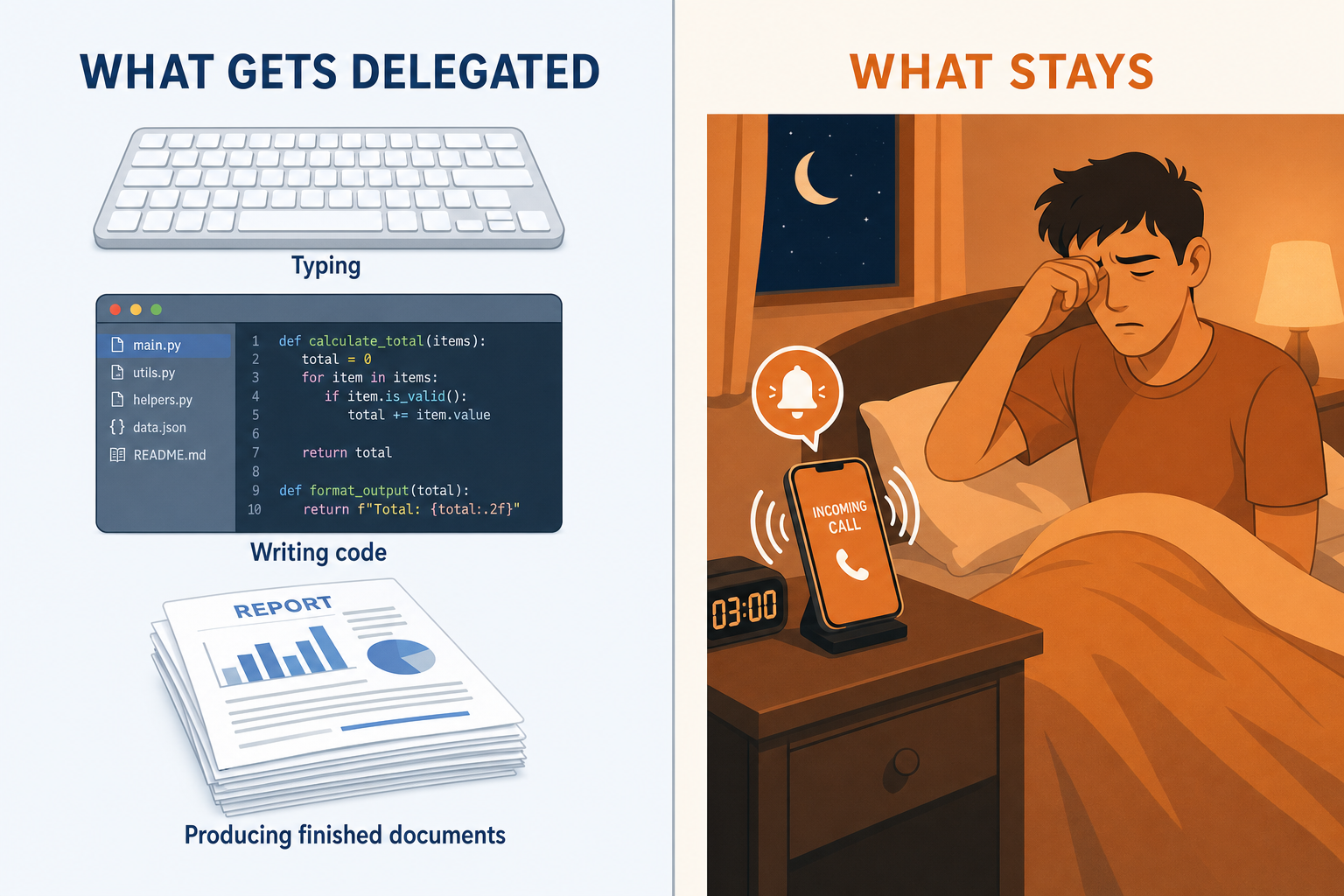
The work has changed sides. What rings at night has not moved.
Getting something developed costs less than it used to. A website for your club, an application for your business or an internal tool: the 2026 quote has very little in common with the 2023 one. Ask for several quotes. The gap has become huge between those who have adapted their method and the others. But look carefully at what you are buying. Typing is no longer worth much, review is worth everything. A very low quote, with no solid person behind it, often becomes a bill that arrives later.
If your kid wants to get into this, the door isn't closed, but the entrance has changed. The diploma alone is no longer enough, since companies are mainly looking for seniors. What still works is showing up with a project that runs and that you can show people. You also have to accept starting in a small company rather than in a large group. Small teams still train people, because they often have no choice.
The applications you use are going to evolve faster and break a little more often. Code rewritten within two weeks eventually reaches you, in the form of an update that fixes the previous update. It's not inevitable. It's the result of a company choosing between speed and care.
What to do right now
I'm not going to give you a list of fashionable technologies. It's better to start from a simple principle: what retains value is what someone can be held responsible for. A machine writes code. It doesn't sign anything, get up at three in the morning or explain to the client why Tuesday's orders have disappeared.
If you're already in the profession. Specification is becoming more valuable, because knowing what needs to be built remains more difficult than building it. Same thing for architecture and its trade-offs. You also have to know how to check, meaning refuse an answer from the machine and explain why. Add security, day-to-day operations, incident management and knowledge of your client's business. The latter isn't found in any corpus, in other words in any mass of data used to train an AI.
Add orchestration to that. The word refers here to the ability to divide a task between several agents, meaning AI tools capable of carrying out tasks. You have to know how to write solid instructions, put automatic safeguards in place and check the result. It's a real discipline. It can be learned in a few weeks, but very few people master it today. The window is open. It won't stay that way for ten years.
If you're starting out. The trap is accepting everything that compiles, therefore everything the computer manages to turn into an executable program. Adopt three habits to develop your judgment. From time to time, deliberately do by hand what you could delegate. Do it to learn, not to slow down production. Also practise refusing an answer from the machine while knowing how to explain what is wrong with it. Look at the code it produces. Compare its changes if your code is versioned with Git. Finally, take responsibility for an incident, even a small one. That's where, and almost nowhere else, you really learn the trade.
Taking the time to look at what AI produces is sometimes boring, it doesn't show up on a CV, and yet it's what separates those who improve from the others.
The time I spend with AI has doubled
At first when I was using Claude Code, I was telling myself: "Wow, it goes fast!" but I was using Claude Code like a chatbot, today I have created "skills", "hooks", "commands", "loops" that automatically improve my code by testing, doing code reviews on their own until getting 0 WARNINGS, I open 3 Claude Code sessions on my screen, I check, I jump from one to the other across 3 different projects and damn, what a crazy amount of time it takes me! My wife complains: "I don't see you anymore! You're always in your office with your Claude!" Yes, it's true, I love Claude, he has become my friend, but I admit that he takes up a lot of my time and the more you refine your "skills", your "hooks", the more a little thing you ask it to do easily takes you 2 hours to reach the end of the development. It's very different from the beginning.
Here too, you have to know how to manage your time and say "stop" from time to time or not open 3 projects at the same time. It has to be said that the 5-hour chunk system Anthropic gives its Claude and the percentage system calculated in my statusline below Claude makes you want to use your credits all the way to the end: "Ah, I still have 12% left before the week's reset, come on, full steam ahead, I'll use OPUS and /effort MAX and start something new!"
It's something I hadn't anticipated at all right at the beginning of using AI. I should manage my time better.
What I think about it
There will be no going back. None! AI will be everywhere in development, and far beyond. Two years were enough to bring down boundaries we thought would stand for ten years. Those waiting for things to settle down may be waiting a long time.
I would advise all developers: Get your nose into vibe coding, whether with Claude code, codex or others, create "skills", "hooks" today! Don't wait, don't put it off until next week: you risk losing added value to sell yourself better in an interview. Show things you've made with AI, create a site that represents you, with your projects in the showcase.
What worries me isn't my place. I have twenty-five years of mistakes behind me. They still count for something, and the tool makes me more useful than before. What worries me is that we are collectively sawing off the branch we're sitting on, each for excellent individual reasons. A company that doesn't hire a junior optimizes its quarter. A hundred companies doing the same thing destroy their reserve of seniors for 2035. Each is right when looked at alone. Together, they're wrong. And nobody has any interest in moving first.
This isn't a technological problem. It's the oldest problem in the world. We have never found any other solution than someone agreeing to pay today for a benefit they won't see themselves.
Personally, if I had to put together a team today, I would take a junior. Not out of charity. Because in five years, seniors will be impossible to find and overpriced. And the one I've trained will already be there.
Join the conversation
You need an account to comment on this article. Creating one is free and takes under a minute.
No comments yet.