Processor: AI agents designed an entire chip all by themselves, is this serious?
A completely new processor, with its own instruction set, architecture, fabrication layouts, checks, compiler. Everything. And not a single engineer to draw the tiniest bit of circuitry: AI agents did it all. That's what the start-up Architect Labs is announcing with Frostbite, unveiled on November 18. With, as a bonus, a chip that would consume four to five times less energy than a conventional core for the same work. I put my coffee down.
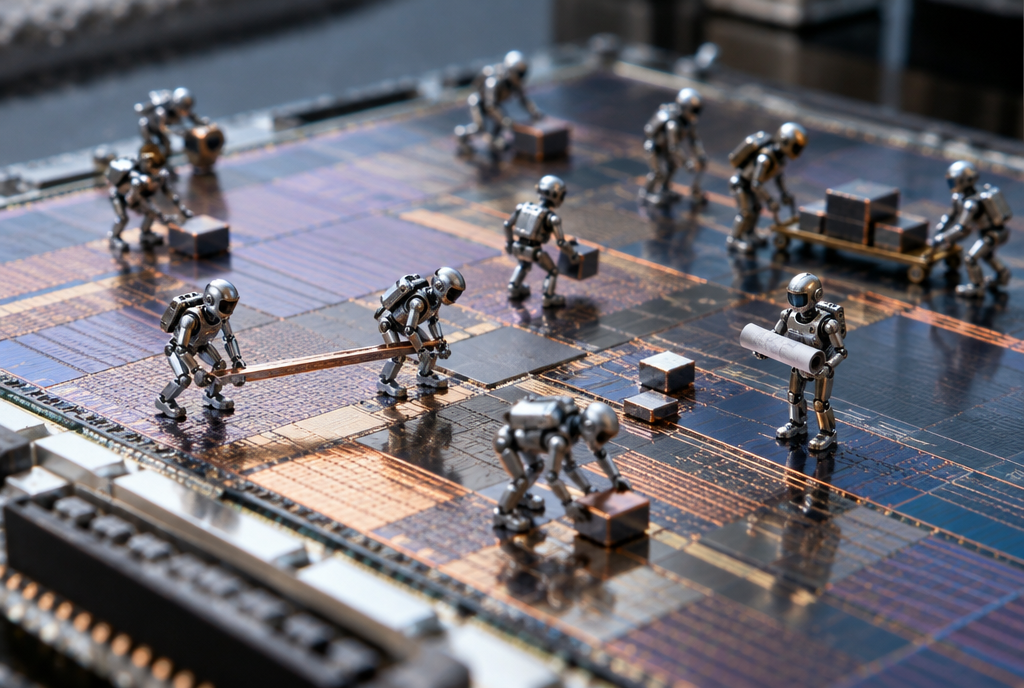
On this construction site, no worker takes a coffee break
Before you cry miracle, let me warn you right away: the chip doesn't exist for real yet. All the figures come from simulations, and they are the company's own figures. But the basic idea is so clever that it deserves a closer look, and it's a... French idea, from 1990.
The big flaw in your current processor
The processor in your computer or phone receives programs as a long queue of instructions, one after another. To go fast, it tries to execute several at the same time. But it can't do just anything: if instruction 5 needs the result of instruction 3, it has to wait. So it spends its time checking what depends on what, reading the instructions, decoding them, distributing them, juggling intermediate memories to have the data at hand.
It's a bit like a chef who receives a 200-line recipe and, before every move, reads through the whole thing again to find out whether he can peel the carrots while the water heats up. It works. But it's tiring. And a chip, when it "gets tired", consumes electricity.
The idea from 1990 that the agents pulled out of the drawer
Starting from scratch, the agents at Architect Labs dug through existing research and settled on "interaction nets", invented in 1990 by French logician Yves Lafont. The principle: instead of a queue, the program becomes a network of small nodes connected to one another. Computing simply means replacing a pair of connected nodes with a result. And each pair only touches its immediate neighbors.
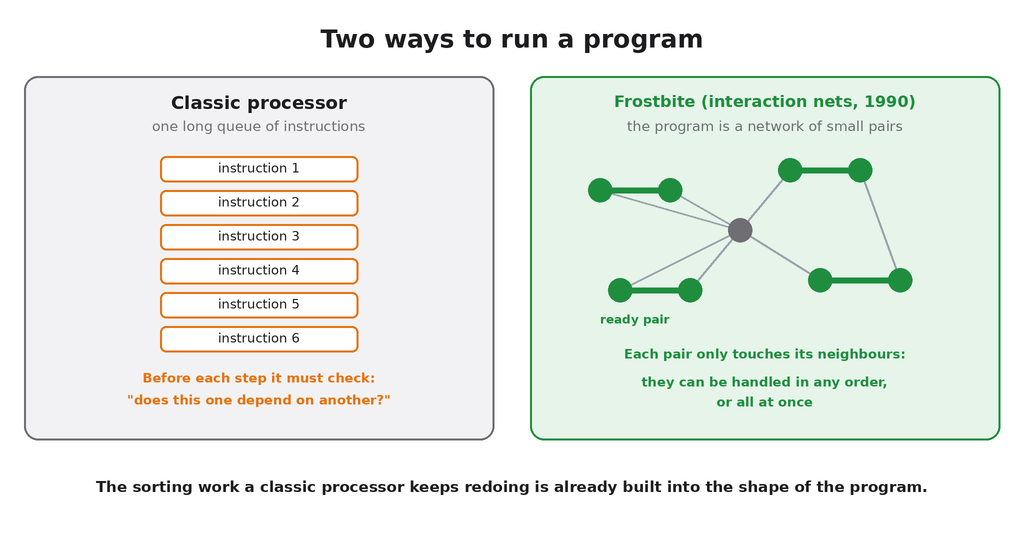
On one side a queue at the post office, on the other little pairs that manage on their own
The consequence is huge. Two pairs never get in each other's way, so they can be processed in any order, or all at once, and the result is always the same. No need to check what depends on what: the answer is already written into the shape of the program. To return to the kitchen, it's as if the recipe arrived cut up into small independent cards that any cook can pick up.
The downside, and it's a big one: programs have to be written differently. Architect Labs uses a language called Vine for this, which looks like Rust. Your current Windows or Mac software wouldn't run on it without being rewritten or translated.
Cooks stealing each other's work
The chip is divided into small "tiles", each with its own small memory, grouped in fours. What remained was to figure out who does what, without a central conductor. And then, according to Architect Labs, the agents found a rule on their own that nobody had given them: "work stealing".
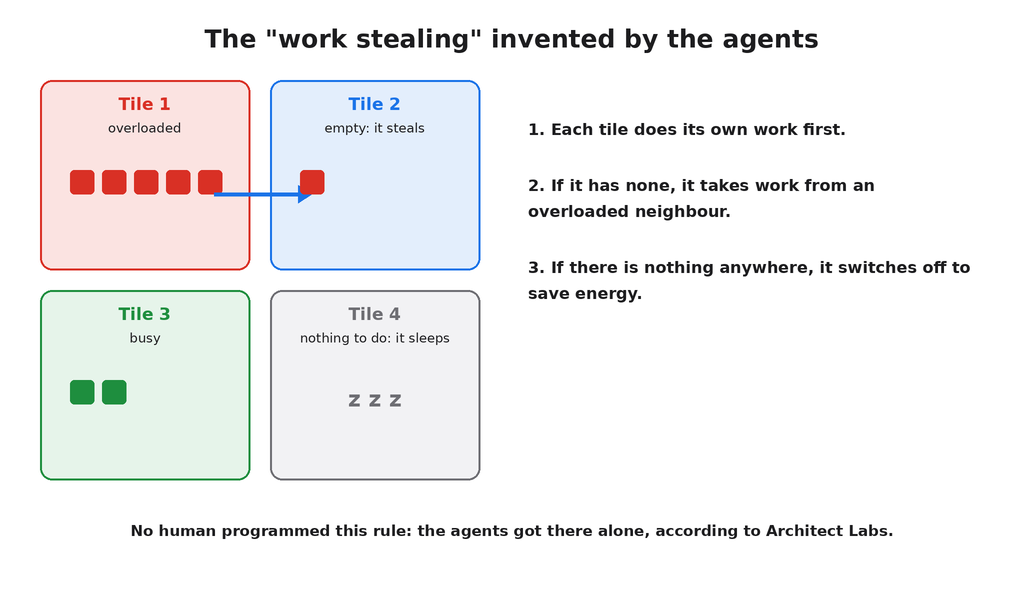
The only kitchen in the world where the sleeping commis saves money
Each tile first does its own work. If it has nothing left, it goes and pinches some from an overwhelmed neighbor. And if there is nothing anywhere, it shuts down so it consumes nothing. Exactly what a well-oiled kitchen brigade would do.

We help each other out, and the one with nothing to do costs nothing
The principle has existed in computing for a long time, I am not going to pretend that AI invented helping each other out. What is new is that it emerged on its own during the research, alongside 57 other ideas tested by the swarm of agents. Of those 58 ideas, 37 were kept, according to Architect Labs' post. It reminds me of Google's agents that independently verified a 1974 mathematical proof last week : we no longer ask them to execute, we ask them to search.
The figures, and the only line that matters
Architect Labs compares Frostbite with a conventional processor core, “proven on silicon”, fabricated at the same 7-nanometer process and roughly the same size. On 25 test programs (matrix calculations, compression, sorting, JSON parsing, encryption...), Frostbite would perform an average of 4.59 times more computation per watt consumed, according to the company's post.
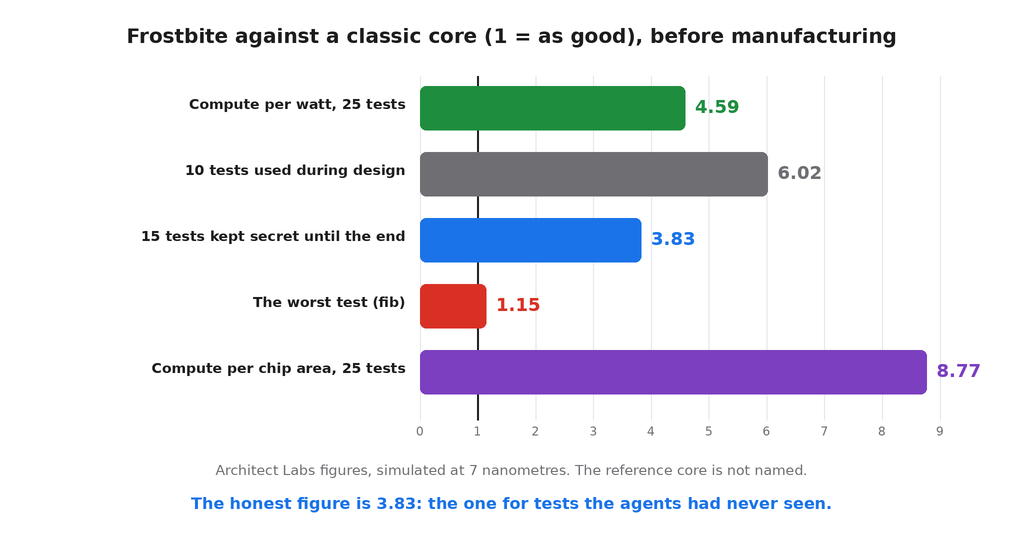
The good student who saw the exam questions in advance, that exists among AIs too
But look closely at the detail. On the 10 programs the agents used during the design, Frostbite does 6 times better. On the 15 programs we had hidden from them until the very end, it drops to 3.83. Makes sense : when you optimize while looking at a test, you always end up fitting the test a little too closely. The figure that matters is therefore 3.83. And frankly, almost four times more efficient on programs it had never seen, if this is confirmed, that is huge.
Where does the gain come from ? From the famous sorting work. According to the simulated measurements published by Architect Labs, in the conventional core, preparing instructions (reading them, decoding them, distributing them) eats up 27% of the energy. In Frostbite, 6%. Some of the savings go into the network connecting the tiles, but the balance remains very much positive.
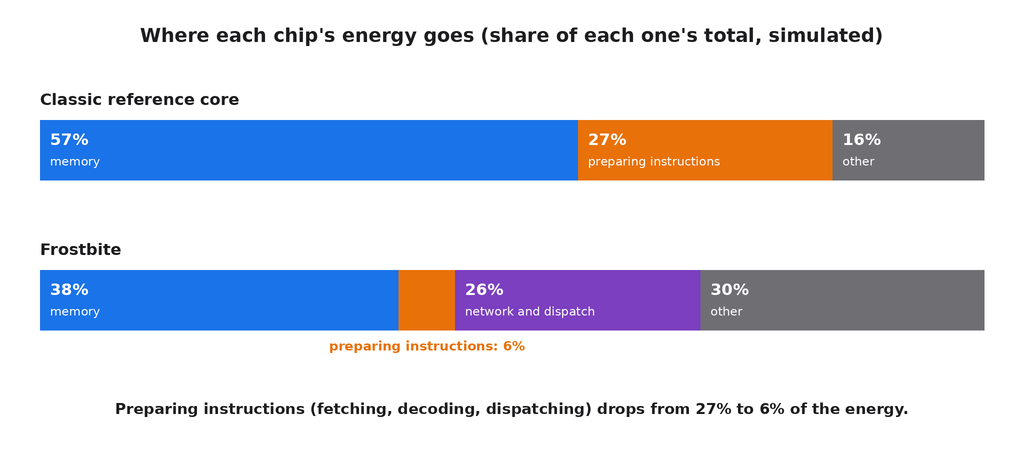
The paperwork drops from more than a quarter of the energy to almost nothing
Now, the fine print, and there is plenty of it. The reference core isn't named, Architect Labs says it can't do so “for legal reasons”. It's a small, simple core, the kind you find in microcontrollers, not a gaming PC monster. As the Hardware Busters site points out, the chip runs at 500 megahertz in its final design, while your phone goes beyond 3 gigahertz. And nothing was measured on a real chip: everything is calculated from models. In short, we're comparing a very promising prototype with a competitor whose name we don't know.
Concretely, what does this change for you?
Today? Nothing. You're not going to buy a Frostbite PC for Christmas. But if the idea lives up to its promises once it's etched into real silicon, here's where we might find it.
First in your pocket. A processor that does the same work while using three to four times less power, in a phone or a watch, means a battery that lasts much longer. The day you forget your charger on a weekend away, that makes all the difference.

The real dream behind all this: a charging cable gathering dust
Then on your bill, indirectly. The data centers that run AI already consume as much as entire cities, and someone always ends up paying for the electricity: the ChatGPT subscription, the price of the cloud, the power grids that need reinforcing. More efficient chips mean less pressure on all that.
And finally in the way we design hardware. Designing a processor currently takes years and hundreds of engineers. If agents can explore dozens of ideas and sort out the good ones themselves, we might see specialized chips appear for specific uses (a security camera, a car, a medical device) that weren't worth the cost of an entire team.
The timeline, let's be honest: Architect Labs is first announcing a version on reprogrammable chips (FPGAs, which can be reconfigured at will to test a circuit), a basic operating system, broader tests and the publication of the plans. No manufacturing date has been given. Between a simulation and a chip in a phone, it often takes five to ten years. And sometimes, it never happens.
But I keep one story in mind. In 1985, a small English company, Acorn, released an experimental processor so efficient that, during the first tests, it worked even though its power supply wasn't plugged in: the current leaking from neighboring circuits was enough for it. It was called ARM. Today, there is one in almost every phone on the planet. So I'm not saying Frostbite will be the next ARM. I'm just saying that, when a chip promises to use a lot less power, it's better not to laugh too quickly.
Personally, what fascinates me most isn't even the chip: it's that AI agents, starting from zero, decided on their own to bring back an idea from a 1990 French logician that the industry had left in a drawer. Mr. Lafont, if you're reading this, your time may finally have come!
Sources
- Architect Labs, November 18, 2026: presentation of Frostbite (in English)
- Hardware Busters, November 22, 2026: Frostbite, designed end to end by AI agents, and its limitations (in English)
- Tom's Hardware: AI agents design a processor architecture from scratch (in English)
Article written with the help of Claude Code, proofread and corrected by me.
Join the conversation
You need an account to comment on this article. Creating one is free and takes under a minute.
No comments yet.