AI: a real language model that fits on a floppy disk and runs under DOS, how is that possible?
An AI that fits on a floppy disk. That runs under MS-DOS, on a 90s 486 PC. And that answers you out loud through the little speaker that went “beep” at startup. I swear, I thought it was a joke. It isn't one: it's called TINY 2.1, it's free, it's been on GitHub since November 15, and it was written by... Claude.
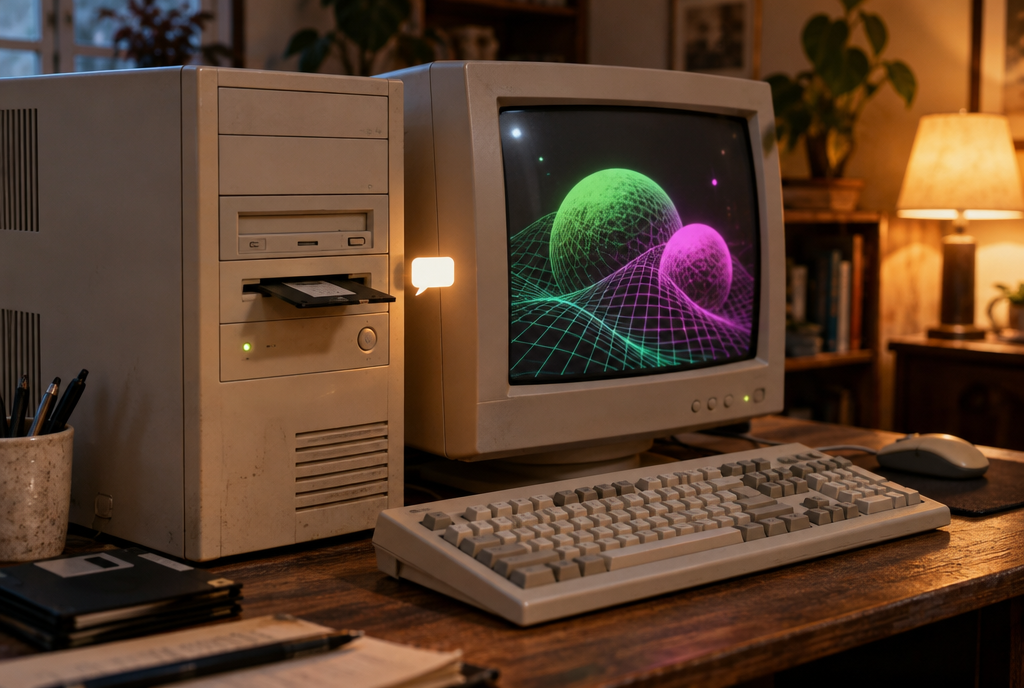
The PC from your childhood has just learned to talk, and it has an opinion on the capital of Peru
The project was published by a developer who goes by WollyMonjac on GitHub, and the page has this little line that made me burst out laughing: “Written by Fable 5.2 and trained by Opus 5.5”. Anthropic's two most advanced models, the ones that cost a fortune to run in giant data centers, were therefore used to write a program in Turbo C 2.0, a compiler from 1988. It's a bit like asking a Michelin-starred chef to prepare you a meal with a camping stove. And the worst part is, it's good.
What it can really do
TINY answers simple questions, in English. The capitals of the world's 194 countries, neighboring countries, currencies, the 118 chemical elements, animal sounds, multiplication tables up to 12, Roman numerals, a few words of French, German or Spanish. About 3,500 facts in all according to the documentation, each learned through lots of different phrasings. You type “what is the capital of peru”, it thinks for a few seconds, and it answers “lima”. By speaking.
Well, “speaking”... The developer is honest: it's not a real voice. Real speech synthesis wouldn't fit alongside the model in memory. So each letter becomes a little sound: the vowels buzz, the “s” and the “f” hiss, the “p” and the “t” click, with the rhythm of speech. The result sounds like the robots in 80s movies. Honestly, it's even better this way!
And while it's answering, a “neural monitor” displays the activity of its 4 computation layers and its confidence for each letter in real time: green when it's sure, orange when it's hesitating, red when it's guessing. That's something I'd like to see in ChatGPT.
How can something like this answer
This is where TINY becomes really interesting, because it shows in miniature what big AIs do. It reads your question letter by letter. Then it guesses the most likely letter to start its answer. Then the next one, taking into account what it has just written. And so on, until it decides it's done.
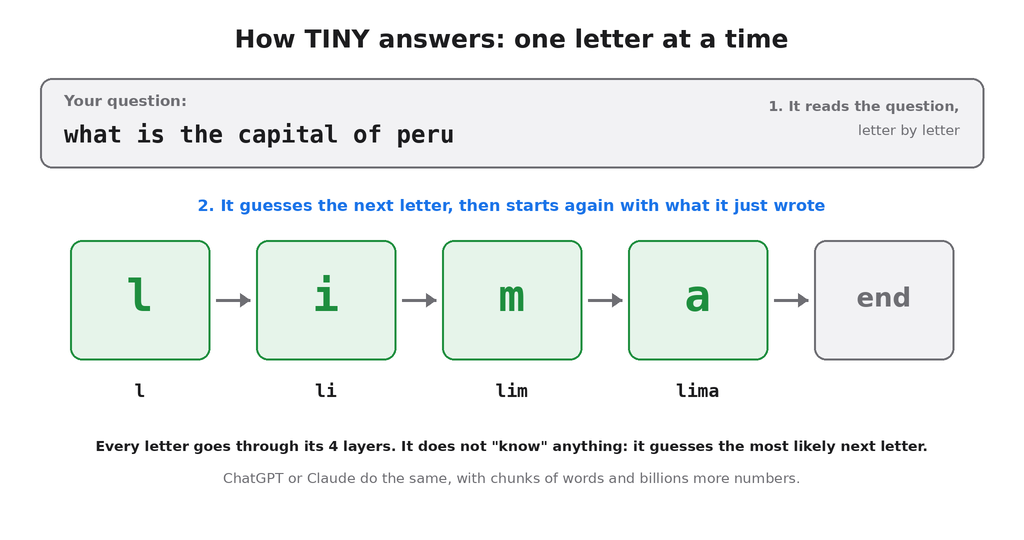
L, i, m, a: four bets won in a row, and there's a capital
ChatGPT and Claude do exactly the same thing, except they guess chunks of words instead of letters, and they have infinitely more “parameters”. A parameter is a number adjusted during training: it's in these numbers that the model stores what it has learned. TINY has 367,000 of them. That sounds like a lot? A small model running on an 8 GB graphics card has about 3 billion, or 8,000 times more. And the very large models exceed a trillion.
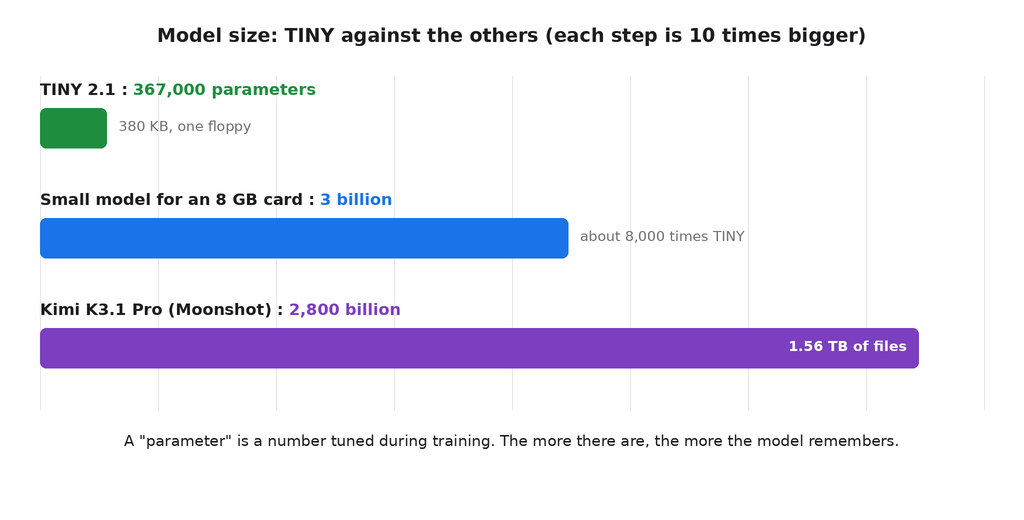
Even with a scale that cheats by ten at each step, TINY is still a shrimp
The real magic trick: fitting into 640 KB
Under DOS, a program has at most 640 KB of memory (yes, kilobytes, your phone has about ten thousand times more). But 367,000 “floating-point” numbers, normally stored at 4 bytes each, add up to 1.47 MB. It doesn't fit. Period.
The solution is called quantization, and it's exactly the same trick that lets a large model run on your graphics card at home. We “compress” the numbers by rounding them. TINY stores each number in just 1 byte, an integer between -127 and 127, and keeps a “scale” alongside each row of numbers to recover roughly the original value at calculation time. The model loses a little finesse, but becomes four times lighter: about 380 KB.
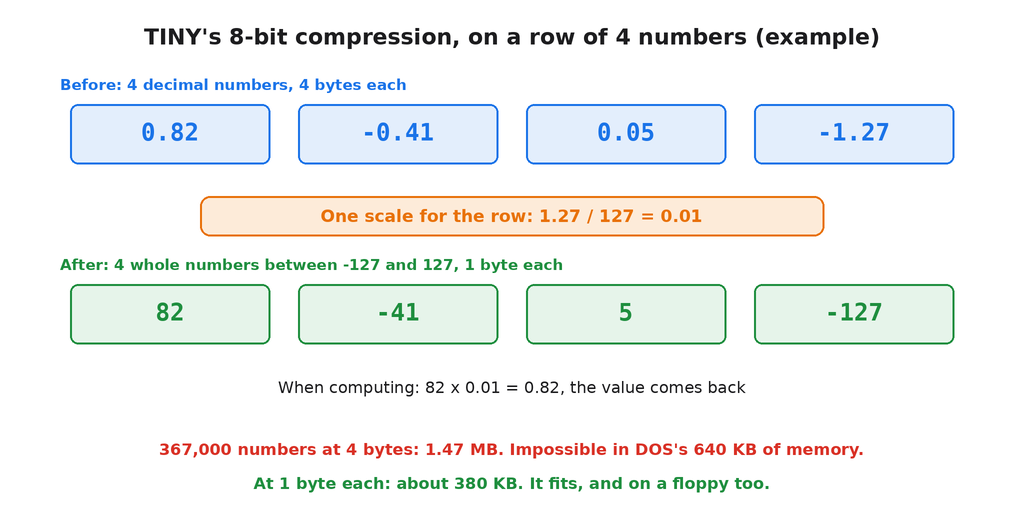
We put the numbers in smaller boxes, and miracle, they get through the door
If you've already seen model names with “Q4” or “Q8” in them while downloading a model for Ollama or LM Studio, that's it: 4 or 8 bits per number instead of 16 or 32. I talked about llama.cpp, the engine that runs these models at home nine days ago. TINY is the same recipe, pushed to absurdity.
And does it make mistakes? Oh yes it does
The developer publishes his own figures in the project's documentation, and I appreciate that he doesn't cheat. Out of 780 questions worded in a way it had never seen before, TINY gives the right answer about six times out of ten. Version 1 barely did better than once in twenty. On questions asked as they were during training, it gets up to nine out of ten.
And above all, outside its 3,500 facts, it makes things up. With confidence. Ask it the name of someone it doesn't know, and it will give you an answer instead of saying “I don't know”. Doesn't that remind you of anything? That's exactly what is called a hallucination in ChatGPT or Claude. The big AIs do it much less, but the principle is the same: a model that guesses the most likely next thing doesn't have an “I don't know” box provided from the start. TINY makes the flaw visible to the naked eye, and just for that, it's a wonderful tool for understanding.
As far as hardware is concerned, the documentation asks for a 486DX or a Pentium, that is, a processor with a “math coprocessor”, the little chip that calculates floating-point numbers. There, an answer takes a few seconds. On a 486SX or a 386 that don't have one, the calculation is simulated in software, and an answer can take several minutes. You have time to go make yourself a coffee. And come back. And make another one.
Concretely, what does it do for you?
Because TINY demonstrates something many people forget: an AI isn't a magical being that lives in the cloud. It's a file of numbers and a little program that performs multiplications. Nothing more. If it runs on a PC from 1993, then a model with a few billion parameters obviously runs on your PC from 2026, without the Internet, without a subscription and without your questions being sent to someone. That was the whole point of my article three days ago about Inkling 2 Mini and graphics cards for individuals.
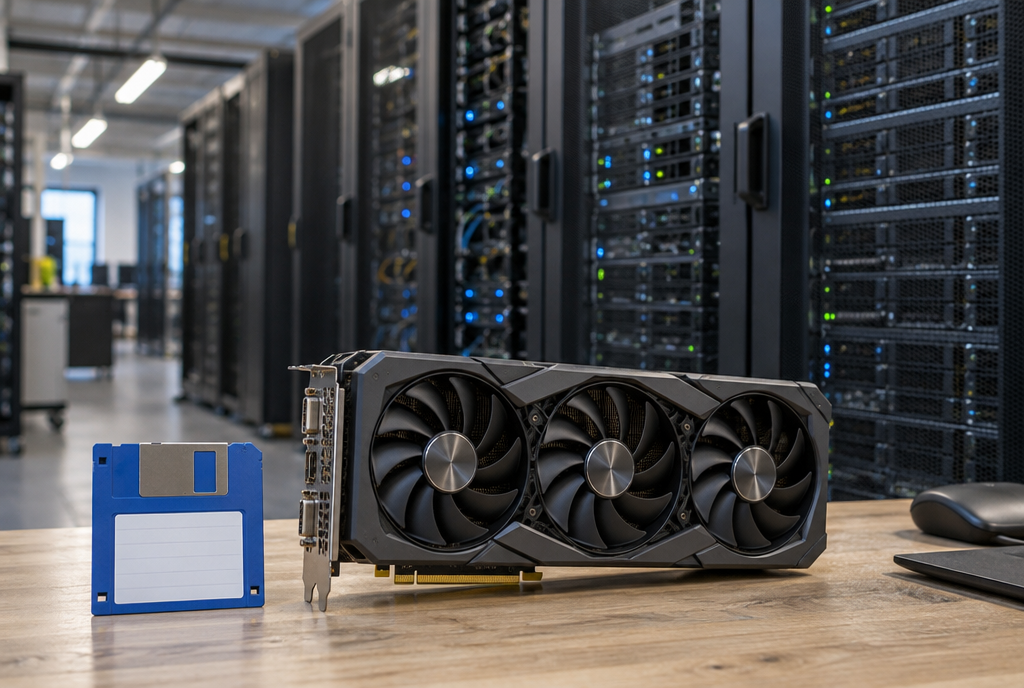
A floppy disk, a graphics card, a data center: three sizes, one recipe
And there's the educational side. The project is under a free license and provides the facts, the question generator and the Python training scripts. You can replace its 3,500 facts with your own (the players from your soccer club, the plants in your garden, the error codes from your boiler) and retrain the model on a normal computer, without a graphics card. For a computer science teacher or a parent who wants to show their kids what's really inside an AI, I don't know of a better example.
To try it without dragging the old PC out of the attic, a DOS emulator like DOSBox should do the job, since it also simulates the coprocessor. I haven't tested it myself yet, but here's how to do it according to the project's documentation:
git clone https://github.com/WollyMonjac/Tiny-2.1
# puis, dans DOSBox :
mount c /chemin/vers/Tiny-2.1/dos
c:
TINY /DEMO
The /DEMO option makes it ask itself questions, and you take back control by pressing a key. And the F4 key sets its “creativity” from 0 to 9: at 0, it always gives the safest answer, at 9, it varies its wording and makes more mistakes. It's the equivalent of the “temperature” setting of big AIs, with a much more honest name.
Personally, I think this project is brilliant, because in 380 KB it does what pages of explanations fail to do: show that an AI is numbers guessing what comes next. And if one day TINY tells you that the capital of Belgium is Bruges, do as you do with ChatGPT: verify!
Sources
- GitHub, WollyMonjac: TINY 2.1, a language model for DOS that fits on a floppy disk (in English)
- TINY 2.1's DOS documentation: speed, memory, voice and limitations (in English)
- Tom's Hardware: a language model on a floppy disk for 486 and Pentium PCs (in English)
- Hackster.io: AI arrives in the DOS era (in English)
Article written with the help of Claude Code, proofread and corrected by me.
Join the conversation
You need an account to comment on this article. Creating one is free and takes under a minute.
No comments yet.