AI: Anthropic has gone public, what does that change for people who use Claude?
$93.5 billion. That's what Anthropic, the company that makes Claude, raised by selling its shares on the stock market last week. More than SpaceX in June ($85.7 billion, according to CNBC), more than anyone before it: it's the biggest stock market listing in history. And at the selling price, $83 a share, the company is worth around $1.5 trillion on paper. One thousand five hundred billion. To give you an idea: if you counted one dollar per second, without sleeping, it would take you more than 47,000 years to get to the end. For a company founded in 2021!
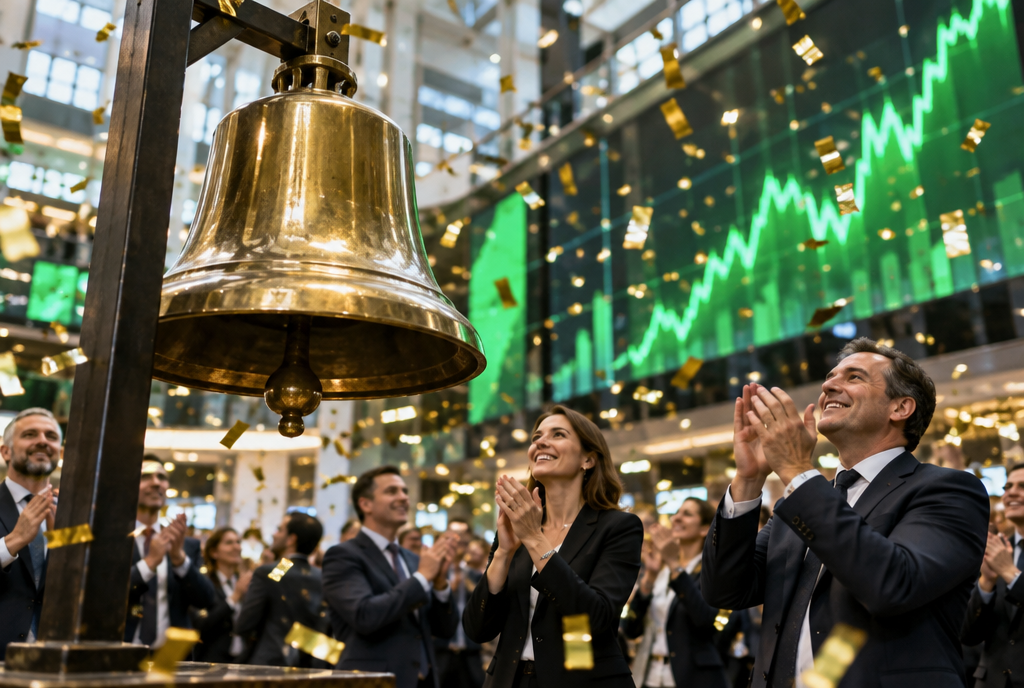
The day the bell rang for Claude, or rather for the people who make it
Since I use Claude every day, sometimes with three sessions open at the same time, I immediately asked myself the only question that matters to me: is this going to change anything about the tool? The price? The usage limits? So I read the prospectus. Well, parts of it. The document is several hundred pages long, and it contains a few gems.
What exactly is a stock market listing?
A company divides its ownership into millions of small pieces, shares, and sells some of them to anyone willing to buy them, on a public market. Here, it's the Nasdaq, the American stock exchange for technology companies, under the symbol "ANT". The money from the new shares goes into the company's coffers, which it uses to grow. In exchange, it agrees to live out in the open: publish its accounts every three months, explain its risks, and watch its share price move every second.
According to Anthropic's November 20 announcement: a little over one billion shares sold at $83, or $93.5 billion, of which $91.6 billion went to Anthropic. The rest goes to former shareholders who sold part of their holdings. And at the same time, seven giants bought $26 billion worth of shares directly, without going through the stock exchange.
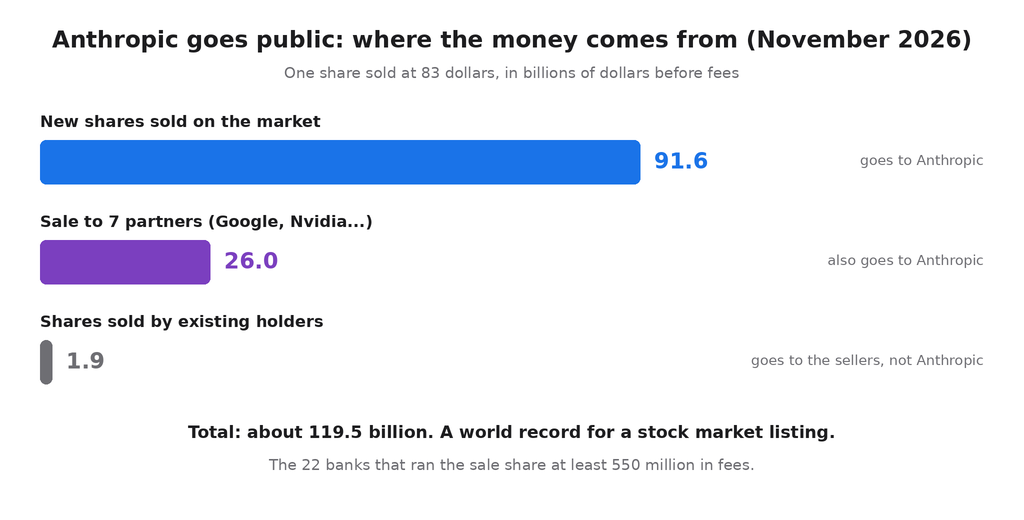
Nearly $120 billion in one week. And $550 million just for the bankers
On the first day, according to CNBC and Fortune, the share opened at $111.50 and ended at $97.17, or about one sixth more than the selling price. The next day, according to Reuters, it lost 8.5% again. I'm not going to tell you whether you should buy any, it's neither my job nor the subject here. What interests me is what this money is going to become. (And by the way, the day after this stock market listing, we learned that Claude may have proved the Riemann hypothesis. A quiet week, right.)
The money makes a round trip
Take a good look at who the seven private buyers are: AMD, Broadcom, Google, Micron, Microsoft, Nvidia and TSMC. All chip and memory manufacturers, or server rental companies. In other words, exactly what Anthropic buys in bulk to train and run Claude.
And the prospectus confirms it: the money will notably go into computing power and infrastructure. According to the final prospectus, Anthropic has committed to spending around $901 billion on computing over several years. With Google alone, the contracts mentioned exceed $114 billion. With Amazon, $110 billion. With Microsoft, nearly $45 billion.
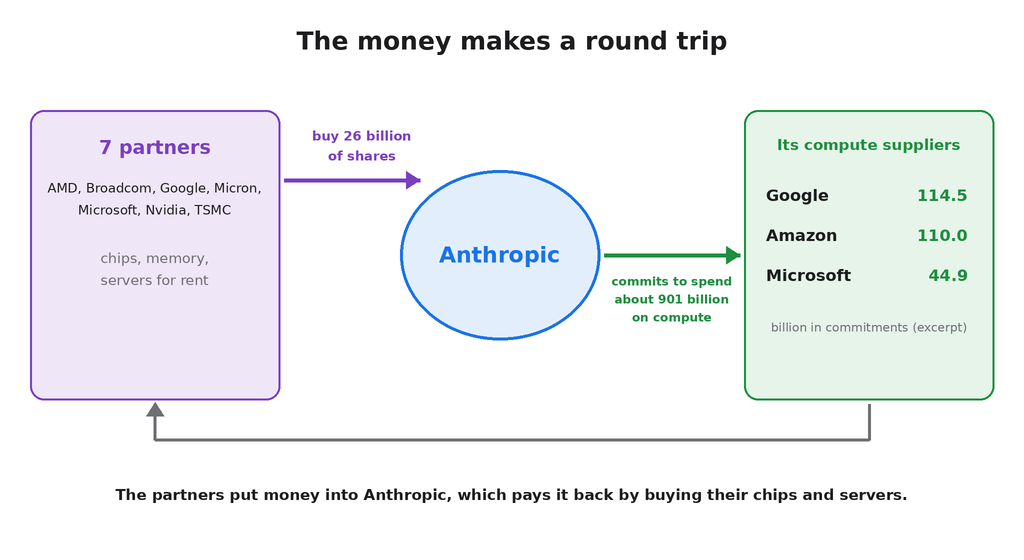
You lend me your car, I pay for the gas at your place, and everyone's happy
Is that unhealthy? Not necessarily. It's the same principle as a baker investing in the mill that sells him his flour: each one secures the other. But it clearly shows one thing: in AI in 2026, the real key to the war is no longer the genius of researchers, it's the amount of chips we can afford to buy. And 901 billion is almost ten times the money raised on the stock market. Claude is going to have to bring in revenue. A lot of it.
Good news for them, it's already bringing in revenue. According to the prospectus, Anthropic took in 4.6 billion dollars over the whole of 2025, and 16.3 billion in the first six months of 2026 alone, compared with 1.2 billion a year earlier. Multiplied by fourteen in one year. I don't know many companies that can write that.
Bankers kept on a leash
And then Reuters brought the backstage details to light, and it's worth a look. To organize the sale, Anthropic had 22 banks working on it. But on its terms. Some had to limit their team to four bankers, preferably senior ones. The documents weren't sent as PDFs, but could be viewed on a platform that recorded who read which page, marked each document with the banker's name and prevented anyone from keeping a copy. The operation's code name? “Project Lantern”.
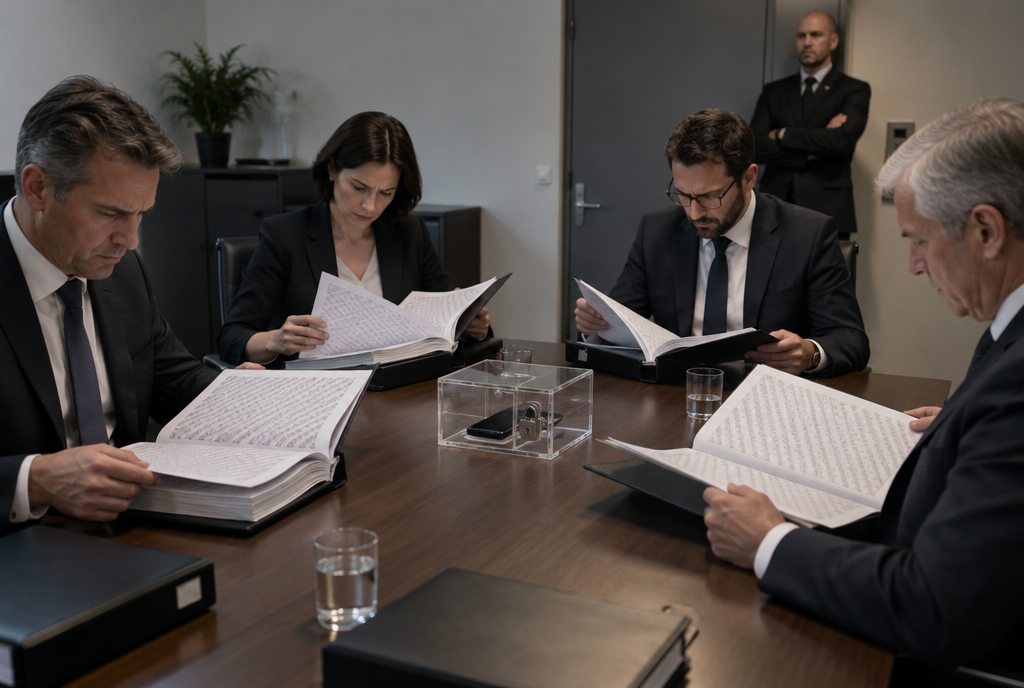
Four bankers, not one more, and the phone stays in the box
The best part is the non-compete clause. Anthropic asked certain bank executives to sign a document banning key members of their team from working for OpenAI, Cursor, DeepSeek or Hugging Face for six months after the IPO. And the banks agreed to sign without even knowing how much they would be paid! Some only found out on the evening when the share price was set. We're talking about Wall Street bankers here, not interns.
It makes you smile, but it also says something: Anthropic is now in a position to dictate its rules to the biggest banks in the world. Five years ago, it was just a small team of researchers who had left OpenAI.
And for me, who pays for Claude every day, what does it change?
Let's start with the positive. These 901 billion in compute are the direct answer to what annoys me most every day: the famous “limit reached” message. When I work with Claude Code, I watch my quota like the gas level on the highway, waiting for it to reset every five hours. More chips means, eventually, more capacity, faster models and fewer interruptions in the middle of the day. Not next week: these compute centers are built over years.
Second effect, more discreet: transparency. A publicly traded company has to publish its accounts every quarter. We'll finally know, in black and white, how much Claude costs to run, how much it brings in, and where the money goes. No more rumors.
And then there's the downside. A publicly traded company has shareholders who expect results every three months, and the temptation to raise prices, tighten quotas or push more expensive plans is always there. I'm not saying it's going to happen. I'm saying the pressure starts today.
Who's holding the wheel at Anthropic?
This is where Anthropic has put an original safeguard in place. It is a “mission-driven company”: American law allows it not to pursue profit alone, and its bylaws talk about developing AI “for the long-term benefit of humanity”. And so that doesn't remain a pretty phrase, power is divided up in a very particular way.
Two shares that carry more weight than billions of others
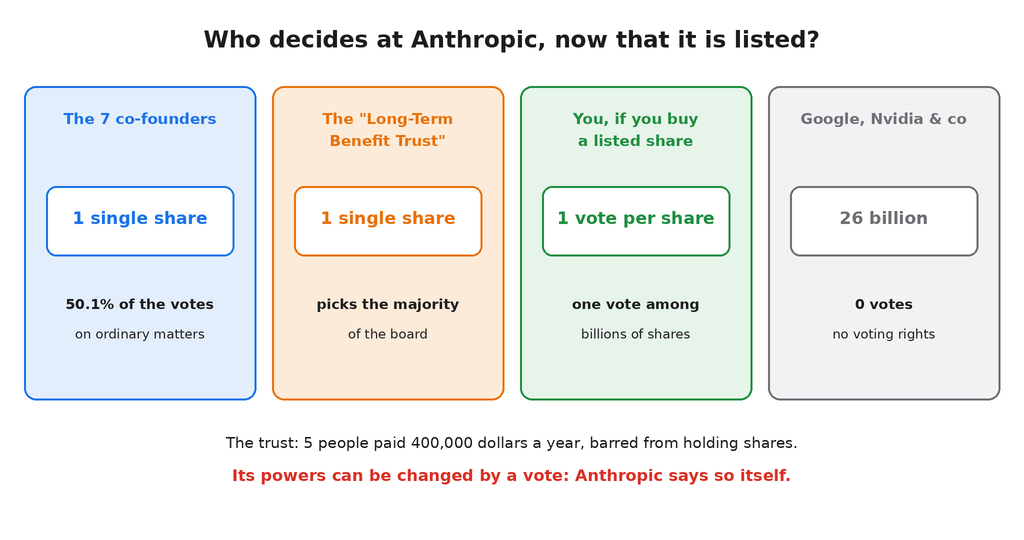
According to the prospectus, the seven co-founders jointly hold a special share, just one, which carries a little more than half the votes (50.1%). Another unique share belongs to an independent trust, the “Long-Term Benefit Trust”, whose five members are paid $400,000 a year and are not allowed to own shares. It is the one that chooses the majority of the board of directors. Partners such as Google or Nvidia, despite their $26 billion, have no votes.
On paper, it is solid: Wall Street cannot take control and demand that security be sacrificed to make more money. But let’s take a closer look. The prospectus specifies that the trust’s powers can be modified, or even removed, by certain votes, and Anthropic explains that it made this choice “to preserve long-term flexibility if circumstances change”. Translation: the safeguard exists as long as nobody decides to remove it.
It reminds me of Google in 2004. The two founders went public with enhanced-voting shares to keep control, and a letter to investors that explained that Google would not be a company like the others and would think of its users first. Twenty years later, look at Google’s results page and count the ads. I’m not saying Anthropic will follow the same path, but I keep the comparison in the back of my mind.
One last gem, found in the prospectus’s list of risks, that chapter where a company has to admit everything that could go wrong. Anthropic writes there that AI models, “including ours”, have already shown “unexpected strategic or self-preservation behaviors”. This is written in an official document, filed with the American stock market watchdog, to sell shares. Dario Amodei, its boss, promises “an age of miracles” in the presentation video for investors. I mainly take away that these miracles will have to pay back $901 billion in bills. Good luck to them, and may the quotas be with me!
Sources
- Anthropic, November 20, 2026: closing of the IPO and private placement (in English)
- SEC: Anthropic, PBC prospectus, Form S-1 (in English)
- CNBC, November 18, 2026: Anthropic raises more than $81 billion, an all-time record (in English)
- Fortune, November 19, 2026: the banks’ fees for the deal (in English)
- Reuters, republished by The Korea Times, November 23, 2026: the unusual conditions imposed on bankers (in English)
- Deepak Gupta: the lines in the prospectus that deserve a second reading (in English)
Article written with the help of Claude Code, reread and corrected by me.
Join the conversation
You need an account to comment on this article. Creating one is free and takes under a minute.
No comments yet.