Maths: has Claude really proved the Riemann hypothesis, the world's most famous problem?
I didn't see that one coming. On Friday, November 20, Levent Alpöge, a mathematician who works at Anthropic, posted a four-page note on his website that begins with this sentence: “I think I have discovered, while working with Claude, a proof of the Riemann hypothesis.” The Riemann hypothesis! The most famous maths problem in the world, open since 1859, the one that generations of geniuses have attacked without ever getting to the end of it, with a million-dollar reward at stake. And the next day, Saturday, the people who maintain the software used to verify proofs wrote in black and white: “We have full confidence that Alpöge's proof of the Riemann hypothesis is correct.”

A notebook from 1859 and a laptop: it took both
Well. I'm not a mathematician, I'm a developer. But even I got chills on Saturday night.
What is the Riemann hypothesis?
It all starts with prime numbers. They are the numbers that are divisible only by 1 and themselves: 2, 3, 5, 7, 11, 13... They are the building blocks of all numbers, because any whole number can be obtained by multiplying prime numbers together. 12 is 2 times 2 times 3. 35 is 5 times 7. And the problem is that they turn up anywhere.
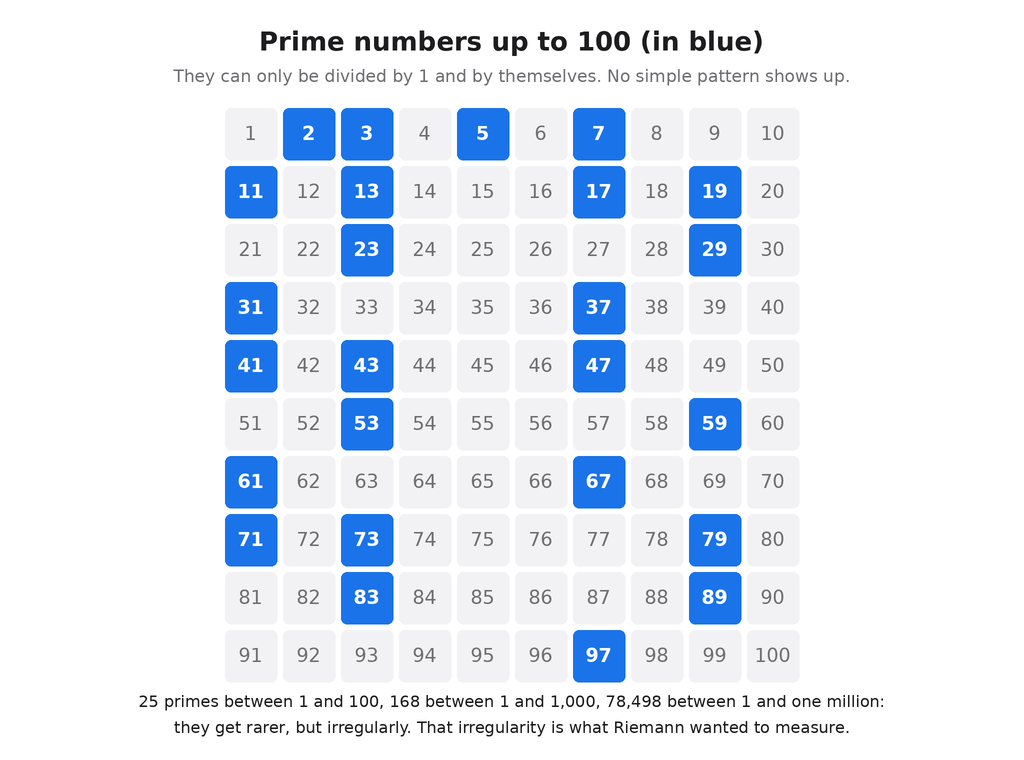
Try to guess the next prime number after 97 without calculating. There you go, that's the problem
We have known for a long time that they become rarer as we go up. But not regularly: sometimes two prime numbers follow each other almost immediately (11 and 13), sometimes there is a big gap. In 1859, a German mathematician, Bernhard Riemann, published an eight-page paper in which he linked this disorder to a mathematical function, and especially to the places where this function equals zero, which are called its “zeros”.
Mathematician Alex Kontorovich has an image that I think is brilliant for understanding this. Imagine that prime numbers are music, and that each zero is an instrument in the orchestra. If all the instruments play at the same volume, the apparent noise becomes a harmony, and we can predict where prime numbers fall with maximum precision. The Riemann hypothesis is exactly that: all the zeros are lined up on the same straight line, so no instrument covers the others.
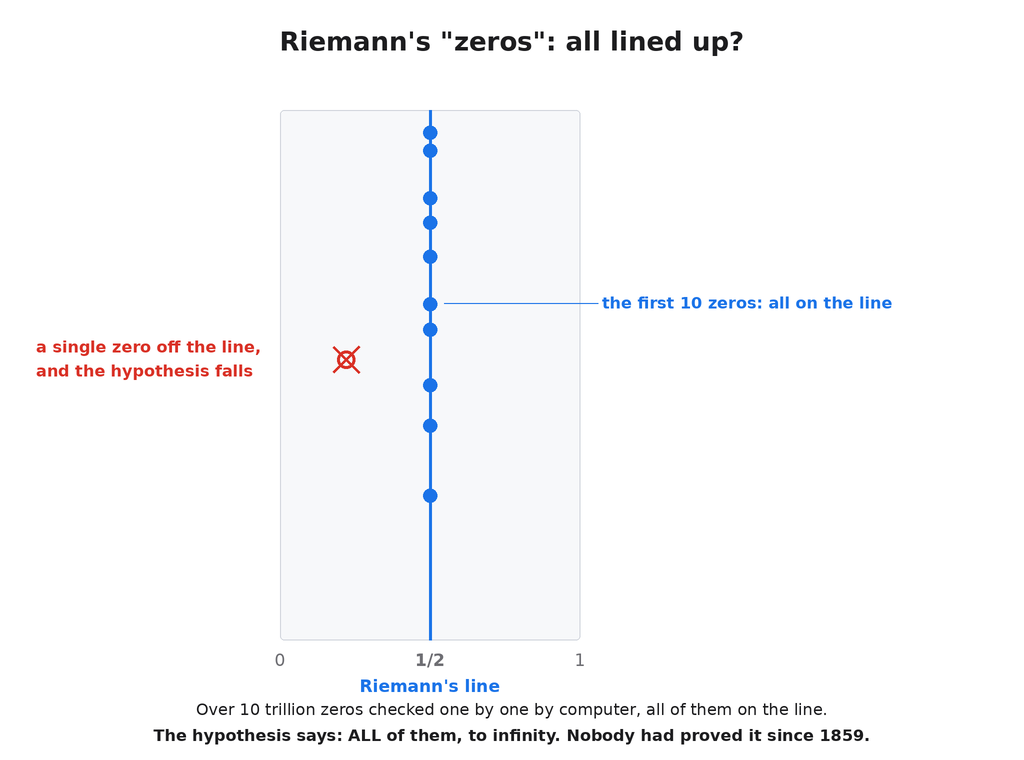
It only takes a single red dot, somewhere in infinity, to bring everything down
As early as 2004, a giant computation carried out by French researcher Xavier Gourdon had checked the first 10,000 billion zeros, one by one. All of them on the line. But checking 10,000 billion cases does not prove that there is never an exception. There are infinitely many zeros, and a single one going off the rails somewhere is enough to bring everything crashing down. That's why, in 2000, the Clay Mathematics Institute put it on its list of the seven millennium problems, at one million dollars each. And that's why, barely a month ago, Terence Tao, probably the best-known living mathematician, imagined that an AI would not get close to it before around 2050.
2050. It's 2026...
41 days, 17 million lines and 250,000 pages
What Alpöge describes in his note is a real two-person effort. First, Claude and he tackle a simplified version of the problem, a toy model, to see whether the idea holds up. Then the real conjecture, starting on October 6. They revive an old technique from a Russian mathematician, which works well elsewhere but gets stuck on whole numbers. And it's Claude that finds the trick to unblock it: stringing together a large number of small transformations instead of one big one. On November 16, forty-one days later according to the chronology in his note, the proof is complete.
Except that it is not written like a normal maths paper. It is written in Lean, a slightly unusual programming language: every step of the reasoning is broken down as far as the most basic rules of logic, and a program checks that every step really follows from the previous one. No hand-waving, no “it is obvious that”: if a single step is wrong, the program refuses. It is exactly the technique that Google's agents used a few days ago to have a machine verify a famous 1974 proof.
And now, hold on. According to the Lean community, the proof is about 17 million lines long. Printed out, it would exceed 250,000 pages, according to The Decoder website. No one, absolutely no one, can read that.
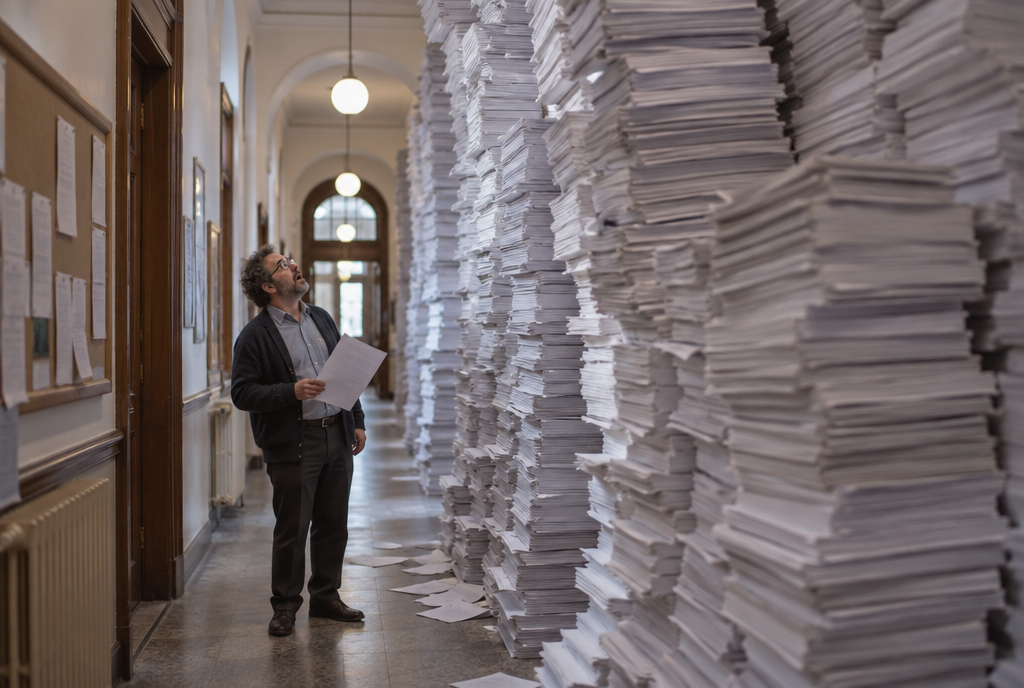
Good luck rereading that before dinner
Alpöge says it himself, and I find that unusually honest: he does not yet master all the mathematics that the proof relies on. In some areas, Claude was faster than him. He promises a version readable by humans in the coming months, and he thinks he can shorten the proof pretty quickly.
I use Claude every day for my work. It hunts down my compiler warnings to the very last one, rewrites my SQL queries, and proofreads me before I do something stupid. And while mine hunts down the small errors in my code, one of its cousins solves the biggest problem in the history of mathematics! As much as I know what it is capable of, it still feels weird.
The most important thing is the verification. If Alpöge had posted 250,000 pages of classical maths, it would have taken dozens of specialists years to reread them. With Lean, dozens of people reran the verification on their own computer in less than a day, and several independent checking programs went over it with a fine-tooth comb. Two tools also checked that what is proved really is the Riemann hypothesis as it had already been recorded in Lean, and not a version quietly modified. On Saturday, Lean FRO and the Mathlib Initiative, the two organizations that maintain this tool, signed the sentence I quoted at the beginning. Andrew Sutherland, from MIT, even published his own verification files.
And meanwhile, at Stanford...
The story has a second episode, and it is delicious. A few hours after Alpöge's announcement, Ravi Vakil, a Stanford professor and president of the American Mathematical Society, published a “hurried announcement” on his blog: a young researcher in his department, Alessandro Masullo, also has a proof, written entirely by hand, without AI. He was planning to spend a year polishing it before publishing it. Anthropic forced him out into the open.
And guess what happened next? About eight hours later, Vakil updated his post: several people had reported problems in Masullo's proof. And some of those flaws were found... with the help of other AI models. The human proof is being proofread by machines, the machine's proof was verified by software. We live in a strange time!
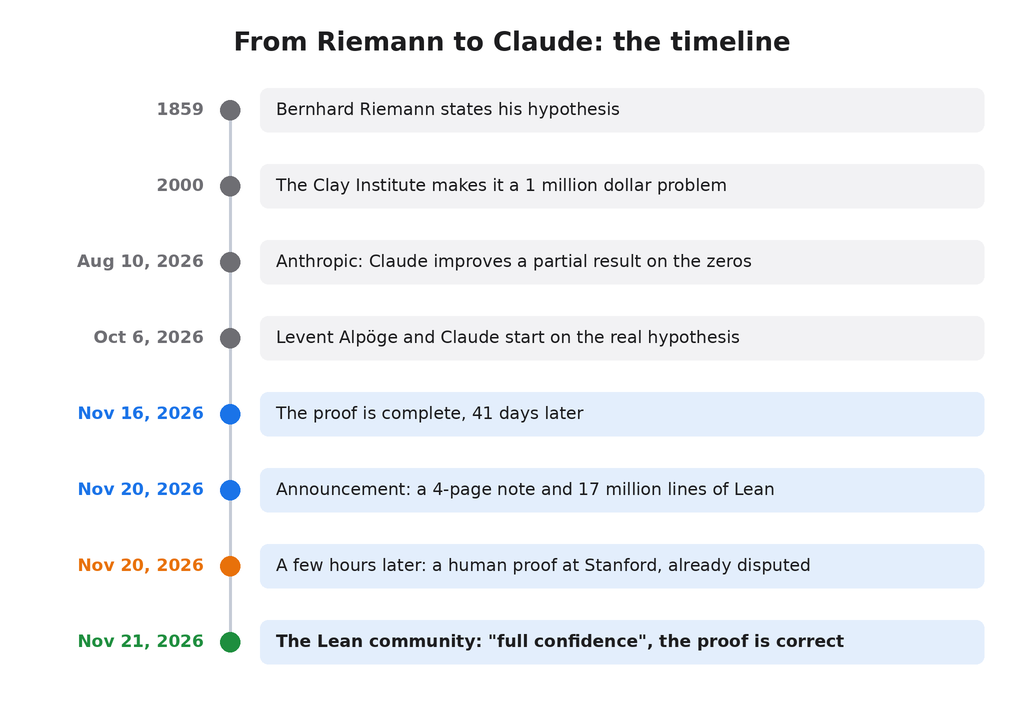
167 years of waiting, then everything comes down to two days
To be fair to Masullo: his proof isn't dead, it's being reviewed, and a Stanford specialist, Brian Conrad, has been poring over it for months. Vakil himself is asking for it to be translated into Lean to settle the matter. That says a lot: even among humans, it is now the machine that decides.
Okay, so what does this change for you?
The first question everyone asks: prime numbers protect my payments, is my bank in danger? No. And it is a very good question, so let's take it seriously.
The little padlock in your browser, your contactless payment at the bakery, your banking app: a good part of what protects you rests on one very simple fact. Multiplying two enormous prime numbers is instantaneous. Finding those two numbers from the result takes so long that even the biggest computers in the world can't do it. Yet the Riemann hypothesis says nothing about how to break a number into pieces. It says how prime numbers are distributed, not how to find them. Your card can sleep easy.

Contactless payment rests on prime numbers, and the proof changes nothing about that
What really changes is elsewhere. For more than a century, hundreds of mathematical results have begun with the same sentence: « if the Riemann hypothesis is true, then... ». Researchers have built entire floors on these foundations without knowing whether they would hold. If the proof is confirmed, all of that becomes true at once. The same goes for certain computer programs: there is for example a fast method for checking whether a number is prime, whose guaranteed efficiency rested on a version of the hypothesis that Alpöge's note also claims to prove. It would go from « very probably reliable » to « proven ».
And the timeline, honestly? For your everyday life: nothing tomorrow morning. The Scientific American journalist who covered the announcement writes it plainly, this result has no immediate application. For the 1 million dollar prize, the Clay Institute requires publication in a journal and two years without serious challenge. For a version readable by humans, a few months according to Alpöge. For concrete consequences, ten years, fifty years, or never.
But beware of « never ». In 1940, the English mathematician G. H. Hardy boasted in a book that number theory, his specialty, had absolutely no practical use. Thirty-seven years later, in 1977, three researchers invented RSA, an encryption system built precisely on prime numbers, which today protects a good part of the planet's payments. “Useless” maths have an unfortunate tendency to end up in your wallet.
The real change, actually, is in Brian Conrey's sentence, one of the greatest specialists on the subject: « I don't think a human was about to find this. » An AI has just found something that no book contained and that no human had found in 167 years. This isn't even the first time this autumn: at the end of October, I told you how Claude and an OpenAI AI had demolished another famous hypothesis on the same day, without consulting each other. If it works on Riemann, it could work one day on the chemistry of a battery, on a medicine, on a material. And that would end up affecting your life.
What still bothers me
Three things. First, nobody understands this proof yet. We know it is correct, because the machine checked it, but we don't yet know why it works. Terence Tao was warning precisely against these “black box” results, where we know that something is true without understanding why. For mathematicians, understanding is the whole point of the job. An association that defends mathematics done by humans also said it was « gravely concerned ».
Next, the timing. The announcement came the day after Anthropic's record-breaking stock market debut. Alpöge acknowledges that the timing may seem cynical, insists that this is not a publicity stunt and explains that waiting was no longer possible. I readily believe him, the proof speaks for itself. But admit that it comes at a good time...
Finally, there is still a small margin for human error: the risk that the hypothesis may have been copied incorrectly into Lean at the outset. That is precisely what the two checking tools verified, and the experts believe that this point can be checked quickly. But as long as the readable version has not been released, I am keeping one foot on the brakes.
Andrew Sutherland had the most fitting words in my view: “a human triumph”, because the most important step in the proof may have been building a machine that thinks. And Alpöge, for his part, ends his note with a sentence that made me uncomfortable: “It is natural to feel that this is an ending.” The end of what, exactly? Of mathematics done by hand? I don't know. But Tao had bet on 2050. If AIs are 24 years ahead of the greatest living mathematician, I really wonder what they will have solved by Christmas.
Sources
- Levent Alpöge, November 20, 2026: the four-page note announcing the proof (in English, PDF)
- Scientific American, November 20 and 21, 2026: an Anthropic mathematician says he has proved the Riemann hypothesis (in English)
- Phys.org, November 2026: an Anthropic researcher says he has proved the Riemann hypothesis with Claude (in English)
- OfficeChai, November 21, 2026: the Lean community certifies the proof (in English)
- The Decoder: a few hours after Anthropic, Stanford publishes a competing proof written by hand (in English)
- Ravi Vakil, November 20, 2026: the rushed announcement of Alessandro Masullo's proof (in English)
Article written with the help of Claude Code, reread and corrected by me.
Join the conversation
You need an account to comment on this article. Creating one is free and takes under a minute.
No comments yet.