Layoffs: Microsoft offers 60,000 employees the chance to leave, and Nadella explains why
“I wish I could tell you that everything will stay the same. I can’t.” It was Satya Nadella, Microsoft’s boss, who let that slip on Wednesday, November 18, on the stage of the DealBook Summit, the New York Times’s big economic conference. He was talking about the proposal Microsoft made at the end of October to around 60,000 of its employees: leave voluntarily, with a check. Sixty thousand! More than one employee in four. Enough to fill King Baudouin Stadium, and still leave ten thousand people in the parking lot. And for the first time, he explained why, putting AI at the center of the picture.

60,000 Microsoft employees have until early December to accept or refuse the departure offer
What exactly is a voluntary departure?
This isn’t a layoff. In a layoff, the company chooses who leaves. Here, Microsoft makes the offer, and the employee decides whether to take the envelope or stay. The offer was announced on October 26 in an internal message from Amy Coleman, the human resources director. It targets employees in the United States, Canada, the United Kingdom and India, from entry-level employees up to certain executives who hold a vice president title. No age or seniority requirement. Data center, sales and marketing teams are excluded. And for Belgian readers: neither Belgium nor the rest of continental Europe is affected.
The check corresponds to Microsoft’s usual severance package: an amount that depends on level and seniority (according to the Indian news agency PTI, one month of base salary per year with the company), the company shares that keep coming in, health coverage for a while and help finding another job. Those concerned have until the first week of December to decide, and those who accept leave on December 31.
The most surprising thing is that Microsoft isn’t expecting a tidal wave. The company is counting on fewer than 5% of employees accepting, meaning fewer than 3,000 departures out of the 60,000. In the spring, a more generous early retirement offer had appealed to around three out of ten of the 8,750 people concerned. Microsoft also specifies that this offer does not replace possible layoffs later on. It does not rule them out.
Many more machines, a few fewer people
Nadella talks about giving people “autonomy”, the ability to choose where to go while Microsoft reorganizes work around AI. He rejects the idea that AI is replacing employees: according to him, it changes the way they work. In principle, I prefer this a hundred times over an email at 6 a.m. that deactivates your badge. But the figures tell a slightly drier story.
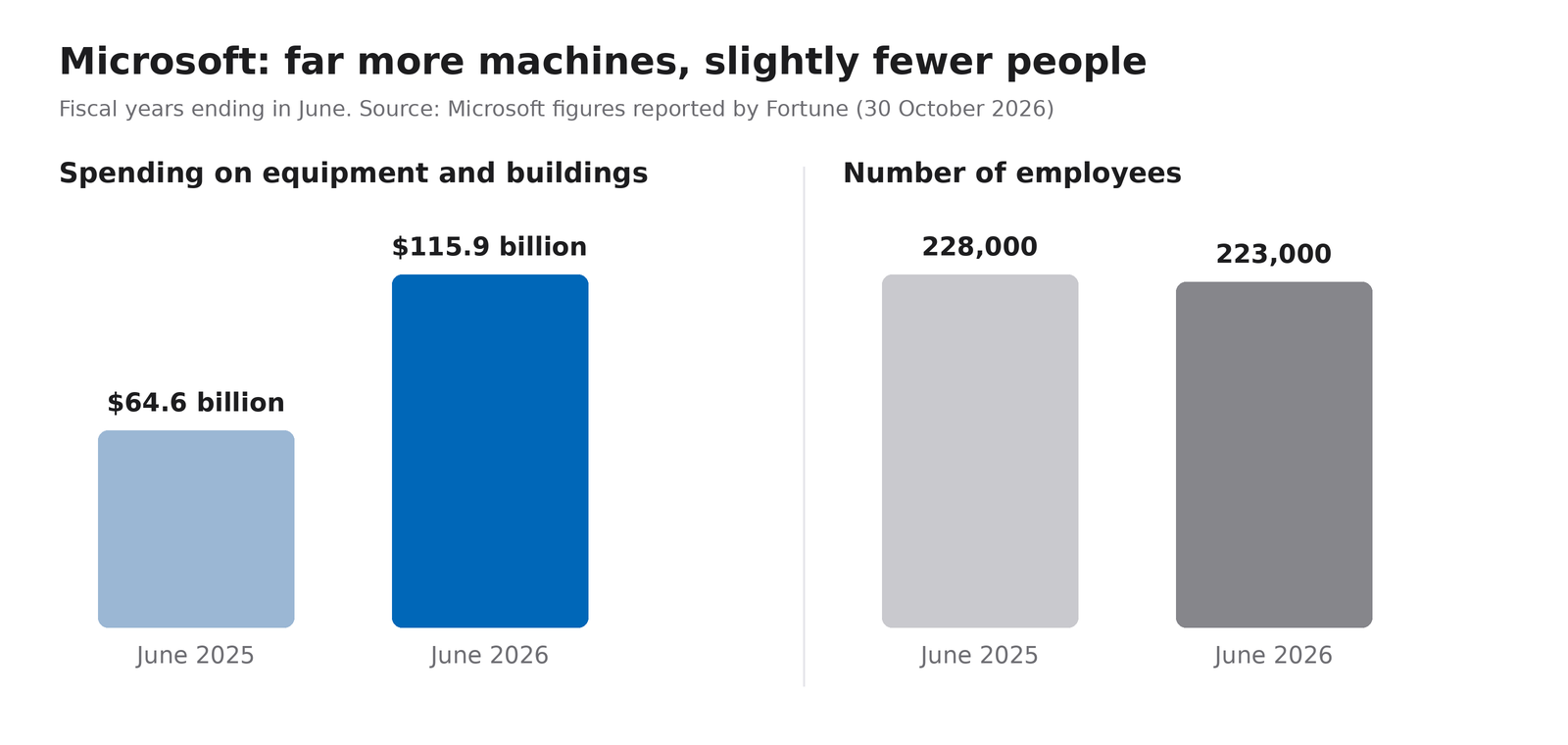
In one year, spending on equipment almost doubled, while the workforce lost 5,000 people
For the fiscal year ending in June 2026, Microsoft spent $115.9 billion on equipment and buildings, compared with $64.6 billion the year before. Almost twice as much, and most of it is going toward chips and data centers for AI. During that time, the workforce lost around 5,000 people, falling to 223,000. Jay Zagorsky, an economist at Boston University, doesn’t mince words in Fortune: to him, it is “a clear indication that they want fewer employees”. His colleague Joseph Phillips, from the University of Seattle, is more nuanced: Microsoft is hiring on one side and cutting back on the other, the company is simply relying more and more on machines.
Eleven developers and a lot of AI
To show what tomorrow’s work looks like, Nadella gave an example: Cowork, an AI agent integrated into Microsoft 365 apps, built by a team of “just 11 developers who use AI to do their work”. They no longer code everything by hand, they direct AIs that code alongside them. And for him, this is what awaits every profession: we will no longer do the work ourselves, we will steer agents that do it.

A small team steering AIs, the model Nadella highlights
I can't fault him there. I spend my days steering agents in Claude Code, and a team of eleven people who knows how to do that gets the work of a much bigger team done than two years ago. It's exhilarating when you're in it. Much less so when you're the one they no longer need to hire.
And what about juniors?
That's the question that makes people angry, and it was asked. On The Pragmatic Engineer podcast last week, Nadella acknowledged that Microsoft was hiring fewer beginners while reviewing the size and role of its teams. But he considers it “too early” to draw long-term conclusions from it. And in New York, he also warned that the transition and salary changes would take longer than people imagine.

Microsoft acknowledges hiring fewer beginners, and considers it too early to draw conclusions
That's exactly the gap I was describing in August in my article about the future of developers with AI : seniors steering agents, and no one left at the bottom of the pyramid to become tomorrow's seniors. When Microsoft's boss says “too early to draw conclusions”, what I hear above all is that no one has the answer yet.
And what does it change for us?
Directly, not much : the offer affects neither Belgium nor France. But three things concern you anyway. If you work in a big tech company or a bank, remember the method, because it's going to spread : economist Jay Zagorsky expects other tech giants to announce the same thing. If you use Word, Outlook or Teams at work, the AI features arriving there, like Cowork, are now being built by small teams that work with AI themselves, and it's going faster than before. And if your son or daughter is studying computer science, the real skill to add to their résumé is no longer just a programming language : it's knowing how to steer AI agents and review what they produce.
To me, a well-paid voluntary departure is still a pretty decent way to do things, especially compared with the waves of outright layoffs we've seen elsewhere. And if you're one of the 60,000 and you're hesitating, one month's salary per year at the company makes for one hell of a Christmas bonus. Provided you have the next job lined up : a little over two weeks ago I explained that on average it takes a month longer to find work again when AI is what made you lose yours. Do your sums carefully before signing!
Sources
- AI Weekly : Nadella presents the departure offer for 60,000 employees as a choice left to employees (in English)
- Fortune, October 30, 2026 : Microsoft's departure offer announces a future with fewer employees and more hardware (in English)
- Business Standard : Microsoft's voluntary departure offer, who is concerned, what it contains, and until when (in English)
- WindowsForum : Nadella on employee choice, AI and junior hiring (in English)
Article written with the help of Claude Code, proofread and corrected by me.
Join the conversation
You need an account to comment on this article. Creating one is free and takes under a minute.
No comments yet.