Layoffs: losing your job because of AI, how long to find another one?
One month. That is how much longer it takes, on average, to find work when AI is what made you lose your job. The figure comes from Goldman Sachs, the major American investment bank, which ran the numbers on more than 15,000 people laid off between 2016 and 2025. And reading the study all the way through, I found two pieces of news that the headlines somewhat forgot. One bad one, and one genuinely good one.

One extra month of searching, on average, when the lost position was highly exposed to AI
How do we know it is AI's fault?
Good question, and it was the first thing I asked myself. No unemployment form contains a box saying “fired because of ChatGPT”. Pierfrancesco Mei, the Goldman economist who signed the note, did things differently. He started with a major survey from the US Department of Labor, which interviews people who have lost their jobs every two years. Then he gave each lost job a score: is it a job that AI can already do partly, does the company use AI a lot, and was the position eliminated, rather than just filled by someone else.
He put the top three jobs out of ten in the “probably replaced by AI” category. It is an estimate, not proof, and he says so himself. But there is one detail that makes the result solid: for layoffs before 2023, before ChatGPT arrived in every office, he finds no difference between the two groups. The gap appears right when AI arrives.
The bad news: one month more, and a salary that does not keep up
According to the Goldman note, those who lost a position highly exposed to AI look for work for about one month longer than the others. One month sounds like nothing, until you are the one doing the math at the end of the month. And one year later, out of 100 people, about ten more are still looking.
And it hits the older ones harder, obviously, because the world of work has never been kind to gray hair. To get back to working full time, it takes about five more weeks after 35, compared with three before.
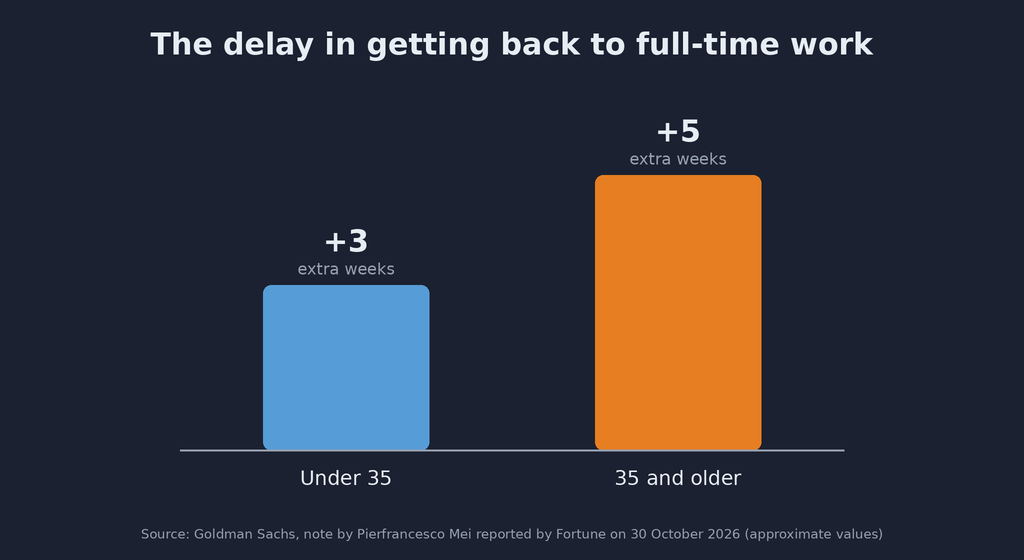
The delay in getting back to working full time, according to age
On the salary side, the picture is not cheerful either, and this concerns all laid-off workers, not just those affected by AI. Among people who had at least three years of seniority and who got back to working full time after being laid off between 2023 and 2025, barely one in two earns as much as or more than before. In the ministry's previous survey, two years earlier, it was six out of ten. Goldman compares the effect with the great waves of automation of the past forty years: each time, those who got the boot took years to catch up with their salary. A scar that remains, the bank writes.
The good news: young people bounce back
And there, surprise. Those under 35 are doing significantly better. They get back to working full time faster, they string together fewer small temporary contracts, and they less often need a second job to make it through the month. Mei sees it as “an encouraging sign”: young people “could adapt more flexibly”.
Those who had little seniority in the lost position do better too. Makes sense, when you have spent only two years on in house software that nobody else uses, you do not have much to unlearn. And American students have already understood the message: they are increasingly choosing fields less exposed to AI and that are hiring.
And the companies calling back their former employees
The second piece of good news is not in the Goldman note, but it came the same week. The Washington Post reported on October 29 that companies are quietly calling back the people they replaced with AI. The case that made me smile was Ford: the automaker rehired and even promoted more than 350 experienced engineers, because its major wave of automation had created quality problems that its models did not know how to fix.

At Ford, more than 350 experienced engineers were called back to fix what the models couldn't fix
Ford is not an isolated case. A survey by Careerminds of 600 human resources managers, conducted in February and just brought back up by the Washington Post, points in the same direction: a third of the companies that had laid people off citing AI have already rehired between a quarter and half of the positions eliminated. And a little more than a third have rehired more than half of them! Most commonly cited reason, by more than half of those surveyed: they found themselves « babysitting the technology ». Honest caveat: Careerminds actually sells layoff support services, so it's not the most neutral witness in the world.
The funniest part is the bill. Only one company in four reckons it made money from the operation. Three in ten say they ended up worse off than if they had laid nobody off. In short, firing everyone and then calling everyone back is a steep price to pay for learning that experience can't be installed with one click.

A third of the companies that laid people off in the name of AI have already rehired some of the positions
Before panicking, three caveats
First, all of this is American data. The Belgian or French labor market doesn't work the same way, with longer notice periods and benefits that don't stop after six months. Then, the « replaced by AI » box is still an estimate. Finally, not everyone agrees: Yale University's Budget Lab finds no link between exposure to AI and the overall unemployment level.
But the other figure of the week is not an estimate. The Challenger firm, which counts layoff announcements in the United States, recorded more than 120,000 justified by AI between January and September, according to figures reported by Fortune. More than one announced layoff in five, and it has become the first reason given. I talked about it with Barclays and its 5,000 positions last week: AI has become the excuse people cite first.
What if your job is the one in the crosshairs?
The study doesn't provide an instruction manual, but it clearly says who comes out best, and that translates very well into normal life.
Those who bounce back are the ones whose know-how can be taken elsewhere. The accountant who has known only her company's in-house software for fifteen years starts with a handicap. The one who also knows how to run a spreadsheet, read a balance sheet and explain a figure to a client finds work again faster. Same thing at a bank counter, in the customer service department of an energy supplier or in a design office.
Then, those who have already used the tool. If your job is on the list of « exposed » jobs, writing letters, answering the phone, translating, doing data entry, the day you go to an interview, being able to say « yes, I use it every day and here's what it changes » carries more weight than one more diploma. The young people in the study aren't smarter. They're just less afraid of changing tools.
And finally, time. Where we live, between notice periods and benefits, an extra month of searching is easier to get through than in the United States. That's not a reason to wait for the letter, it's a reason not to panic when you receive it.
What I think
I've been developing for twenty-five years, and what sticks with me most is the Ford story. AI can do part of the job, and better and better. But the guy who knows why the part bends as it comes out of the mold, because he's seen it bend a hundred times, no model has that in its memory. That's exactly what these companies fired, and that's exactly what they're buying back today at a higher price.
And for me, that's the good news hidden in this whole story: experience still has a price, and it has just gone back up. And to the bosses who laid people off too quickly: I hope you kept their phone numbers!
Sources
- Fortune, October 30, 2026: Goldman Sachs report on workers replaced by AI
- AI Weekly, October 30, 2026: one more month to find a job
- AI Weekly, October 30, 2026: the Washington Post, Ford and the Careerminds survey on rehires
- Careerminds: what HR executives regret after AI-related layoffs
Article written with the help of Claude Code, proofread and corrected by me.
Join the conversation
You need an account to comment on this article. Creating one is free and takes under a minute.
No comments yet.