AI: Gemini 4 Hydrogen, Google’s new cheap model, is it worth it?
Google released Gemini 4 Hydrogen on Thursday, November 12, a fast and cheap AI model, which Google presents as its “everyday model” for agents, those AIs that string tasks together all by themselves. And the detail that brings a smile: according to Google, on the Artificial Analysis benchmark, an organization that puts all models through the same tests, this newcomer does just as well as Gemini 4 Argon, the big model Google was keeping under lock and key six weeks ago. The little brother catches up with the big one before we've even been allowed to touch the big one. Well, things move fast at Google!

Hydrogen is the cargo bike of the range: lighter, faster, and it gets everywhere
Hydrogen, Carbon, Argon: who does what?
Google now has three Gemini 4 models, and they don't have the same job. Carbon and Argon are the big brains, made to think for a long time about a difficult problem. Hydrogen, on the other hand, is made to execute quickly: write code, fill in a spreadsheet, string actions together in software. Google even imagines it working as a team: Carbon makes the plan, Hydrogen does the work.

Carbon draws the plan, Hydrogen carries the bricks
And Google gives a figure for that. In its Antigravity programming tool, when Hydrogen acts as conductor, it completes almost as many tasks as Carbon, while using 24% less quota and finishing 19% faster. On Terminal-Bench, a test where the AI has to manage on its own inside a computer using commands typed on the keyboard, it scores 57%, compared with 18.2% for the previous fast model, Gemini 3.8 Flash. Three times better in one generation. Google's figures, obviously.
The price per piece, and the real price
An AI is paid for by the token, a small piece of a word of about four letters. Hydrogen costs $1.50 per million tokens sent to it, and $7.50 per million that it writes. That's twice as much as Gemini 3.8 Flash. Put like that, it's not a bargain.
Except that, as I explained with Claude Fable 5.2 four days ago, the price per piece doesn't tell you how many pieces the model is going to consume. And here, Artificial Analysis did the calculation for real, test by test. Result, according to its figures from November 13: Hydrogen costs an average of $1.87 per task, compared with $7.77 for Flash. More expensive per piece, but four times cheaper in the end, because it goes around in circles much less before finding the answer.
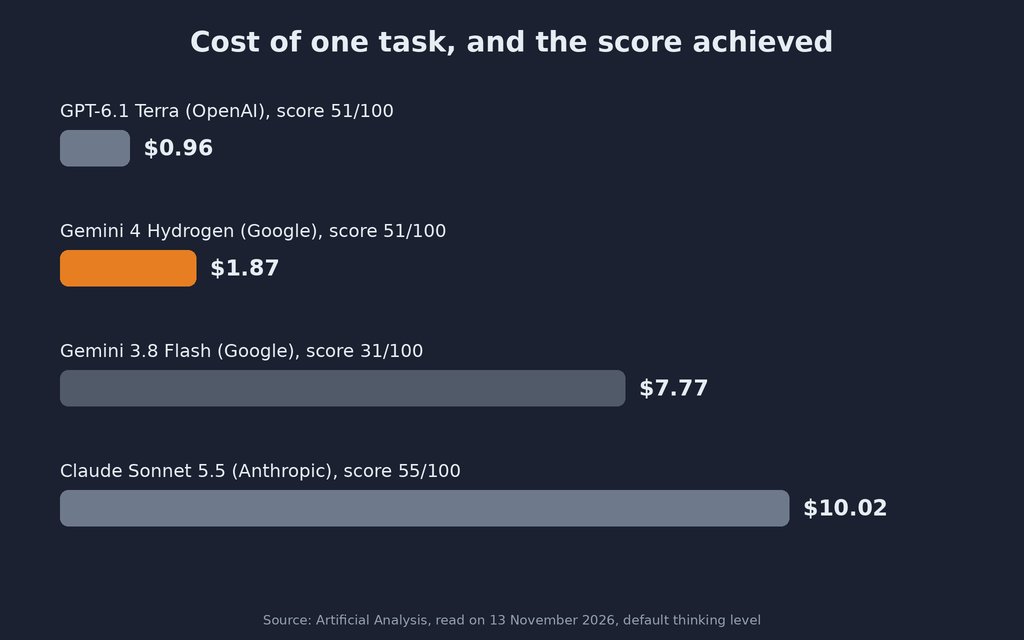
Average cost of a task on the Artificial Analysis benchmark, at the default setting
The same figures still put Google back in its place. GPT-6.1 Terra, from OpenAI, gets exactly the same score, 51, for about half the price: $0.96 per task. And Claude Sonnet 5.5, from Anthropic, does better, 55, but for more than five times the price. Hydrogen is therefore not the cheapest in its category, it's very well placed, that's all.
Small trap to know about: the most advanced setting, xhigh, raises its score to 54, but the model then becomes a real chatterbox. On the benchmark, it wrote about four times more text than a comparable ordinary model. Three extra points, for a bill that rises to $3.16 per task. That's the kind of setting you keep for special occasions.
And you, who pay nothing?
This is where it gets interesting for everyone, not just developers. Hydrogen is coming to the Gemini app, where free users get it automatically when the app decides it suits the question. And Google is also rolling it out in its search engine, for all users.
Concretely, the next time you ask Google a long question while making dinner, something like “what can I make with three zucchinis, some eggs and some leftover feta, without an oven”, it might be the one answering you. Faster, and in principle with less nonsense. Google announces an honesty rate of 94% in its own internal tests, which means the AI more often recognizes when it doesn't know. We'll see how it holds up in practice, but this is the right direction.

Hydrogen is also coming to Google Search, for everyone
Want to try it right away? In the Gemini app, tap the model name at the top of the screen and choose it from the list when it appears for you. If you're a developer, it's already in Google AI Studio, Google's free testing site: give it a real task from your job, not a “hello”, and compare it with what you usually use. That's the only test that matters.
And if you have a Google subscription for work, it's also coming to Google Sheets, the online spreadsheet, for eligible accounts. The spreadsheet that fills in its formulas by itself, we're almost there.
My developer's opinion
I work with Claude all day, so I'm not going to pretend to be neutral. But what interests me about Hydrogen is the message it sends to the whole industry: we no longer need the biggest model for most of the work. Most of what an agent does is execution, not genius. And for execution, a fast model that doesn't go round in circles is better than an oversized brain that thinks for ten minutes before renaming a file.
That's exactly what I already do in my own settings: the big model plans, the lighter ones execute. Google has just turned it into a sales pitch. And at these prices, I'm eagerly awaiting Anthropic's next small model!
Sources
- Google, November 12, 2026: Introducing Gemini 4 Hydrogen (in English)
- Artificial Analysis: Gemini 4 Hydrogen, rating, speed and price (in English)
- eesel, November 12, 2026: Gemini 4 Hydrogen, ratings, cost per task and verdict (in English)
Article written with the help of Claude Code, proofread and corrected by me.
Join the conversation
You need an account to comment on this article. Creating one is free and takes under a minute.
No comments yet.