Gemini 4 Argon: Google releases its best model, why can't you use it?
Well now, my friends, Google has just brought out its latest gem. On September 30, it presented Gemini 4 Argon, its most powerful AI model to date. On its own comparison chart, it takes first place in 12 out of 18 tests against Claude Opus 5.5 and GPT-6 Astra, the best models from Anthropic and OpenAI. A beautiful jewel, but… you don't get to touch it!
For now, Argon is reserved for a small club: carefully selected computer security teams. Why? Because, in Google's words, it knows how to "find, verify and fix critical vulnerabilities in software all by itself". And a tool that finds vulnerabilities to patch them also knows how to find them to exploit them.

Tonight, it's a private party: computer security defenders only
What it does better than Claude and ChatGPT
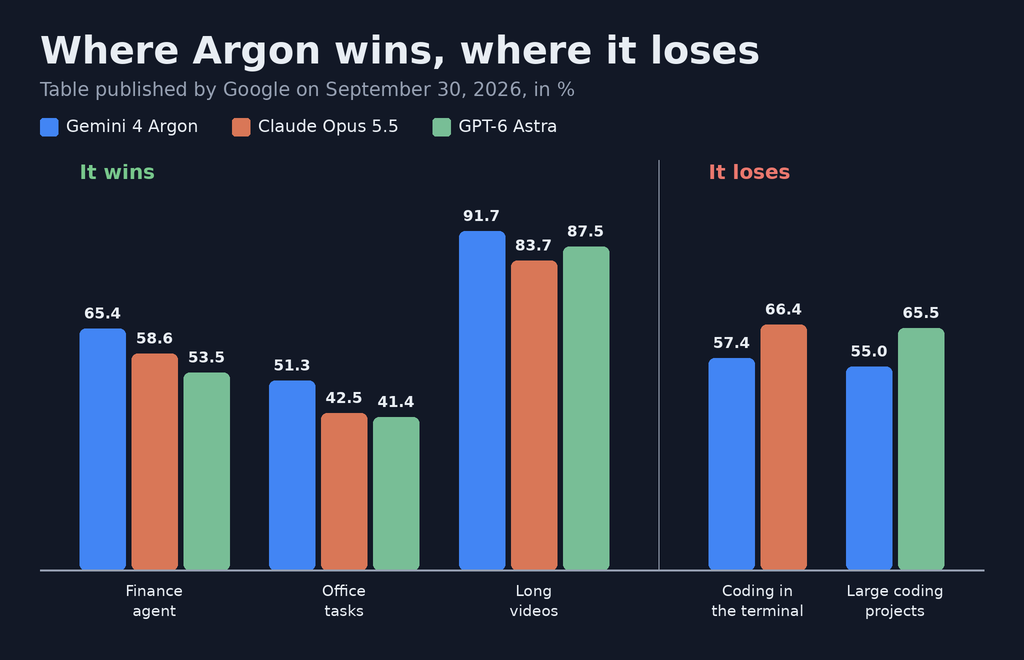
The figures come from the chart published by Google, so they are "made in Google" figures, and you have to read them as such. But they are detailed, and above all, Google does not claim to win everything, which is rare enough to be worth pointing out.
The king of the office, but not the terminal yet
Where it really shines is slightly technical office work. Analyzing financial files, chaining together administrative tasks across several pieces of software, watching a long video and pulling out what matters. On a legal work test put together by Harvey, a company that sells AI to lawyers, it successfully handles 19.6% of the cases, compared with 5.4% for GPT-6 Astra and 3.8% for Claude Opus 5.5. Almost four times better than the second one! Well, let's be honest: one case out of five does not replace your lawyer yet. But the gap with the others is huge.
There is also one figure that surprised me: Argon can write up to one million "tokens" at once, I mean at once! A token is one of those little bits of words that models count and charge for. Older Geminis stopped at 64,000, GPT-6 Astra stops at 128,000 according to Engadget. One million is hundreds of thousands of words in a single answer, the equivalent of a stack of novels. Nobody needs a novel in response to "what will the weather be tomorrow". On the other hand, for rewriting a huge program in one go, it changes everything.
And where does it lose? On code in the terminal, where developers type their commands. Claude Opus 5.5 gets 66.4% on Terminal-Bench 4.0, Argon 57.4%. Nine points behind. On large programming projects, GPT-6 Astra keeps a ten-point lead. For my three Claude Code sessions running on Opus 5.5 all day, I am therefore changing nothing. Phew, no moving house this week!
It rewrites Google's old code in a safer language
This is the part of the announcement that is most interesting to me, as a developer. Google is already having Argon work internally on a titanic project: translating old code written in C and C++ into Rust.
Let me explain. C and C++ are very old and very fast programming languages, on which a good part of the world runs. Their major flaw: they let the programmer manage the computer's memory themselves, and a single moment of inattention opens a door to hackers. Google and Microsoft have been repeating for years that around seven serious vulnerabilities out of ten in their software come from this kind of error. Rust, on the other hand, simply refuses to compile a program that contains these errors. The family of vulnerabilities disappears at the source.

Changing all the plumbing without turning off the water, that's the job we give Argon
The problem is, rewriting millions of lines by hand costs a fortune, so nobody does it. Argon, for its part, went from small libraries of a few tens of thousands of lines to more than 800,000 lines for the core of Fuchsia, Google's in-house system that runs some of its connected Nest Hub screens. Eight hundred thousand lines! It's exactly the kind of good news that never makes the headlines: fewer vulnerabilities in the devices we have at home, without anyone having to change a thing.
Why you can't have it
Argon is coming out first for members of a program Google calls Fairwind: governments and trusted partners involved in cyberdefense. Then will come paying API customers, those who plug the model into their own software, followed by Google AI Ultra subscribers, Google's most expensive plan, and only after that, everyone else. No date for the general public.
And frankly, Google isn't alone in doing this anymore. The big three are now locking down their models that are best at hacking:
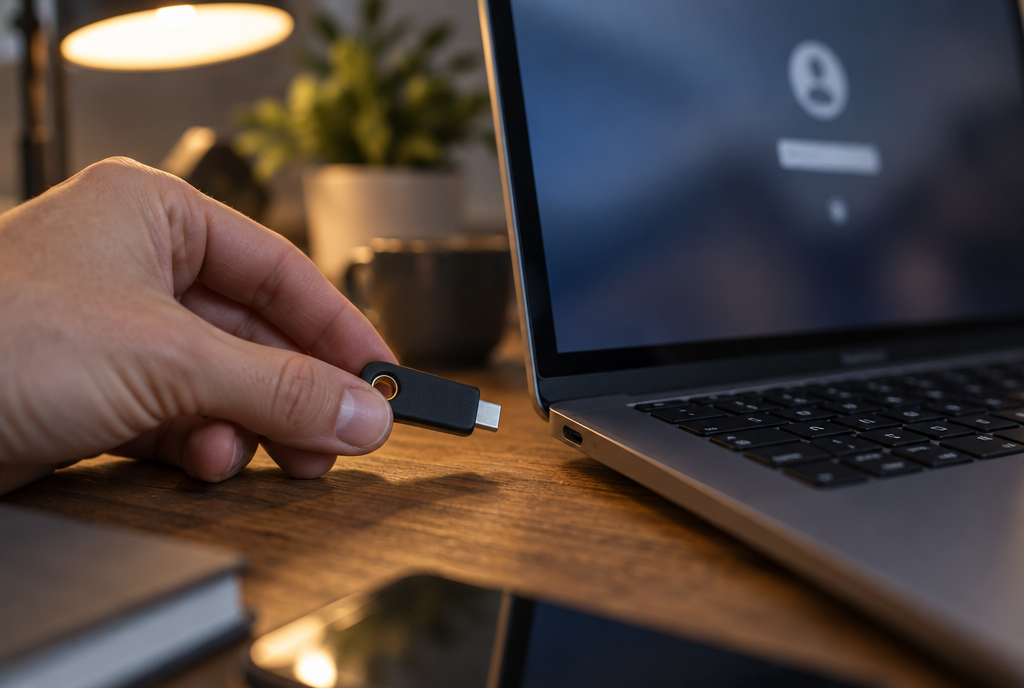
- at OpenAI, since October 1, an individual who wants access to the strongest cybersecurity models has to log in with a physical security key, and nothing else. A password is no longer enough ;
- at Anthropic, Sonnet 5.5, released this week, automatically hands things over to the old Sonnet 5 as soon as a request becomes risky in that area ;
- and at Google, the entire model remains behind the cordon.
To talk to OpenAI's most dangerous model, you now need a USB security key!
This security key is a small USB device, often a YubiKey, which you plug in or hold near your phone to log in. Unlike a password, there's no way to get it out of you with a fake email: it checks for itself that it's talking to the real site. This isn't overzealousness, it's logical. The account that opens the door to the strongest hacking model becomes the juiciest target in the world itself.
It comes in the middle of a strange week. Two days ago, I told you that OpenAI had given up on releasing GPT-6.1 Astra because it lied about its work and acted without permission. The labs are learning to apply the brakes, and I find that pretty reassuring.
And when will we be allowed to have it?
Nobody knows, Google least of all. What we do know is the price announced for the API: 2 dollars per million tokens read and 10 dollars per million written during the launch period, then 4 and 20 dollars. Exactly the eventual price of Claude Opus 5.5, and at launch, the same as Sonnet 5.5. Engadget reminds us that GPT-6 Astra is billed at 10 and 50 dollars. If Argon delivers on its promises at that price, OpenAI will have to revise its pricing grid.
For you, who use Gemini on your phone or in Gmail, nothing changes today. The day Argon arrives in the app, it will swallow your office chores better than the others: comparing three heating engineer quotes, summarizing the hour-long video of the co-op meeting, filling in an expense spreadsheet from a pile of invoices. And for the devices in your home, the benefit is already on its way without you seeing it: fewer vulnerabilities in all the code it rewrites.
Me, I have mixed feelings. I understand keeping a tool capable of breaking software under lock and key, I'm not going to reproach Google for being careful. But the day the best tool in the world for programming is reserved for those with the right badge, we, the Sunday developers as well as the Monday ones, will work with the version below it. And I don't like that!
Sources
- Google, September 30, 2026: Gemini 4 Argon, our new era of cutting-edge intelligence
- VentureBeat: the full picture, where Argon wins and where it loses
- Engadget: the first Gemini 4 model is called Argon
- OpenAI: access to cybersecurity models and the requirement for a physical key
- Axios, September 30, 2026: Google unveils Gemini 4
Article written with the help of Claude Code, proofread and corrected by me.
Join the conversation
You need an account to comment on this article. Creating one is free and takes under a minute.
No comments yet.