Claude Code: Sonnet 5.5 does almost as well as Opus, should you switch?
What great news! Anthropic is giving us a gift! The little model, the little kid brother, has just caught up with the big one, and it costs us half as much. On Monday, September 28, Anthropic is releasing Claude Sonnet 5.5, and also in Claude Code, that wonderful programming assistant I use from morning to night, it is already replacing the old Sonnet 5. In a test of real office work, it finishes two points behind Opus 5.5, considered the big model in the lineup (yes, and Fable too, the high-end one above Opus, but we'll come back to that). Two points out of more than 1,800. That's as good as a tie!
So obviously, the question we're asking ourselves is: do I keep paying for the big kid brother to do everything?

The big one's bike cost twice as much
Sonnet, Opus, Haiku: three sizes, three prices
A quick reminder for those who don't sleep with Claude. Anthropic sells its AI in three sizes, a bit like the cups at a coffee counter. Haiku, the small one, fast and cheap. Sonnet, the medium one, the one we all use every day. And Opus, the big one, which thinks longer and costs more. Haiku 5.5 isn't here yet, it has been announced “in the coming weeks”.
As for the prices, it's simple: on the pricing table Anthropic published on September 28, Sonnet 5.5 costs exactly half as much as Opus 5.5. Two dollars versus four for what it reads, ten versus twenty for what it writes, each time per million “tokens”, those little bits of words that models bill by the piece. And it's the same price as the old Sonnet 5, so at the same price, you've got a better engine under your hood.
Now, the scores. I'll translate them for you:
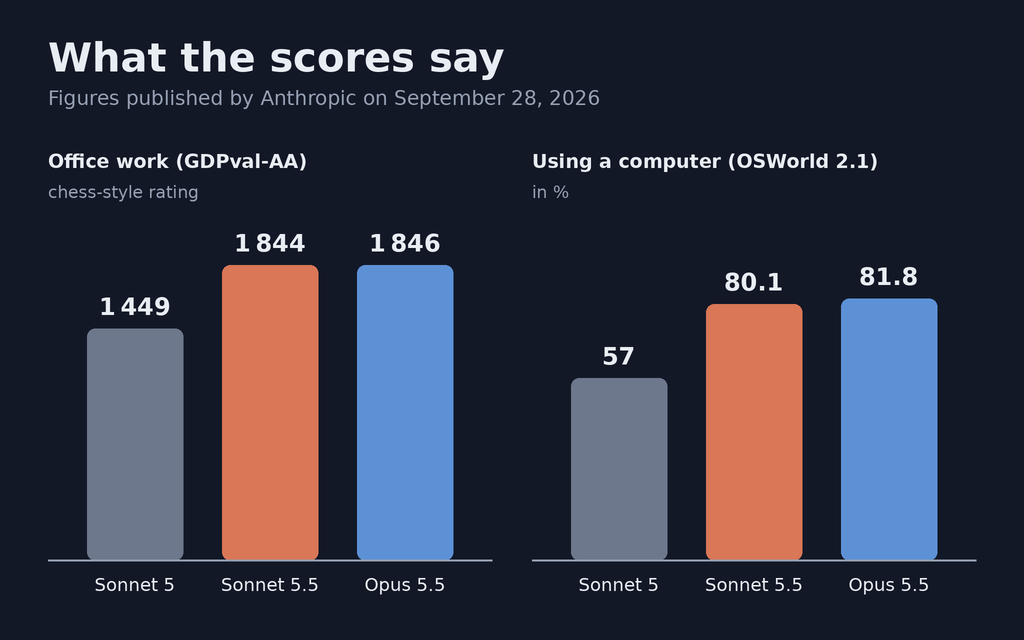
The medium one sticks to the big one, and the old medium one watches the train go by
The first test, GDPval-AA, has the AI do real office work, things like spreadsheets, presentations or reports, and it ranks the models like chess players are ranked. The second, OSWorld, gives it a computer and lets it manage on its own: clicking, opening windows, filling out forms. In both, Sonnet 5.5 matches Opus 5.5, and leaves the old Sonnet far behind.
But the figure that surprised me was the one for the terminal, that black window where developers type their commands. On Terminal-Bench 4.0, a test where the AI has to carry out a job on its own from start to finish in that window, the old Sonnet scored 10.3%. The new one scores 70.6%. Almost seven times more! And it goes 30% faster than the old one, with up to 30% less cost per task, because it needs fewer words to reach the same result. These are Anthropic's figures, so take them as company figures, but the gap is too big to be window dressing.
A fun little bonus: it's the first Sonnet to finish Pokémon Rouge while looking only at screenshots. It sounds like a gimmick, but keeping hours and hours of gameplay going without losing the thread is exactly what AI was missing on a long coding project. And between you and me, how many kids from the 90s made it all the way through?
What if you don't code?
It concerns you too, more than you think. Sonnet is the model that the Claude app has given free and Pro accounts by default since Sonnet 5 came out in June. Anthropic hasn't yet written in black and white that 5.5 has taken its place in the app, so the simplest thing is to open the little model selection menu (in Claude Code, it's the /model command), at the bottom of the area where you type your question, and look at the model that's selected. If it's that one, you get faster answers, and an assistant that makes your spreadsheets and presentations almost as well as the big paid model.
And above all, you'll come across it without knowing it. A lot of companies put this kind of model behind their customer service, the little chat at the bottom right of the site where you go to complain about your lost package. Zendesk, one of the big customer service software companies, announces in Anthropic's presentation that Sonnet 5.5 handles its requests 20% faster. A cheaper and faster model means customer service that answers faster, and companies that no longer have an excuse to leave you waiting around.
At home, Sonnet is already doing the research
In my Claude Code setup, I don't run everything on the same model. Claude Code can launch “sub-agents”, little specialized assistants that it entrusts with one part of the work. The ones that rummage through the code to find where what is (Explore) run on Sonnet 5.5, just like the one that launches the tests (Tester) to check that nothing is broken. Everything that writes code or judges it stays on Opus. Paying Opus to rummage through files is like sending your boss to look for a screwdriver in the van.

The kitchen assistant peels, the chef tastes, and nobody pays the chef to do the dishes
Anthropic says the same thing, by the way, in its own Claude Code help page : Sonnet is the right choice for the vast majority of programming work, and Opus uses noticeably more of your quota. I quote: “spending Opus on routine work is the fastest way to drain your limit”. Anyone who read my article about the quota that melts too fast, three weeks ago, knows that this isn't a minor detail.
Changing models along the way takes one command, typed directly into Claude Code :
/model sonnet
/model opus
And there's a second setting that matters just as much as the model: the effort, that is, how long the AI thinks before answering. When Opus 5.5 came out last week, I turned all my agents down a notch, because this model already thinks more than the old one at the same setting. Same result, less quota burned. With Sonnet 5.5, it's the same logic: before turning the effort up to maximum, try the setting below first.
Your old CLAUDE.md may be talking to a model that no longer exists
I didn't see this one coming. Three days before Sonnet 5.5, version 2.1.283 of Claude Code added a command that gives your instructions a health check.
For those who don't know: CLAUDE.md is a text file that Claude Code rereads every time it starts up. You write your rules, your habits, what it must never do. It's the little note you leave for the babysitter on the fridge.
The problem is that this file may have been written for a child who has grown up. A year ago, you had to shout at models to be obeyed: “IMPORTANT” in capital letters, “think step by step”, “you MUST absolutely”. Today's models take all that literally and overdo it. The new command spots these old formulas, but also paths to files that you have renamed since then, commands that no longer exist, and instruction files that contradict one another. It shows you its report, and it asks you before touching anything. Type this :
claude update
/doctor prompt-audit
Mum writing to her teenager
I admit I'm very curious to know what this doctor is going to think of my own instruction file. It has a section called “FATAL Rules”. In uppercase. I think I already know part of the diagnosis.
Another small practical novelty that arrived with Sonnet 5.5: automatic mode, the one where Claude Code moves forward without asking your permission at every step, still asks you when it wants to read a file outside your project. Before, it was yes or no for real. Now, you can answer “yes, but ask me again next time”. It's very simple, and it's exactly what was missing so you wouldn't open the door wide just because you were in a hurry.
So, do we ditch Opus?
No. And Anthropic is the one saying it: Opus 5.5 remains better at vague, open-ended work, the kind where you have to keep using your judgment for a long time. Designing a software architecture, untangling a bug that nobody understands, deciding what we're going to do before doing it. That's where the big one keeps its lead.
One detail I found interesting: Sonnet 5.5 is strong enough in cybersecurity for Anthropic to have given it the same safeguards as its best models. When a request becomes risky in that area, it visibly hands things back to the old Sonnet 5. The little brother got the same locks as the big one, which tells you how much he has grown.
For me, the rule is clear: Sonnet for the hands, Opus for the head. And I'll be honest, what I like most about this isn't even the score, it's being able to keep my three Claude Code sessions open a little longer before the quota gauge turns red!
And Fable in all this? Frankly, I only use it for very special cases, when Opus can't manage, and as an architect analyst, it can come up with a solution, but that is becoming really rare. Maybe a tear-up-the-place Fable 5.5 soon? We'll see.
Sources
- Anthropic, September 28, 2026: presentation of Claude Sonnet 5.5
- Claude Code: version history 2.1.283 to 2.1.285
- VentureBeat: Sonnet 5.5, 30% lower cost per task
- SiliconANGLE, September 28, 2026: Sonnet 5.5, 30% faster than the previous generation
- Claude Help: models, usage and limits in Claude Code
Article written with the help of Claude Code, proofread and corrected by me.
Join the conversation
You need an account to comment on this article. Creating one is free and takes under a minute.
No comments yet.