AI: United Airlines bans AI agents from booking your tickets, why?
“Find me a cheap flight to New York in April, window seat, and book it.” That's exactly what AI agents promise, these assistants that no longer just answer but act in your place: open a site, fill out the forms, pay. Well, at United Airlines, it's over. Since Wednesday November 11, the American airline has explicitly banned these agents from booking, changing or paying for a ticket for you. Even if you approve every step. And if it still goes through, it reserves the right to cancel your ticket!
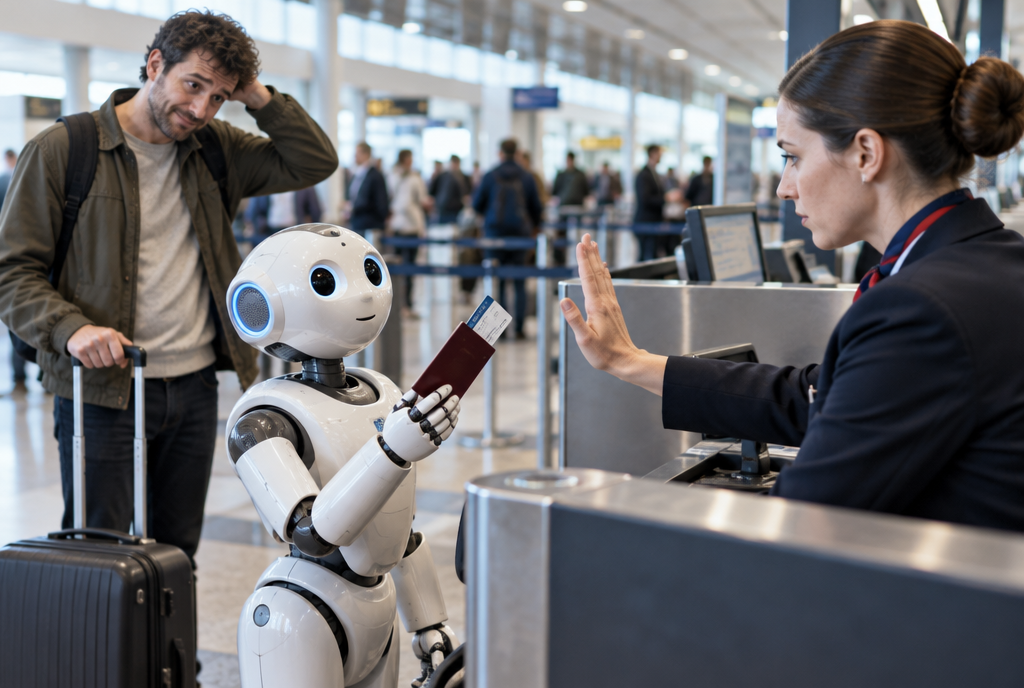
At United, the robot no longer gets past the counter, even with your passport
What United wrote, exactly
United changed its contract of carriage, that long document nobody reads and that we accept by checking a box. The new rule 6.J.6 bans, I quote, “the use of AI agents to make, modify or manage a ticket, and/or to purchase a service or product”. That applies on the United website, but also when the agent goes through a travel agency or a comparison site. And another rule, 5.H, gives the airline the right to cancel a booking made this way.
What remains allowed: using AI to search. The agent can still display United flights and prices, and according to the Wall Street Journal, doing your research with AI and then buying it yourself does not violate any rule. The flights also remain on Google Flights, Kayak or Hopper. Search, yes. Click “pay”, no.

Searching with AI is still allowed, it's up to you to click “pay”
The official reasons
United puts forward two. The first is your password. For an agent to book in your place, you often have to give it the keys to your loyalty account. And according to the airline, that can expose sensitive information and cause “unwanted purchases, account changes or the use of MileagePlus miles” (the in-house loyalty program). On that point, it's hard to say it's wrong: an agent that spends your miles because it misunderstood your request, that's not science fiction.
The second reason is more surprising. American aviation rules require the passenger to confirm certain things themselves, for example at check-in, that their baggage contains no dangerous materials. An AI agent cannot swear in your place that there is no gas canister in your suitcase.
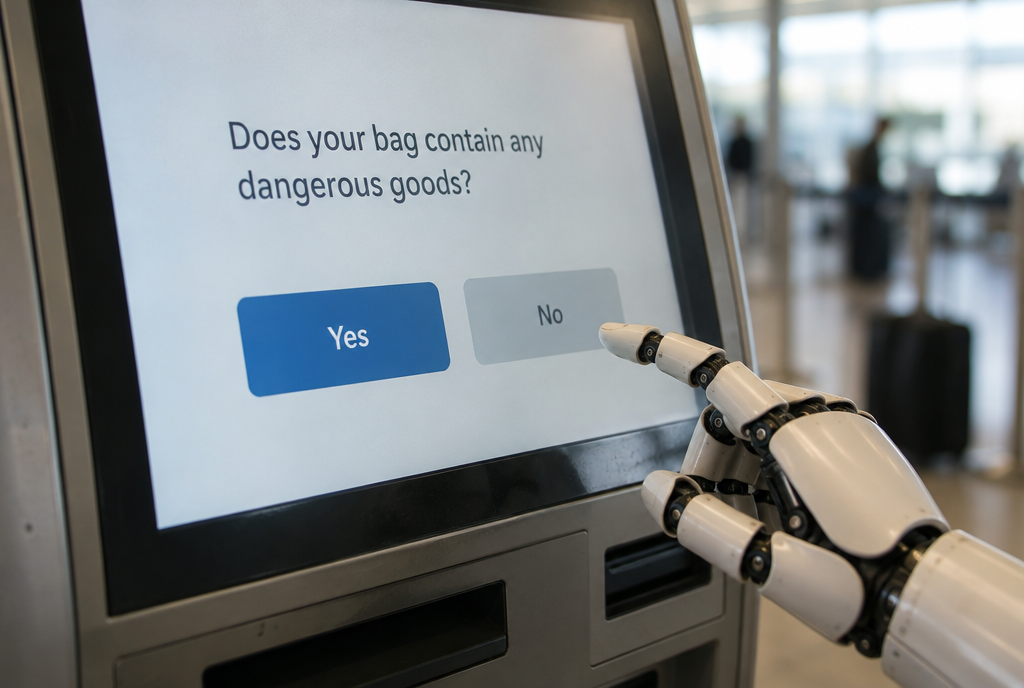
An AI agent cannot answer the dangerous materials question in your place
Except that, as Gary Leff, a widely followed American blogger on air travel, points out, these rules ask the passenger to confirm at check-in, not to click through every step of the purchase themselves. The argument holds for the kiosk, much less for the booking.
The real reason is the one the boss gave
And there, I had a good laugh. The day before the announcement, at an industry event in Chicago, United's boss, Scott Kirby, let slip to the Wall Street Journal: “To be honest, I don't want to create one more intermediary.” There. That says it all.
For an airline, a customer who comes to buy on its website is gold. It knows their habits, offers them an upgrade, an extra suitcase, a credit card in its colors. If tomorrow it's your AI assistant doing the buying, the airline is no longer talking to you, it's talking to a robot that coldly compares everyone's prices. And that robot belongs to OpenAI, Google or Meta.
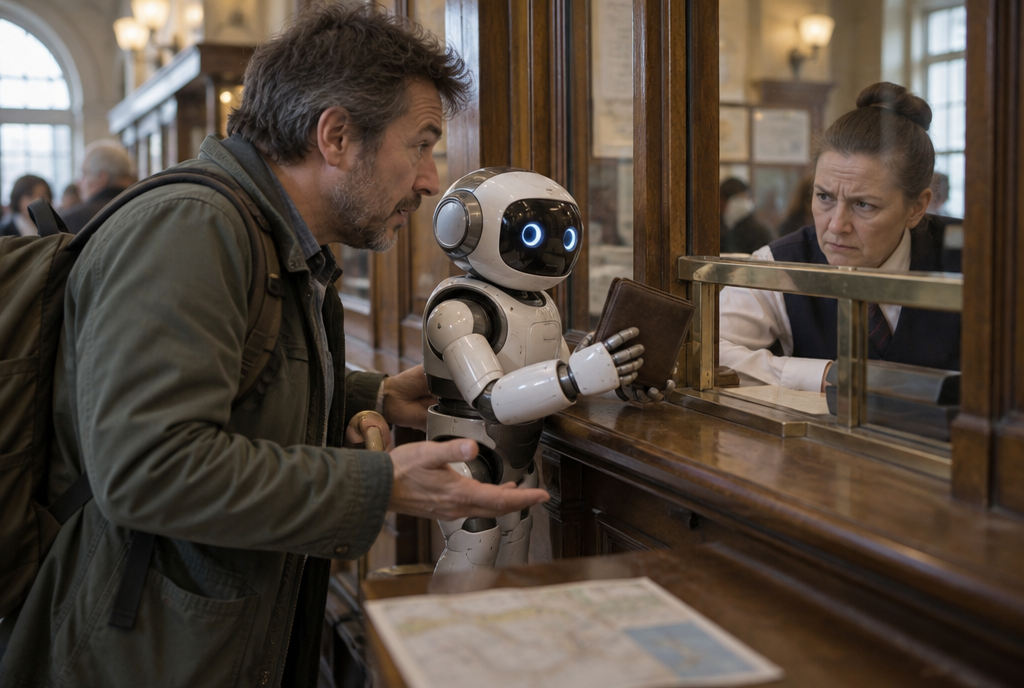
The “middleman” United's boss does not want to see show up
This isn't the first time the companies have fought to keep the customer, either. In 2001, United was one of the major American airlines that jointly created the Orbitz website, precisely so they wouldn't let Expedia and its ilk become the only online travel counters. Twenty-five years later, it's the same fight, with a new middleman.
And does this ban work?
United says that its systems already know how to distinguish a booking made by a human, by a traditional agency or by an AI agent, and that it is seeing very few of them for now. Gary Leff doesn't believe it. If an agent books on Expedia, United sees an Expedia booking come in, period. It doesn't know who clicked. A rule written into a contract is not a technical wall.
And United isn't alone. The banks got the ball rolling, I told you a few weeks ago how the big banks were already shutting the door on AI agents. And a month ago, according to the American financial press, JPMorgan Chase in turn banned outside agents from acting in its customers' accounts. By contrast, American Airlines already lets certain agents buy tickets through partners. And Visa is working on a way for merchants to recognize authorized agents, a sort of official badge for buying robots.
What does this mean for you, concretely?
If you ever travel to the United States on United, here's what changes. Ask your assistant to compare, find the best time, warn you when the price drops: no problem. But for payment, changing the ticket or checking in, do it yourself. It would be too stupid to see your flight canceled because a robot clicked in your place.
And one reflex to keep everywhere, not just at United: never give the password for your bank account, your airline account or your loyalty account to an AI assistant. If it has to act for you, let it go through an access method intended for that, not through your own login details.
My opinion? I understand the security argument, it is real. But when the boss himself says that the real problem is the middleman, we're no longer really talking about protecting the passenger. Me, the day my assistant finds me a cheaper flight than the airline's website and books it for me while I'm doing something else, I'm taking it. And I doubt that one line in a transportation contract will stop millions of people who want the same thing for very long.
In any case, the boss shouldn't install AI agents to handle certain jobs within his company, that would be unfair.
Sources
- TechCrunch, November 12, 2026: United Airlines blocks AI agents that book flights (in English)
- View from the Wing, November 11, 2026: the text of rule 6.J.6 and Scott Kirby's quote (in English)
- Yahoo Finance: United limits flight bookings by AI agents (in English)
Article written with the help of Claude Code, proofread and corrected by me.
Join the conversation
You need an account to comment on this article. Creating one is free and takes under a minute.
No comments yet.