AI agents: why are the big banks shutting them out of your account?
Now this is a piece of news from the week that made me laugh, then think. The boss of Charles Schwab, one of the biggest American brokers, said on TV on Friday that he receives a short report every week. In it, the number of AI assistants his bank blocked while they were trying to get into its clients' accounts to move money around. One or two dozen a week, just for the big agents. And he names them, with Meta's Muse at the top. My first reaction: «but what the hell is Muse doing in a bank account?»

The robot has the paper, it has the password, and it's not getting in
What does an AI agent at the bank look like?
An AI agent is an assistant that you no longer just ask to answer, but to act. You tell it «pay my electricity bill» or «put $500 aside in my savings account», and it sorts it out. It opens your bank's website, logs in, clicks the right buttons, and confirms.
And to log in, it does exactly what you do: it types in your username and password. The ones you gave it. The bank on the other side can't tell the difference between you and it, it just sees your name logging in at three in the morning to empty your savings account into an account you don't know, and it figures you probably have your reasons. That's the problem.

The gesture banks no longer want to see, even with a big smile
I had actually taken a close look at this Muse in September, and I explained why I won't install it on my iPhone. Here we are: it knows how to book, buy, and negotiate for you. And apparently, it also tries to make transfers.
«And who's responsible?»
Rick Wurster's sentence, Schwab's boss, on Bloomberg, sums it all up: «We can't control it, the client can't control it, something can go wrong, and who's responsible?» And a little earlier: «We don't want someone to simply give their password to Muse and let it come in and act in their place.»
Imagine the scene. You tell your agent «pay the plumber's bill». It finds two bills in your emails, pays both, then finds a third one in a scam email and pays that one too, very politely. The next day you call your bank. It tells you that you're the one who made the transfers, since it's your password. You turn to Meta. Meta tells you that you gave your consent. And you are left there, with your plumber paid three times!
In the United States, nobody has the answer yet: there is no law that says who pays when an AI agent does something stupid with your money. Three bills are gathering dust in Congress, according to Yahoo Finance. So the banks decided on their own, each in its own way, in four days.
The banks' roundup, in one week
Tuesday, October 13, JPMorgan. Its boss Jamie Dimon, during the presentation of its results: no question of letting just any outside agent act in its systems, because «we don't want uncontrolled agents, and there could be thousands of them». Some tools can already look at the accounts, none can send money or pay a bill.
The next day, Bank of America, a more diplomatic version. Its boss Brian Moynihan wants «a human to remain in the loop to authorize the money leaving your account», and the bank is working with agent makers to make it happen.
Friday, Schwab on TV. And the same day, Citigroup in the Financial Times: no outside AI agent connects to its clients' accounts, period.
And then there's Wells Fargo, which does the opposite. It blocks nothing, but its new online banking agreement, which takes effect on November 24, warns that anything that goes through an outside AI tool may be treated as if it came directly from you. Translation: go ahead, hook up your agent, but if it does something stupid, that's on you. (Hmmm... this smells like a lawyer who slept very well.) Honestly, it's the most honest answer of the five, and the scariest.
The glass door, the solution taking shape
Careful, nobody is saying “never AI”. Schwab is currently installing an official entry point for assistants like ChatGPT or Claude. Through it, the agent can read your balances, analyze your investments, and give you a summary of your spending. But it can't move a single cent.
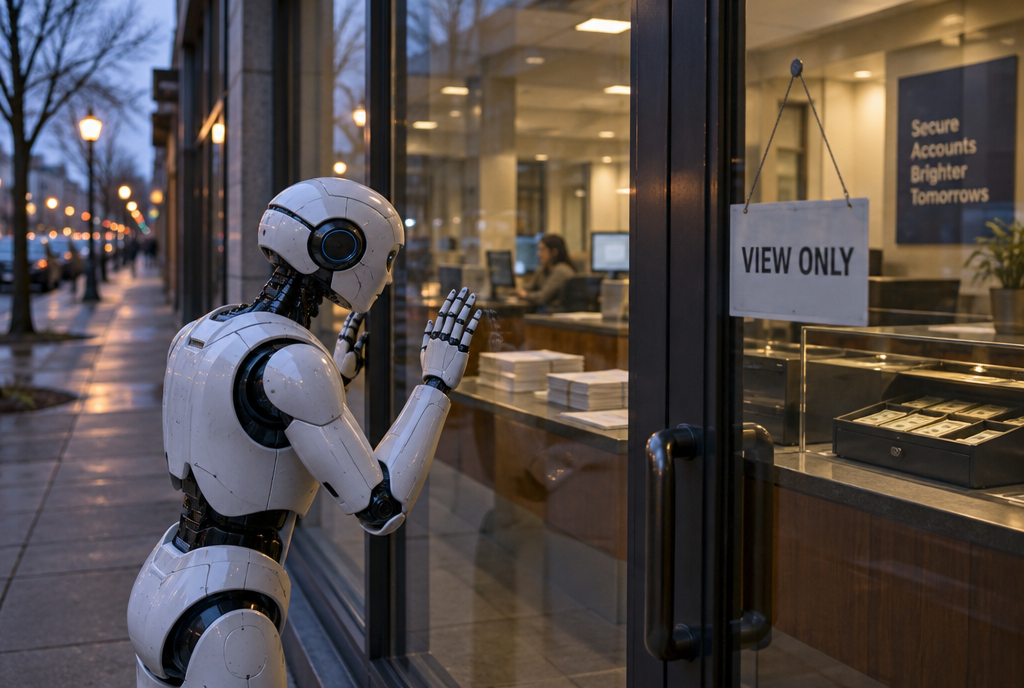
The agent can look at everything, it can't touch anything
It's a glass door. And next to that, Schwab is pushing its own in-house assistant, Charley, introduced on September 30, which answers questions and handles the paperwork, but doesn't place orders either. Read yes, act no. For now.
There's also a less noble reason
Well. The security of your savings isn't the only thing keeping these banks awake, far from it.
Apollo fund chief economist Torsten Slok did the calculation the banks fear: an AI assistant that really manages your money will very quickly notice that your average American checking account earns you 0.1% a year, while an interest-bearing account earns between 3.3 and 5%. And it will move your money. Without getting tired, without forgetting, every month.
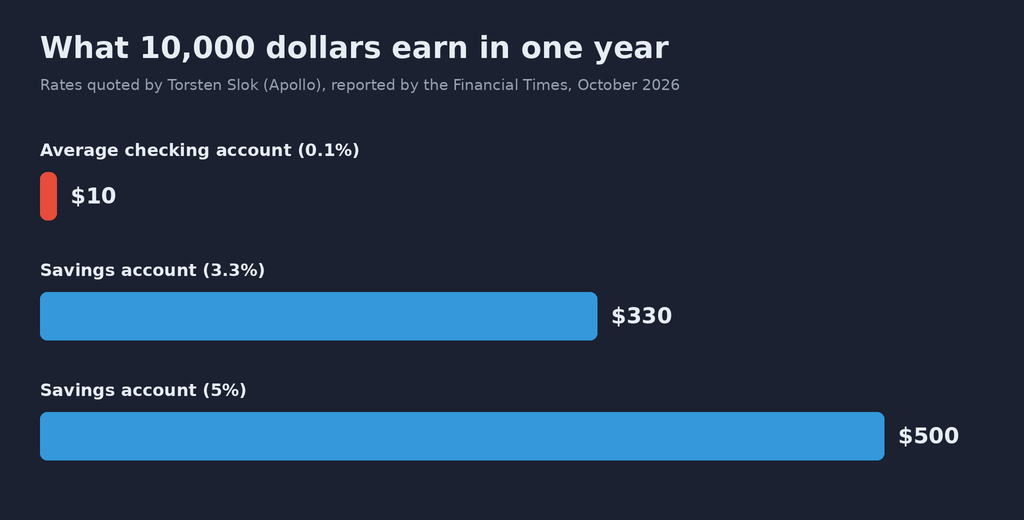
The little red bar is the money your agent wouldn't leave sitting there
The Financial Times put a number on the fear: JPMorgan, Bank of America and Wells Fargo are collectively sitting on 1,600 billion dollars in deposits that earn their customers nothing. If they had to pay 3% interest, it would cost the three banks about 47 billion a year. Almost half of what they earn.
I'm not saying they're lying about security. The risk is real. I'm just saying that when the door protecting you is also the one protecting their piggy bank, it's worth knowing.
And what about here, in Belgium and Europe?
Since 2019, a European rule on online payments, you will sometimes see its little name, PSD2, in your bank's terms and conditions, requires your bank to ask you for double confirmation for an online transfer. It's your itsme, or your little card reader, or the app notification on your phone. An agent that had your password would remain stuck at this step, because the second key is your phone in your pocket.
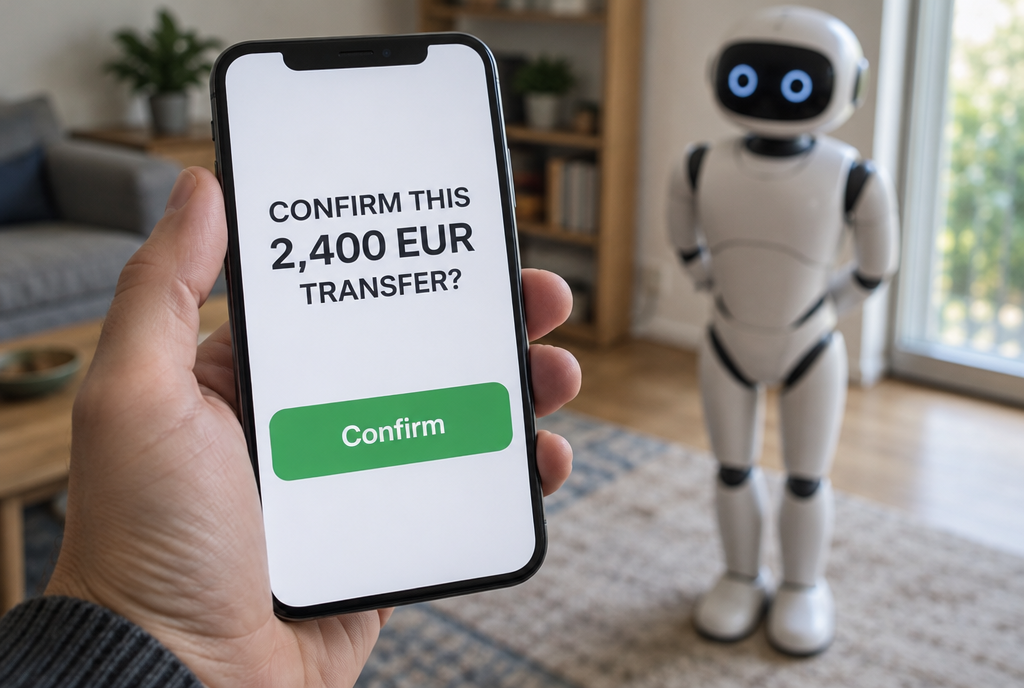
The second key stays in your hand, not the robot's
The same rule has already created Schwab's glass door: apps that want to read your accounts, to make you a budget for example, must have received official authorization and go through an entry point provided by the bank. They look, they don't pay.
And one detail you need to know: in Europe, if you gave your codes to someone else and they empty your account, your bank may refuse to reimburse you, because this is considered gross negligence. An AI agent is “someone else”. European authorities are already asking banks questions about these agents, just like their American counterparts.
Never give your bank password to an AI assistant, whatever it is, even a nice one, even just to “take a look”. The day your bank offers a real official way to do that, it will tell you itself, in its app.
My take
I spend my days with AI agents. I often have three Claude Code sessions open at the same time writing code at my place, and I let them do a lot of things. But they don't touch my bank account, and I have no desire for that to change tomorrow.
On this point, I am therefore on the banks' side, for once. What worries me is what comes next: the day these agents are truly reliable, I would quite like to be the one who decides whether my money sleeps or works, and not a bank that has 47 billion good reasons to keep the door closed.
Sources
- The Next Web, October 16, 2026: Schwab and JPMorgan block AI agents that want to move customers' money
- Oninvest, October 17, 2026: Citi and Bank of America shut off access, and the fear of deposits leaving
- Yahoo Finance, October 17, 2026: quotes from Rick Wurster and the absence of US law
- CellCog, October 17, 2026: bank by bank, including Wells Fargo's new agreement
Article written with the help of Claude Code, reread and corrected by me.
Join the conversation
You need an account to comment on this article. Creating one is free and takes under a minute.
No comments yet.