Crypto: Binance closes accounts in four European countries on December 31, and in Belgium?
If you have a Binance account in France, Spain, Italy or Poland, you may have received a not-so-nice email in the last few days. Your account will be closed on December 31, 2026, and starting November 29, Binance will charge fees every month on what's left in it. It confirmed this to specialist site CoinDesk on November 7: the affected accounts "will be closed as of December 31, 2026". And us, in Belgium? We're not on the list. Not yet, anyway.
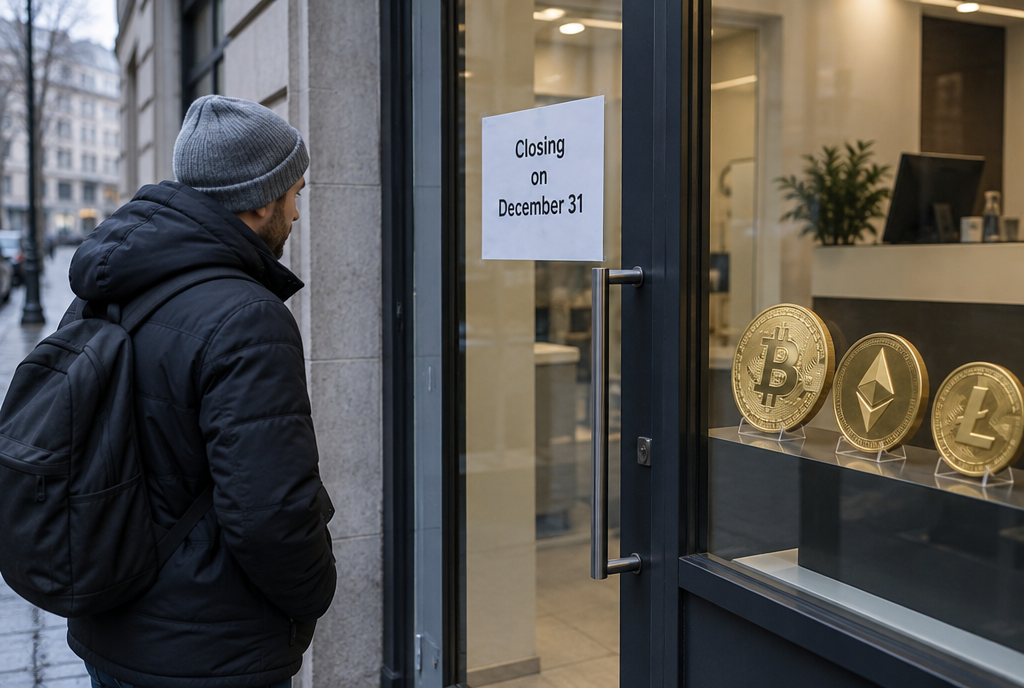
In four European countries, the door closes on December 31
Why is Binance shutting up shop in these countries?
It has nothing to do with the theft of $6.3 billion suffered by Binance on October 29: according to CoinDesk, the first emails to customers in these four countries date back to June. The reason is MiCA, the European regulation on cryptocurrencies. Since July 1, 2026, any platform that wants to serve European customers must have a license, a sort of permit to operate, issued by a country in the Union. One is enough, it applies throughout Europe. Except that Binance still doesn't have one.
It had filed its application in Greece, then withdrew it in June, announcing that it would try in another country, without saying which one. I told you two months ago that it was continuing to serve European customers despite everything. In France, its former national registration expired by itself on July 2, according to the French stock market watchdog, the AMF. The four countries concerned are those where Binance had a locally registered subsidiary before MiCA: that's where the cleanup is happening first.
Binance, for its part, says that its "commitment to Europe remains unchanged" and that it is moving toward getting its license. I think that's a shame for a platform that had the trust of a lot of people for years, myself included. But a permit is a permit.
The dates to remember, and the fees that sting
Since the email, you can no longer deposit anything into these accounts. On the other hand, you can still withdraw your crypto and euros, and Binance insists: nothing is frozen overnight. The schedule is as follows:
- on November 29, Binance calculates the fees for the first time, and deducts them within three days;
- after December 24, it calculates them a second time;
- on December 31, the accounts close.
The fees, as described in the Binance emails quoted by CoinDesk: 0.025% of what's left in the account, per month, with a minimum of 10 USDC. USDC is a digital token that's always worth one dollar, so basically, it's a minimum of 10 dollars per month. And it's this minimum that hurts. On $40,000, 0.025% is exactly 10 dollars, nothing dramatic. But on an old remainder of $100 forgotten in a corner, that's 10% that goes all at once. And if you have less than 10 dollars in the account, Binance takes everything. A storage fee that costs more than what's in the locker, you had to have some nerve!
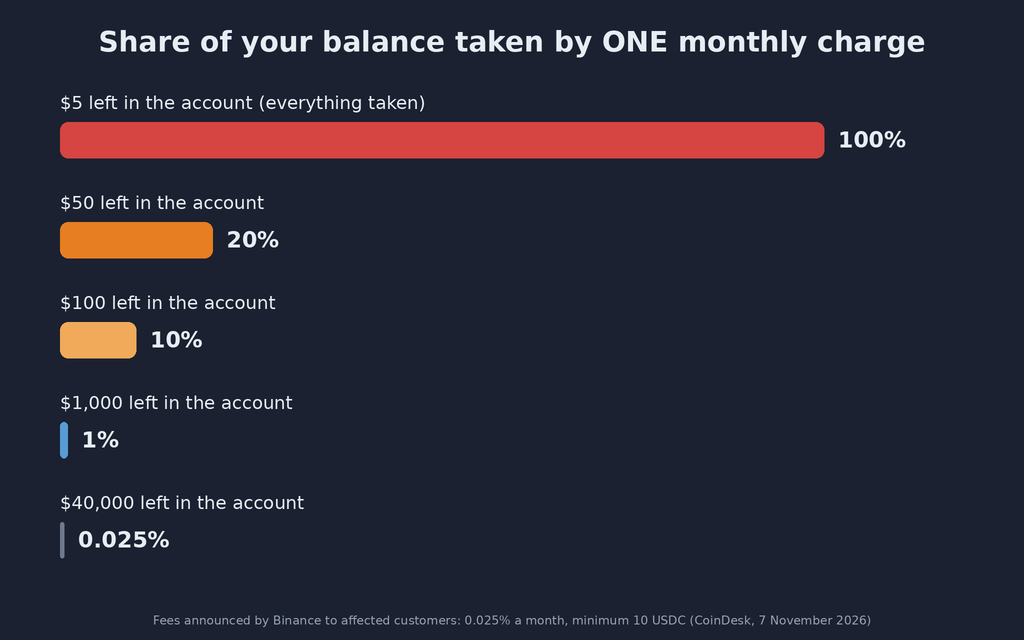
The smaller what's left is, the more the 10 USDC minimum eats into it
The fees are taken first from your USDC, then from your other crypto if there isn't enough. And what's left after December 31 comes under the inactive account rules: according to Binance's terms, your crypto can then be converted or transferred elsewhere, and recovering it may require additional checks. In short, you'd better not leave it lying around.
Whatever remains after December 31 falls under the inactive accounts regime
What about Belgium?
Belgium is in a situation somewhere in between. Since July 1, according to the CryptoAdventure website, Binance has already stopped new registrations, deposits and its savings products there, as in France, Italy, Spain, Poland and Sweden. Withdrawals still work. But neither Belgium nor Sweden appear in the closure emails reported so far: only the four countries mentioned have received a date.
Is this going to happen here? Nobody has announced it, and I'm not going to play fortune-teller. What is certain is that as long as Binance does not have MiCA authorisation, it is in principle not allowed to serve customers in the Union, including Belgium. If you have an account with them, keep an eye on your inbox, and not just the advertising folder.
You're affected, what do you do?
I'm not going to tell you what to do with your crypto, that's not my role. But here are the three exits that exist, and what they involve.
The first is to send it to another exchange platform that has MiCA authorisation. This can be checked: the European markets authority, ESMA, maintains a public register of authorised platforms. If a platform isn't on it, you know why you risk going through the same story again.
The second is to keep it yourself, on a hardware wallet: a small device that looks like a USB stick and keeps your crypto at home, outside any platform. You are the safe, but you are also the one responsible for the recovery phrase that lets you get everything back. If you lose it, nobody will be able to help you.

Before November 29, moving only costs the withdrawal fees
The third is to sell and withdraw your euros to your bank account. In all three cases, the withdrawal itself has a cost: every crypto transfer comes with network fees, and Binance has not announced that it would cover them. And if you sell, don't forget that the tax authorities in your country may have something to say about it.
What do I take away from all this? MiCA is no longer a text that you read diagonally: it is now really closing accounts. And I think there is a certain unfairness in seeing customers pay fees for a licence that the platform did not obtain. But the saddest thing will be those little $5 leftovers forgotten for years, which will disappear at the beginning of December without their owner realising it.
Sources
- CoinDesk, November 7, 2026: Binance asks its customers in four European countries to withdraw their crypto before the fees and closure (in English)
- crypto.news, November 8, 2026: details of the fees and closure schedule (in English)
- CryptoAdventure, July 1, 2026: Binance restricts registrations and deposits in six European countries, including Belgium (in English)
- ESMA: the MiCA regulation and the register of authorised providers
Article written with the help of Claude Code, proofread and corrected by me.
Join the conversation
You need an account to comment on this article. Creating one is free and takes under a minute.
No comments yet.