Crypto: Europe classifies USDC as an "important" token, what does that change for you?
On Wednesday, October 14, the European Banking Authority put USDC in a category no crypto had ever entered before. That of “important” tokens, the ones a European regulator comes to oversee itself, and not just the French watchdog. This is the first time among the 45 tokens of this type declared in Europe. And bizarrely, it's good news for anyone who holds it.

Someone is going to come and count the bills, and not just once in a blue moon
What exactly is USDC?
A digital dollar. You give a real dollar to an American company called Circle, it creates a token worth one dollar for you, and keeps your dollar aside in reserve. When you want your money, you give it the token back, and it gives you the dollar back. It's called a “stablecoin”, a crypto whose price doesn't move, as opposed to bitcoin, which goes up and down like a yo-yo.
What is it actually for? To park your money in crypto “dollars” without going back through the bank. You sold a crypto on a Sunday evening, you don't want to buy back right away: you stay in digital dollars, and you wait. It's the parking lot of the crypto world. USDC is the second of its kind, with around $73 billion in circulation according to data from specialized website The Block on October 15, far behind Tether's USDT and its $184 billion. USDT, for its part, has no European approval, and a few days ago I explained why European platforms have to get you to take it out before January 8. Circle, by contrast, took the necessary steps: its European subsidiary has been licensed in France since 2024.
The day the digital dollar was no longer worth a dollar
This whole surveillance business rests on a stupid question: what if the reserve wasn't there? We got the answer for real on March 11, 2023. That evening, Circle announced that $3.3 billion of its reserves, around one dollar in twelve, was stuck in an American bank that had just collapsed, Silicon Valley Bank. On Saturday morning, USDC was trading at around 87 cents on the Kraken platform, according to data from CoinDesk.
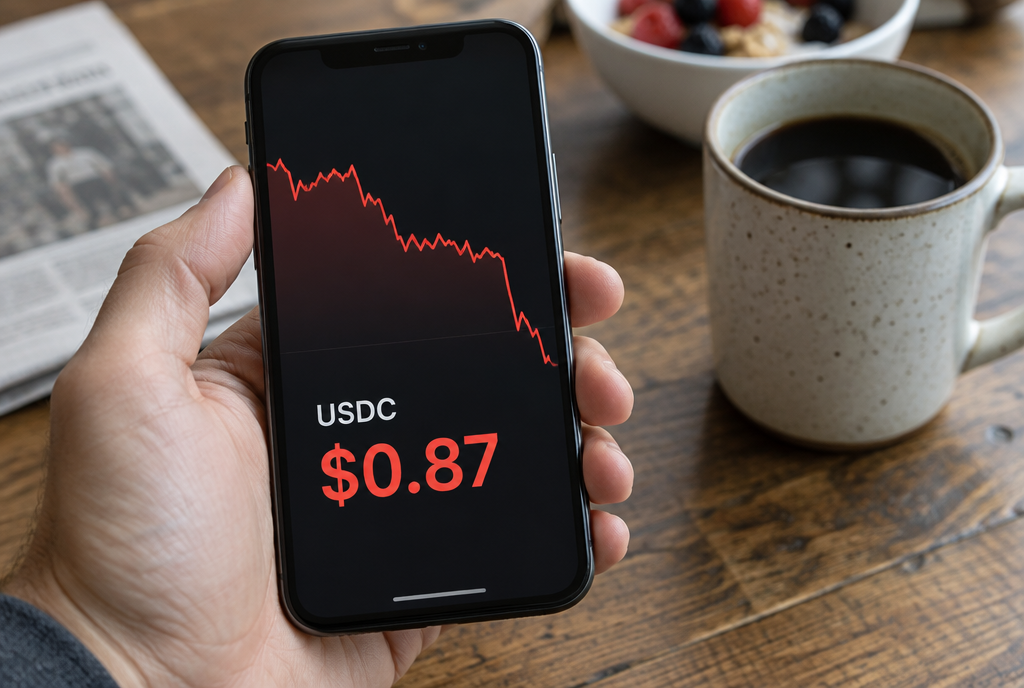
The Saturday morning wake-up call in March 2023. A dollar that's worth 87 cents is a dollar that no longer works
On Monday, the American government guaranteed all the bank's deposits, the money came back, and the token rose back to one dollar within a few days. Nobody lost anything in the end. But for two days, the parking lot where everyone leaves their money had lost an eighth of its value. That's exactly what the European rules are trying to avoid: not a spectacular bankruptcy, just the weekend when nobody knows anymore whether the reserve exists.
Why USDC and not another one?
Because it has become too big for its fall to go unnoticed. And that isn't an impression, it's a list. The European regulation on cryptos, called MiCA, lays out seven criteria in its article 43, and you only need to check three of them to move into the category above.
Three examples of these criteria, and you'll see that there's nothing mysterious about them: more than ten million people holding the token, more than five billion euros in circulation, or more than two and a half million transactions per day for a total exceeding 500 million euros. The other four are cut from the same cloth: circulation in several countries, links with the financial system, that sort of thing.
The European Banking Authority, abbreviated EBA, hasn't said which ones USDC checked off. Given the size of the beast, everyone can guess, but I would have liked to read the figures. The review takes place every year, and the other 44 tokens on the list go through exactly the same check: nobody is being singled out, the counter decides.
Two boxes of files changing offices
Here's what changes on November 12. Until now, it was the ACPR, the French watchdog for banks and insurance companies, that controlled everything at Circle, since its European subsidiary is French. From that date, the matter is split in two. Ironically, the two administrations are in the same city: the EBA has had its offices in Paris since Brexit.

Both authorities have their offices in Paris, but only one works for all 27 countries
The EBA takes over everything related to money: the company's own funds, that is, its own cushion in case of a hard blow, the reserve that guarantees the tokens, its ability to return the money quickly, and the plans in place to reimburse everyone if things go wrong. The ACPR keeps everything related to the company itself: who runs it, how it is organized, the subcontractors, conflicts of interest.
And the cushion is getting bigger. An ordinary issuer must hold own funds equal to 2% of what it keeps in reserve. For an “important” token, MiCA raises the bar to 3% in Article 45. On reserves of this size, that single percentage point represents several hundred million to be immobilized. Add an independent audit of the reserves every six months instead of once a year, regular stress tests, and the possibility for the EBA to demand even more if those tests go badly.
The EBA has also signed a cooperation agreement with New York State's financial regulator, where Circle issues its digital dollars on the American side. Two administrations promising each other that they will exchange information does not make a big headline, but it is exactly what was missing in 2023 to see the California bank's blow coming.
Okay, and what does that change for you?
If you have USDC on a European platform: nothing to do, no deadline, no message to wait for. It is the company that is being monitored, not you.
What you get is another pair of eyes on the reserve that guarantees your tokens. That's all, and it's already not bad. And there are two rights that MiCA gives you and that a lot of people don't know about: the issuer must reimburse you at any time, one token for one dollar, without charging you the slightest fee. In exchange, it is not allowed to pay you interest on it. A stablecoin is not a savings account, and it is written in the law.

The top line is good news. The bottom line is the one people forget
On the other hand, be careful not to confuse it with your bank account. In Belgium as elsewhere in Europe, your bank deposits are guaranteed up to 100,000 euros by the European deposit guarantee system if your bank goes under. A stablecoin, even monitored by the EBA, has nothing like that. What the rule guarantees is that someone checks that the reserve is there. Not that the state will reimburse you if it is not. Monitored does not mean guaranteed!
My opinion
Usually, regulatory news makes me yawn: three acronyms, two dates, and we forget. This one is actually useful. Think back to that weekend in March 2023: everyone was sending each other the screenshot of the plunging chart while wondering if it was the end, and nobody could answer, because nobody had the right to open the safe and take a look.
Now, someone has that right. We'll see what they do with it on the day it really matters, because a controller who only checks things in calm times is useless. And meanwhile, the other 44 tokens on the list are watching this from a distance and hoping very hard never to check three boxes!
Sources
- European Banking Authority, October 14, 2026: the EBA classifies USDC as the European Union's first significant e-money token
- The Block, October 15, 2026: the amounts in circulation and the agreement with the New York regulator
- Text of the MiCA regulation, Article 49: redemption at any time, at face value and without fees
- CoinDesk, March 11, 2023: USDC at 87 cents after the announcement of the $3.3 billion stuck at Silicon Valley Bank
Article written with the help of Claude Code, reviewed and corrected by me.
Join the conversation
You need an account to comment on this article. Creating one is free and takes under a minute.
No comments yet.