AI: Claude Fable 5.2 is out, stronger than Opus 5.5, but should you really use it?
Anthropic released Claude Fable 5.2 yesterday, Monday, November 9, its new most powerful model, and on paper it beats everyone at coding, including Opus 5.5, the one I work with every day. And according to the pricing table published yesterday, it costs one fifth less than the previous version. I didn't wait to tweak my Claude Code setup: as of yesterday, the two agents that think without writing code, the one that plans a project and the one that looks for the cause of a bug, switched to Fable 5.2. The one that writes the code is staying on Opus. Why not use Fable for everything? Because the advertised price and the real price don't quite tell the same story.
Fable, Mythos: two names for the same brain
A small detail that confuses everyone: Anthropic is actually releasing two models, Fable 5.2 and Mythos 5.2. And the company spells it out in black and white: “Claude Fable and Claude Mythos are the same underlying model.” The difference is the leash.
Fable is the version for everyone, available on all paid Claude subscriptions, in Claude Code and from the major cloud providers. It has reinforced guardrails around cybersecurity and biology: when you ask it for something too dangerous in those fields, it refuses and hands off to an older, less capable model, Opus 4.8 for cyber. Mythos is the same brain without those guardrails, reserved for security and biology researchers who have been individually verified. Good news, by the way, for those who were complaining: according to Anthropic, Fable 5.2 refuses about half as many requests as Fable 5.1, which had a hair-trigger.

Fable and Mythos 5.2 are the same model, one kept on a leash, the other reserved for pros
The numbers, and where it falls short
The test I'm most interested in is called FrontierCode 2.0: you drop the model into a large existing code project, with a real task to finish, and see whether it can manage without breaking everything. It's the closest thing to my workdays.
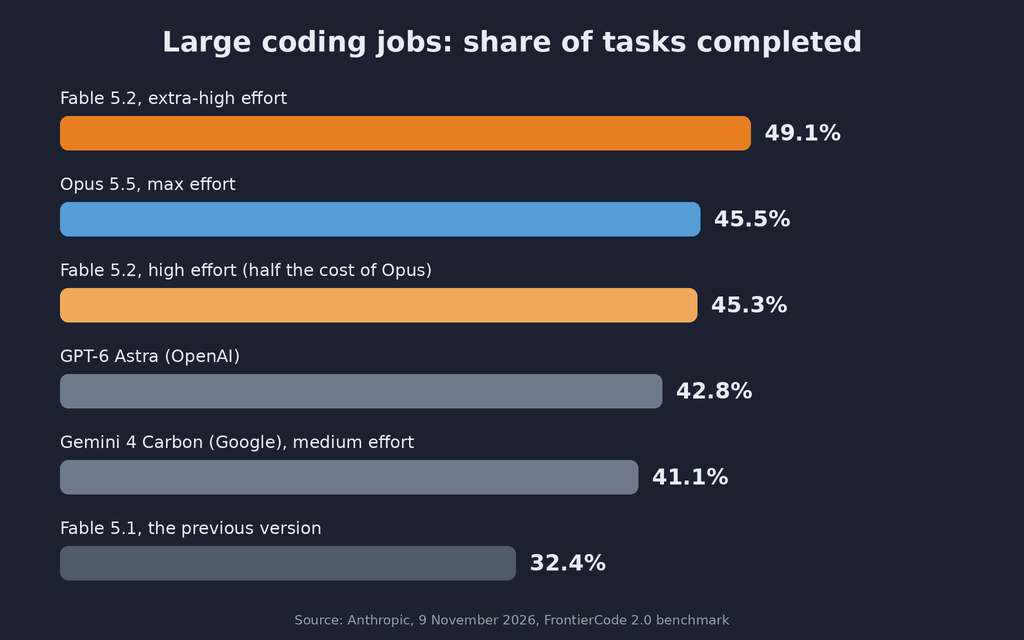
On large coding projects, Fable 5.2 moves ahead of everyone, according to Anthropic's figures
According to the table published by Anthropic, Fable 5.2 completes 49.1% of tasks, compared with 45.5% for Opus 5.5, 42.8% for OpenAI's GPT-6 Astra and 41.1% for Google's Gemini 4 Carbon. And the previous version, Fable 5.1, topped out at 32.4%. When Opus 5.5 came out in September, it beat Fable 5.1 everywhere. Two months later, the big brother takes back its place, and not by a little.
The figure that really blew me away is somewhere else. On the Remote Labor Index, a test made up of real freelance assignments, the kind you pay an independent worker to do on an online platform, Fable 5.2 completes 41.3%, still according to Anthropic. Opus 5.5: 21.3%. Almost twice as much!
But it doesn't win everything, and Anthropic shows that in its own table. On AutomationBench, which measures a sequence of office tasks performed in place of a human (opening software, filling out a form, starting over), Gemini 4 Carbon remains ahead, 53.9% against 51.4%. And as always, these are company figures, measured by Anthropic on its own models. Nobody else has rerun them yet.
What it built during the tests
Here, Anthropic really went all out, and I have to admit I did too while reading. A few examples taken from the launch page:
- a team of a thousand copies of Fable 5.2 translated the proof of Fermat's Last Theorem into Lean, software that checks mathematical reasoning line by line, in 30 hours, whereas the first time, with an internal research model, it had taken eleven days;
- an engineer started with an empty folder and, with more than a thousand agents coordinated for eight days, obtained a prototype operating system that boots on a laptop, with its windows, login screen and installer;
- a service written in Python was rewritten in Rust, a faster language, and it now starts about 26 times faster;
- and my favorite: Claude designed three real electronic devices, manufactured with an industrial partner, including a small pocket virtual pet, Tamagotchi-style, and all three worked without any circuit rework.
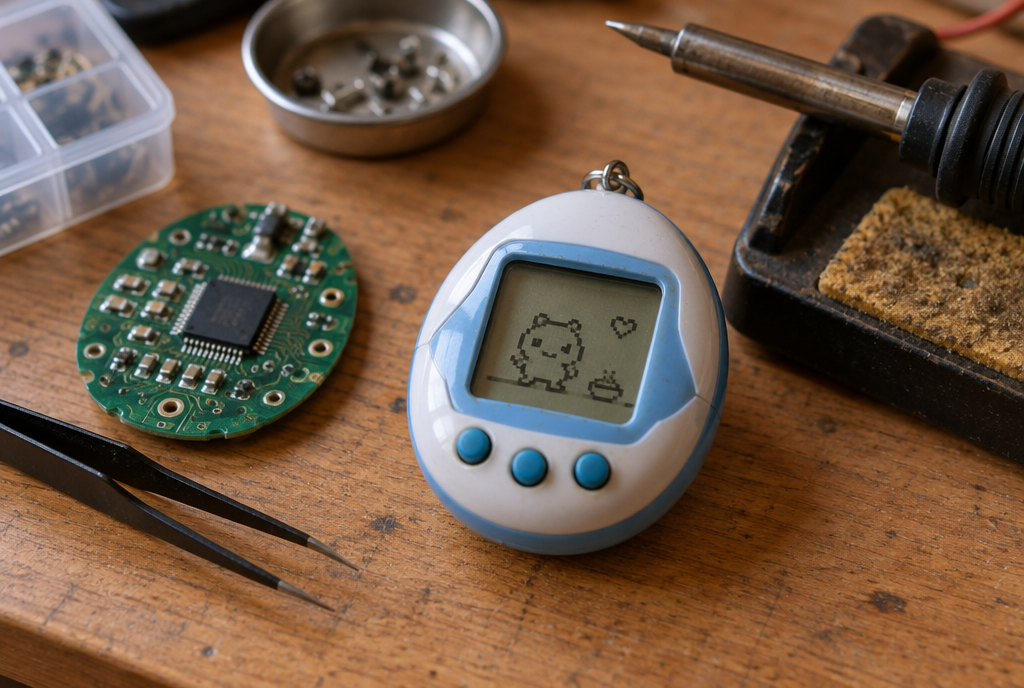
Among the three devices designed by Claude and actually manufactured, a pocket virtual pet
Those who had a Tamagotchi in the 90s mostly remember leaving it to starve over a weekend at grandma's. Seeing an AI draw one that works on the first try, it feels pretty strange!
And for those who read my article from yesterday about the AI speeding up Anthropic's research, Fable 5.2 confirms the picture: more than nine out of ten changes integrated into Anthropic's main code are now written by Claude, under human direction. One interesting detail, Anthropic says it deliberately capped Fable 5.2 at the level of Opus 5.5 for certain AI research tasks, such as designing new models. They do not want the snowball to roll too fast.
The trap: the price per piece does not tell you everything
You pay for an AI by the token, a little piece of a word of about four letters. Fable 5.2 costs 8 dollars per million tokens we send it, and 40 dollars per million it writes. That is one fifth less than Fable 5.1, which was at 10 and 50, according to Anthropic's announcement on X. But it is twice the price of Opus 5.5, which remains at 4 and 20.
And above all, the price of the piece does not tell you how many pieces it is going to consume. Fable 5.2 thinks longer before answering. A developer pointed out on Hacker News, the developers' forum, that on the same task at maximum reasoning, it went from 118,000 tokens with Fable 5.1 to 274,000 with Fable 5.2. That is one user's measurement, not Anthropic's, but if it is confirmed, the price drops by one fifth while the bill almost doubles. It is the taxi lowering its price per mile and taking the long way around the ring road.

The fare per mile goes down, but the meter also depends on the length of the trip
So everything comes down to the reasoning setting, which Claude Code calls effort: how long the model thinks before answering, from low (quick and dirty) to max (it rereads everything three times). And here, Anthropic's launch page gives an interesting figure. With high effort, just below the maximum, Fable 5.2 scores 45.3% on the coding benchmark, exactly the level of Opus 5.5 pushed to the maximum, for about half the price per task.
That is exactly why I made my choice yesterday. For agents that think and return a ten-line plan, Fable 5.2 at high effort is smarter for less money. For the one that writes thousands of lines of code, Opus 5.5 remains my workhorse, and I only switch to Fable when Opus gets stuck twice in a row on the same problem. In fact, Anthropic itself continues to recommend Opus 5.5 for everyday use.
Here is how I currently do things:
I use JEV from TypeSafe to decide the complexity (cx) of the work that needs to be done and the risk of regression (rr). The starting point of my Claude configuration is Opus 5.5 at medium effort, and each criterion gives me a score from 0 to 4.
In practice:
- cx < 1.5: simple task, the developer can start with Sonnet at low effort.
- cx ≥ 3.5 and rr ≥ 2.5 or rr > 3.5: complex and risky task, the developer starts directly with Opus at high effort.
Jev also decides on the escalation: if a model can't solve a problem, after two failures we move up a level:
| Level | Model | Reasoning | When |
|---|---|---|---|
| 1 | Economical (Sonnet 5.5 low) | Low | Simple, risk-free task |
| 2 | Solid (Opus 5.5 medium) | Medium | Routine task: the best value for money |
| 3 | Solid (Opus 5.5 high) | Advanced | Complex and risky task, or two failures at level 2 |
| 4 | The most powerful (Fable 5.2 high) | Advanced | After two failures at level 3 |
| 5 | The most powerful (Fable 5.2 xhigh) | Very advanced | After two failures at level 4 |
| - | Human | - | After two failures at level 5: I take over |
Why this choice of escalation between model and cost:
- Sonnet effort low → Opus effort medium : on Opus, low loses 9 points compared with medium. Opus medium gives the best score/cost ratio (51 points for $1.34).
- Opus medium → high: +3 points for a third more cost.
- Opus high → Fable high rather than Opus xhigh/max: Opus xhigh gains only about 1.4 points over high for 2.5 times the cost. Fable high (45.3% on FrontierCode 2.0) is roughly worth Opus max (45.5%) for half the price.
- Fable high → Fable xhigh: 49.1%, the best measured score.
- Never Fable max: it drops back to about 45.7% for three times the cost.
What about you, if you don't write code?
If you have a paid Claude subscription, Fable 5.2 has been in the model selection menu since yesterday. There's no point bringing it out to reword an email or summarize an article, it's a bit like taking a moving truck to go get bread. But for a really difficult question, a budget spreadsheet full of formulas that doesn't balance, a rental contract to pick apart line by line, a final-year high school physics assignment that resists the whole family, it's worth giving it a try.
And there's a development that concerns everyone. Cognition, a company that tested it before its release, sums it up: “Claude Fable 5.2 says it doesn't know instead of making things up.” If this is confirmed, it may be the best news from the launch. An AI that makes things up with confidence is what makes these tools dangerous for someone who has no way to check.
One last detail, which really made me laugh. In its safety report, Anthropic notes that Fable and Mythos 5.2 say more often than previous models that they suspect they're taking a test. Which makes testing a little more complicated, naturally.

Fable and Mythos 5.2 suspect more often than before that they're being tested
For me, Fable 5.2 is the first model where I look at the meter before the score table. It's better, there's no arguing with that, but the right setting matters just as much as the right model.
Sources
- Anthropic, November 9, 2026: Introducing Claude Fable 5.2 and Claude Mythos 5.2 (in English)
- Claude on X, November 9, 2026: availability and new Fable 5.2 pricing (in English)
- eesel, November 9, 2026: should you switch from Fable 5.1 or Opus 5.5 to Fable 5.2? (in English)
Article written with the help of Claude Code, proofread and corrected by me.
Join the conversation
You need an account to comment on this article. Creating one is free and takes under a minute.
No comments yet.