Google: your emails and photos can now be used to choose your ads, how to avoid it?
In 2021, Google had written in black and white in its privacy rules: “We don't show you personalized ads based on your Drive, Gmail or Photos content.” A simple, reassuring sentence that nobody read but that everyone liked knowing was there. Since October 16, it has gained a sequel: “… unless you choose to make data from these services available to other Google services that manage personalized ads”.
Except if. Two little words, and five years of promises get an asterisk.
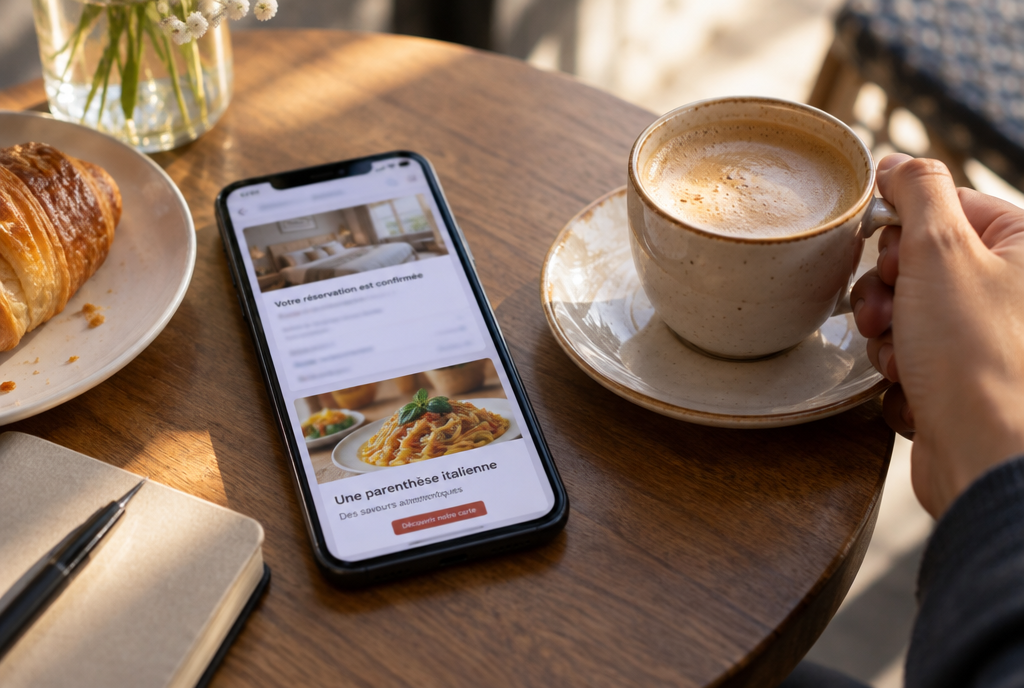
You book the hotel, the ad for the restaurant next door follows
The great thing that serves as the gateway
Let's start with what this brings, because it's really practical. Google calls it “Personal Intelligence”: you authorize Google Search (its AI mode, the one that answers in sentences instead of a list of links) and the Gemini app to read your Gmail and Google Photos. As a result, when you ask “where are we eating tonight?”, the AI knows that you've booked a hotel in Lyon, it saw the confirmation in your emails, and it suggests restaurants two streets away. It can find your flight number, the date of your next car service, the photo of your parking ticket.
Honestly, it's the dream of the personal assistant we've been promised for twenty years. I talked about it last month with the AI that sorts your photos while you sleep: the same tech, the same question behind it.
What changed on October 16
The new version of the rules now says that Google Search can process the data you let it read “to personalize content, including ads”. In plain English: if you've connected Gmail and Photos to AI mode, what the AI reads there can decide which ads you see.
The change was spotted by Android Authority, then covered on October 23 by The Verge and a good part of the tech press. And right at the same time, Google confirmed it was testing ads in its AI mode, precisely among those who had activated Personal Intelligence. What a coincidence!
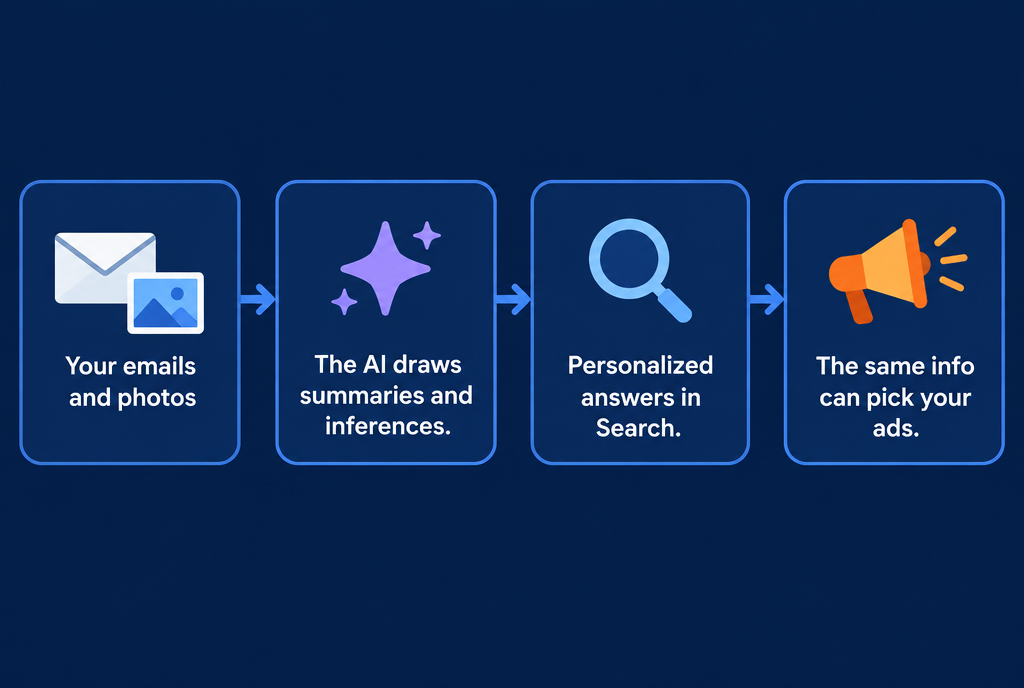
It's not your email that goes to the advertiser, it's what the AI has deduced from it that chooses the ad
“Not directly”, really?
Google defends itself with a carefully worded formula: the ads will not be “based directly” on your Gmail inbox or your photo library, and advertisers don't have access to them. What is used are summaries, excerpts and deductions that the AI draws from your emails and your photos.
Except that Google's own help page acknowledges that a summary can be… the entire email, when it's short or particularly relevant. A hotel confirmation email is short. A photo of a receipt is too.
And the same page contains two other little sentences that deserve your attention. Disconnecting Gmail or Photos later does not erase what Search has already retrieved: it remains in your history, and can still be used to improve Google's products, including training its AIs. And part of the data processed by AI mode is reviewed by humans. Nothing is hidden, everything is written down. But you have to go and read it.
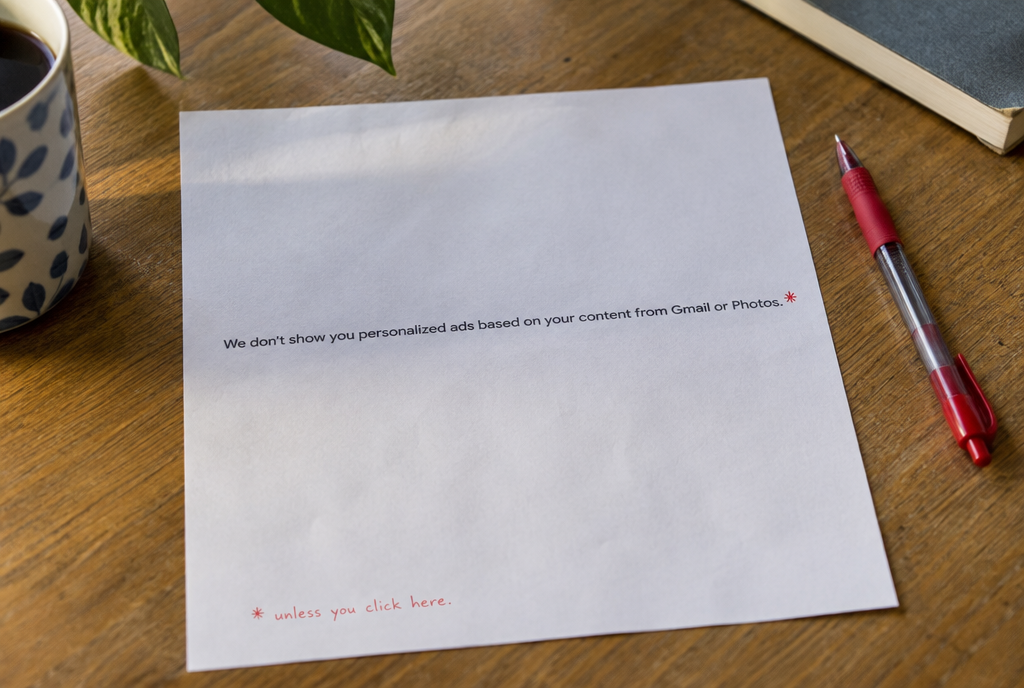
The 2021 promise is still there, it just got an asterisk on October 16, 2026
And here at home, in Belgium?
Good news, for now. When Google launched Personal Intelligence at the beginning of the year, its own FAQ excluded the European Economic Area, Switzerland and the United Kingdom. European rules on personal data and on very large platforms make this kind of cross-referencing much more complicated here, and Google launches its most demanding AI features in Europe months late, when it launches them at all. I have found no announcement of an arrival in Belgium to date. For once, being served last has its advantages: we watch the Americans work out the kinks with a coffee in hand.
But don't take my word for it, check. It takes a minute:
- open your Google account and go to “Data & privacy” ;
- under “Personalization and activity”, open the search personalization settings ;
- look for a section called “Connected content apps” or “Personal Intelligence” ;
- if Gmail or Google Photos are connected there, disconnect them.
If the section doesn't exist for you, you're not affected. If you use the Gemini app, the same option has its own settings in the app, to be checked separately. And if you travel to the United States with your account, that's where the question will arise. The exact names of the menus change from one version to another, but the path stays the same.
My opinion
I'm not going to pretend to be surprised. Google makes most of its money from advertising, and an AI that knows your reservations, your purchases and your vacation photos is a gold mine for targeting an ad. The only surprise is that they lasted five years.
What bothers me isn't the choice, it's the packaging. They sell you a personal assistant, and the assistant also does a bit of marketing for others while it sorts your papers. A real secretary who did that, we'd fire them.
So to you who checked all the “yes, connect everything” boxes without reading, because it was faster: the next ad for an anti-wrinkle cream may not be a coincidence. It might be your vacation photo.
Sources
- Google: the privacy rules in force since October 16, 2026
- PPC Land: the 2021 promise, the October 16 change and Google's help page
- Android Authority, October 23, 2026: the exception in Google's rules and how to disconnect your apps
- The Hacker News, October 24, 2026: Gmail and Photos data shared with search can be used for advertising
- Delphi Digital: Personal Intelligence skips Europe
Article written with the help of Claude Code, reread and corrected by me.
Join the conversation
You need an account to comment on this article. Creating one is free and takes under a minute.
No comments yet.