Quantum: Google offers $150,000 to whoever can slim down its programs, and AI is allowed to participate
Google has put $150,000 on the table, and for once you're not being asked to build a quantum computer. You're being asked to slim down its programs. The competition is called "Verifiable Quantum Circuit Compilation", it opened on October 22 on Kaggle, the programming competition site owned by Google, and you have until January 20, 2027 to take part. And the best part: Google encourages you to have an AI do the work.
So naturally, I wanted to understand what there was to win. And not just the $50,000 first prize.
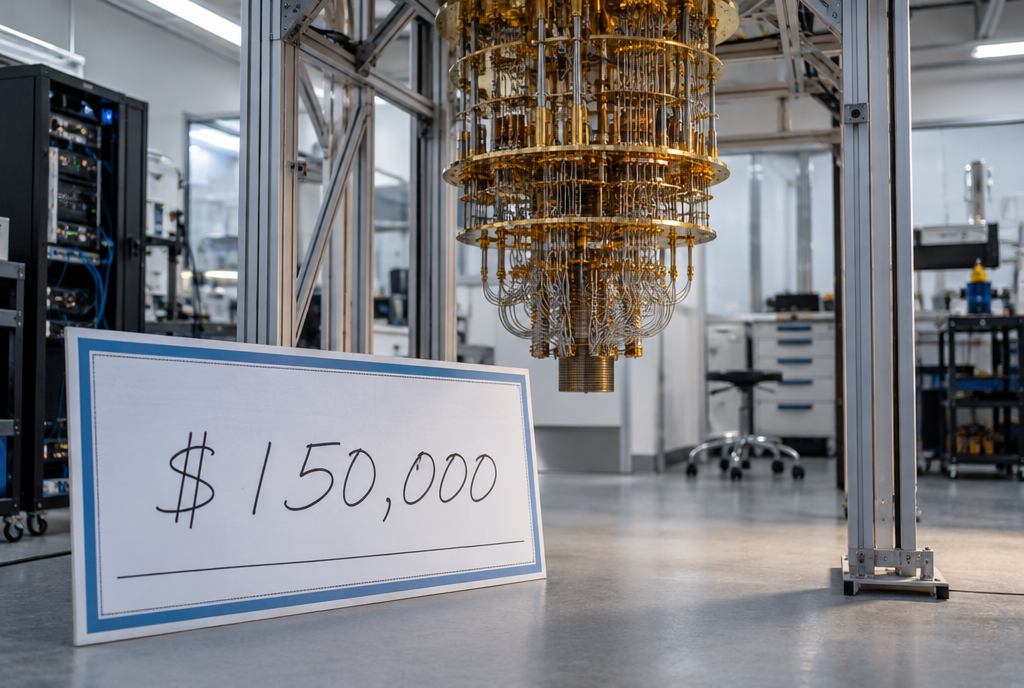
The first prize is worth $50,000, and the giant check isn't provided
Why slim down a quantum program?
A quantum computer computes with "qubits", very special bits that can explore several possibilities at once. The problem is, they're fragile. The slightest breath of heat or noise makes them get things wrong. To correct these errors, you need a correction system that costs a fortune: each useful qubit uses hundreds, even thousands, of others to watch over it. I told you last week how Google had just divided the errors of a key part of this system by 40.
As a result, a quantum program is paid for by the number of qubits it uses and the number of operations it chains together (the "gates", the quantum equivalent of an instruction). Each qubit removed and each gate removed lowers the bar that the machine has to clear. Google spells it out in its announcement: programs have to be compressed so that useful applications arrive sooner.
Do you remember MP3? Nobody had a hard drive big enough to store their music collection in CD quality. We didn't wait for big drives: we compressed the music, and hundreds of songs fit into a player as big as a deck of cards. It's the same here. Rather than waiting for the giant machine, we shrink the program so that it fits on a smaller machine.
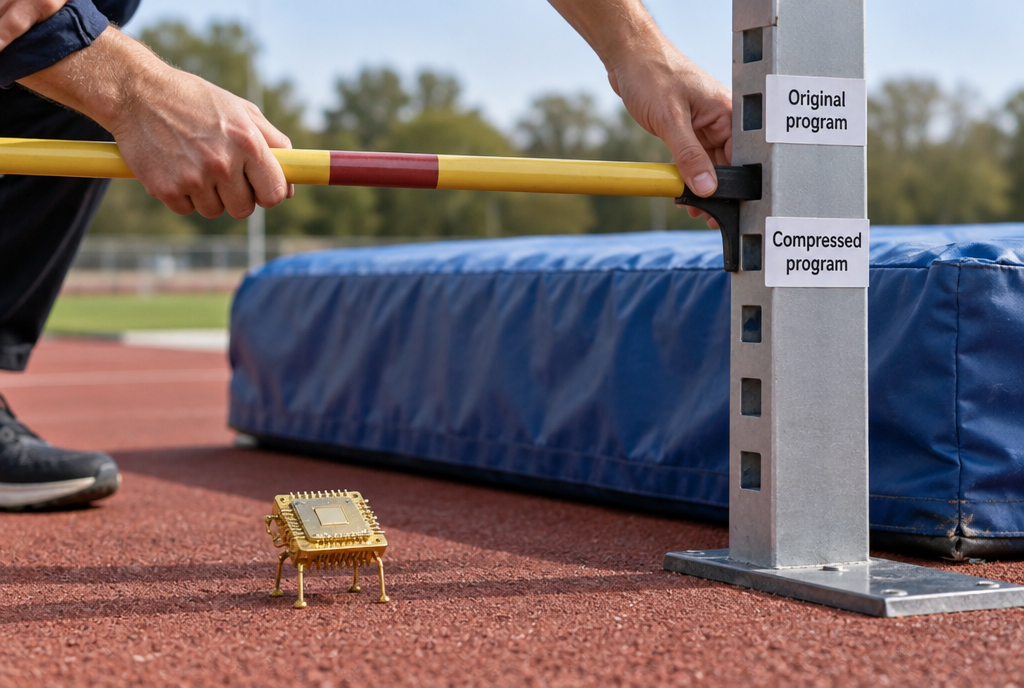
Each operation removed is one notch lower for the machine
Three exercises, including one with a whiff of Quake III
The competition offers three pieces of program to compress, each taken from a real problem.
The first comes from nuclear fusion, that energy researchers dream of producing by imitating the Sun. To simulate a plasma, you have to calculate an inverse square root in a loop, one over the square root of x. And the geek sleeping inside me smiled, because the "fast inverse square root" is the name of the most famous programming trick in the history of video games: the one from Quake III, in 1999, with its baffling magic constant and its developer comment that became legendary. Twenty-seven years later, Google is asking for its quantum version.
The second is an optimization problem, finding the best solution among billions. You have to decode a Reed-Solomon code. It sounds barbaric, but you use it every day: it's the technique that lets a damaged QR code or a scratched CD still be read.
The third is fertilizer chemistry. Yes, fertilizer. We'll come back to it below, because this is the one that ends up on your plate.
For each exercise, Google provides a starting program and a verifier. You propose a shorter version, the verifier checks that it still gives the right result, and you score points according to the number of qubits and gates you saved. It's all open source, under the Apache 2.0 license, so anyone can reuse it.
How do you verify a quantum program without a quantum computer?
That's the real trick of the contest. Normally, simulating a quantum program on a classical computer becomes impossible beyond around forty qubits. But the pieces chosen by Google have one particular feature: they behave like an ordinary calculator, one input gives one output, without ever mixing the possibilities. Your PC can therefore test them by sending them thousands of random inputs and checking every answer.
Google released a free tool for this, kickmix, which tests up to 60 billion operations per second on a single processor core, according to Google. To give you an idea, that's more than seven operations per second for every human being on Earth, with just one little bit of your PC. The only nuance, which Google itself acknowledges: random testing does not prove one hundred percent that two programs are identical. But most quantum calculations tolerate a small bounded error, so that's enough.
And that's exactly what makes the contest tailor-made for AI: an agent proposes a modification, the verifier answers yes or no within moments, the agent starts again. Thousands of times per hour, without ever getting tired.
Google already has the answer, in a sealed envelope
A tasty little detail. Internally, Google set its own Gemini models loose on the three exercises, and they beat the best results published so far, on all three. But Google is not showing its programs. It has only published their digital fingerprint, a “hash”, a kind of unique barcode calculated from the file. It is impossible to recover the program from this barcode, but it is also impossible to cheat afterward: at the end of the contest, Google will reveal its circuits, and anyone will be able to check that they do indeed match the fingerprint published today.
That's the sealed envelope at the notary's office, 2026 version. Google is basically saying: we've already done better than everyone else, let's see if you can do better than us. That's called having confidence in yourself!

Google has published the fingerprint of its circuits, it will not reveal them until after the end of the contest
Okay, and what good will it do for you?
Let's take the chemistry exercise, because that's the one that ends up in your shopping cart. FeMoCo is the little metal heart of an enzyme that certain bacteria use to make fertilizer from the air, at room temperature, in the roots of peas and clover. We, to do the same thing at the factory, heat it to more than 400 degrees under enormous pressure, and this process alone gobbles up one or two units out of every hundred of all the energy produced on the planet, according to an editorial in the journal Nature Synthesis published in 2023. Understanding how the bacterium does it is the dream of cheaper, less energy-hungry fertilizer, and therefore, in the long run, your baguette and your vegetables.
Same thing for fusion: if it works one day, that's clean electricity on your bill. And optimization is the delivery truck that drives fewer miles to bring your package to you.
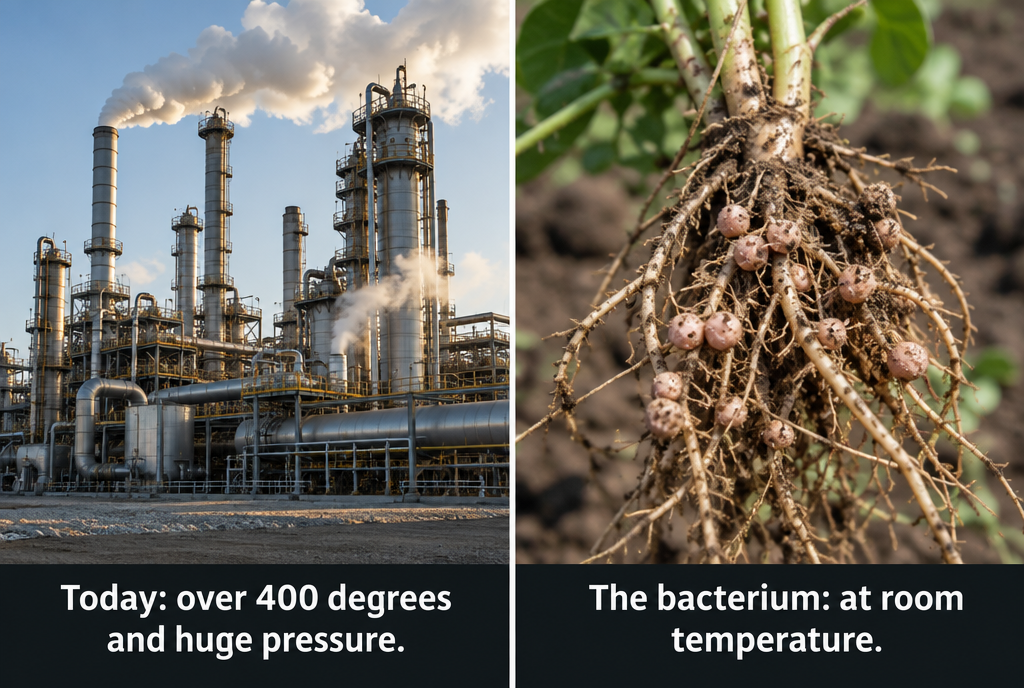
What a bacterium does in a pea root, our factories do at more than 400 degrees
Now, the honest part. No current quantum computer knows how to run these calculations. We will need much bigger and much more reliable machines, and that will take years, maybe decades, and there is no guarantee that it will ever be profitable. The contest is not bringing tomorrow morning's miracle fertilizer any closer. It is bringing closer the day when the machine will be good enough, by lowering the bar it has to clear.
We've already seen this movie. The laser, in 1960, was called “a solution looking for a problem”. Today it reads the barcodes on your groceries at the checkout and carries the Internet through fiber. And these same compression techniques are also useful in the other direction: it is with calculations of this kind that researchers estimate how many qubits would be needed to threaten your bitcoins one day.
What I like about this competition is that, for once, quantum computing isn't happening in a multimillion-dollar lab with a fridge at minus 273 degrees. It's happening on a PC, with a good AI agent and a bit of persistence. And I'm not going to lie, the idea of letting Claude Code loose on it for a weekend has been on my mind. See you on January 20, when Google opens its envelope: we'll see who, Gemini or humans armed with their AIs, has written the shortest program!
Sources
- Google Open Source Blog, October 21, 2026: the announcement of the competition by Tanuj Khattar and Ryan Babbush
- Kaggle: the competition page, its rules and dates
- Nature Synthesis, 2023: the share of global energy consumed by fertilizer production
- arXiv: Google's scientific paper accompanying the competition
- The Quantum Insider, October 23, 2026: the details of the prizes and the three exercises
- Quantum Computing Report: kickmix and circuit verification
Article written with the help of Claude Code, proofread and corrected by me.
Join the conversation
You need an account to comment on this article. Creating one is free and takes under a minute.
No comments yet.