Layoffs: Barclays cuts 5,000 jobs and cites AI, are developers next?
On October 1, Anthropic proudly announced that the British bank Barclays was going to equip half of its developers with Claude Code by the end of the year. Claude Code is the assistant that writes code for you while you explain what you want, the one I've had open on my screen from morning to night. Three weeks later, on October 22, the same bank announced 5,000 job cuts. And among them, its chief financial officer explicitly cited “fewer developers, because AI makes our teams more productive.”
Three weeks between “we're giving you a great tool” and “we need fewer of you.” I checked the dates twice. They're right.

The box arrived before the end of the year
One person in twenty
The figures first, as Barclays gave them with its third-quarter results. Around 5,000 full-time positions are disappearing this year, out of some 93,000 employees worldwide. That's 5%, one person in twenty. A thousand have already left in the first half of the year, the other 4,000 are due to follow by December, subject to consultation with employee representatives. And six out of ten come from “support functions”, meaning everything that keeps the bank running without dealing with customers: IT, human resources, compliance. The developers are included.
How many exactly? A mystery. The bank gave no figure for developers alone. We just know they're mentioned, in so many words, on the results slide.
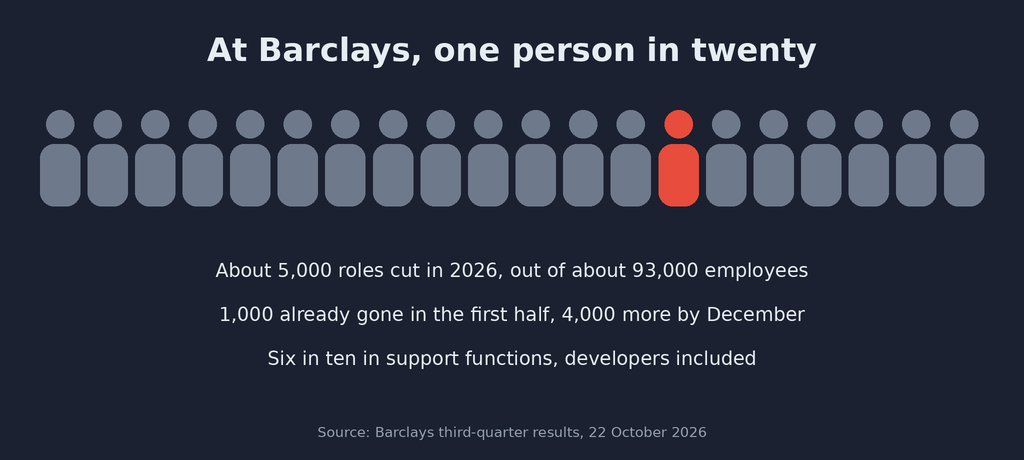
5%, on paper that doesn't seem like much, in an office of twenty it's your neighbor
“The cherry, not the cake”
Where it gets interesting is that the bank's boss, C.S. Venkatakrishnan, spent his conference playing down the role of AI. To him, AI is “the cherry on the cake, not the cake”. The cake is years spent modernizing the bank's old IT systems and simplifying its organization. Without that, he says, AI is useless.
And frankly, I believe him on that point. A bank that's still running on programs written thirty years ago gains nothing by plugging Claude into them. You have to redo the plumbing first. A professor at the University of Warwick, Carsten Maple, says the same thing: blaming AI for the 5,000 positions would be false, the bank is carrying out a broad cost-cutting and modernization plan. But he adds something that, to me, stings more: until now we thought AI would mainly replace repetitive tasks and entry-level positions, and we're now seeing specialized jobs like development getting hit too. Barclays is also aiming for more than £2 billion in savings between 2026 and 2028.
The Unite union sees things differently: to them AI is an excuse, and the bank is thinking short term by treating its employees like disposable parts. One small detail that doesn't help contradict them: the same day, Barclays announced a 12% rise in quarterly profit, to £2.3 billion, and £500 million to buy back its own shares, a way of returning money to shareholders.

According to Barclays' boss, AI is only the cherry: the cake is years of IT modernization
What the bank puts on the other side of the scales
Because there is also a part of the announcement that nobody picks up in the headlines. Barclays promises around £150 million by 2030 to train its employees for new jobs, and says it wants to fill its vacancies internally before recruiting from outside. Someone whose job disappears will therefore be able to apply elsewhere in the company.
And above all, the bank is keeping 2,800 places in 2027 for beginners: young graduates, apprentices, interns. That is genuinely good news. I was saying four days ago that Anthropic is barely hiring junior developers anymore, and that is exactly the trap: if nobody trains beginners anymore, there will be no seniors in ten years. Barclays, at least, is not cutting off the base of the pyramid.
And the next day, American Express
Friday, October 23, it is American Express joining in: 5% of its workforce worldwide, or around 3,500 to 3,800 people depending on which starting figure you use. Its chief financial officer, Christophe Le Caillec, says it plainly to CNBC: the aim is to make the company leaner and to “prepare for AI”, by removing levels of hierarchy so that it can automate in the coming quarters. And, as at Barclays, this is being announced alongside rising results.
Its boss, Stephen Squeri, did still have a reassuring sentence for his customers: no question of letting AI assistants “roam freely” through the bank’s systems, only approved agents will get through. Phew, your card will not be piloted by a mad robot. Just by a few fewer humans.
Two major financial institutions, two days in a row, the same 5%. We are starting to see the pattern.
Right, and what if you are a developer?
I have been coding for more than twenty-five years, and I am going to be honest: what strikes me in Barclays’ sentence is not “fewer developers”. It is “more productive”. When Claude Code writes in twenty minutes what used to take me a day, a company can do two things: deliver twice as many projects with the same team, or deliver the same projects with a team half the size. Barclays chose the second option. It was not the tool that chose.
So my advice, and I apply it to myself: the developer who is content to type the code he is told to type, that one is in danger. The one who knows what the client really wants, who rereads what the agent produces and spots the error before it goes into production, becomes more valuable instead. I talked about it last month: AI is far from being the only reason for layoffs in tech, but it has become the most convenient explanation to give shareholders.
And if you are not a developer? Then look at your bank. At Barclays, when a customer calls about a blocked card or a transfer that gets stuck, the adviser on the other end of the line is already reading the answers suggested by an assistant built on Claude: more than 16,000 employees use it, and they take care of more than 20 million customers in the United Kingdom, according to Anthropic. Tomorrow, the question will be whether there is still someone on the other end of the line, or only the assistant. American Express says, for that matter, that it wants to “automate in the coming quarters”. Concretely, get ready to type into a chat window more often and to wait a little longer on the day you want to speak to someone who knows your case.
Gentlemen bankers, one small question anyway: on the day Claude Code also does the work of your chief financial officers, will you announce it with the same slide?
Sources
- Banking Dive: Barclays is cutting 5,000 jobs this year, Anna Cross’s quote about developers
- CNBC, October 22, 2026: Barclays will cut 5,000 jobs in an AI-related efficiency plan
- Newsweek: £150 million in training, Carsten Maple’s view and Unite’s reaction
- Briefs, October 23, 2026: the internal memo, the 2,800 places for beginners and priority for internal candidates
- Quartz: the 5,000 jobs compared with the bank’s roughly 93,000 employees
- Anthropic, October 1, 2026: Barclays expands Claude and Claude Code to its teams
- CNBC, October 23, 2026: American Express cuts 5% of its workforce to “prepare for AI”
Article written with the help of Claude Code, reread and corrected by me.
Join the conversation
You need an account to comment on this article. Creating one is free and takes under a minute.
No comments yet.