Junior developers: why is Anthropic hardly hiring any more of them?
“An army of Claudes, and each one demanding my attention.” When I read this sentence from an Anthropic engineer, I thought: “but that's me!” It comes from a report that Anthropic published Friday about its own employees. Not about the job market in general, not about a consulting firm's study: about themselves, with their payslips, their schedules, their hires and the trace of everything their AIs have done. And in the middle of the good news, there's one figure that stings: young developers now account for only 9% of technical hires. They were 27%.

“An army of Claude, and each one demanding my attention”
First, what works
The productivity figures are a little dizzying. In March 2026, the combined working time of AI agents, those assistants you entrust with an entire task, exceeded for the first time that of the humans steering them. In August, it was six hours of agent time for one hour of employee time. Six to one! Each engineer records five times more code changes than six months ago.
And there, I was waiting for the classic trap: much more code, therefore much more crap. Wrong. Anthropic compared 192 engineers who started using agents with 74 who did not, and the code written by the AI is not deleted or reverted afterward any more often than the code the same person writes by hand. Same quality, in much greater quantity.
It doesn't just affect developers. Salespeople sign more contracts, lawyers review more of them, accounting processes more invoices. One salesperson says his automations have absorbed about a fifth of his old tasks and that he talks to 30% more clients. And non-technical people who started a coding session twice a month in August 2025 now start 90.
Then the painful figure
At the beginning of 2025, juniors, meaning developers and researchers at the start of their careers, made up 21% of Anthropic's technical teams. Today, 14%. And in hiring, the drop is even steeper: from 27% to 9%.
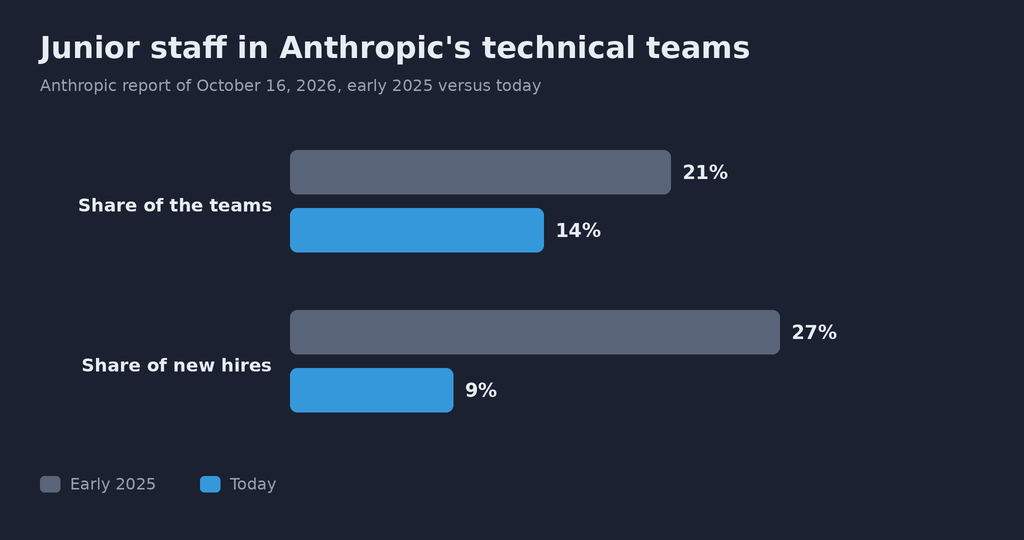
Fewer than one in ten technical hires is still a beginner
The company tripled in size in one year and the technical teams kept growing. What is falling is the share of beginners, not necessarily their number. But the trend is clear, and the report dates it precisely: people started talking about it in January 2026, and in April the engineering and research teams had slowed down on entry-level positions. One third of artificial intelligence managers and one fifth of developer managers say they are hiring less because of AI.
One engineer sums it up without mincing words: “overnight, it changed what we were looking for”.
I asked myself the question in August, in my article about the future of a developer with AI: seniors, yes, but with no juniors left at the base of the pyramid, what do we do in ten years? I would not have bet that the first company to answer me with figures would be the one making the tool.

The pyramid is holding. For now, the bottom is plastic
The real bottleneck is us
Claude sessions spend about 80% of their time waiting. Waiting for what? A human. To review, respond, validate. Reading everything the agents produce would take more than half the working week, even in teams that do not do technical work.
For me, it's three Claude Code sessions open at the same time, I jump from one to the next, and every time I come back to the first one, it's patiently waiting for me with a “I'm done, do you want me to continue?”. It finished ten minutes ago. I'm the one who's behind!
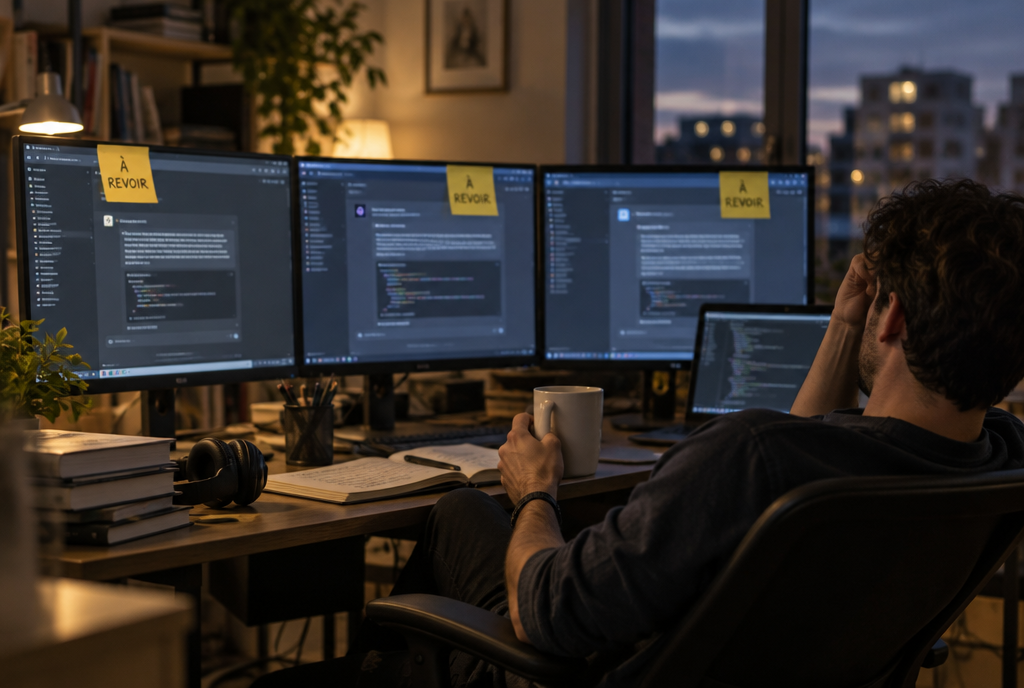
Three screens, three sticky notes, one brain to review them
The report puts a number on this new workload. Work on the work, like writing agents' instructions, reviewing what they produce, monitoring what's running, has gone from 10% to 22% of sessions. Time spent in meetings has increased by 20% in a year. And the standing instructions given to agents have gone from a few hundred to 8,500. We don't code less anymore, we code differently: we supervise.
What they're looking for in a developer now
In job interview reports, Anthropic is seeing two words come up more and more: autonomy and judgment. And it's seeing specialized expertise in one specific technical field decline. Mention of AI tool use in evaluations, meanwhile, has tripled since 2024.
In other words, what we're buying is no longer someone who types fast. It's someone who knows what to ask for, who can tell when the machine is talking nonsense, and who makes a decision. One employee put it nicely: the 20% of his job that used to be strategic thinking is becoming 90% of the role.
So, to the juniors reading this: don't wait for someone to teach you. Build entire projects with AI, from start to finish, put them online, and above all review what it wrote until you can explain it to someone else. That's the judgment they're looking for, and you don't learn it by copying.
What if you're not a developer?
Don't think this only concerns IT people. In Anthropic's executive office, they say it straight: they've already moved past the stage where Claude helps a little with entry-level administrative tasks. It does those tasks. Filing, summarizing, preparing a file, chasing up a supplier: that's exactly the first job usually given to someone who's just starting out, in any office.
And Anthropic's employees, the ones who see the machine up close more than anyone, think that by 2030 AI will do three quarters of their work. Other Americans, asked the same way, say a little over a quarter. If you have a teenager looking for their first summer job in an office, or if you're looking for one yourself, this is the gap you need to keep in mind: the first rung is in the process of getting higher. That doesn't mean there won't be any more work, the company has tripled in size. It means people enter through the small door less often.
And what is Anthropic doing for its people?
Two things, and I give them credit for speaking frankly about it. It's building an alert system that spots roles that are starting to shift, so it can move people before it's too late. And things are moving: employees who've been there for more than a year are changing departments 50% more often than in 2025.
But the report itself states the limit: protecting the people who are already in the house did not protect those who wanted to get in. And one executive came out with this sentence that I find very accurate: “a team that is constantly worried is not a team that works well”.
All these figures come from Anthropic, about Anthropic. Nobody from outside has verified them. And a five-year-old AI company that pushes its employees to use Claude for everything isn't the local small business. But it's probably a glimpse of what's coming elsewhere a year or two late.
My opinion
This report doesn't teach me that AI makes people more productive, I live it every day. It teaches me that even the company in the best position in the world to train beginners with AI has stopped hiring them. And that bothers me. Because the seniors of 2036 are the juniors we're not hiring today, and I still don't see who's going to teach them the trade while we're busy reviewing our armies of Claude.
Sources
- Anthropic, October 16, 2026: how employment is changing at Anthropic
- The full report in PDF, by Nathan Wilmers, Regina Catipon, Maxim Massenkoff and Peter McCrory
- Anthropic, October 16, 2026: what employees expect from AI, compared with the general public
Article written with the help of Claude Code, reviewed and corrected by me.
Join the conversation
You need an account to comment on this article. Creating one is free and takes under a minute.
No comments yet.