Has Anthropic's AI really discovered a new enzyme?
Last Wednesday, Anthropic, the company that makes Claude, put out the press release every AI company dreams of: its agents had supposedly discovered all on their own, in 21 hours, a biological mechanism that nobody had ever described before. Something that looks like CRISPR, the famous DNA scissors that earned a Nobel Prize. And this weekend, crash. A researcher from the University of Copenhagen raises his hand and says, basically: “this is what I've been working on for four years, and I've talked about it with Claude for three years.”
So, discovery or memory? I'm telling you about it, because both answers are interesting, and one of them directly concerns everything you type into a chatbot.
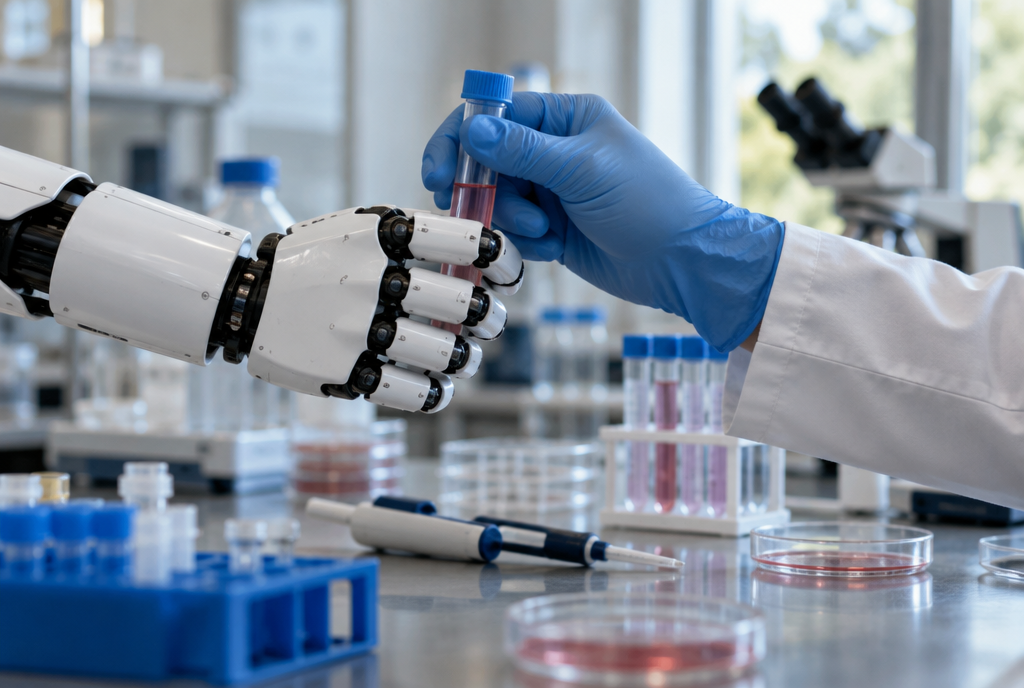
One hand has been holding the tube for four years, the other has just found it
950 Claudes, 21 hours and a DNA haystack
First, the setting. This month, Anthropic opened a real biology lab, with lab benches and white coats, in the San Francisco Bay Area. I talked about it last week : the idea is to have AI agents think things through (programs that carry out tasks on their own, not just a chat window) and let humans check their ideas with real experiments.
For the first attempt, the researchers gave them an initial instruction and five examples from a specific family of enzymes, reverse transcriptases. An enzyme is a little molecular machine in the cell. This one does something weird : your DNA is the recipe book stored in the library, RNA is a photocopy of a page that we take into the kitchen, and reverse transcriptase makes the trip in the other direction, it copies the photocopy back into the book.
Next, around 950 Claude agents searched through a huge public database of DNA sequences for 21 hours. They read 210 million “tokens” (the little pieces of words that an AI reads and writes), enough to fill roughly two thousand novels. They reviewed more than 200,000 of these enzymes, kept 3,500 of them, and produced a report on the 20 most promising ones.
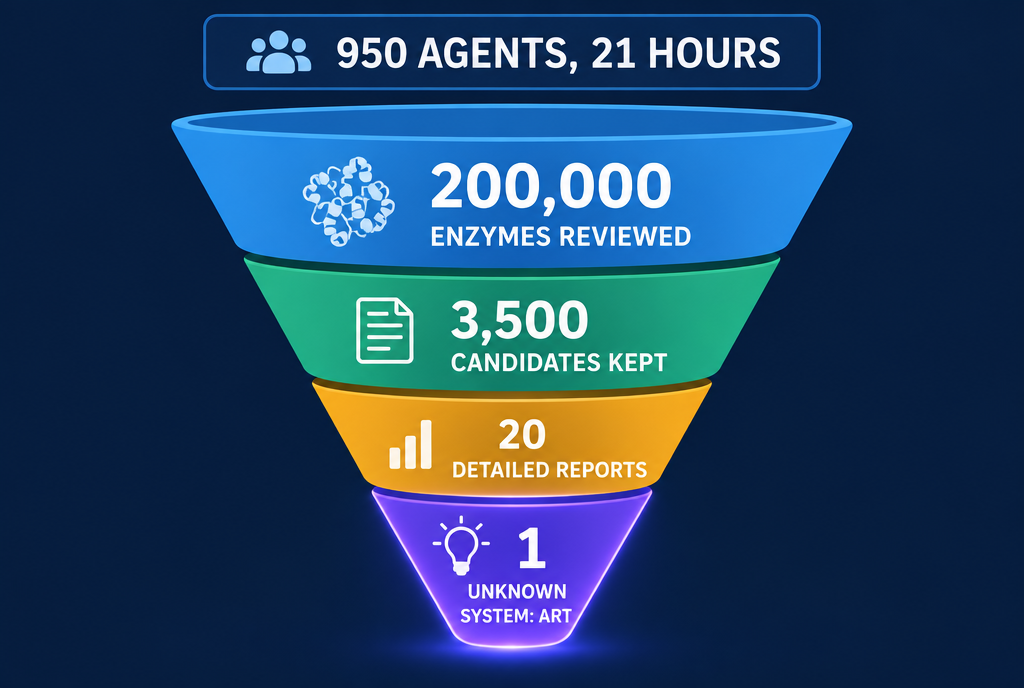
The ant work no PhD student wants to do, knocked out between breakfast and the next morning
And in the bunch, one of the agents comes across a strange structure : next to the gene for an unusual reverse transcriptase, a long series of little repeated bits of DNA, regularly spaced, like the teeth of a comb. Its reaction, copied exactly by Anthropic : “I can see with the naked eye a series of repeats... is this a CRISPR-like repeat array?!”. A question mark AND an exclamation mark. Honestly, it's the most human sentence I've read from an AI this year!
Anthropic named the thing “ART” (for array-associated reverse transcriptases, in English). The lab checked that these repeats do indeed produce different short pieces of RNA, which suggests that the system could be “programmed”, like CRISPR. What is it used for in nature? Nobody knows. Even Feng Zhang, one of the pioneers of CRISPR, finds it “really intriguing”. The work came out as a preprint, meaning without review by other scientists for now.
The Copenhagen researcher who says: it's mine
Four days later, the New York Times published the testimony of Mario Rodríguez Mestre, a biologist at the University of Copenhagen. He and his colleagues have been studying these enzymes since 2022. They found them in “giant phages”, large viruses that attack bacteria, and nicknamed them “jumbotrons”. Nothing has been published yet.
Except that for three years, his team has been using Anthropic's models every day, to write code, draft articles, and everything else. He pasted drafts of his thesis and of the article describing precisely these enzymes into Claude. The newspaper was able to see the exchanges. “The resemblance struck us”, he says. And above all: “What worries me is that this information may have been used to train later versions of the models.”
Anthropic's response, on Sunday, comes down to three points: the company knows of no published work describing this system before its own, Claude was not trained on any user conversation, and its biology team cannot access them anyway.
Ah, and one detail for completeness: Mestre is listed as co-inventor on a patent filed in 2023 by a biotechnology company, which covers several of these enzymes. So he, too, has something at stake.
Did Claude discover it, or did it remember?
I'll be honest, my first reaction was: “hmmm... a researcher who tells Claude about his enzymes for three years, and a Claude that ‘discovers’ them on its own, that's still quite a lot”. And then I read the rest, and it's less simple.
First, Mestre himself remains cautious. Without seeing exactly what Anthropic's AI did, he says, it's impossible to be sure that it was guided by his work: “coincidences happen”. Then, he wasn't the only one who knew about these critters. Seth Shipman, a Californian researcher, puts it bluntly: “we've been talking about it with him for years, many of us know these systems”. And a Stanford team described a similar system on its side. When several labs are working around the same thing, two parallel discoveries are nothing extraordinary.
The history of science is full of them, too. In 1858, Darwin and Wallace arrived at the same theory of evolution, each on his own, and Wallace even announced it to Darwin by letter. Newton and Leibniz spent years tearing into each other over who had invented calculus. Nobody had AI, and they were already arguing.
What's new is the question we couldn't ask before: when a machine has read part of your professional life, how can you prove that it didn't use it? Neither Mestre nor Anthropic can demonstrate it. FYI, since fall 2025, Anthropic has been able to train its models on conversations from individuals who leave a small switch turned on in their settings. Here, it says that wasn't the case. We only have its word, and that's the whole problem.
Concretely, what does it change for you?
Two things, one that makes you dream and one that can be dealt with tonight.
The first is speed. Whether it's a discovery or a rediscovery, 950 agents did in 21 hours the sorting that took a human team years to do. Nature is full of these little machines that we've never looked at. And it's in this kind of forgotten drawer that CRISPR was found: in 1987, Japanese researchers noticed curious repetitions in the DNA of a bacterium, without having the slightest idea what they were for. It took until 2012 to turn them into DNA scissors, 2020 for the Nobel Prize, and the end of 2023 for the first medicine, which treats sickle cell disease, a hereditary blood disease, by modifying the patient's cells.
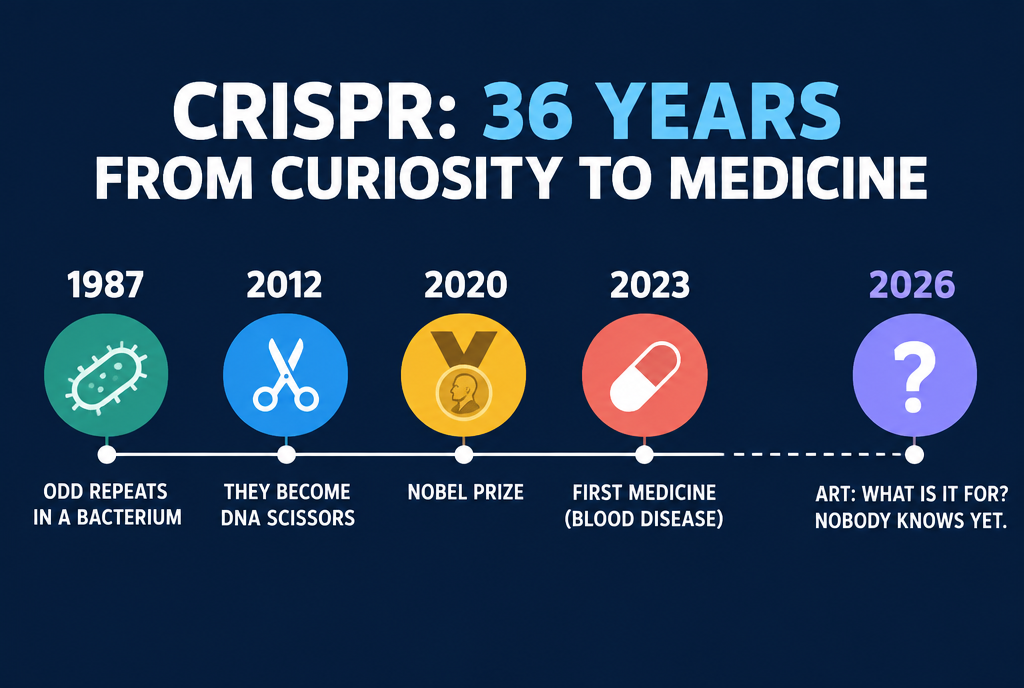
It took CRISPR 36 years to go from curiosity to medicine. ART has just entered the 1987 box
ART is exactly there, in the 1987 box. It could become a tool for medicine in fifteen years, or remain a curiosity in a drawer forever. Nobody can say, and I'd be wary of anyone who claims otherwise. What changes is that we'll open many more drawers, much faster.
The second thing is much more down to earth. If you paste your work into a chatbot, your business project, the manuscript of your novel, a client's file, go and look at the settings line that talks about using your conversations for training. In Claude's case, it's the switch that offers to “help improve Claude”, in the privacy settings. Turned on, Anthropic can keep your conversations for up to five years and use them to train its models; turned off, it's thirty days. ChatGPT and Gemini have an equivalent button. And conversations in Claude's incognito mode are never used for training. Claude's professional accounts aren't affected.
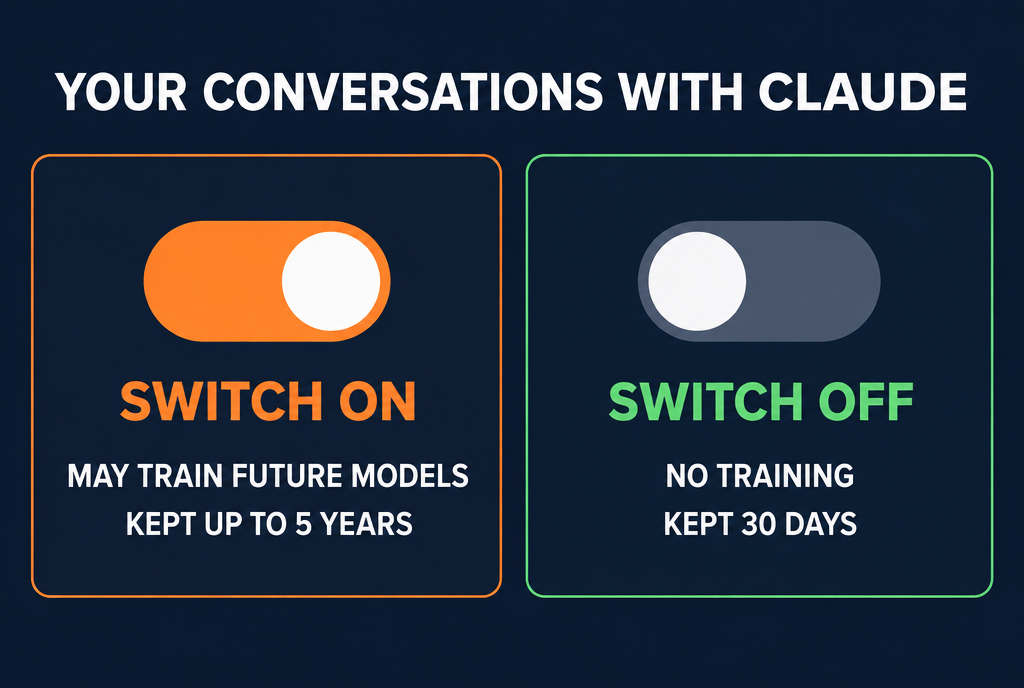
A small switch, and your manuscript stays in your drawer
I paste code into Claude all day long, and I've never had the feeling that I was telling my secrets to someone. This story changed my mind about one thing: even if it's a pure coincidence, a researcher learned from a press release that a machine had just “found” in 21 hours what he had spent four years looking for. Four years of work not yet published... that must hurt like hell. I'm going to take a look at my switch tonight, and I advise you to do the same.
Sources
- Anthropic, September 23, 2026: Claude discovers a new enzyme system
- Phys.org, September 24, 2026: the discovery, Feng Zhang's opinion and Stanford's neighboring system
- The Irish Times (reprint from The New York Times), September 28, 2026: Mario Rodríguez Mestre's testimony and Anthropic's response
- MIT Technology Review, September 28, 2026: when can we say that an AI has made a discovery?
- Benzinga, September 28, 2026: the 2023 patent and the history of Copenhagen's work
- Anthropic: terms of use for individuals
Article written with the help of Claude Code, reviewed and corrected by me.
Join the conversation
You need an account to comment on this article. Creating one is free and takes under a minute.
No comments yet.