On September 18, Anthropic confirmed something nobody expected from it: the company had opened a real biology lab, with lab benches, freezers and robots that pipette, somewhere in the San Francisco Bay Area. Not a partnership, not a software platform sold to researchers. A lab of its own, that it runs.
And the lab's user is Claude. The model reads the protocols, writes them, then dictates them to the machines that handle the samples. A human validates things, but the sequence of actions is produced by the machine.
It made me smile for a second, then I reread the date three times. Because a few weeks ago, I was wondering precisely whether an AI had already found something that nobody knew before it. We're building it the place to do that.
They bought the lab six months before announcing it
The September announcement is only the end of a whole saga. In April 2026, Anthropic bought Coefficient Bio, a small New York company, fewer than ten people, for around $400 million. At the time, nobody really understood what a language model maker wanted to do with a team of biologists. Now we know.
And that's not all, because something else happened in between, more quietly: at the end of August, Anthropic published a standard for talking to laboratory machines. The idea is as simple as can be and nobody had done it properly. Today, every device has its own software, its own cable and its own way of saying hello, and connecting a new machine to an automated chain takes weeks, sometimes months. With their standard, the device describes itself and responds through the same three doors as everything else: an MCP protocol, a command line or an API.
The announced gain is staggering: it goes from weeks to a few hours. QuEra, which makes neutral-atom quantum computers, used the process to stabilize its lasers, and alignment precision went from 58% to 99.3%. The tool was also tested at the Janelia Research Campus, at Genentech, and eight automation manufacturers announced that they would embed the standard.
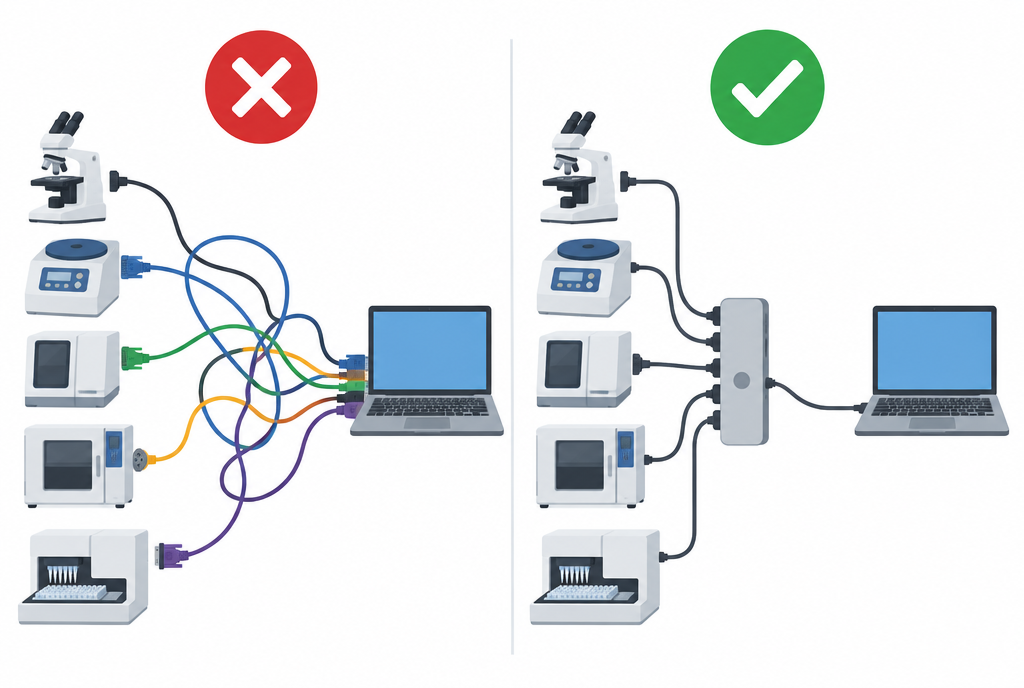
Connecting a lab machine. On the left the 2025 version, on the right the version that speaks the same language as the others
Two honest details all the same: the standard isn't open, Anthropic keeps control of it, and its own engineers write in black and white that language models still lack physical intuition. Translation: they still don't understand why something falls to the ground. You can't do biology with that alone. That's precisely why they're hiring people in lab coats.
Why rare diseases and not cancer
The choice of field is the most interesting part of the whole story. Anthropic says it is working on neglected and orphan diseases, which in plain English means diseases that almost nobody has, and therefore that almost nobody pays for.
Understand the calculation. A rare disease affects fewer than one person in two thousand. A private laboratory that has to cover its costs has no interest in devoting ten years and a billion dollars to it. It's the black hole of pharmaceutical research, and it's huge: around 7,000 rare diseases recorded, more than 350 million patients worldwide, including 30 million in Europe and 3 million in France. In 95% of cases there is no treatment that cures, only care that eases the symptoms.
A model that writes protocols costs almost nothing to test, doesn't get tired and doesn't need a market to justify its subject. That's exactly the job profile for this hole. It still has to work, we'll come back to that below.
Concretely, what does it change for you
You've probably never set foot in a laboratory and that's perfectly fine. So here's what it could change in an ordinary life.
First use, the most obvious one: diagnosis. A rare disease takes an average of five years to be identified in Europe, and during those five years they search, they get it wrong, they send you to another specialist. 72% of these diseases are genetic in origin and 70% begin during childhood. A machine that reads a complete file, cross-references the symptoms and suggests a rare possibility in a few minutes, that doesn't replace a doctor, but it can save years for a family that doesn't understand what's happening to their kid.
Second use: treatments that don't exist. Of those 7,000 diseases, more than 230 currently have a medicine authorized in Europe. That's not nothing, it's even an achievement, but it leaves a desert behind. If a lab run by an AI brings down the cost of an initial trial, molecules that interested nobody become candidates again.

Five years of appointments before finding out. If the machine cuts that time in half, everything is already won
Third use, the one I believe in most: making fewer things for no reason. A laboratory protocol means thousands of repeated actions, most of which lead nowhere. An automated system that learns as it goes does not do better than a human on the first try, it just makes many more attempts per week, and it records everything.
The historical comparison is right there and it is telling. In the United States, a 1983 law created a tax advantage for orphan drugs, and Europe followed with a regulation in 2000. Before those texts, nobody was looking for these diseases at all: it was not a science problem, it was a billing problem. We invented a mechanism to make the work profitable, and the field got started. Here, it is not a tax advantage that brings the cost down, it is the cost itself that collapses. It may happen quickly, or not at all.
What this does not change, and I would rather say it right away
Now for the cold shower, because there is one and it is a big one. Anthropic talks about preclinical work. Preclinical means everything that happens before a human being, so cells and mice. No clinical trial has been announced, no molecule has been named, no timeline has been given. Between a cell that reacts well in a dish and a drug in a pharmacy, there are ten years in the best-case scenario and a wall of regulatory tests in every case.

The complete path. Anthropic's lab works at the far left of the drawing
And there is the competition, which is not behind. Isomorphic Labs, DeepMind's subsidiary, has been doing this since 2021 with the blessing of major laboratories, and OpenAI has unveiled an in-house workflow for biological research on its side. Three giants finding themselves in the same corridor is not a sign that a problem has been solved, it is a sign that it has become important enough for everyone to tackle it at the same time.
The contradiction that has been buzzing around in my head for a week remains. On September 15, I was telling you here that the bosses of Anthropic and OpenAI were themselves asking to slow down. Four days later, one of the two announces that he is putting his model in charge of a biology laboratory. The two things may not be incompatible, you can want to slow the race down and speed up drug development. But if someone explains to me how you can hold this reasoning without fooling yourself, I'm all ears.
Join the conversation
You need an account to comment on this article. Creating one is free and takes under a minute.
No comments yet.