Everyone has done this calculation once in their life: switch to an office suite that isn't Microsoft's, realize that it works very well, and go back anyway. Not for convenience. Because the day you have to edit a document without a connection, on a train or in a room without wifi, you find yourself with a browser tab that refuses to open the file.
That is precisely the wall that is coming down. On September 16, Nextcloud announced Hub 26 Summer, its new version, with something in it that did not exist before: a desktop application for Euro-Office, the office suite it is promoting. Word processor, spreadsheet, presentations, installed on the machine, which edit locally and keep the link with the server's files. The application itself will arrive in the coming weeks.
What was missing from the start
Euro-Office is not new. It's been months since we've been able to open a document in it, in a browser, on a Nextcloud. And honestly, for 80% of needs, that's enough: write a note, correct a spreadsheet, send it. The problem is in the remaining 20%, the situations where there is no network, where you want to open a file lying around in a folder without uploading it first, or simply where you want your machine to stop sending every keystroke to the server.
That is exactly the criticism made of Google Docs for fifteen years. Microsoft built Word on the desktop before putting it in the cloud, free software suites were born on the desktop, and the newcomers skipped that step. The desktop is old, it's boring, and it's what you miss when the connection disappears.

The moment of truth for every office suite: the train enters the tunnel and you still haven't saved
Who's behind it, and what it changes
Euro-Office is not a one-person project, and the list of participants gives you an idea of the scale of the affair. There you find XWiki and Abilian on the French side, IONOS, Open-Xchange, OpenProject and Nextcloud on the German side, Proton on the Swiss side, Tuta, and the Office EU organization on the Dutch side. The first version came out on June 9, under a free license, and the stated idea is simple: a complete office suite that does not depend on an American provider, with the files staying on your server.
For an individual, the argument comes down to three very concrete questions. Who can read my documents? Who decides the price next year? And what happens if the service shuts down or changes its terms overnight? These are not theoretical questions: they come up for a municipality that stores residents' files, for a school with the children's report cards, or for a small business that does not want to explain to its clients that their files are with somebody else.
It's visible in the press release, and it amused me: Nextcloud names its institutional users. Dataport, the German public-sector IT provider, gave its feedback on the messaging feature. SURF, the Dutch education and research organization, contributed the room finder for calendar bookings. The state of Schleswig-Holstein requested and obtained a structure import feature for its spreadsheets. These are not logos placed on a marketing page, they are people who ask for things and get them.

The municipality's files, the school's report cards: this is what a client of office software that cannot afford to make mistakes looks like
The part the press release does not highlight
Now, the reservation, and it's not a small one. Euro-Office was not written from scratch: it is a copy of OnlyOffice's source code, software whose roots are Russian and whose code comes largely from developers working in Russian time zones. For a product sold as the European solution, the contradiction was pointed out right away.
The story went even further. OnlyOffice accused Euro-Office of violating the terms of its license, and broke an eight-year partnership with Nextcloud in the process. Then the Free Software Foundation, the reference organization on these issues for forty years, examined the case and concluded that Euro-Office had not broken the rules. The other side therefore lost its main argument, and the code is free, which means that anyone can go and read it.
That doesn't settle everything, and I find the wording of a commentator from the scene very apt: compatibility is not sovereignty. Copying software and changing its name isn't enough to make it an independent cornerstone, you need people to maintain it and decide its future. That, that will be judged in five years, not in a press release. And for those bothered by the legacy, LibreOffice released version 26.8 last month, with a much simpler family tree and the same free price.
So, concretely, what does it change for you?
Three situations, and none of them requires you to be a computer expert.
You have a server at home, an old PC running in a corner or a network storage box, and you already keep your photos and documents there. Until now, to modify a text, you had to download it, edit it in software installed on your laptop, then send it back manually. Now you double-click it, it opens, it saves itself in the right place. It sounds tiny written like that. It's the difference between a shared folder and a real workspace, and that's what made Google Docs famous back in the day.
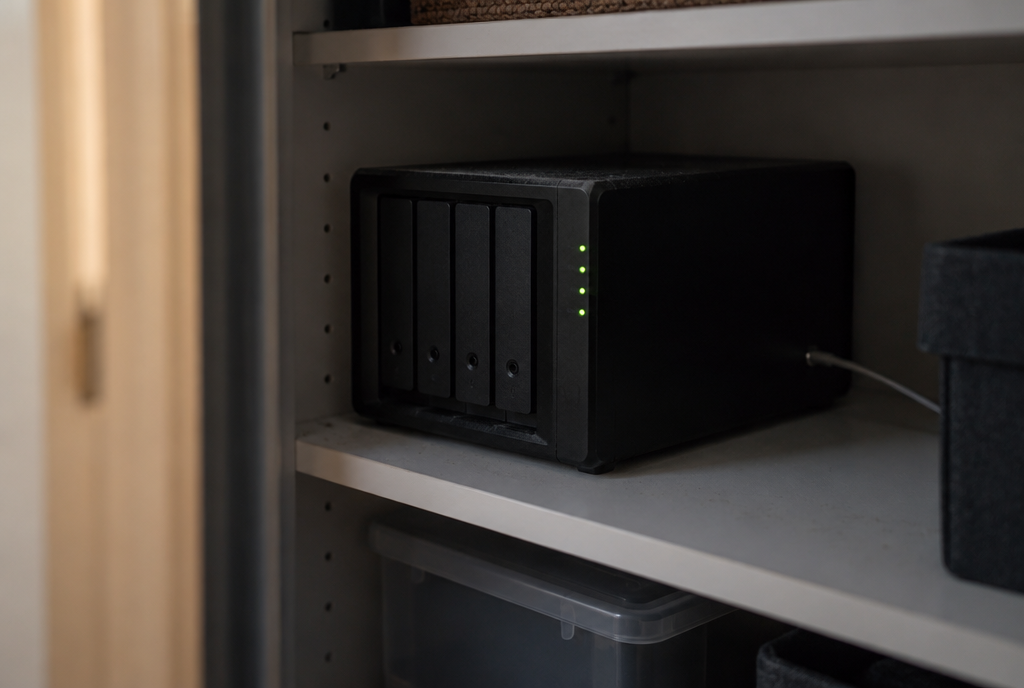
The box in the cupboard becomes a real workspace, without anything leaving the house
You work in a government department, a school or an association. There, the issue isn't your comfort but that of the files you handle, and being able to say where they are. That's exactly why Dataport and Schleswig-Holstein are mentioned above: they are demanding clients who don't settle for a demonstration.
And third situation, the most common one: you'll never use it, but you'll benefit from it without knowing it. The local authorities that switch over pull prices down and push the other software publishers to take better care of their file formats. Every time a major public client goes elsewhere, the rest of the market benefits from it two years later.
What it doesn't do, on the other hand: it doesn't replace a real Word for twisted documents. Complicated layouts, corporate templates with headers everywhere, files that three departments have been passing back and forth for eight years, those are the cases where all the alternatives to Microsoft, free or not, show their limits. And to use them, you need either a Nextcloud server, or someone else to take care of it for you. It's not software you install on your laptop in three clicks.
One question remains that I find more interesting than the usual showdown between the software giants. We've spent twenty years moving our files to other people's servers because it was more convenient, and the only thing that was really holding us back was being able to edit a document on the train. Now that obstacle is gone, what is still holding us back?
Join the conversation
You need an account to comment on this article. Creating one is free and takes under a minute.
No comments yet.