OpenAI cuts off its models in Cursor on November 12. What do you do if you use it?
OpenAI cuts off its models in Cursor on November 12. What do you do if you use it?
Friday evening, OpenAI gave notice: starting November 12, its models will no longer run in Cursor. For those who don't know, Cursor is the software in which a developer writes their code, except this one has an AI grafted into it that types out a good chunk of the work in their place. It's one of the most widely used tools in the profession, and its parent company announced $3 billion in annualized revenue in May (company figure, nobody audited it).
And then you think: right, a supplier slamming the door on a customer, that happens every day. Except that in this specific case, the customer is a code editor, the door is the engine that writes the code, and the notice arrives on a Friday evening for a shutdown in eleven weeks.
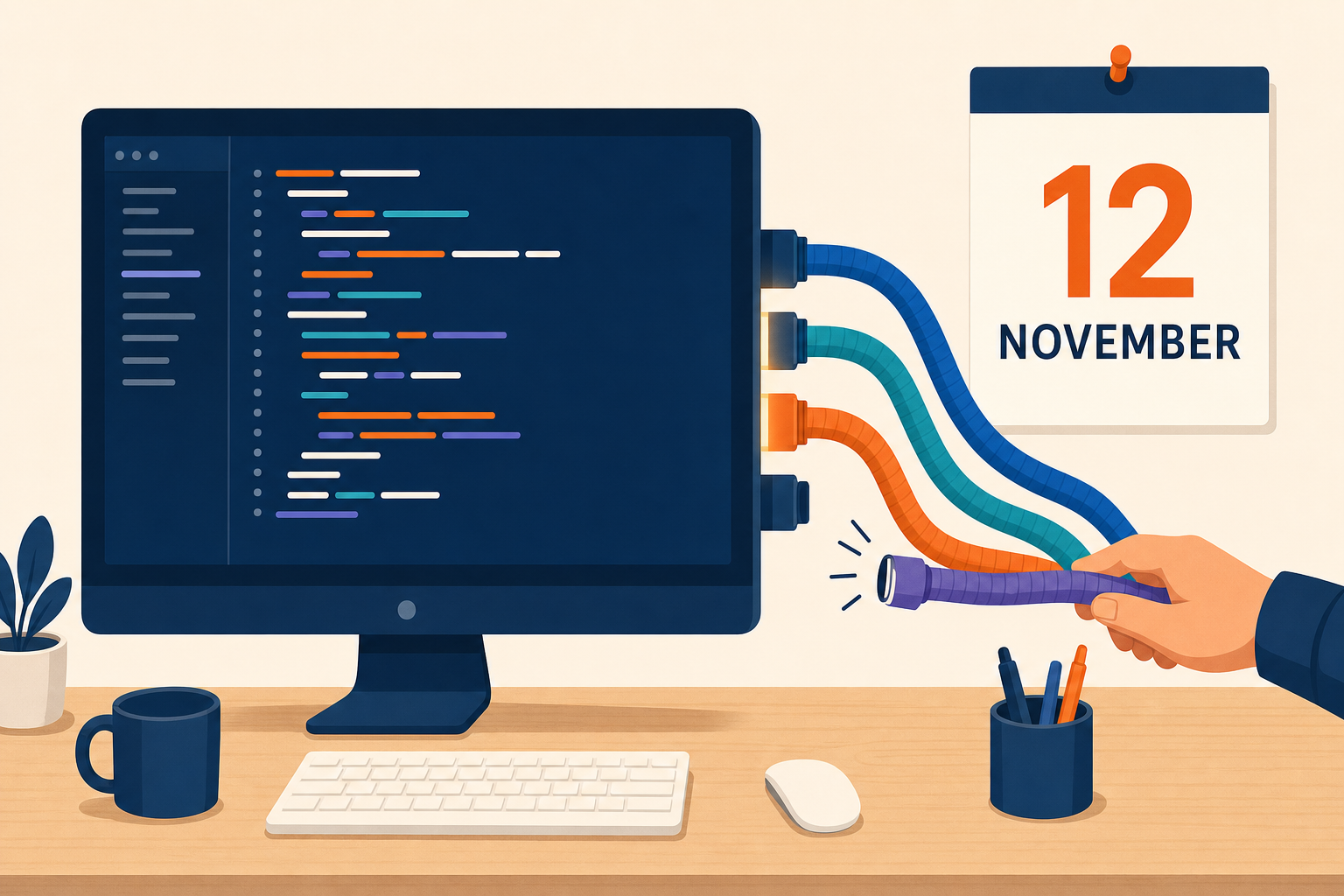
There are eleven weeks left. That's longer than a resignation notice, and shorter than a move.
What happened, in order
In June, SpaceX announced the acquisition of Anysphere, the company that makes Cursor. $60 billion, paid entirely in SpaceX shares, so not a single euro changes hands: Cursor's shareholders become SpaceX shareholders. The deal closes in mid-August.
Two weeks later, on August 28, OpenAI activates what is called a change-of-control clause. That's the line in the contract that says, basically: I supply you because you're you, and if you change owners, I can stop everything. It sits in more or less every serious supply contract, and it never gets used. This time, it did.
The reason given by OpenAI, word for word: "We are making this choice because we cannot be certain that SpaceX will use our technology in compliance with our terms of use, given our experience with Elon Musk's companies violating contracts." There you go. We're not going to spend three paragraphs on this, these are two companies glaring at each other and it won't change a line of your code.
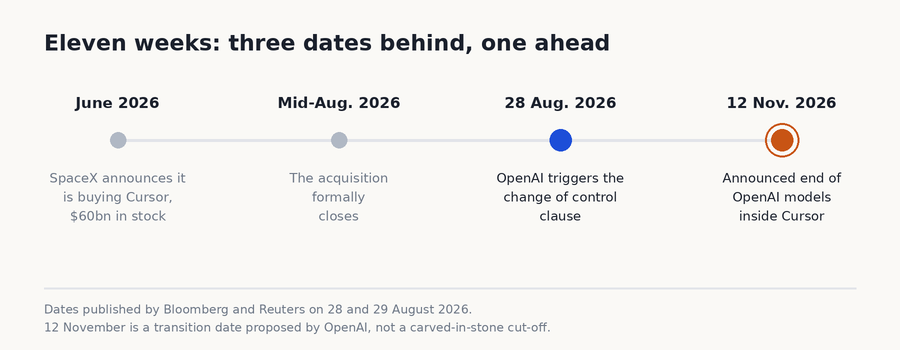
Four dates, two and a half months of reprieve. The fifth box is the one you're interested in.
What changes your line of code, though, is the following detail: November 12 isn't a fixed shutdown date carved in stone, it's a transition date proposed by OpenAI. The current models will continue to be served until then. Future models, on the other hand, will no longer be supplied to Cursor at all. In other words, even if the two companies reconcile over the schedule, the tool has already been removed from the queue for new releases.
Why is OpenAI cutting them off? It eventually said
OpenAI didn't just notify Cursor. On August 28, it published an official note on its own website to explain its decision. You don't do that for an ordinary end of contract. And the reason it gives has nothing to do with technology.
What it writes: it cannot be certain that SpaceX will use its technology while respecting the rules it imposes on all its customers, "based on our experience with Elon Musk's companies violating contracts". Two examples are cited in the note. After the acquisition of Twitter, the company broke the terms of its contract with OpenAI. And Musk apparently admitted under oath, earlier this year, that xAI, now also part of the SpaceX group, had violated those same rules.
So this isn't a story about competition. At least not in OpenAI's version. It's a story about trust.
Second thing I hadn't realized: November 12 wasn't picked at random. It's the longest notice period that the contract between the two companies allows, and OpenAI says it took it on purpose, to give developers as much time as possible. In other words, no point hoping this will slip into spring. We're already at the end of the deadline, and that at least makes it possible to plan.
Third thing: OpenAI's next big model has a name, Astra, and it is explicitly out of the running. Cursor won't get it.
A balancing clarification all the same, because it matters: all this is OpenAI's version, written by OpenAI, on OpenAI's website. Neither SpaceX nor Cursor has responded on this specific point.
And on the question everyone is asking, the one about the personal key? Nothing. Not one line. OpenAI publishes an entire text about its decision, and the only point that really changes anything for someone who opens Cursor tomorrow morning isn't in it. So what I write below about this remains valid, word for word.
5% of the traffic, says Cursor's boss
Michael Truell, co-founder of Cursor, reacted with the figure that says it all: OpenAI's models account for about 5% of his users' traffic. Translation: out of a hundred requests sent to an AI from Cursor, five went to OpenAI, while the other ninety-five went elsewhere. Mostly to Anthropic's Claude, Google's Gemini, and Composer, Cursor's in-house model.
Take that figure for what it is. Truell said neither over what period he measured it, nor exactly what he was counting: requests? text tokens? users? Those are not the same thing at all. A “complete this line” request and a “read through these forty files for me” request are the same 1 in a counter and a ratio of 1 to a thousand in actual usage. So 5%, yes, but 5% of what, we don't know.
What remains true despite the vagueness: it's not 80%. The people coding with Cursor have overwhelmingly chosen something other than OpenAI's models, all on their own, without anyone pushing them to do so. And I'm not exactly surprised, I spend my days in Claude Code and I haven't opened an OpenAI model for coding in a while.
What if I pay OpenAI directly?
This is THE question everyone has been asking since Friday night, and I'm going to answer it honestly even if nobody likes the answer.
The plan, in theory, is simple. You open an account with OpenAI, you get what is called an API key, a long personal code that proves it's really you knocking on the door, you paste it into Cursor, and from then on you pay OpenAI based on usage. No more intermediary, no more contract between the two companies, no more problem. That's what we've been reading everywhere for three days.
Will it work after November 12? Nobody knows. And I mean that literally: neither OpenAI nor Cursor has written a single line about this specific case. I looked, there's nothing, anywhere.
So here's why I advise you not to bet on it. Even with your own key in your pocket, your request doesn't go from your computer to OpenAI in a straight line. It goes through Cursor's plumbing, exactly the same as the regular service. Now, that is precisely the plumbing OpenAI is in the process of disconnecting. It may very well keep working, it may very well stop on the same day, and until one of the two has written it in black and white, making your plans around it amounts to counting on a hole in a fence that is precisely being repaired.
And even in the optimistic scenario, your key doesn't give you back the Cursor you know today. This, on the other hand, is documented in black and white, and long before this dispute: a personal key is only used for the conversation with the model. The agent mode, the one that goes off and modifies several files on its own while you watch, does not work reliably.
As for the gray text that appears in front of your cursor to finish your line, the one you accept by pressing the Tab key, it doesn't come from OpenAI and never has. It comes out of models that Cursor makes itself. Good news while we're on the subject: the feature you use three hundred times a day won't move an inch on November 12. Bad news: your personal key therefore doesn't make you independent, you will pay OpenAI on one side and keep paying Cursor on the other.
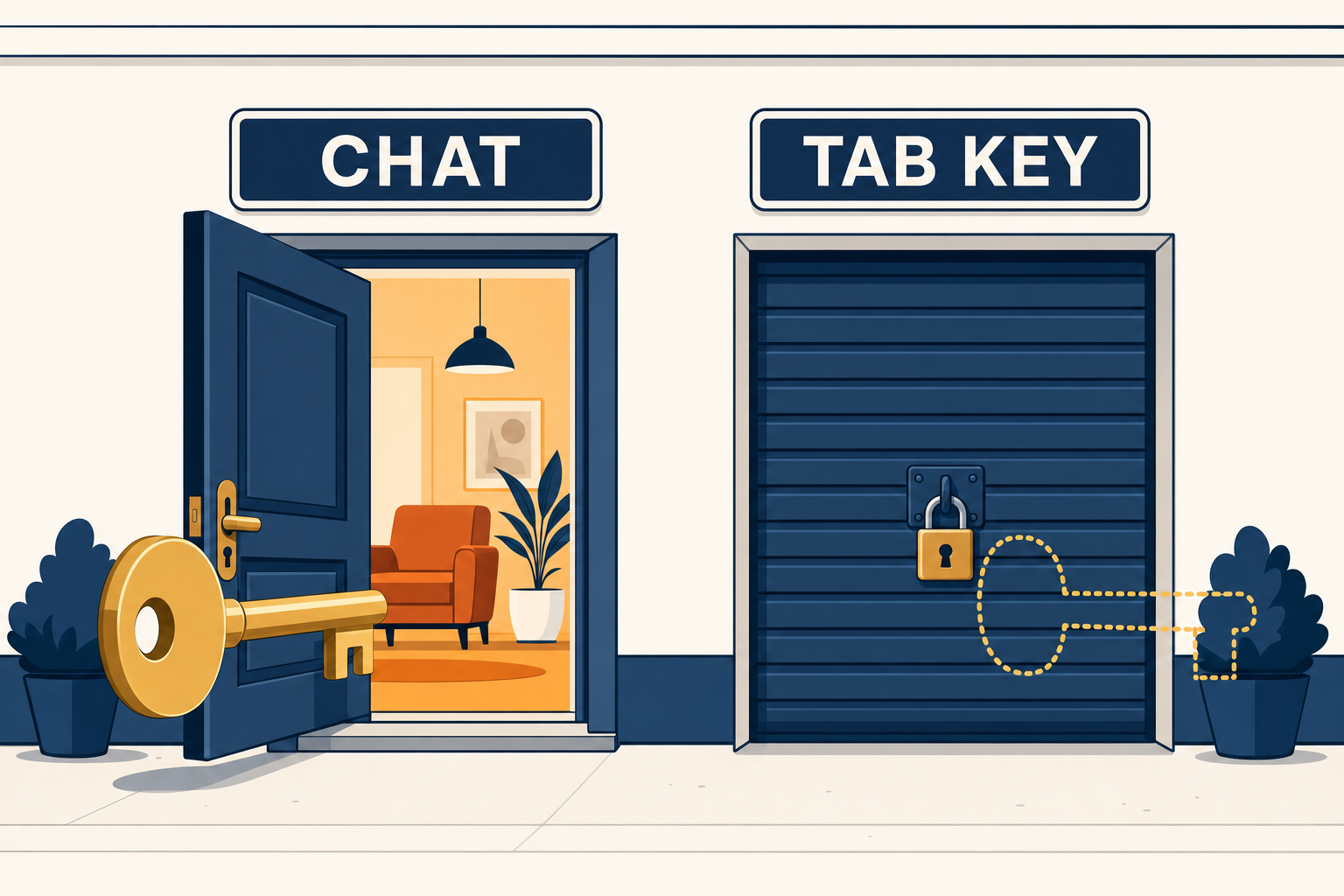
Your key opens the front door, not the garage. All that's left to find out is whether the front door will still be there in November.
One last point, invisible this time, and it deserves thirty seconds. Today, Cursor is the one promising you that your code isn't kept once the answer has been delivered. The day you plug in your own key, that promise no longer applies: it's your own contract with OpenAI that takes over, and it doesn't say the same thing about who has the right to keep a copy of what you send, or for how long. Your code takes exactly the same route as before, down to the comma. What changes is the rule written at the destination. And if that code belongs to a client, that's the kind of detail that is never noticed at the right time.
The funny part: it proves that the tool isn't the engine
Now I'm going to say something that will seem counterintuitive, but I really mean it: this cutoff is good news, and it is good news for a reason that has nothing to do with the two companies arguing.
Two years ago, if your coding tool lost its model, you lost your tool. Today, an entire profession is being told that one of the four engines is shutting down, and the answer fits in a dropdown menu. You open the model selector, pick the one next to it, and carry on. Anthropic even announced right after that it was increasing its computing power to absorb Cursor's users. Tom Brown, one of the co-founders, said so publicly.
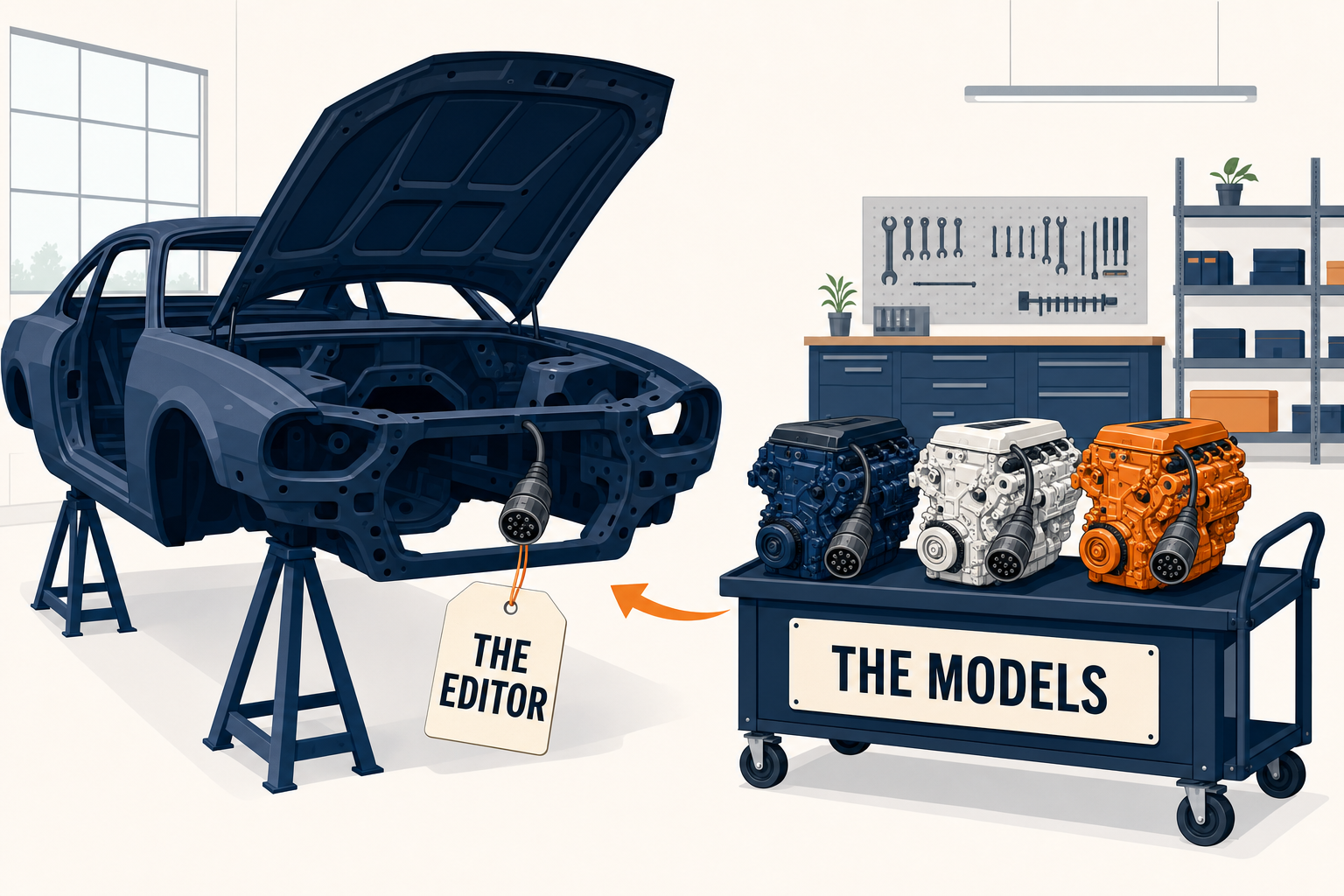
The editor is the body. The engine can be changed at a red light, without getting out of the car.
This is something the industry built without meaning to, and it's precious! Code tools started talking to several models for bad reasons (going for the cheapest, getting around outages, testing the latest little thing), and the result is that no provider can hold anyone by the collar anymore. The day you can change providers in three clicks, the provider can no longer blackmail you, and honestly I much prefer this world to the one where my code editor belongs to a single company.
If you use Cursor every day
Here's the order I'd do things in, and it takes fifteen minutes.
First, look at what you really use. In Cursor's model selector, if the name that keeps coming up for you starts with claude, gemini or composer, November 12 won't do anything to you at all. Nothing. You can close this article and go get your coffee.
Next, if you're in the 5%, try the other model now and not on the evening of November 11. Eleven weeks is exactly the amount of time it takes to quietly realize that the model next door works differently on your project, with your conventions and your old code. You discover that by working, not by reading a comparison table.
Finally, if your company has written rules about who is allowed to see the code, read them again before connecting a personal key. It's no longer the same contract, and this kind of detail always comes to light at the worst possible moment.
What I think
What strikes me in this story isn't the falling-out. It's the speed at which a tool that hundreds of thousands of people open every morning can change owners, lose a provider and end up in the papers, all in two and a half months. A code editor used to live for ten years. You installed Visual Studio and knew it would still be there for the birth of your second child.
So yes, the nice surprise is that the move fits inside a dropdown menu. But the real lesson, for me, is this: never base your way of working on a single provider, whoever it may be. Keep two tools under your fingers, learn to change engines before you're forced to, and the day two billionaires fall out, you'll learn about it by reading the news instead of discovering it in front of your screen!
Sources
- OpenAI: Our decision on Cursor following its acquisition by SpaceX, August 28, 2026, the official note: the stated reason, the maximum notice period and the upcoming models
- Bloomberg: OpenAI to End Partnership With Cursor After SpaceX Acquisition, August 28, 2026, the announcement, the date of November 12 and OpenAI's statement
- Reuters via Investing.com: OpenAI to cut off AI models for SpaceX-owned Cursor, August 28, 2026, the $60 billion in shares, the acquisition schedule and Anthropic's reaction
- Cursor founder says OpenAI models account for just 5% of user traffic, August 29, 2026, Michael Truell's figure
- Cursor documentation: Personal API keys, what the personal key covers and what it doesn't cover
Join the conversation
You need an account to comment on this article. Creating one is free and takes under a minute.
No comments yet.