Claude Code: six versions in five days. What changes for you?
Claude Code: six versions in five days. What changes for you?
Between Monday and Friday, Claude Code went from version 2.1.234 to 2.1.239. Six releases in five days. I read all six version logs in full, line by line, and came away with a strange impression.
Taken one by one, they're fixes. A terminal bug here, a proxy setting there. The kind of list you skim while telling yourself that nothing has changed.
Put together, they all tell the same story. This tool is in the process of stopping being something you sit down in front of.
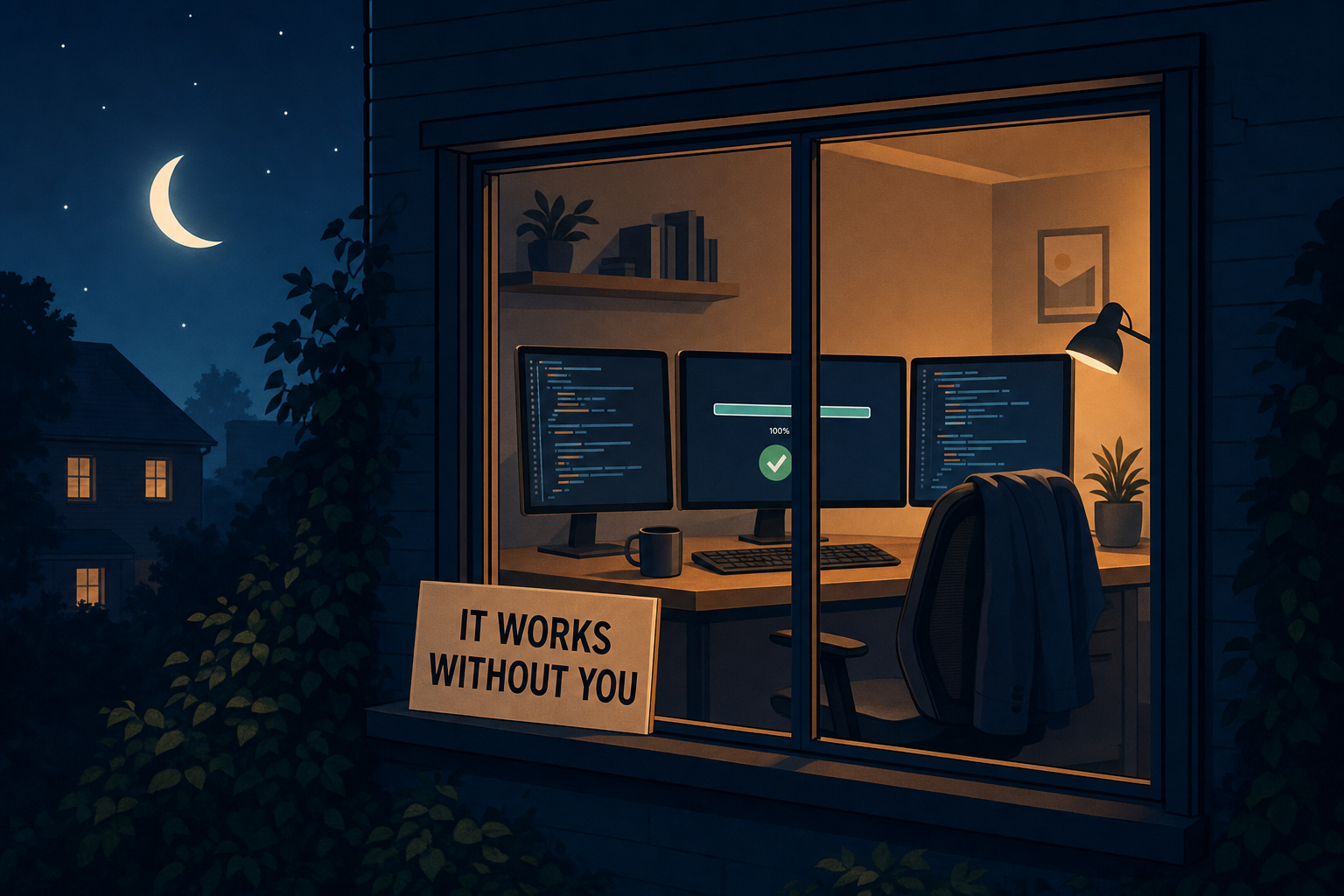
The mug is cold, the chair is empty, and the three screens are working. We're almost there.
The line I've been waiting for for months
It's in 2.1.234, stuck in the middle of twenty others, and nobody talked about it: Claude Code now continues your session all by itself when your usage quota recharges.
You have to have lived through the thing to understand. Anthropic gives you chunks of usage that recharge every five hours. When you hammer away at them on a big project, you always end up hitting the wall: no more credit, session stopped, and the agent staring at you. Until now you had to come back, see what had happened, and restart it by hand. If the wall came at 11 p.m. and you went to bed, you found frozen work the next morning, exactly where it had stopped.
I keep an eye on that percentage all the time in my statusline, and I know the little evening calculation by heart: I've got 12% left, do I restart something now or do I wait for the reset? Now, the question doesn't come up in quite the same way. You launch it, it hits the wall, it waits, it starts again. It's activatable in /config.
It doesn't look like much. It's the difference between a tool that works as long as you're there, and a tool that works as long as there's work to do.
It checks in on you, and it has learned patience
Second thread, and this is the clearest of the six versions. The /goal command, which serves to give the agent a broad objective while it's grinding away at something else, received three fixes in a row.
First, in 2.1.234: when background tasks make an objective wait for more than thirty minutes, the agent checks in on its own. Then in 2.1.236: an inactive session whose objective is blocked behind a long process now automatically checks in after half an hour.
And then on Friday, the line that made me smile.
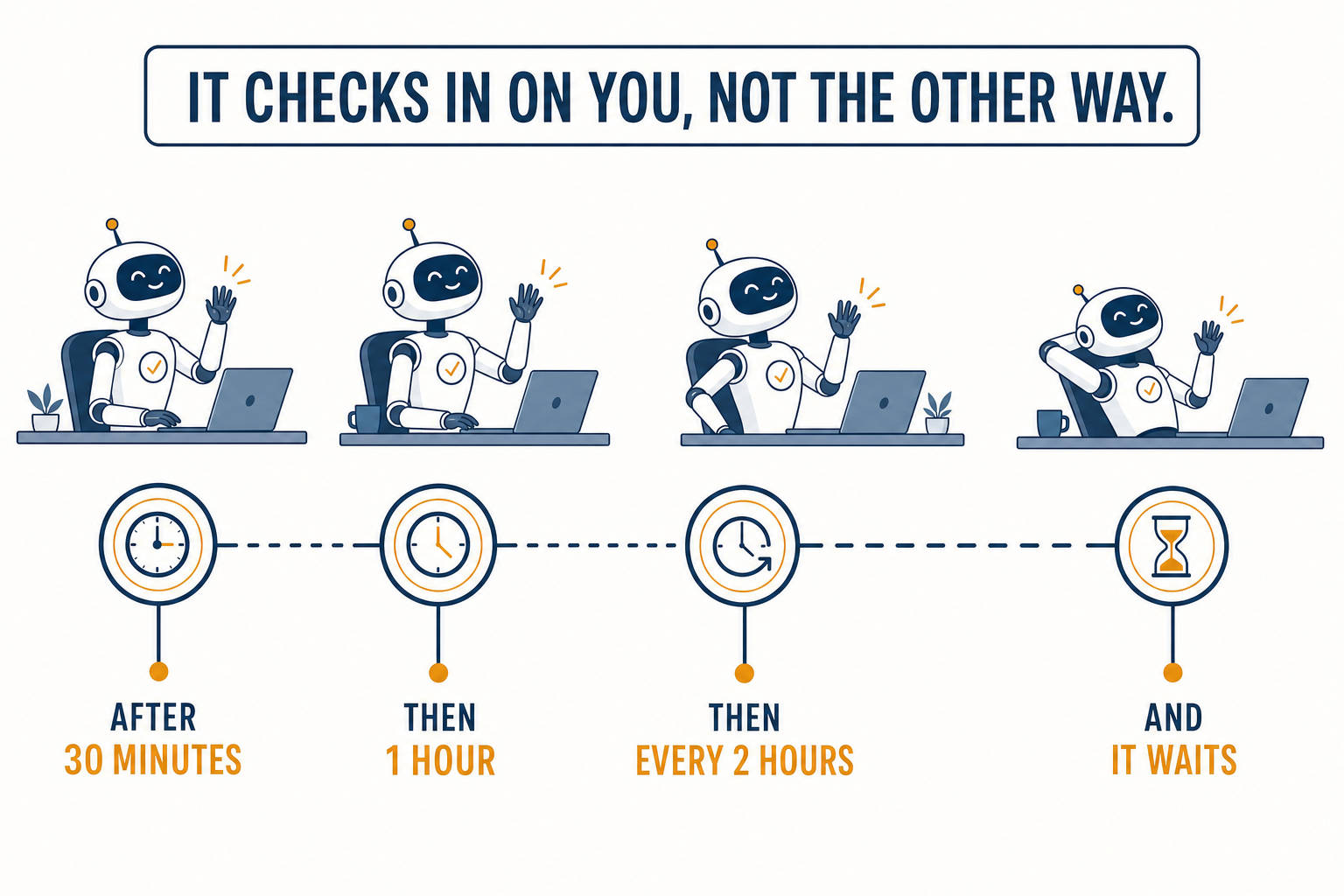
Thirty minutes, one hour, then every two hours. We've all known a colleague who never understood that setting.
Reminders about background work are now spaced out: thirty minutes, then one hour, then every two hours. In other words, someone realized that the agent coming to say « so, is it moving along? » every half hour for six hours was becoming seriously annoying, and taught it to back off a little.
I find this detail more revealing than any announcement. You don't set the frequency of an alert for a tool you're watching live. You set it for a tool that's running while you're doing something else.
Your phone has become a remote control
Third thread, and this one is downright explicit. Several of the week's fixes concern remote sessions, meaning controlling from somewhere else a session that's running on your machine.
The most telling one is in 2.1.234: a change in effort level made from the phone or from the browser now applies to sessions hosted in your terminal. Translation: you're on the train, you take out your phone, you put the agent into « think really hard » mode, and the machine left at home obeys.
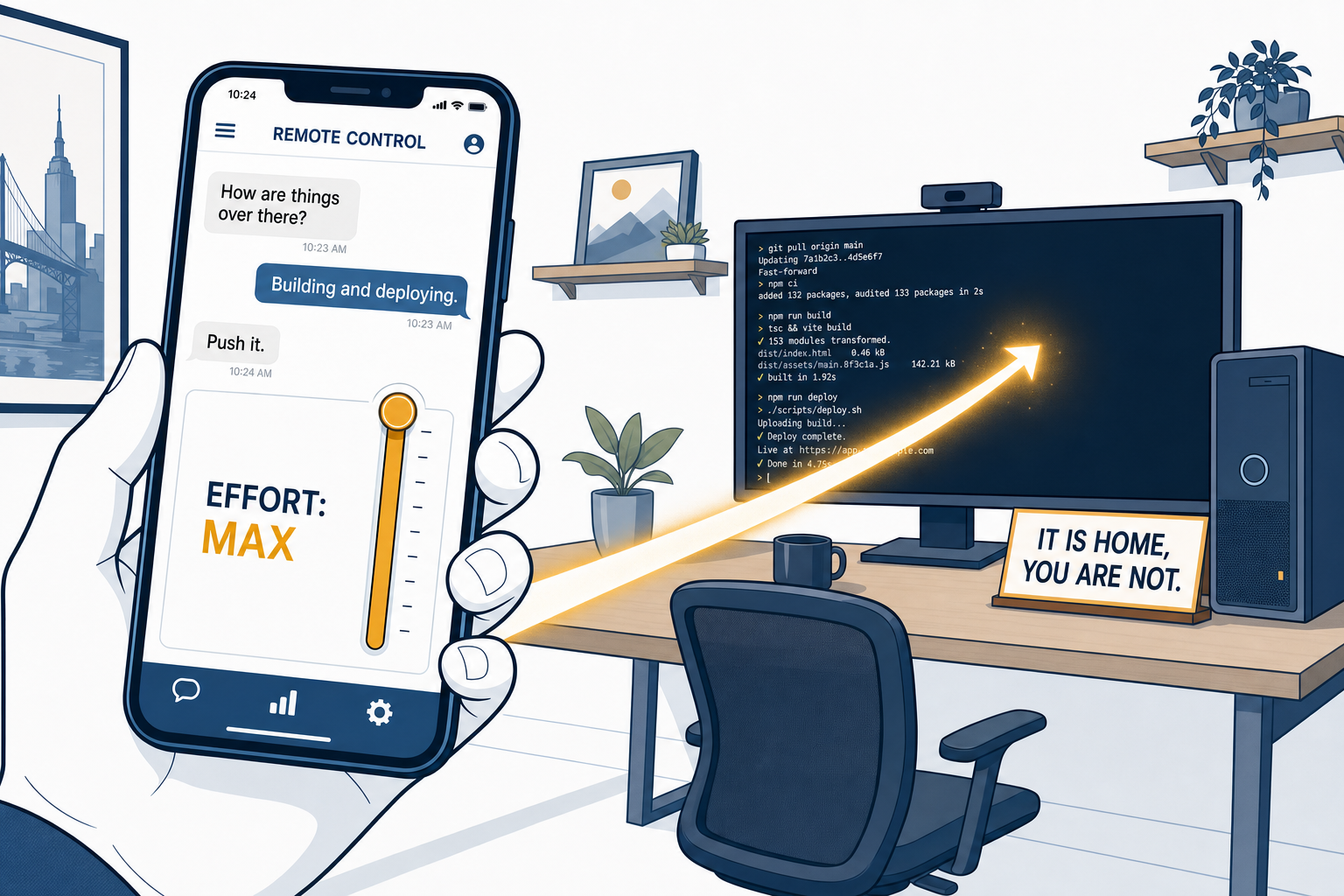
The setting starts at the train station, the calculation happens in your office. All that's missing is a camera to check that the cat hasn't sat on the keyboard.
The rest goes in the same direction and smells like feedback from the field. Remote sessions now send signs of life while a long startup script is running, because without that the server considered the session inactive and cut it off halfway through. Images sent from a mobile now arrive with their file path. Files the agent sends back to you during a remotely controlled session finally get sent for real.
These aren't flashy new features. It's someone who tried using them for real and wrote down everything that broke.
And security is moving forward, quietly
Three lines stopped me, in three different versions.
In 2.1.236, on Mac: read-denial rules with wildcards, like **/.env, now take precedence over read permissions. In plain English: if you've said "you can read my entire project" and "you never read secret files", the denial wins. Before, the broad permission could win in some cases. It's exactly the kind of detail that decides whether your passwords stay with you or not.
In 2.1.234, a more obscure fix that is no less serious: remote file reads, session restores and workflow scripts now reject Windows paths that use a weird internal notation, the one that starts with \??\. It's an old trick for pointing to a file by something other than its normal name and slipping past a filter that was looking at the normal name.
And in the same version, a real bit of comfort: /permissions now opens while the agent is working, and the rules you change apply immediately to the rest of the turn. Before, you had to wait until the end. When an agent is in the middle of doing something stupid, waiting until the end is not a great idea.
All of this comes in a context that I talked about eleven days ago, when the tool started asking for permission less often. The more you delegate, the sturdier the guardrails need to be. At least, the two are moving forward at the same time.
The unglamorous fixes, the ones that really matter
There's a line in 2.1.238 that I want to put in a box: fixed unlimited memory growth in long interactive sessions. Sub-agent tool results are now released when they leave the recent display window.
In plain English: when you left a session open all day, memory usage went up, up, and never came back down. Those who saw their machine crawling by late afternoon without understanding why now have their explanation.
Two more, in the same spirit. 2.1.234 makes active sub-agent cloning enabled by default, and the clone inherits the entire conversation and the cache. The cache, here, means not having to pay twice for the same part of the context: when one agent launches another, it no longer starts from zero. And 2.1.237 fixes context caching for those who go through a homegrown gateway, which, on big sessions, shows up directly on the bill.
Still in 2.1.237, a "concise" output style that gives the result first and skips the preamble. Small personal pleasure: I've never needed someone to summarize what I just asked before answering me.
What I think
Six versions in five days can be read in two ways. Either the tool is unstable and you have to put the pieces back together every morning. Or there are people using it hard and reporting everything that gets stuck. Reading the details, I very clearly lean toward the second.
Because these aren't laboratory fixes. A session cut off because a startup script was too long, a file that won't send from a phone, memory swelling over eight hours: nobody finds that in a test room. You find it by using it for real, for a long time, and getting pissed off.
What leaves me pondering is more the direction. The quota that recharges itself, the objectives that write their own reports, the reminders that space themselves out, the remote control on the phone: everything points toward a tool that we no longer watch working. We no longer pilot, we supervise. And I still don't know whether I find that wonderful or a little worrying. Both, surely.
What I do know is that the question we were asking ourselves a year ago, “can I trust it to write this function”, is in the process of becoming “can I trust it while I sleep”. It's not the same question at all!
So if you're the kind of person who launches a big job before going to bed, go check your /config tonight. And if tomorrow morning the work is finished even though you didn't relaunch it, don't go looking for a ghost in the house: it's just the quota that recharged at three o'clock!
Sources
- Claude Code release log, versions 2.1.234 to 2.1.239, from August 18 to 22, 2026
- Official Claude Code documentation
Join the conversation
You need an account to comment on this article. Creating one is free and takes under a minute.
No comments yet.