New Mac mini: four times faster on AI, and 300 dollars more than two years ago
New Mac mini: four times faster on AI, and 300 dollars more than two years ago
Apple released its new Mac mini yesterday, the little square box you put under the screen and forget about. Two new things inside. One very good, and one that stings.
The good one: it's the fastest machine Apple has ever put in this format, by far. The one that stings: the entry-level model starts at 899 dollars, whereas the same box was selling for 599 dollars less than two years ago.
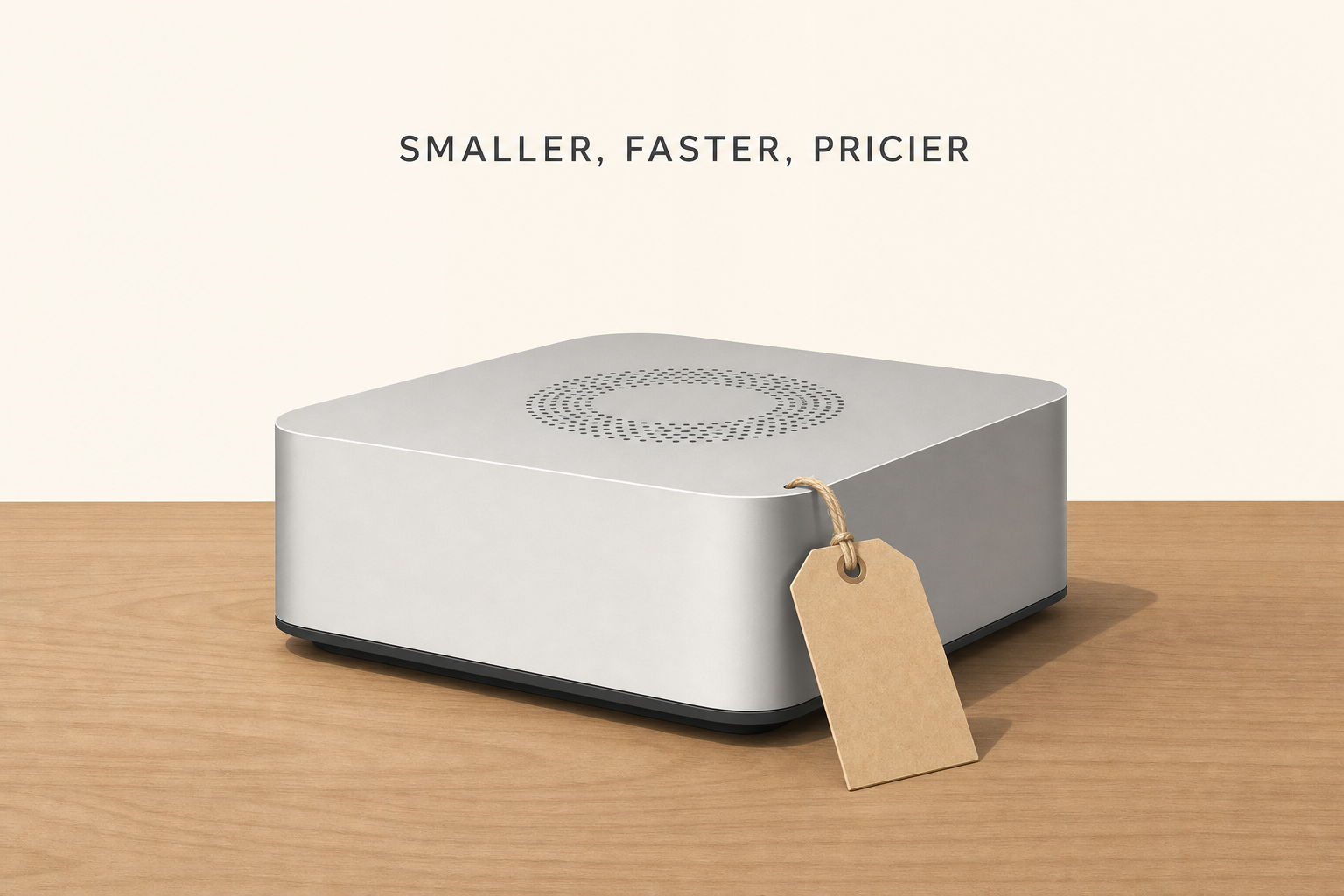
Same box as in 2024, within half a millimeter. What changed is inside, and on the price tag.
What's in the box
The new processor is called M6, and it's Apple's first etched at 2 nanometers. One vocabulary word, just one, and I promise it serves a purpose: nanometers are the size of the microscopic switches a chip is made of. The smaller they are, the more you can fit into the same square of silicon, and the less each one consumes. That's the whole race of the last twenty years summed up in one sentence.
The real change is elsewhere. This processor has two neural engines, whereas all of Apple's chips up to now had only one.
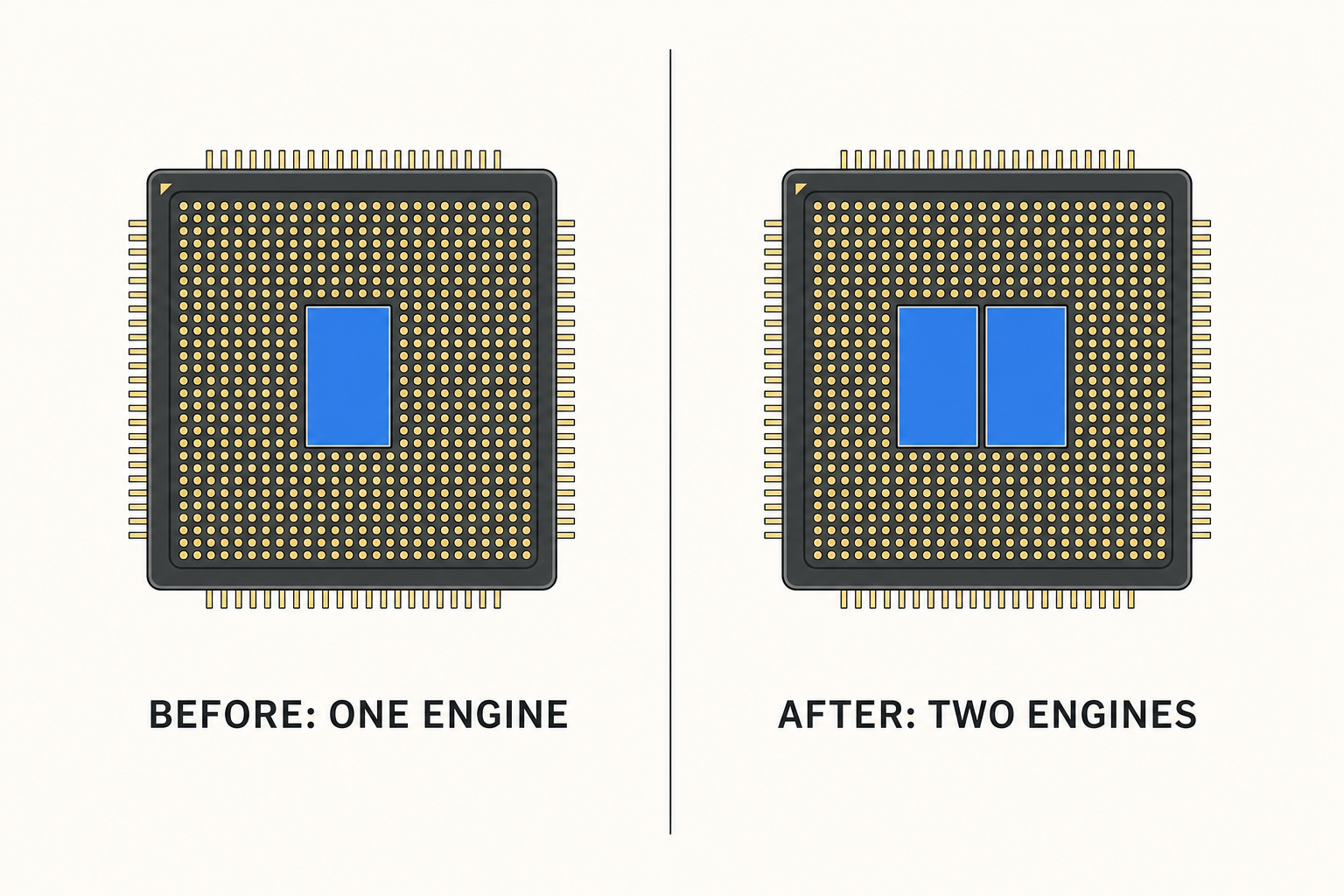
A neural engine is the part of the chip that only knows how to do one thing. It does it very well.
A neural engine is a part of the chip reserved for a single type of calculation, the kind that artificial intelligence software demands. Not general computing, not games: this thing, and nothing else. Putting in two is like opening a second checkout at the supermarket rather than hiring a faster cashier.
The figures announced by Apple, compared with the 2024 model: up to 40% faster in general computing, up to twice as fast in graphics, twice as fast at reading and writing files, and up to four times faster on artificial intelligence tasks. The rest of the specifications follow: latest-generation wireless networking, a 2.5 gigabit network port instead of just one, up to three displays.
A precaution as always: these figures come from Apple, they compare a new machine with a machine from late 2024, and the « up to » does a lot of work in the sentence. The real tests will arrive after September 22.
What good is a neural engine at your place?
Ask the question around you, you'll see: nobody knows. And that's normal, no press release ever answers it. They sell you a neural engine the way they would sell you a turbo, assuming you know what it's for.
Answer: things you already do without knowing they go through it.
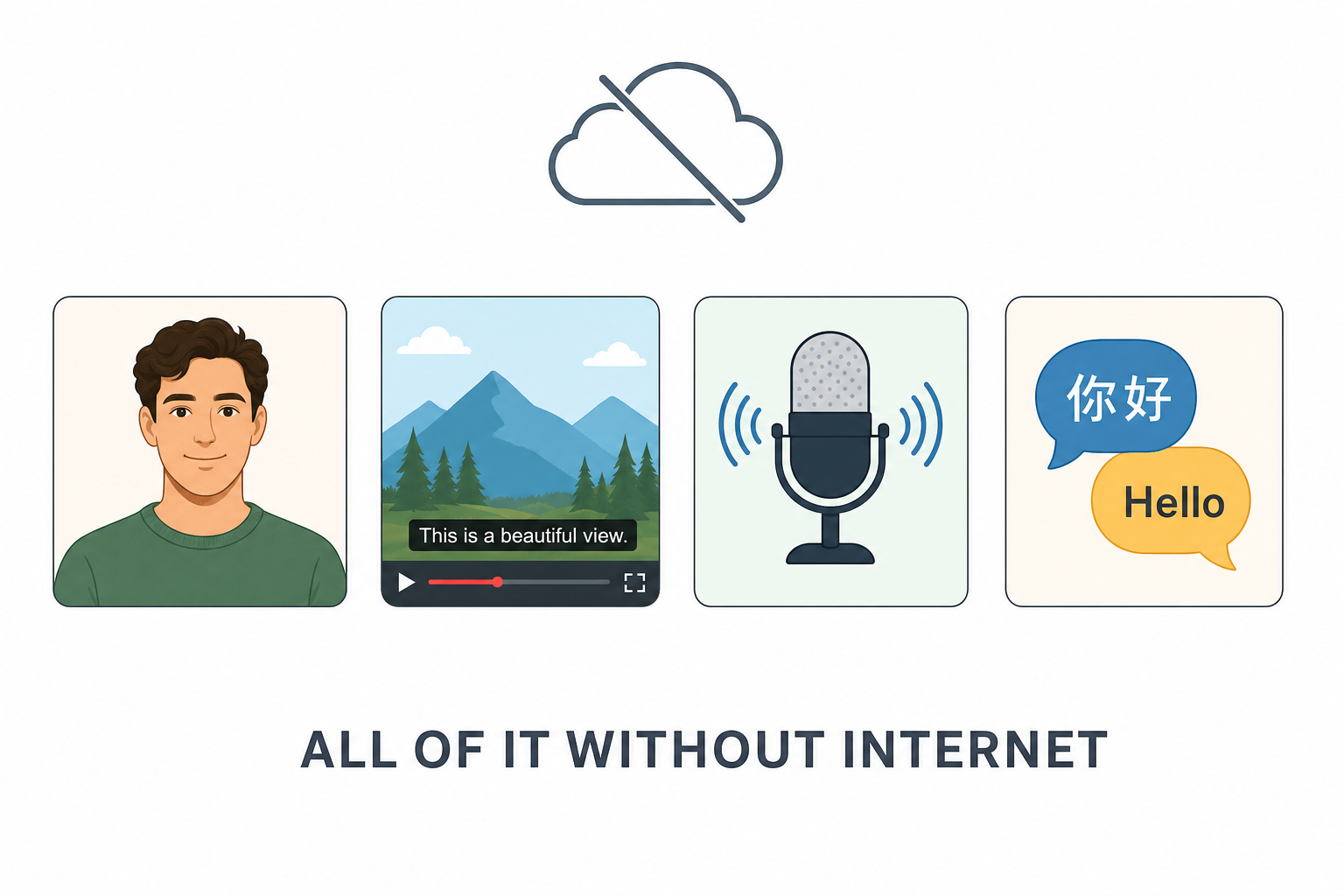
Four ordinary things. They have one thing in common, and it's the crossed-out cloud.
You hold down on a person in a photo and the phone cuts them out all by itself: that's it. You start a video and subtitles appear even though there aren't any in the file: that's it. You dictate a message instead of typing it, you translate a menu by photographing the card, you type « the sea » into your photos and find your 2019 vacation: that's still it. And on a video call, the blur behind your head that hides the mess in the living room, same thing.
The common point of these five examples isn't speed. It's that everything happens on the machine. Your photos don't go off to someone else's server to be analyzed, neither does your dictation, and it keeps working on a train without a network. Two engines instead of one means more things done at home, and fewer things sent elsewhere.
And if you've ever wanted to install one of those AI models at home that answer without the internet, this is exactly the machine that makes it comfortable. I talked about it a month ago with a model small enough to fit in a phone: on a box like this one, you go well above that.
Now, the price
899 dollars for the base version, with 16 gigabytes of RAM and 256 gigabytes of storage. These are American prices, displayed before tax, so you have to add VAT to know what it will come to here.
And there you have the trajectory, which is worth a look.
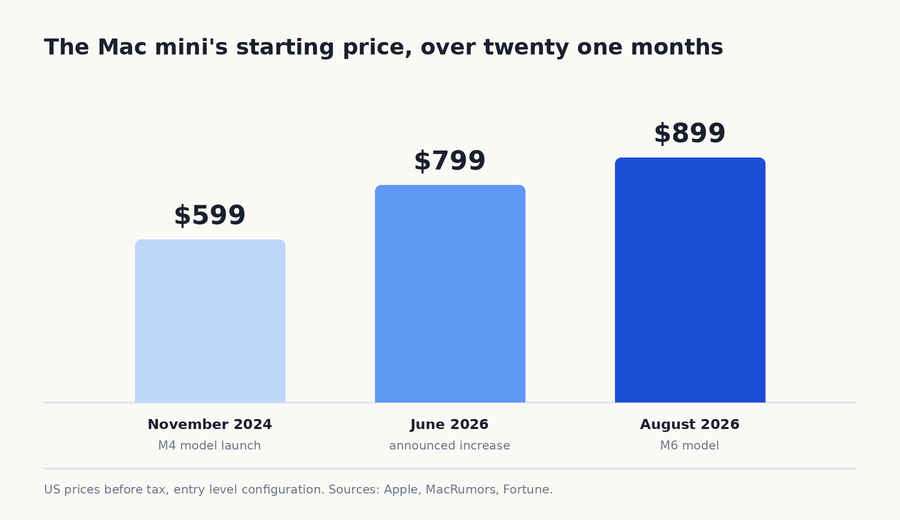
Three price tags in twenty-one months. Not one of them goes down.
In November 2024, this box started at $599, and that was the main argument: the cheapest Mac ever sold, the one you recommended to someone who wanted to try it without sacrificing a month's salary. In June 2026, Apple raised the entry-level price to $799. Yesterday, $899.
Apple itself gave the reason at the time of the June increase, and that's the interesting part: memory chips are getting more and more expensive because artificial intelligence data centers are buying everything that comes out of the factory. Apple explained that it had reached the point where it needed to start raising its prices. Translation: it's not your Mac that has gone up in value, it's the RAM they put inside it that's going somewhere else, and I was talking about it here six days ago because it doesn't only affect Apple, it affects everyone, right down to the memory stick you wanted to add to your PC.
If you're a developer
The rest is for you, skip it if you're not in the field, you won't have missed anything.
The number to look at is neither the 12 cores nor the four times faster, it's the memory bandwidth: 170 GB/s versus 153 on the M5. On a local language model, that's what caps token generation, not raw computing power, so it's the only number that really predicts what you're going to feel while typing. The dual neural engine mainly helps with prompt processing and batch processing.
Second number, and a more annoying one: unified memory tops out at 32 GB on the M6. That's what decides the size of the model you can load, and 32 GB puts the ceiling around a 27 to 32 billion parameter model quantized to 4 bits, with a reasonable context. Beyond that, you have to move up to the M5 Pro and its 64 GB, at $1,699, and then we're not talking about the same purchase at all.
A detail that matters if you plug in fast storage: the M6 comes with three Thunderbolt 4 ports, the M5 Pro three Thunderbolt 5 ports. It's the cheapest model that has the oldest connectivity, which is counterintuitive until you understand that the M5 Pro is a chip from a different range, released earlier this year.
So, do we buy it?
Personally, what bothers me isn't the increase. A faster machine that costs more, that's life, and given what memory is doing right now, I even think Apple is handling it well.
What bothers me is that we lost something along the way. The $599 Mac mini was the gateway in. The thing you recommended to a cousin, a student, someone who was hesitating. That door has just closed, and it didn't close because Apple got greedy, it closed because tens of thousands of servers somewhere needed the same RAM as you.
And to be completely honest, if you don't run any AI locally, if you do office work, if you browse, if you edit a video from time to time, the 2024 machine still does the job perfectly. It didn't suddenly start slowing down last night while you were asleep!
Sources
- MacRumors : Apple Announces New Mac Mini With M6 and M5 Pro Chips, August 25, 2026, complete technical specifications and prices
- 9to5Mac : Apple announces new Mac mini, here's everything new, August 25, 2026
- TechCrunch : Apple's latest Mac mini runs on a new M6 chip, and starts at $899, August 25, 2026, preorders in 30 countries, delivery on September 22
- Fortune : Apple raises Mac Mini's starting price to $799 after AI frenzy drains supply, May 2026
- MacRumors : Apple Hikes Mac Mini Starting Price Amid Rising Memory Costs, June 25, 2026
Join the conversation
You need an account to comment on this article. Creating one is free and takes under a minute.
No comments yet.