Chip prices are going up. Saturation caused by AI
The price of chips is going up. Saturation because of AI
Reuters broke the news on August 18: Samsung raised its chip manufacturing prices in July. Between 10% and 15% for the finest processes, around 10% for the older ones. And this is not an isolated move, the other major manufacturer started the same movement in January with a schedule of increases announced through 2029.
So yes, everything that contains a chip is going to cost more to manufacture. Is your next iPhone or Galaxy going to go up by 15%? We'll do the math at the bottom of the article, with the real figures, because that's the only thing we really care about and nobody is really clear about it.
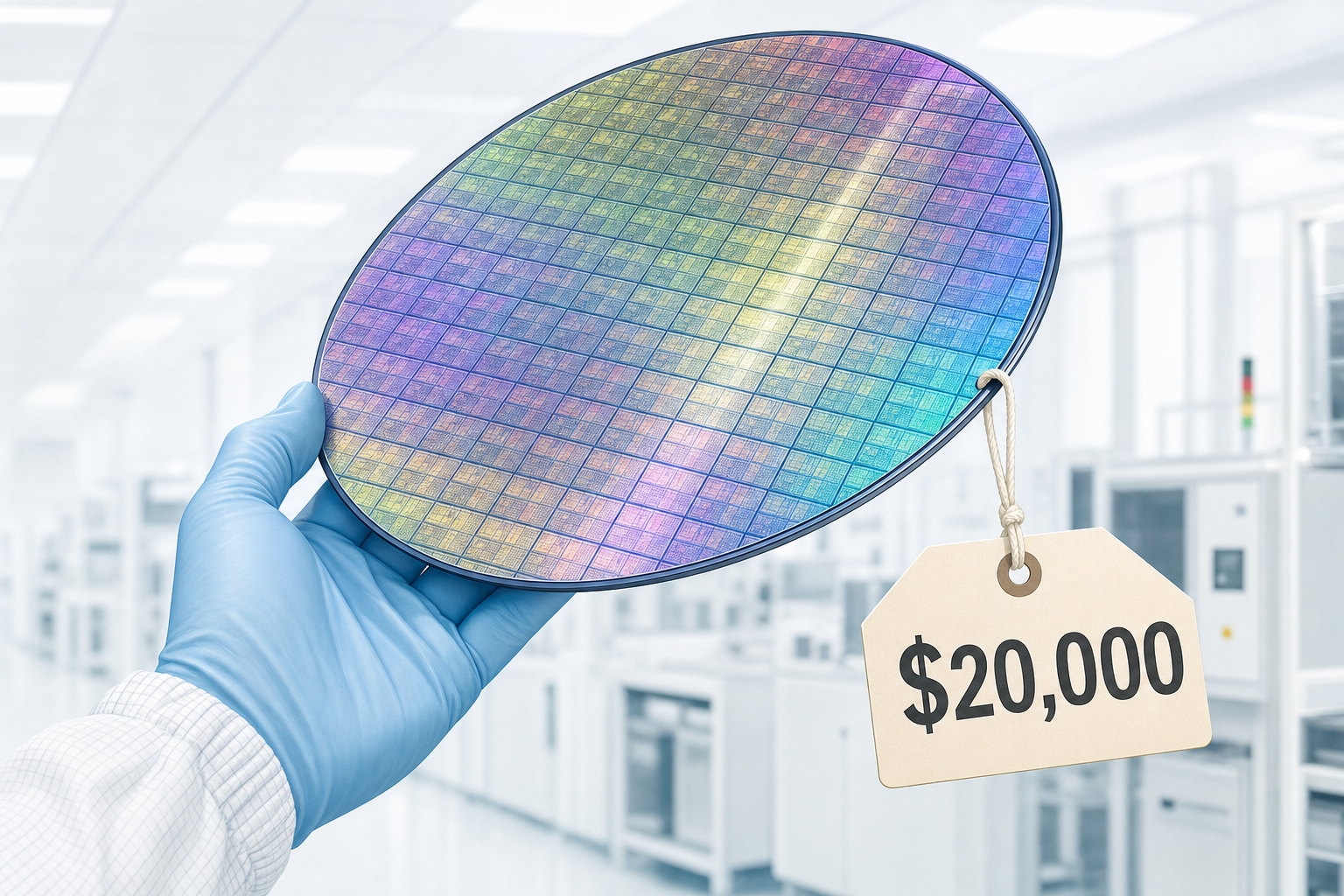
A wafer of chips costs about as much as a small used car. And it still has to be cut up.
Two minutes to understand who makes what
Apple does not manufacture the iPhone's chips. Nvidia does not manufacture its graphics cards. Qualcomm does not manufacture the chips in Android phones. These companies design the chips, like an architect designs a house, and then they send the plan to someone else who has the factory.
That someone else is called a foundry. There are two that really matter for the high end: TSMC, in Taiwan, and Samsung, in South Korea. They sell nothing to the general public. They do the engraving for others, and they send the bill.
And what comes out of the factory is not a chip. It is a large round silicon wafer about thirty centimeters across, on which hundreds of chips are engraved side by side, which are then cut apart. The price is counted per wafer, not per chip. Besides, when you don't cut it up, you get a chip as big as a plate, and that is indeed what some people are doing today for artificial intelligence.
A silicon wafer costs $20,000
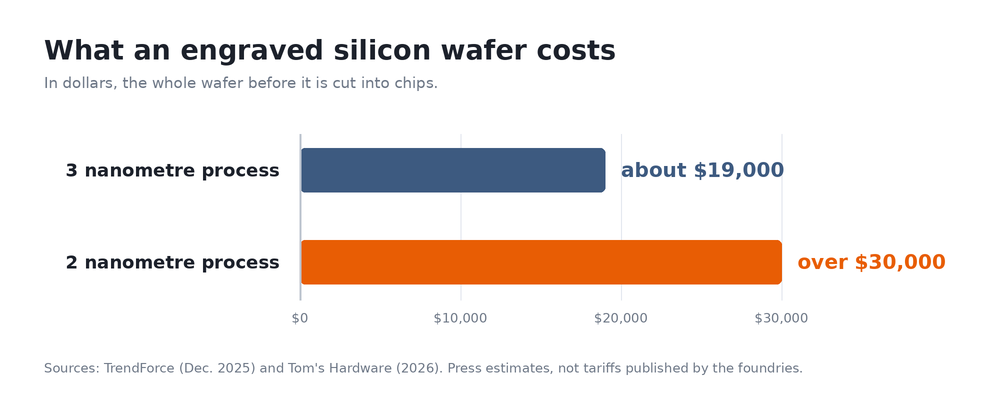
And it still has to be cut up, tested, partly thrown away, and packaged. Silicon is not the expensive part of silicon.
At the finest process available today, a wafer costs between $18,000 and $20,000. For the next generation, the one that's coming, people are talking about more than $30,000. The “nanometer” everyone talks about is the fineness of the design: the smaller the number, the more microscopic switches you pack onto the same surface, and the more powerful the chip is without consuming more. It is also what costs a fortune to develop, because at that scale you are engraving patterns smaller than a virus.
These figures come from the specialist press and not from an official price list: no foundry publishes its prices, these are contracts negotiated with each customer. But the order of magnitude itself is widely agreed upon.
The funniest part is knowing WHO is raising its prices
In the foundry market, in the first quarter of 2026, TSMC accounted for more than 70% of worldwide revenue. Samsung, around 7%. Ten times less. Samsung had lost customers, lost money, lost contracts, and a good part of the industry had ended up politely burying it.
And it is this company that has just raised its prices by 15%.
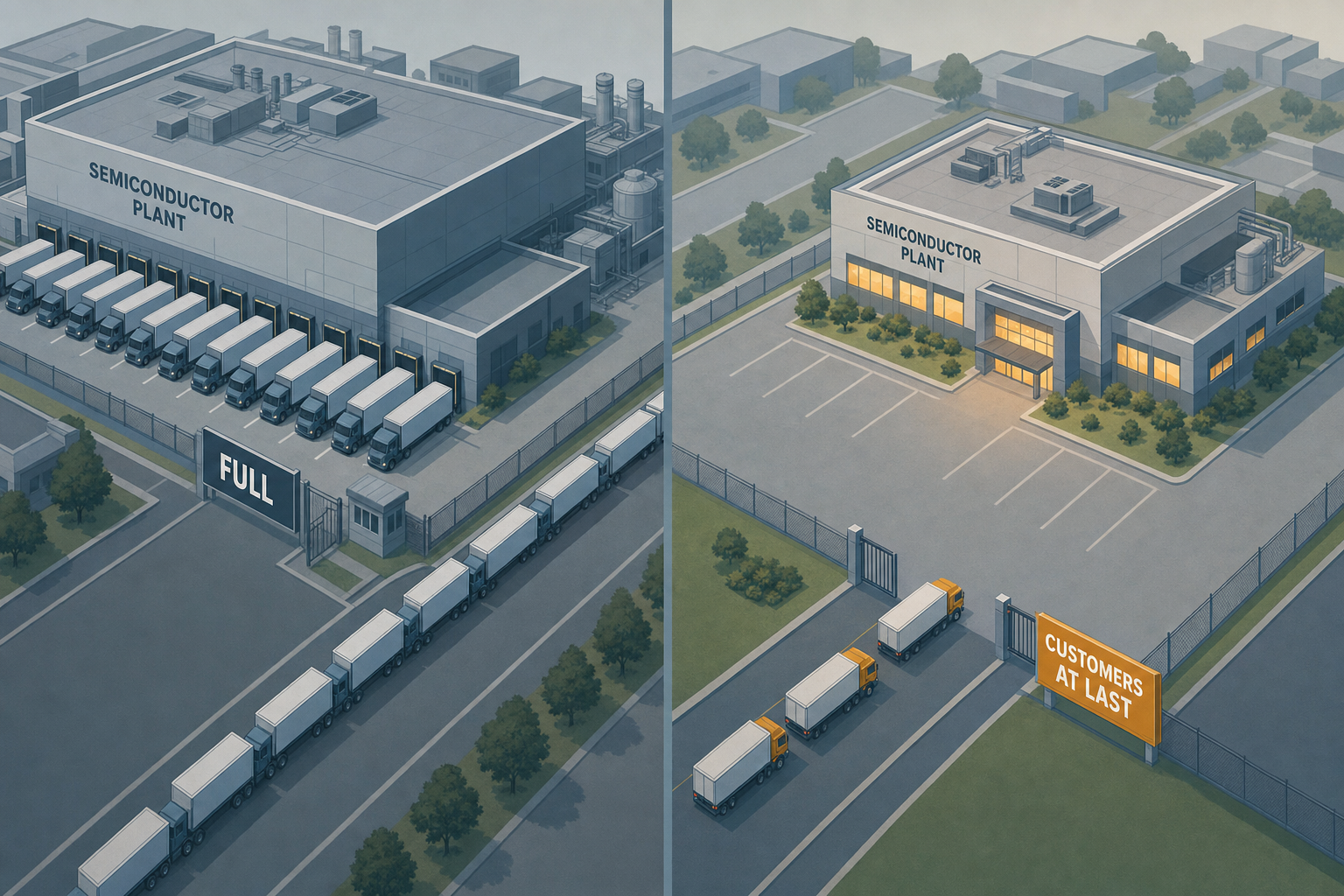
On the left, no more orders are being accepted. On the right, it is reopening its doors.
Why can it afford to do that? Because the factory opposite is full. TSMC's advanced lines are saturated by demand for artificial intelligence chips, and when the top student no longer takes copies, we go see the second one. Samsung's line in Pyeongtaek has been running at full capacity since the end of 2025, and the company is announcing double-digit growth in the second half of the year.
So I know an article about a price increase is supposed to be bad news, but admit that there is something pleasing about it. For years, the sector's great source of anxiety could be summed up in one sentence: a single company, on a single island, makes everything modern on this planet. A fire, an earthquake, a boat going astray, and the whole world stops shipping phones. Today there is a second plant running at full capacity. We pay 15% for it, and frankly, as an insurance premium, I've seen worse.
Okay, so what does that add to my bill?
There are people whose job is to take new devices apart piece by piece and estimate the price of each component. On the latest major iPhone, they come to about $408 worth of parts for a device sold for $1,199. And in that total, the main chip, the famous in-house processor, accounts for about $91.
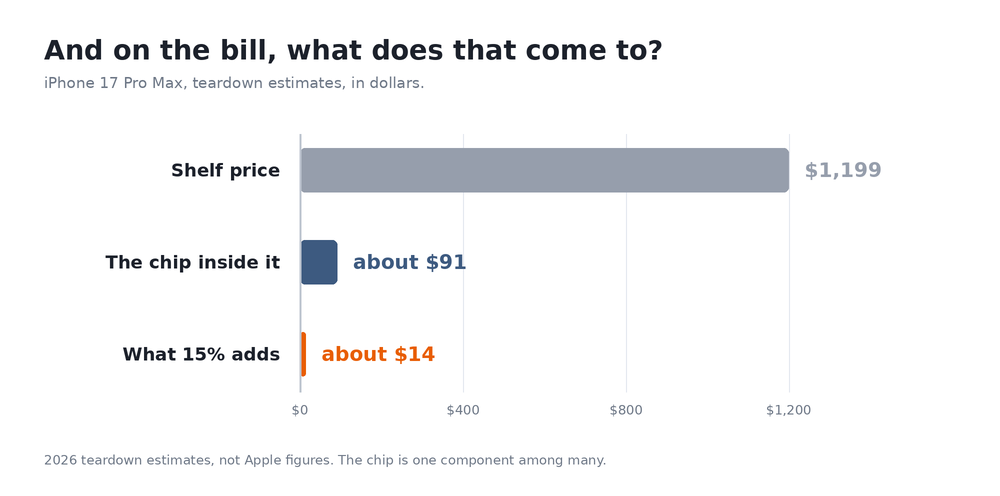
The top bar is what you pay. The bottom bar is what we've been talking about since the beginning of the article.
So 15% more for the chip comes to fourteen dollars. On a $1,199 phone. That is to say, practically nothing, about 1%, and far less than what the seller will take off your trade-in.
There, it's said. If you've seen a headline along the lines of “chips are going up 15%, your devices are going to explode”, you can turn the page. That's not how it works. The price of a phone is research, software, marketing, distribution, taxes and a margin, and the components are only one part of it.
Where it really hurts, though, is with things that are almost entirely chip. A graphics card, a server, an entry-level laptop: when silicon represents half of the manufacturing cost instead of one twelfth, you feel the increase. And on the machines used to run artificial intelligence, where tens of thousands of chips are stacked together, fifteen percent is no longer counted in dollars but in millions.
What I think
We've reached something I find fascinating: the demand for computing for AI has become so enormous that it is moving the price of things that have nothing to do with it. The chip in your washing machine, the one in your car, the one in your box: they come out of the same factories, and those factories are full because of servers you will never see.
I was pointing out yesterday that a small American company had just raised 700 million to manufacture chips that know how to do only one thing. That comes from the same place too: when factory space becomes the limiting factor, everyone is trying to fit more useful work onto the same area of silicon. It's not an engineer's whim, it's real estate.
And there is one thing I would never have bet on three years ago: Samsung is making a comeback. The company was written off as dead in this area, its yields were poor, its customers were leaving. Today it has a full line and it is raising its prices. That doesn't make it number one, there is a tenfold gap, but a second supplier that is breathing is good for everyone. Including you, who will never know which factory fabricated the chip in your phone.
So the next time someone explains to you over a family meal that their phone is expensive “because of artificial intelligence”, you can reply that yes, it's true, to the tune of about fourteen dollars. Enjoy your meal!
Sources
- Seoul Economic Daily : Samsung raises foundry prices up to 15% as TSMC capacity fills, August 19, 2026, based on Reuters (August 18)
- Tom's Hardware : Samsung raises advanced foundry prices by up to 15% as AI demand fills its 4nm lines
- TrendForce : TSMC reportedly to raise sub-3nm prices 3 to 10% in 2026, plans hikes through 2029
- Tom's Hardware : TSMC is reportedly hiking prices for all advanced nodes
- Teardown estimate of the iPhone 17 Pro Max (cost of parts, third-party figures)
Join the conversation
You need an account to comment on this article. Creating one is free and takes under a minute.
No comments yet.