Google offers to buy all the internal data of a company... in bankruptcy
Google buys the data of a company... in bankruptcy
Spirit Airlines grounded its planes and handed back the keys on May 2, at 2:30 a.m. Thirty-four years as an airline, seventeen thousand people out from one day to the next, that's no small thing, and since then, lawyers have been selling off the pieces. The planes, the simulators, the service carts, the coffee machines. The routine of a liquidation.
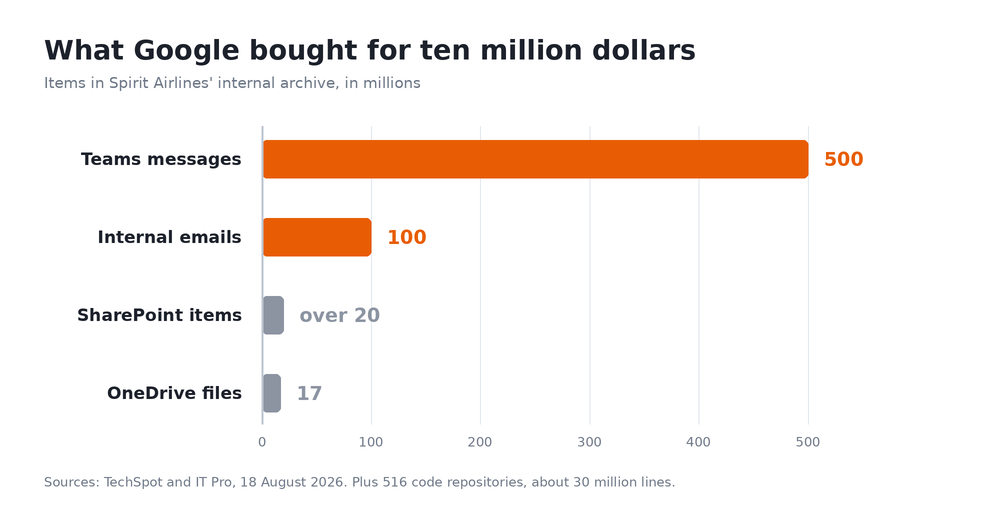
Except that on Monday, there was something unusual. Google is interested in the employees' emails. One hundred million emails. Five hundred million Teams messages. Google paid $10 million for the whole lot. Why buy emails for $10 million?
And they weren't the only ones: there were two other buyers in the room.

Lot number 12: years of internal email.
What's exactly in the box
The inventory is enough to make your head spin, and it's public because a bankruptcy sale goes before a judge. One hundred million internal emails. Five hundred million Teams messages, meaning Microsoft's business messaging service, the thing where you write “is this good for you?” fifteen times a day and paste screenshots. Seventeen million OneDrive files. More than twenty million SharePoint items. And five hundred sixteen code repositories, or about thirty million lines of software written in-house.
Good luck reading all that!
With that come the pricing models, booking curves, crew schedules, fuel vouchers, financial databases and customer service procedures. In other words: not only what people said to each other, but everything they were working on while saying it.
Do the math, it's instructive. Ten million dollars for six hundred million messages puts each message at about one and a half cents. The lot also contains the code and databases, so take it as an order of magnitude and not as a price per pound. But the order of magnitude is enough: your Friday night email saying “okay, have a good weekend” is worth exactly the same price as the three-page one where you explained why the project was heading straight into a wall. The market doesn't do nuance.
What is NOT in the sale, and this is important: passenger data, the loyalty program, bank cards, and everything that identifies a person. An outside provider has to clean the archive before Google touches it, at Google's expense, with Google undertaking by contract not to try to put the names back together.
Why an email archive is worth ten million dollars
Here, you need to understand what Google is really buying, because it's not what you think.
It's not buying information. Nobody gives a damn about the price of kerosene in 2019. It's buying behavior. The way normal humans, in a normal company, make a decision, coordinate, screw up, fix things, chase the colleague who doesn't answer three times and end up bypassing the official procedure because it doesn't work.
And that, no documentation contains. Documentation explains how the system is supposed to work. A thread of forty Teams messages explains how it really works, with the colleague who replies “oh yeah, that's been broken since March, you click twice and it goes through”. Guess which of the two teaches a machine the trade.
That's exactly the fuel missing from the models I was talking about last week, the ones that are no longer trying to answer faster but to work for longer, on tasks that take several hours. To handle a long task, you need to have seen what a workday that goes off the rails looks like. Not a workday from a manual.
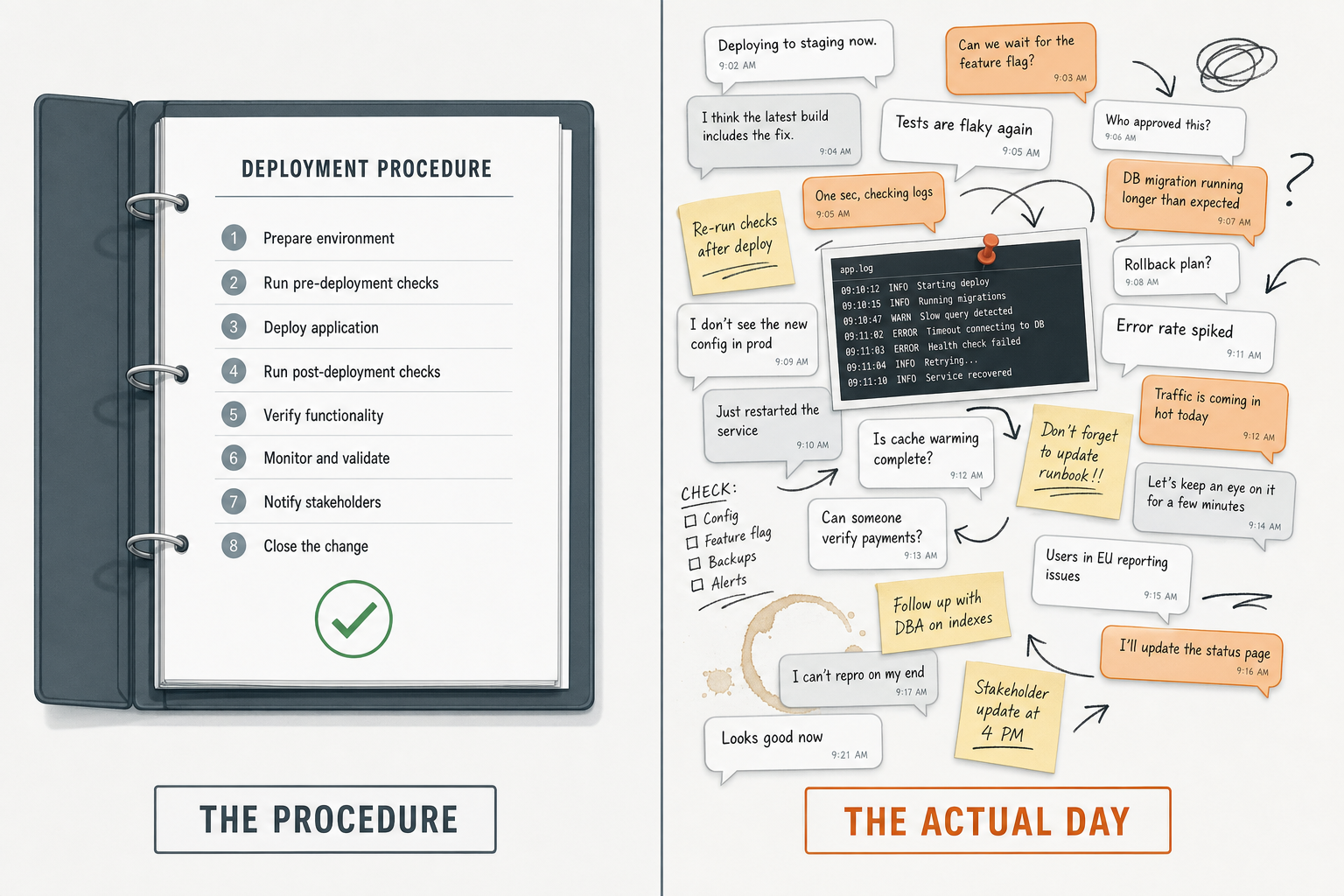
On the left, what the procedure says. On the right, what really happened.
Google says it plainly, in a communicator's phrase so flat that it becomes honest: this dataset « may help improve our products and AI models ». That's it. No grand speech.
And your emails?
Right. I don't know if you realize. You have never worked at Spirit Airlines, and you're wondering what this has to do with you. Three things, and the first one may surprise you.
One. Your work emails don't belong to you. And let's be frank, your personal emails aren't much more yours if you use Gmail, Hotmail or anything else: they sleep on someone else's servers. At the office, it's worse, your emails belong to your employer, to the company, just like the chair you sit on. This isn't new, it's employment law in pretty much every country in Europe. What's new is that this chair now has resale value. If your company disappears, everything you did there goes with the rest of the furniture, and there are now people raising their hands in the auction room and buying the traces you left behind.
Two. It already existed, but not for you. When a company is liquidated, its customer database has always been sold, it's often even the only asset left. The new thing isn't the sale of data. It's that it's no longer the data of the CUSTOMERS that's worth the most, it's the conversations of the EMPLOYEES. Nobody had predicted that the residual value of an airline would be in its written hallway conversations.

Everything in an office has a resale price. Since Monday, your mailbox does too.
Three, and this is the good side. Because there is one: the AI assistants sold to you as being capable of managing your office work are currently trained on clean texts, anything but real LIFE: documentation, manuals, forums. A model that has read six hundred million real messages from a real mailbox may finally understand that an urgent request shouldn't be accepted on a Friday evening at 6 p.m., and that it's better to put it off until Monday.
In any case, Google and its competitors are real vacuum cleaners for anything and everything, as long as it feeds their AI. Let's just hope the AI doesn't become even stupider as a result. If the company's employees did nothing but play cards all day, we might get a great civil-servant AI!
What bothers me, and what doesn't
What doesn't bother me: the principle. A dead company, company data, a buyer, a judge, a contract that forbids reidentification and a contractor paid to remove the names. It's regulated, it's public, it's infinitely cleaner than the hundred ways our data circulates every day without anyone signing anything.
What bothers me is the word « anonymized », because that word mostly sounds like a shortcut.
Removing the names, addresses and numbers from twenty years of messaging, technically, we know how to do that. Removing the context, no. All it takes is a “I’m leaving early on Thursday, I’m picking up the kids from school” or “what are we eating tonight, darling?” in the middle of a thread for the name to become pretty useless: there’s only one person in the department who leaves early on Thursdays, and everyone knows who it is. Multiply that by six hundred million messages written by people who thought they were talking among themselves. I’m not saying it’s going to go badly. I’m saying that “anonymized” describes an intention, not a guaranteed result, and that no one will be able to verify it from the outside.
And then there’s the detail that sticks in your throat. Those seventeen thousand people lost their jobs on May 2. They weren’t consulted, they have nothing to say about this sale, and they obviously won’t receive a cent of the ten million. Their words, on the other hand, will keep working. It’s legal, it’s logical, it’s even provided for by bankruptcy law. It’s still a little sad.
Anyway. If you were planning to write to a colleague today, go ahead. Just remember not to write any nonsense, you never know who’ll reread it in fifteen years.
I have one last question: how long before we see Google send a representative, after someone’s death, offer the family to vacuum up all of that person’s data, the emails, the letters and all the traces they left from birth to death, for a few peanuts... just to feed its increasingly hungry AI?
Join the conversation
You need an account to comment on this article. Creating one is free and takes under a minute.
No comments yet.