For now, this chip can hold only four atoms. That's exactly how computing began.
This chip holds only four atoms. The beginning of a new computing era?
On August 10, a French company called Pasqal announced something that sounds tiny, but really isn't. It managed to trap four atoms, one by one, and then keep them suspended in the air for twenty-seven seconds. Not with a clamp. With light. And above all, with light produced by a small chip about the size of a fingernail.
I know, put that way, you're probably wondering what it's useful for. Give me two minutes; it's worth it.
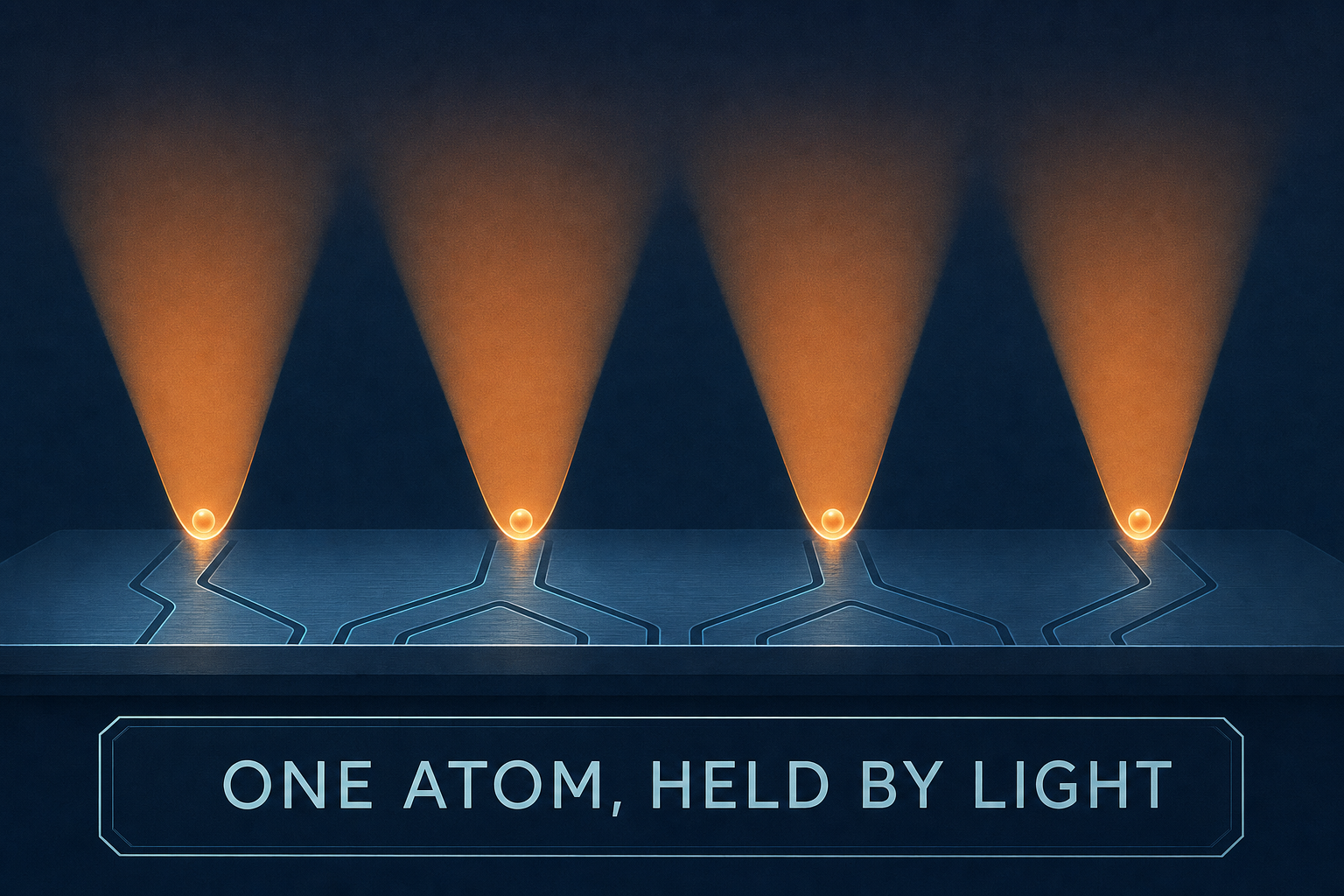
An atom at the bottom of a hollow in the light. Nothing touches it.
An atom placed in a hollow of light
Let's start with the strangest part, because it's also the prettiest.
When a laser beam is strongly focused, something counterintuitive happens. An atom passing nearby is drawn toward the brightest spot. It slides in and stays there, like a marble at the bottom of a bowl. This is called an optical tweezer. There is no contact and no wall. Just a hollow created by light, with a quiet atom at the bottom.
The atom in question is rubidium, a soft metal that is cooled almost to absolute zero. Once placed in its hollow, it serves as a unit of computation. This is called a qubit, the quantum equivalent of the 0 or 1 in your computer. Except that it can represent both at once as long as it isn't measured. Yes, it's strange. No, nobody thinks it's normal, not even the people who make them.
Where it gets interesting is that, to build a computer with this system, four atoms aren't enough. You need thousands of them, each held by its own beam and aligned to within a micron. That's where things have been stuck for fifteen years.
What it replaces, and frankly, it hurts
Until now, these beams came from an optical table. Imagine a platform the size of a dining-room table, resting on legs that absorb vibrations. It's covered with mirrors, lenses, and small motors, with beams zigzagging between the components. Everything has to be aligned by hand, in a room where the temperature is controlled, by people holding their breath.
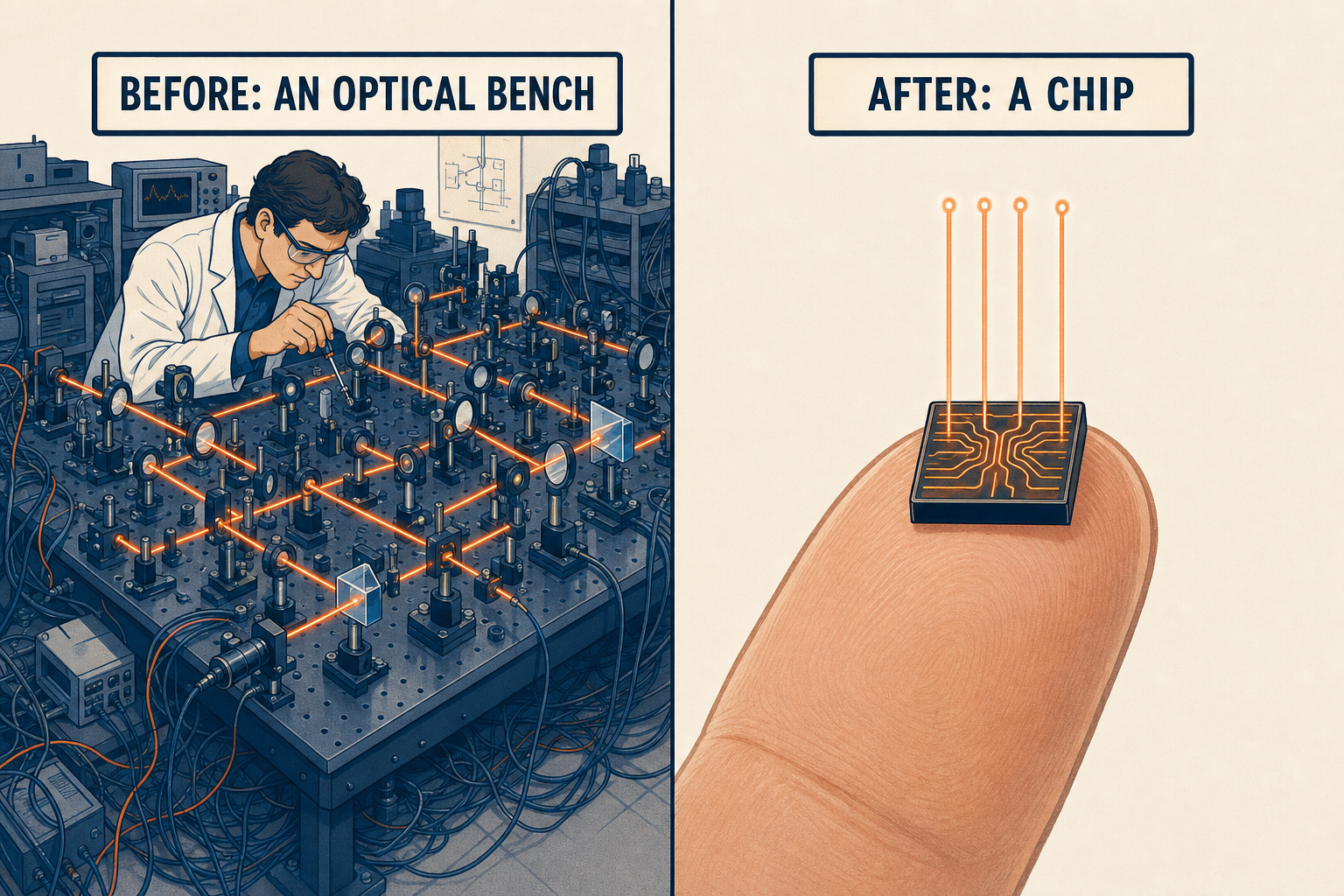
On the left, an entire room and a screwdriver. On the right, something that fits on a finger.
It works very well. But it can't be mass-produced. You can't produce a thousand optical tables aligned by hand. You can't stack them in a server rack either. This kind of problem isn't solved by simply working harder.
Pasqal therefore etched the same functions into a silicon nitride chip, a glass-like material that is deposited much like it would be on an ordinary chip. Light travels through tiny transparent waveguides carved into the material. It emerges from the top and forms the hollows that trap the atoms. Announced result: the optical system takes up as much as fifty times less space and holds the atoms for twenty-seven and a half seconds. That's exactly the same duration as with the large table. The company's CEO, Wasiq Bokhari, says he has “removed what we believe to be one of the biggest obstacles to scaling up.” In other words, one of the main barriers to building larger machines. For once, the corporate phrasing isn't completely off the mark.
The chip comes from Aeponyx, a Canadian company specializing in photonics, meaning components that manipulate light. Pasqal acquired it in June 2025. Buying an optical chip manufacturer and presenting this demonstration fourteen months later is a pretty good move.
Four. Not four thousand, four.
Now for the cold shower. I'm not going to sell you a dream.
The chip holds four atoms. Four. Meanwhile, the machine Pasqal is already operating with its large optical table lines up one thousand and twenty-four atoms on a grid, without leaving a gap. Announced last April, it had already doubled the record set by the company in 2024.
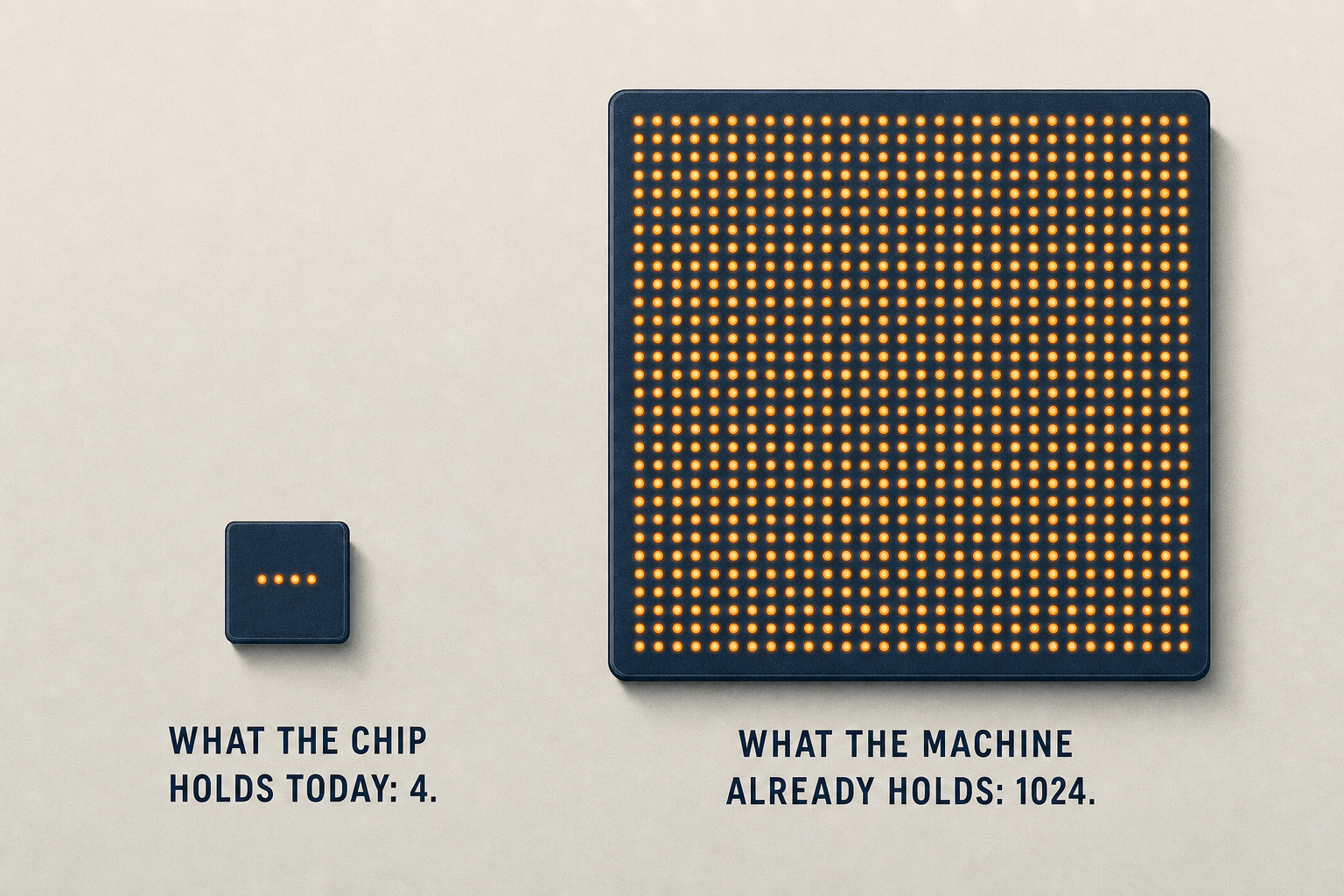
The demonstration on the left. The machine that already exists on the right. There, now it's been said.
In other words, the demonstration on August 10 held two hundred and fifty-six times fewer atoms than the machine next to it. It is a proof of concept, meaning a demonstration intended to show that the method works. It is not a product. Anyone who tells you otherwise this week has not read the press release.
So, why am I writing an article about it?
Because this is exactly the story of the integrated circuit
Back in time. At the end of the 1950s, a computer took up an entire room. Cabinets were filled with separate components, connected one by one by hand by patient people. It worked, but it could not be mass-produced either.
In 1958, Jack Kilby placed several components on a single wafer. The following year, Robert Noyce found a way to connect them properly. Their first integrated circuit looked ridiculous: just a few components, with less power than the era's large cabinets.
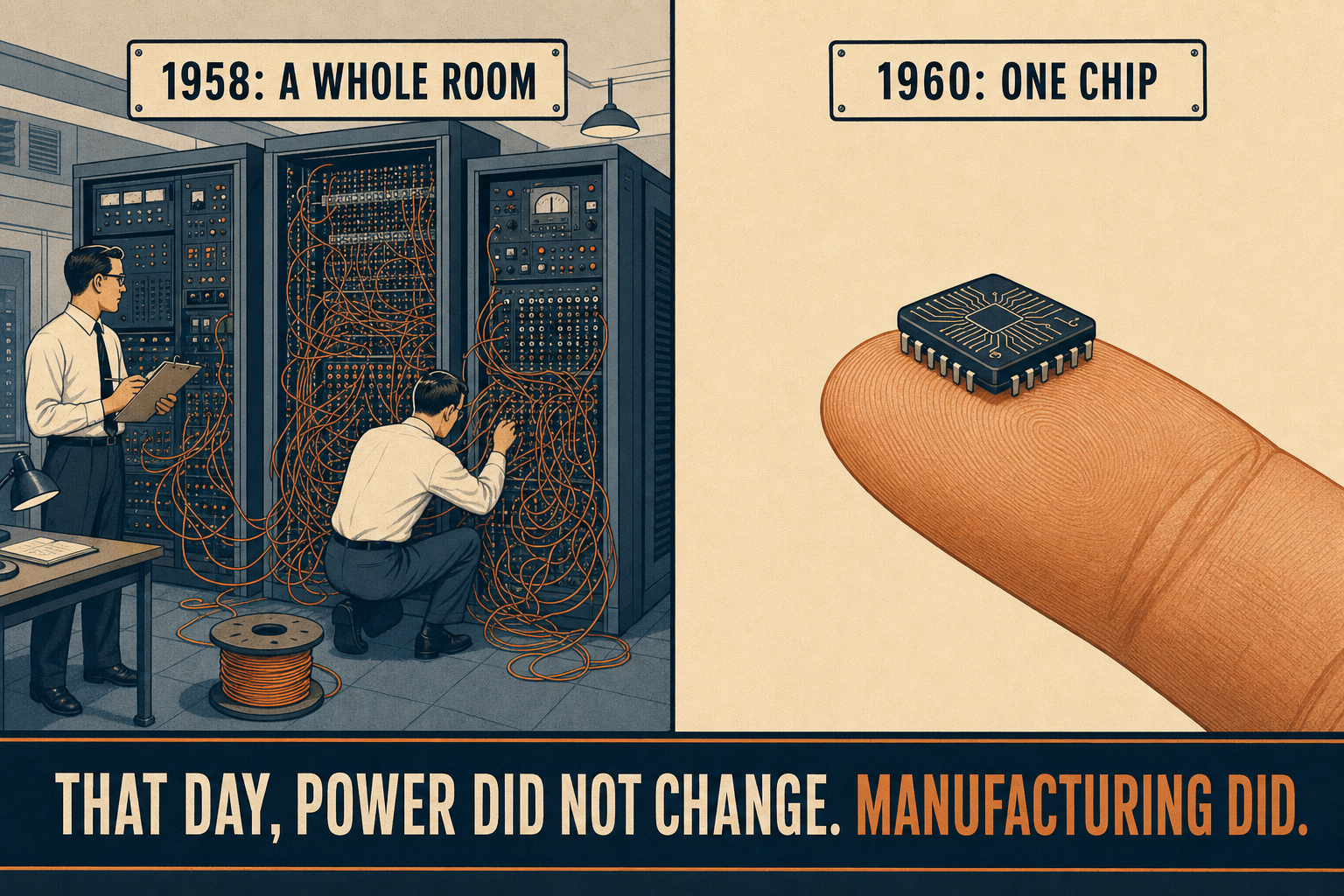
The thing on the right was less powerful than the one on the left. And it won everything.
That day, the power did not change. The manufacturing did. We went from an object assembled by hand to an object that could be printed. From there, everything else became possible, all the way to the phone in your pocket.
Today's quantum machines are at exactly the stage of the hand-wired cabinet. Four atoms on a chip is not much. It is even a little ridiculous. But that is precisely the kind of small breakthrough that matters. The question is no longer just “how many can we fit?”, but “can we manufacture this system in a factory?” The answer has just shifted from no to maybe.
What does this concretely change for you?
Honestly? Nothing. Not this year, not in five years, and perhaps never. I would rather tell you right away than sell you a quantum computer for your living room. That one is not coming. It is not even planned.
These machines are used neither to launch a game nor to open your emails. They are used to calculate the behavior of molecules. Our classical computers do this very poorly, because a molecule is itself a quantum object. Simulating its behavior with 0s and 1s requires an enormous amount of computation.
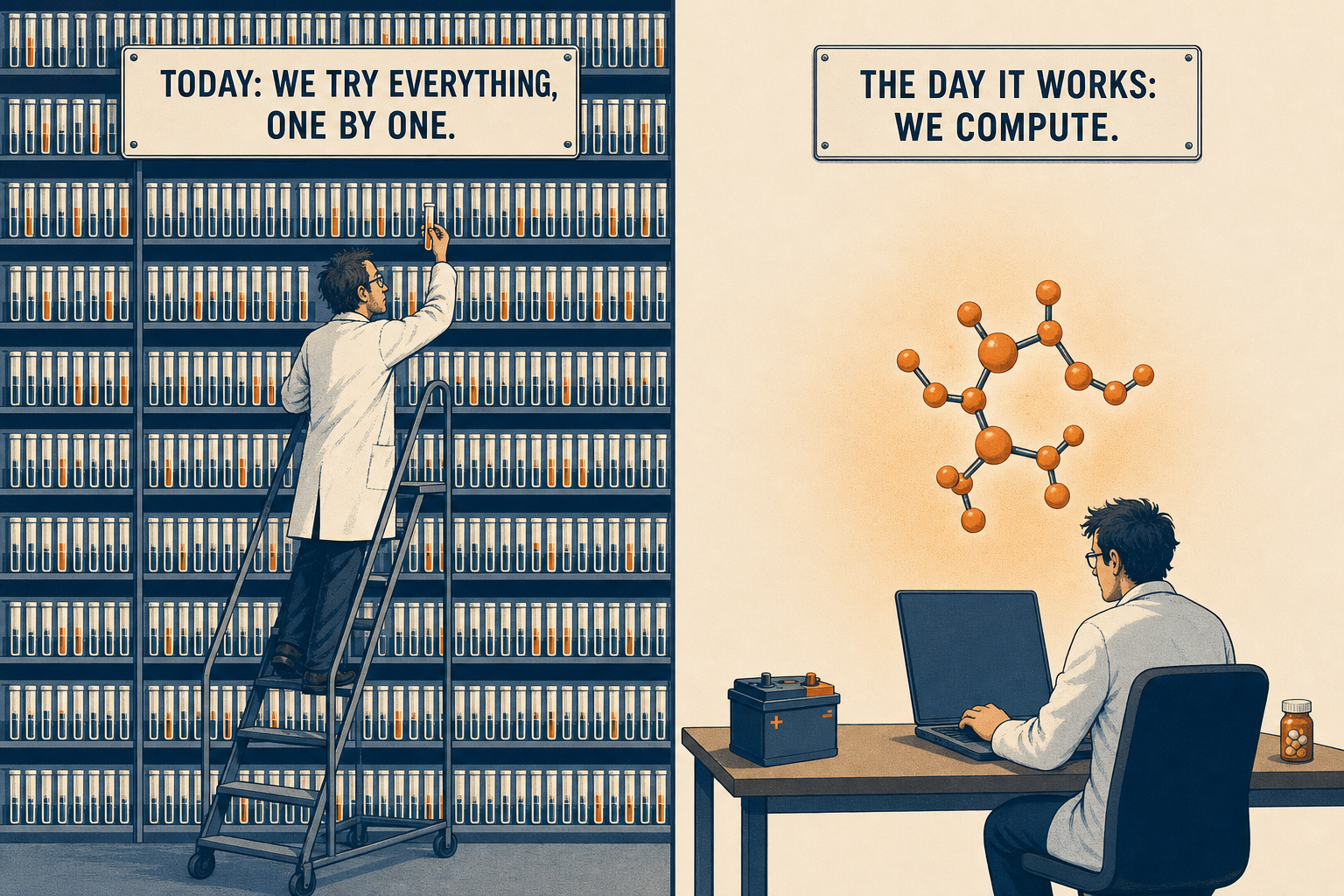
The real challenge is not speed. It is to stop trying at random.
Today, when we look for a better battery or a new drug, we test. Thousands of combinations, at the lab bench, one by one, over the course of years. The day we learn how to do these calculations instead, we will save those years. We will be able to get batteries that hold their charge longer in your car and your phone, drugs designed in a few months rather than over several decades, and fertilizers made without swallowing up the output of a power plant. That is the real goal. It is not about going faster; it is about stopping the trial and error.
And if you think we are funding a lot of people to capture four atoms, remember the laser. In 1960, the press described it as a solution in search of a problem. No one could see what it might be used for. Today, it reads the barcodes on your groceries, engraves your license plates, carries the internet to your street through fiber optics, and performs eye surgery. It took twenty years for people to find uses for it.
What I Think
I like this announcement precisely because it is not spectacular. Quantum technology has accustomed us to grandiose press releases and qubit records that do not mean much. Here, it is the opposite. A team packs its entire cumbersome setup into a chip and achieves exactly the same performance as before. No better. The same. But in fifty times less space.
In computing, the progress that matters has almost always looked like this. It is not the thing that goes faster; it is the thing we become capable of manufacturing at scale. The transistor, the chip, the hard drive, fiber optics: each time, the real turning point was industrial rather than scientific. And each time, it seemed a little underwhelming on the day of the announcement.
So no, you will not have a quantum computer. But if, fifteen years from now, someone finds a battery material that has been sought for fifty years, there is a chance it all started with something like this. Four atoms placed on beams of light, one Monday in August, in a press release that almost no one read.
Join the conversation
You need an account to comment on this article. Creating one is free and takes under a minute.
No comments yet.