On August 31, Chrome wipes out the last real ad blockers. Edge started last week.
On August 31, Chrome wipes out the last real ad blockers. Edge started last week.
In sixteen days, Google will remove from the Chrome Web Store all extensions that have not adopted its new format. The real uBlock Origin is one of them. On August 7, Microsoft announced that Edge would do the same, effective immediately.

The bouncer has left. In his place, a printed list taped to the door. Guess who gets in anyway.
If you block ads with an extension, what's coming concerns you. If you block nothing, you'll understand why some people care so much about these tools.
What exactly is happening, and what isn't
Let's start by cooling things down. Half the articles on the subject are talking nonsense.
On Chrome, the real uBlock Origin no longer works. It has been forcibly disabled since July 2025, with no button to reactivate it. Version 139 of the browser also removed the setting that allowed companies to get around it. On August 31, its listing will disappear from the store. There will be no more updates and, if you uninstall the extension, you will no longer be able to reinstall it. Google locks the door after making everyone leave.
On Edge, the process is starting now. In its August 7 article, Microsoft explains the method in detail. Warnings will first appear on the extensions page. Then, extensions in the old format “will progressively be disabled by default” over the coming months. Test versions will be affected first, then the normal version. For the general public, everything will be over by the end of 2026. Computers managed by a company will get a reprieve until the beginning of 2027.
Want to know where you stand? Paste one of these three addresses into your browser's address bar.
chrome://extensions      Chrome
edge://extensions        Edge
about:addons             Firefox
Why an ad blocker needs to be a bouncer
You first need to understand the mechanism. Otherwise, you can't see why people have been complaining for four years.
With the old format, the extension sits between the page and the browser. It sees every request go by, meaning every request sent by the page to load a file, an image or an ad. It examines them one by one before they leave. This one gets through, that one doesn't, and this other one deserves a check. It's a bouncer in front of a door. He looks at every face.
With the new format, the extension can no longer examine every request. It provides the browser with a list of rules in advance, then the browser applies them. This list has a maximum size and it is prepared in advance. Nobody judges each case when it shows up. It's an A4 sheet taped to the door with the forbidden names.

The man with the fake moustache, on the right, wasn't on the list. Technically, he's in the clear.
Concrete consequence, uBlock Origin Lite, created by the same author for the new format, doesn't do the same job. The main problem isn't even what it blocks, but how quickly it reacts. Its filters arrive with the extension's updates. They therefore have to go through the store's review. When a site changed the way it displayed ads on a Tuesday, the old version could strike back within the hour. The new one waits for the store to finish reviewing its code.
| What we're comparing | uBlock Origin (Firefox) | uBlock Origin Lite (Chrome, Edge) |
|---|---|---|
| Decision for each request | Yes | No, rules prepared in advance |
| Number of rules | No imposed limit | Capped by the browser |
| Hide elements on a page | Complete | Very limited |
| Filter lists | All of them, including yours | A selection |
| Response time | A few hours | The time it takes the store to review it |
Microsoft's figures, and the one that's missing
Microsoft accompanies its announcement with three carefully chosen figures. Among the most-used extensions in its store, 95% have already switched to the new format. Only 58 extensions in the old format remain with serious usage. Of these 58 extensions, only 3 have no modern version available.
Translation: move along, everything's sorted. Only three stragglers remain.
Except one figure is missing: the number of users of these three extensions. And they aren't necessarily stragglers. Their very function may be incompatible with the new format. We're not talking about a developer who didn't have time to fill out a form. We're talking about a tool that can no longer work with the new rules. Counting extensions instead of their users is a very polite way of declaring the problem solved.
What you do this weekend
You have three options. I'll give you mine at the end.
First option, Firefox. In its own version of the new format, Mozilla kept the capability Google removed. The real uBlock Origin therefore works there in full. On Mozilla's store, it shows 10,545,700 users, a rating of 4.8 out of 5 from nearly 22,000 reviews and a version 1.73.0 updated on August 5. This isn't exactly an abandoned project at the back of some garage.
Second option, Brave. This is where many articles get it wrong by claiming that Firefox is the last resort. Brave distributes four extensions in the old format itself, including uBlock Origin, and promises to do so for as long as possible. The problem is that "as long as possible" isn't a date. Recent test versions have already disabled them. I wouldn't make this a five-year plan.
Third option, you change nothing and install uBlock Origin Lite. It comes from the same author, it's honest about its limitations and it still blocks the vast majority of ads. You won't be sent back to 2005, with twelve windows opening on their own.
Personally? Firefox for browsing, and I keep Chrome open next to it for the two company websites that only work with it. I've been doing this for fifteen years and I've never had to pick a side.
Concretely, what does this change for you
If you've never installed an ad blocker, the question is legitimate: why get worked up over a simple extension?
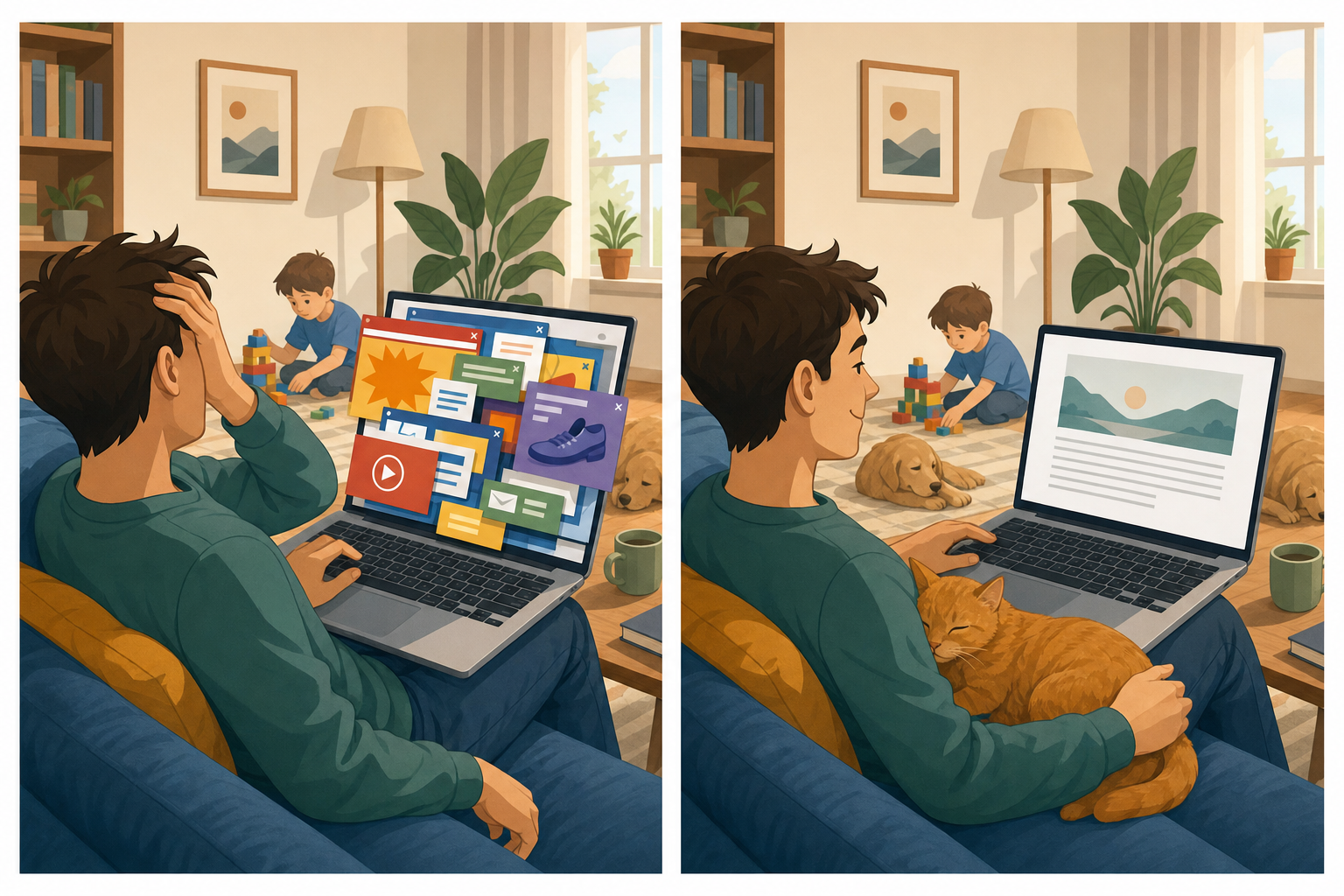
On the left, a normal recipe website in 2026. The recipe is somewhere, apparently.
Three very down-to-earth things. The recipe page for Sunday’s cake, where the list of ingredients hides behind four banners and a video that starts by itself. The mobile data eaten up when you read the newspaper on 4G, because ads often weigh more than the article. And your mother’s old laptop, which crawls less with an ad blocker than with an extra stick of memory. The blocker also costs significantly less.
Let’s be honest: after August 31, no one will wake up to a screen covered in ads. uBlock Origin Lite will keep doing its job. The difference will show up mainly on sites that change their methods every week, especially video platforms. There, the race between ad networks and blockers is played out in days, not months. It will be a slow degradation, not a sudden outage.
We’ve already lived through a comparable situation. In 2004, pop-up windows made the web hellish. Extensions solved the problem before browsers integrated their own blockers. The difference is that back then, no one made a living selling those windows.
What I think
Google’s official argument holds water. We have to admit it. An extension capable of seeing every request can also see everything you do. Real nasty stuff has already been sold as blockers. Limiting that power is therefore not absurd.
The problem is knowing who sets the limits. The company that makes its living from advertising also writes the technical rules for the browser used by everyone. It’s still the one deciding what a blocker is allowed to see. Even assuming that everyone is acting in good faith, this position remains untenable. Microsoft could have differentiated itself on this point. It prefers to follow without question. This mainly shows how costly it is to maintain a browser that is genuinely different from Google’s.
So yes, I’ll check my extensions this weekend. And I’m thinking again about a phrase we used to hear twenty years ago, back in the days of Internet Explorer 6: it’s better that several browsers exist. We were right. We eventually won. And now we have to learn the lesson all over again.
Join the conversation
You need an account to comment on this article. Creating one is free and takes under a minute.
No comments yet.