Meta releases a model for free download, and this one runs on your graphics card
Yesterday, Meta released a 30-billion-parameter model for free download, under the Apache 2.0 license. It's called Muse Glimmer. Yet four months earlier, the company had slammed the door on open source.
What interests me here isn't its size. It's that it combines two qualities we rarely saw together: it fits in a desktop machine and it can work autonomously.
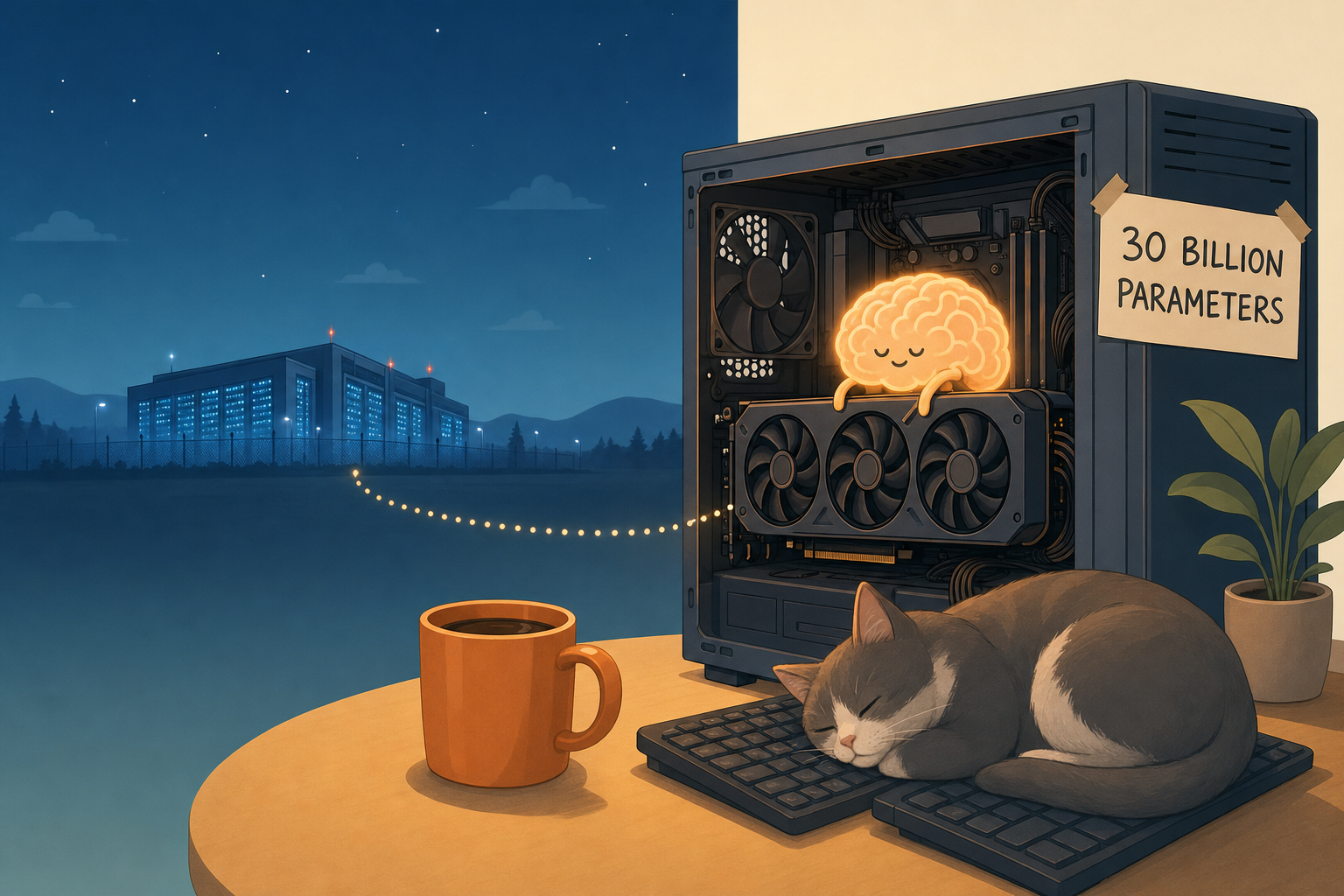
No need to have a brain in a data center anymore; I'm quite happy here in a PC now.
April: Meta closes. August: Meta reopens.
A quick reminder for those who haven't been following the saga. For two years, Meta played the nice guy in class: Llama models could be downloaded, installed, and tinkered with. Then Llama 4 flopped, the AI team was reorganized, and on April 8, 2026, the company released Muse Spark. It was its first closed model, accessible only through its own service.
Many people then wrote that Zuckerberg had put open source away in the cupboard. Apparently, the cupboard wasn't locked.
The detail that matters most is that Glimmer is released under the Apache 2.0 license. Not under a proprietary license. The old Llama licenses were packed with conditions. One of them notably required very large platforms to request permission. Here, none of that applies. You can take the model, modify it, and sell what you build with it. You owe nobody anything. For a company considering building a product on top of it, the difference isn't philosophical. It's legal.
What it is, without the jargon
The model has 30 billion parameters. These are its internal settings, which determine, among other things, its size on disk and in memory. More precisely, 29.6 billion are used to process text and 1.8 billion to analyze images.
It's a dense model: all of its parameters work for every word it produces. Today's giants do the opposite. They activate only a small portion at a time, allowing them to advertise thousands of billions of parameters on the box. Here, everything works all the time. It's less spectacular, but much easier to fit into a single machine.
It accepts 131,072 context tokens, roughly equivalent to a 400-page novel all at once. A token represents approximately three-quarters of a word. The model can also analyze images and was trained on more than one hundred languages.
Above all, it was trained to function as an agent. In plain English, it can call tools, chain together multiple steps, and try to correct itself when a step fails. This isn't a model designed to discuss the meaning of life. It's there to find a file, read it, modify it, and then tell you what it did.
The real question: will it run on your machine?
This is where you need to read the fine print.
At full precision, the model requires more than 55 GB of memory. Needless to say, it won't fit in the average person's machine. Meta therefore compressed it to 4 bits. Each internal setting is stored using four binary digits, at the cost of slight rounding. You lose a little precision, but the size is cut almost threefold. The result: less than 20 GB.
Except that a 20 GB model doesn't make do with 20 GB of memory. You also need to leave room for everything else. The official specifications are clear: 24 GB of video memory for the most compact variant, 32 GB for the other, and 64 GB for the uncompressed version. So you'll need an RTX 5090, or a MacBook Pro equipped with an M4 Max or M5 Max chip. Not the office laptop. Not a 2021 graphics card.
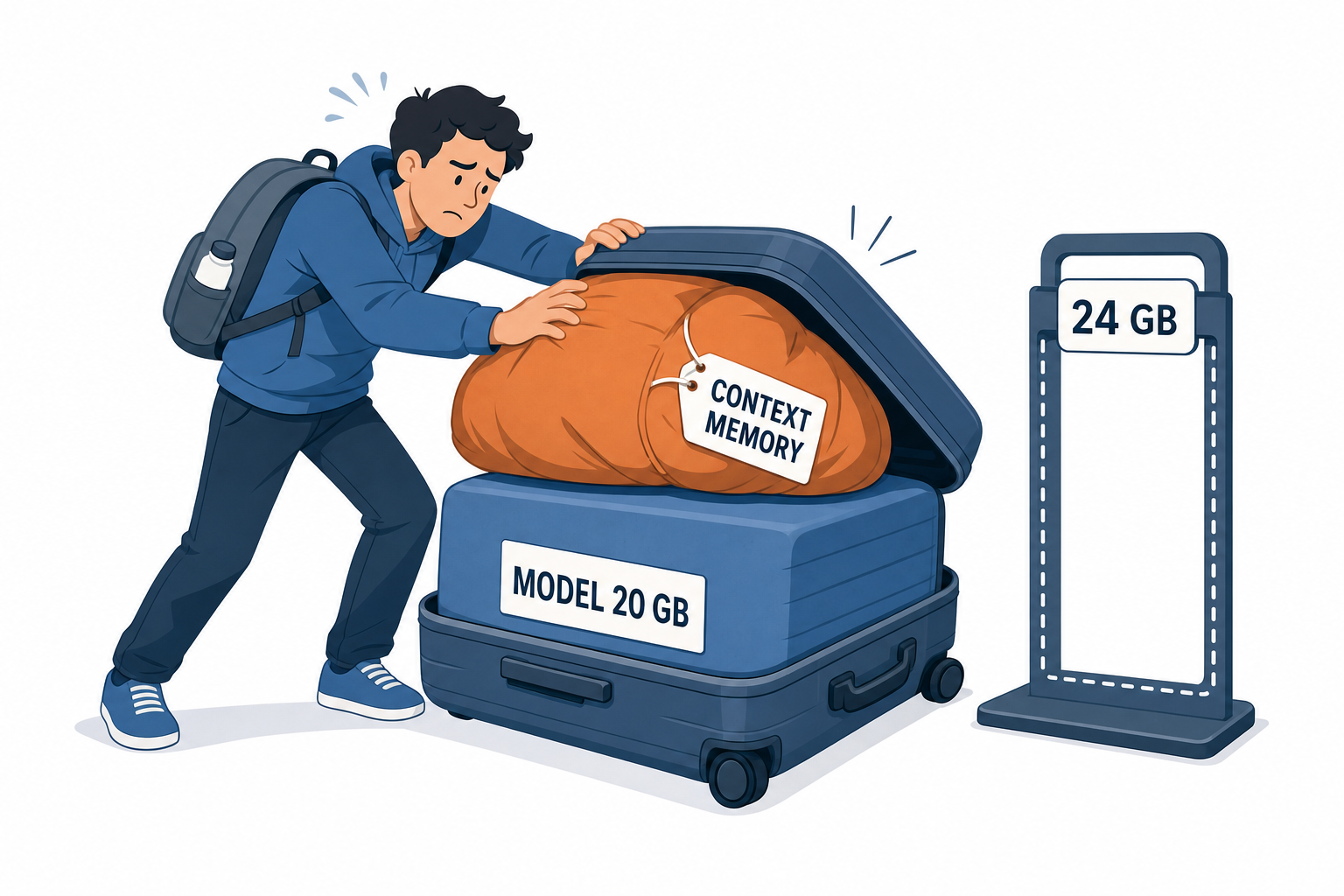
The model fits. It's what you put inside it afterward that causes trouble.
This trap is very real, and we don't talk about it enough. The context memory, which stores everything you've given the model to read, occupies the same memory as the model itself. The more documents you provide it, the less room remains. In the cloud, this ceiling is invisible because it's not your problem. At home, it is very precisely your problem.
And is it fast?
Meta has published figures, which is already quite unusual. Better still, these are absolute figures.
On an RTX 5090, the model produces 74.9 tokens per second. With the supplementary decoder provided, it reaches 233.4. On an M4 Max MacBook, it goes from 23.7 to 37.8. The M5 Max is 1.8 times faster, but Meta has not published the raw values. So I won't make them up.
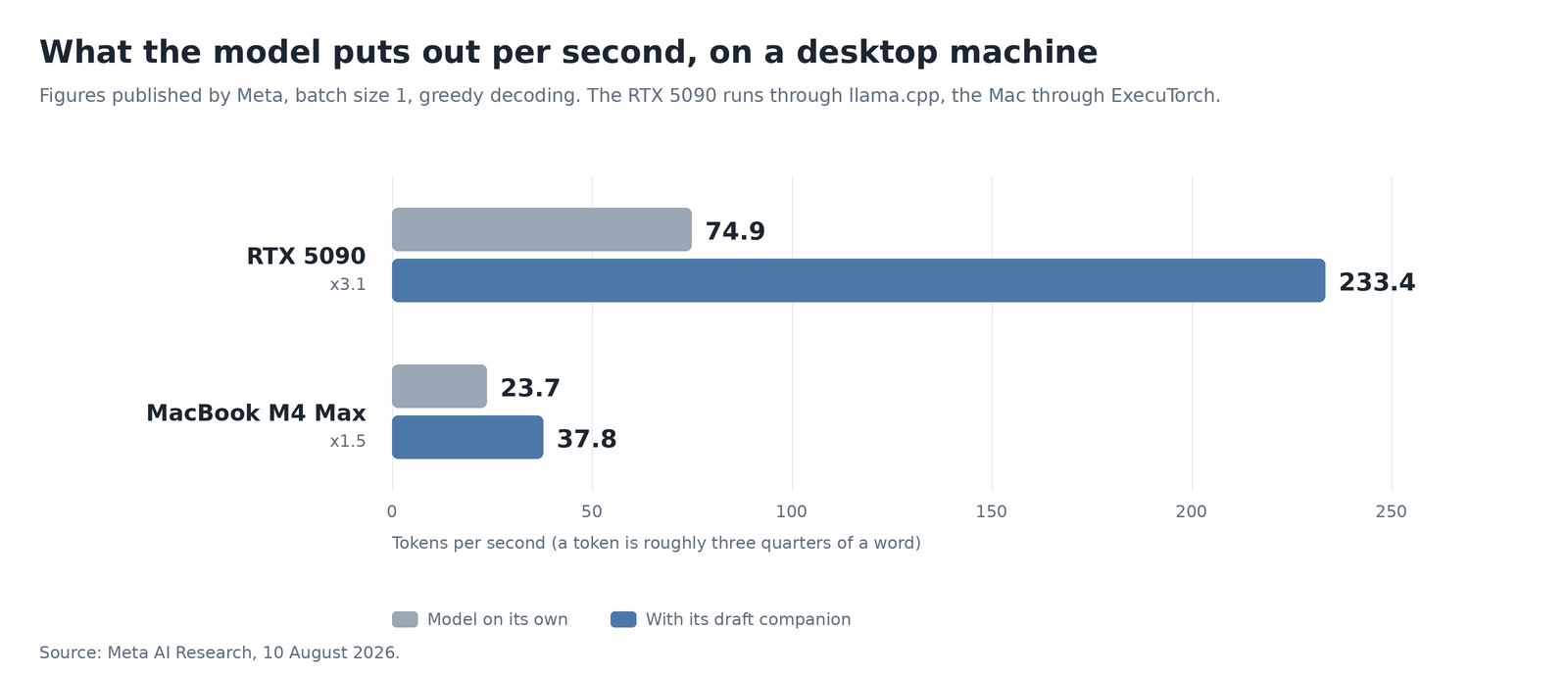
The small model writes the draft, while the large one merely corrects it. It's faster, and that's also how many meetings work.
This supplementary decoder deserves an explanation, because the principle is clever. A small, fast model guesses several words ahead. The large model then rereads them all at once, validating or correcting them. Checking costs much less than writing. In the end, you get the same result faster.
To give you an idea, 37 tokens per second is already faster than your reading speed. At 233, you're no longer reading. You're watching it scroll by.
Okay, but is it any good?
On SWE-bench Pro, a test that asks models to fix real bugs in real code repositories, Glimmer solves 51.2% of the tasks. It beats Qwen3.6-27B, which scores 50.2, and Gemma4-31B, which reaches 36.9. On the AIME 2026 mathematics problems, it reaches 94.7. On MCP Atlas, which measures the ability to use tools, it crushes its competitors: 75.5 versus 62.5 and 54.2.
There's just one major detail. Meta only compared Glimmer with models of a similar size. There was no face-off with the large closed models you use every day. The omission is convenient. So let's see what the comparison looks like.
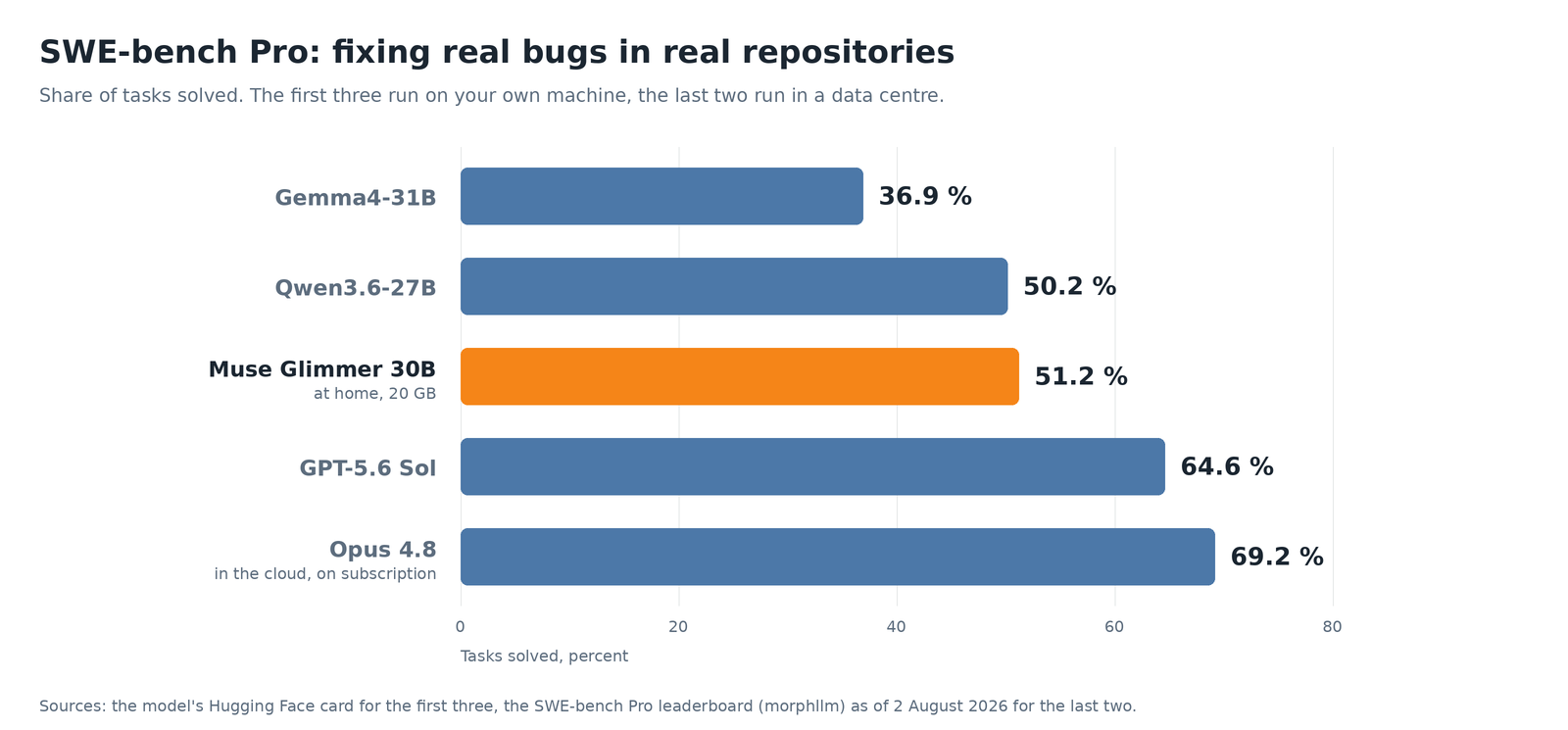
Eighteen points apart. That's the place you pay for when you don't pay for a subscription.
On the same test, Opus 4.8 reaches 69.2% and GPT-5.6 Sol 64.6%. That's up to eighteen points more. No, Muse Glimmer does not replace Claude Code on a serious project. Anyone claiming otherwise hasn't opened the table. Its value lies elsewhere: it installs a decent assistant on your machine, without a meter running.
The Register drives the point home, rightly so: 30 billion parameters is too few to take the crown of open models back from the Chinese. Kimi, Qwen, and DeepSeek are playing in another category. Meta is not returning as a champion. It's returning as a useful outsider.
What does this actually change for you?
If you don't code, you may be wondering why I'm making such a fuss. Here's what it changes.
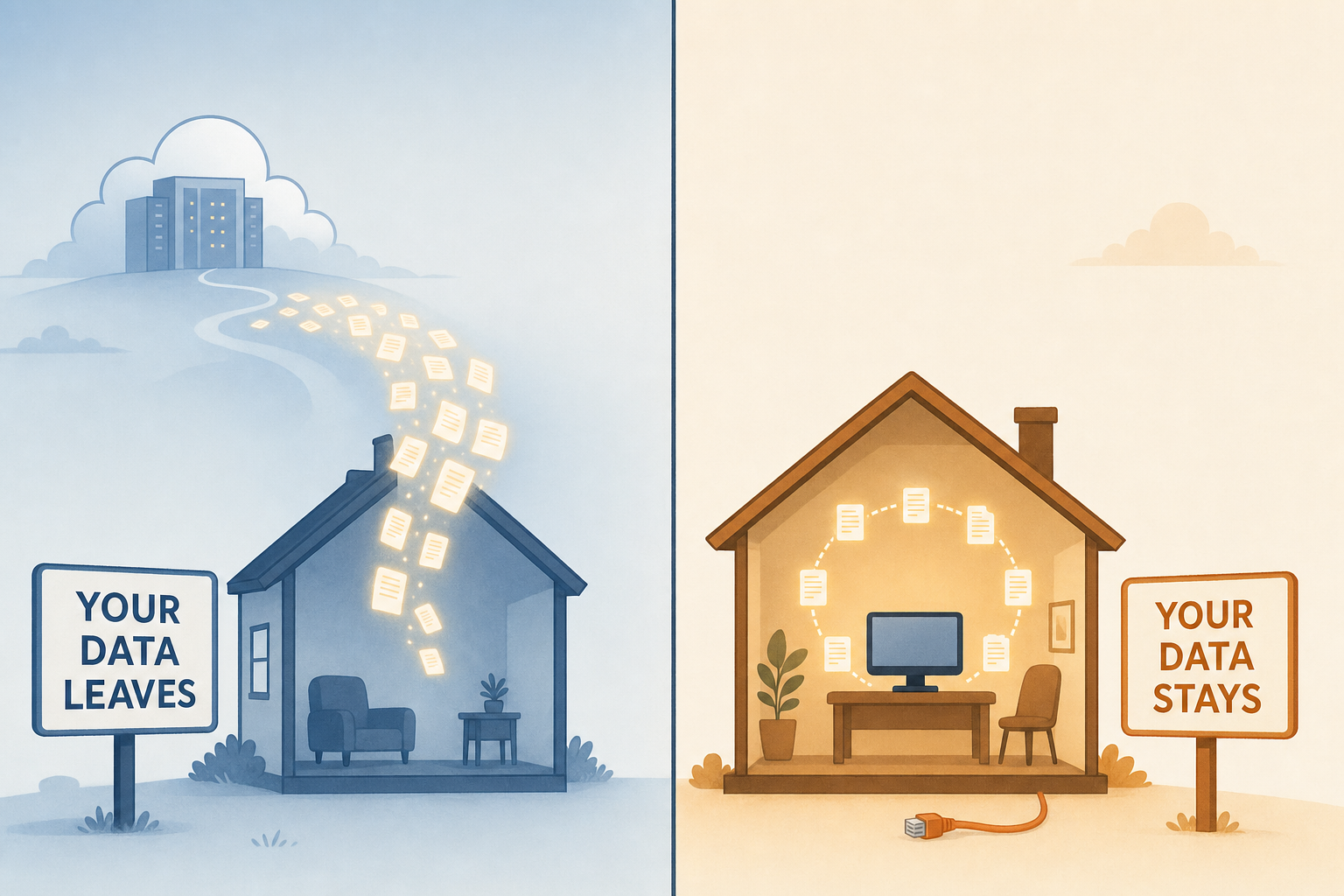
On the right, the cable on the floor isn't an oversight by the illustrator.
Nothing leaves your home. Your family photos, bank statement, school correspondence, or medical report you wanted summarized stay on your machine. These documents cross no network and land on nobody else's disk. This isn't paranoia. It's the only technical guarantee that doesn't depend on a company's promise.
No subscription, no meter. You pay for your machine and your electricity, that's it. If you ask it the same question fifty times because you're learning, nobody bills you for learning.
It works without internet. On the train, in a basement, or on the day your router decides to give up the ghost.
Now, let's turn the page. You have to buy the machine, and a card with 24 GB of video memory costs as much as a very good bicycle. No one will update your model: whatever you download, you keep as is, flaws included. There is no downstream moderation, so there is no safety net if the model starts talking nonsense. Meta also spells it out in the fine print: 4-bit compression is advertised as having no noticeable loss only for agent tasks. For everything else, no figures.
For once, the deadline is pleasant to write down: it's now. Not in ten years. Not in a laboratory. You can download it tonight.
GPS offers a useful precedent for understanding what is happening. At first, it required a subscription and a network connection, and it cost an arm and a leg. Today, the map fits in your phone and works at the bottom of a tunnel. The technology has not changed in nature. It simply ended up fitting in your pocket. Language models are following the same path, fifteen years ahead of what I would have bet on.
How to try it without spending all day on it
The simplest way today is Ollama:
ollama run muse-glimmer:30b-mlxNote that support starts with the MLX engine on Apple Silicon Macs. The rest will come later. On PC, Unsloth is already publishing compressed versions in a format compatible with llama.cpp. LM Studio offers the same thing with a graphical interface, for those who prefer windows and buttons to the terminal.
Plan on downloading around twenty gigabytes. Start the process before you go eat.
What I think
I'm not going to replace Claude Code with Muse Glimmer tomorrow morning. That's not the point. What I like is that someone took the time to design a model that fits in a machine, rather than a model designed solely to win rankings. Compressing it, providing a supplementary decoder suited to 24 GB, and publishing measured speeds on each machine isn't glamorous. It's engineering work. And it was missing.
Personally, I think the Apache 2.0 license is worth more than a few points on a benchmark. A decent model that you can keep, modify, and sell without asking permission always ends up being more useful than a brilliant model rented by the month. You simply have to avoid confusing the two. And don't claim that the little one won.
Join the conversation
You need an account to comment on this article. Creating one is free and takes under a minute.
No comments yet.