A rocket crashed on the Moon on Wednesday, and we knew the exact second
Wednesday, August 5, at 8 hours 35 minutes and 37.5 seconds, Brussels time, an upper stage of Falcon 9 hit the Moon at 8,700 kilometers per hour. Nobody had decided it. Yet everyone had known for months.
The most interesting thing is not the impact. It's that an astronomer, working on his own, was able to announce the location and the second of the impact eighteen months in advance. All on a website that looks like it dates from 1998.
Where does this thing come from
The object is called 2025-010D. Translation: it's the tenth object put into orbit in 2025. It is the upper stage of the Falcon 9 launched on January 15, 2025. The rocket was carrying two landers to the Moon: Blue Ghost, from Firefly Aerospace, and the Japanese Resilience, from ispace.
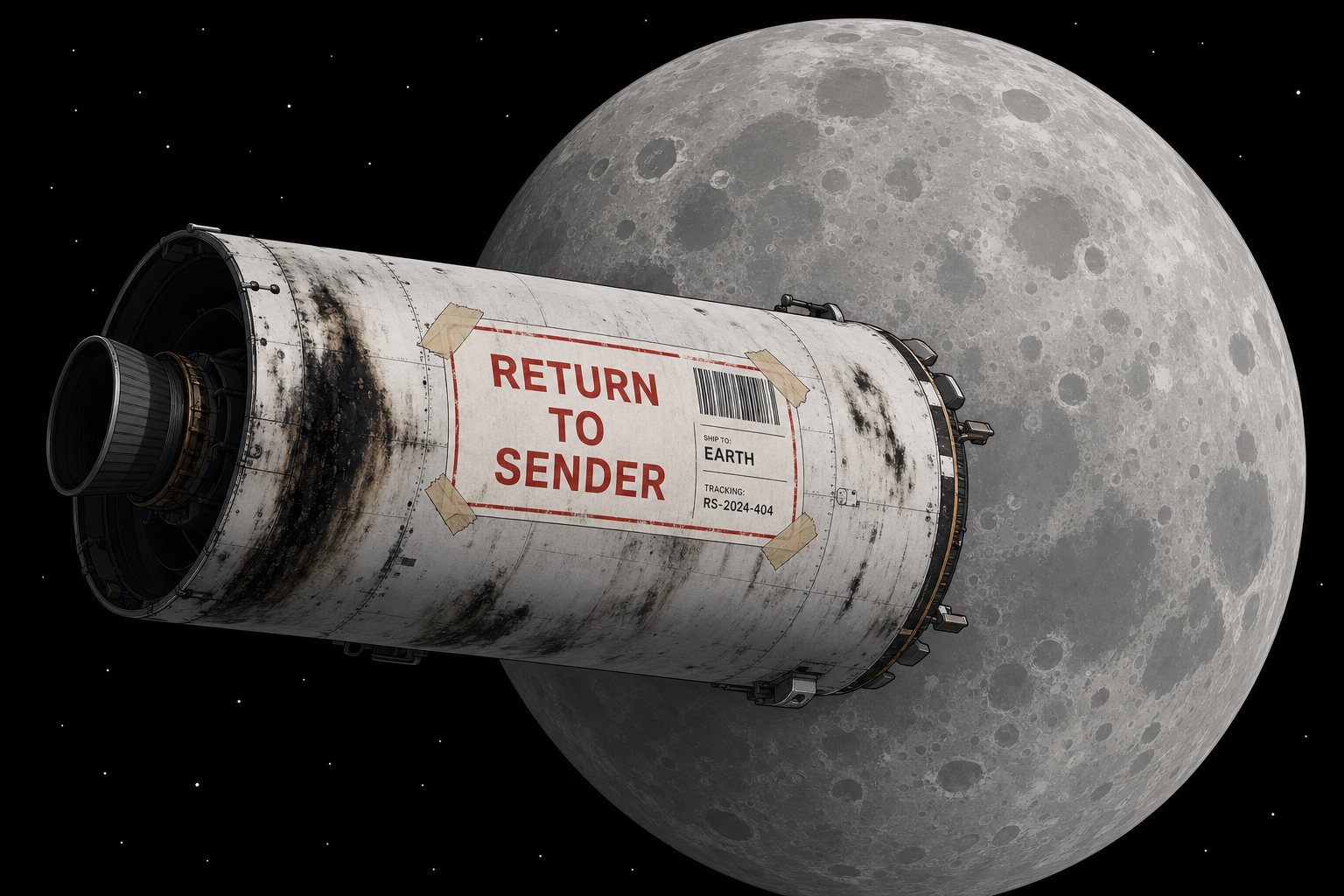
Eighteen months of drifting, and still no pickup service.
Once its job was done, this stage had nowhere to go. It had too much energy to fall gently back to Earth, but not enough to escape for good. So it stayed in the Earth-Moon system. Sometimes pulled by one, sometimes by the other, it followed a trajectory that nobody controlled. This drifting lasted almost nineteen months.
How do you predict this to within half a second
The man behind this prediction is called Bill Gray. He runs Project Pluto and tracks objects placed in high orbit, especially those nobody is looking after anymore. As of February 26, 2026, he had gathered 1,053 observations of this stage. Others came to complete this data right up to the last few days.
Using these observations, he published a precise prediction: August 5, 2026 at 06:35:37.5, universal time. The impact was supposed to take place at latitude 19.461 north and longitude 93.293 west, very close to Einstein crater, on the western edge of the lunar disk.
Behind this calculation, no secret NASA software. There's an astronomer, a network of often amateur observers and a lot of celestial mechanics, the science that makes it possible to calculate the movement of objects in space.
And it worked. The South Korean orbiter Danuri began observing the area half an hour before the impact. It then carried out eight imaging sessions by adjusting its orbit. The American LRO passes over the site about seven days before the impact, then seven days after. This gives us images of the same place before and after the impact.
The time he got it wrong, and wrote about it
The best part of this story goes back to 2022. Bill Gray carried out the same exercise then. He announced that a Falcon 9 stage, used to launch DSCOVR in 2015, was going to hit the Moon. The news went around the world. Then he went back over his calculations, realized he was wrong and acknowledged it on his own website.
“We now know that this object is not SpaceX's launch vehicle: it was an identification error on my part.”
The object was actually 2014-065B, the stage of the Chinese Chang'e 5-T1 mission. China never confirmed that this piece of space junk belonged to it.
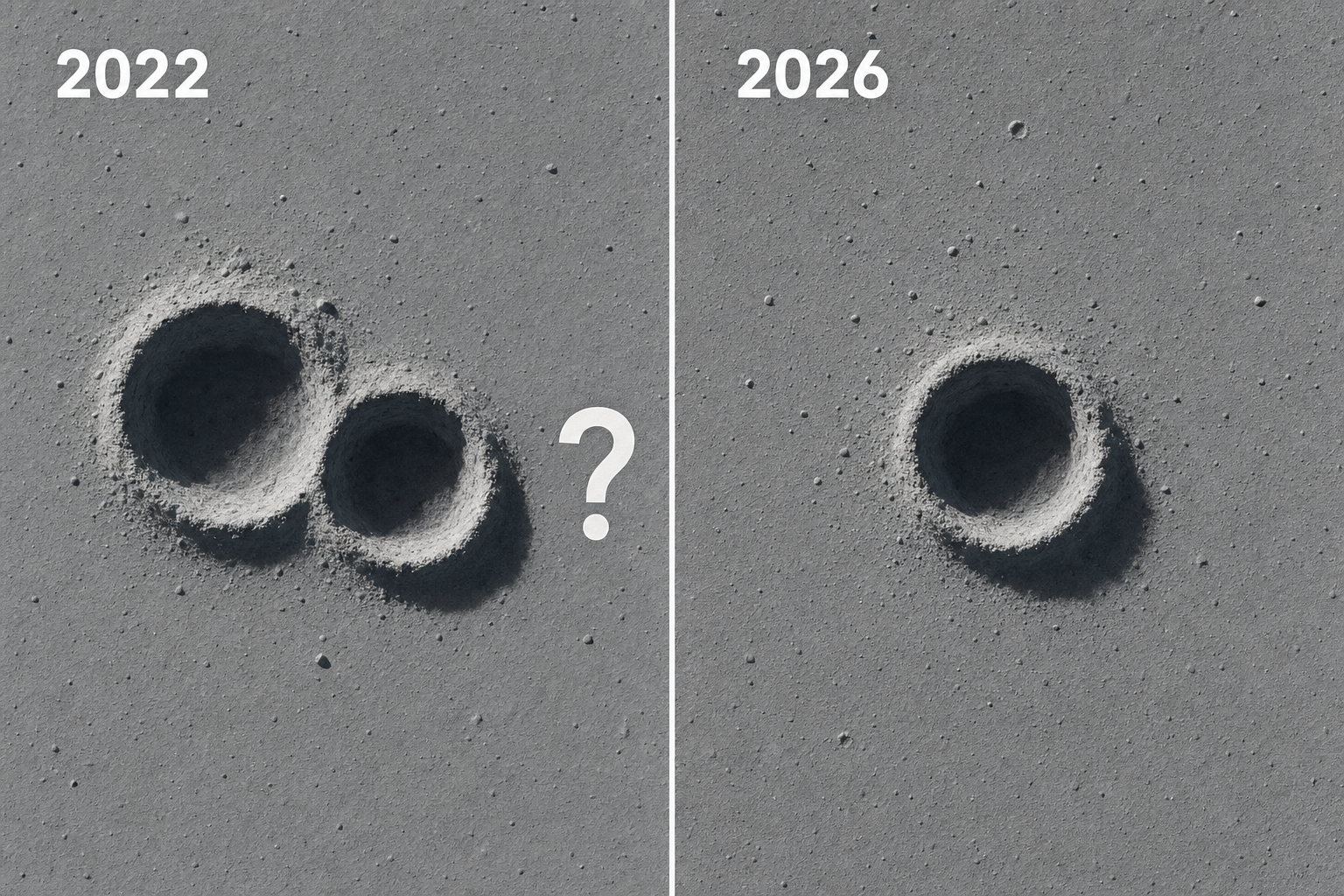
On the left, the double crater from 2022 and its mystery that was never solved. On the right, the crater we expected to see.
One detail was never explained: the 2022 crater was double. Two holes side by side indicate the presence of two heavy masses in the stage. There was the engine, plus something else that nobody identified.
Personally, I find that more impressive than the prediction itself. Bill Gray published his mistake on his own website, in the middle of the media frenzy, when he could have kept quiet. It's exactly the kind of attitude we'd like to see more often.
What it did up there
The stage is 13.8 meters long and weighs about 4 tonnes empty. Launched at 8,700 kilometers per hour into the lunar surface, it leaves very little room for suspense.
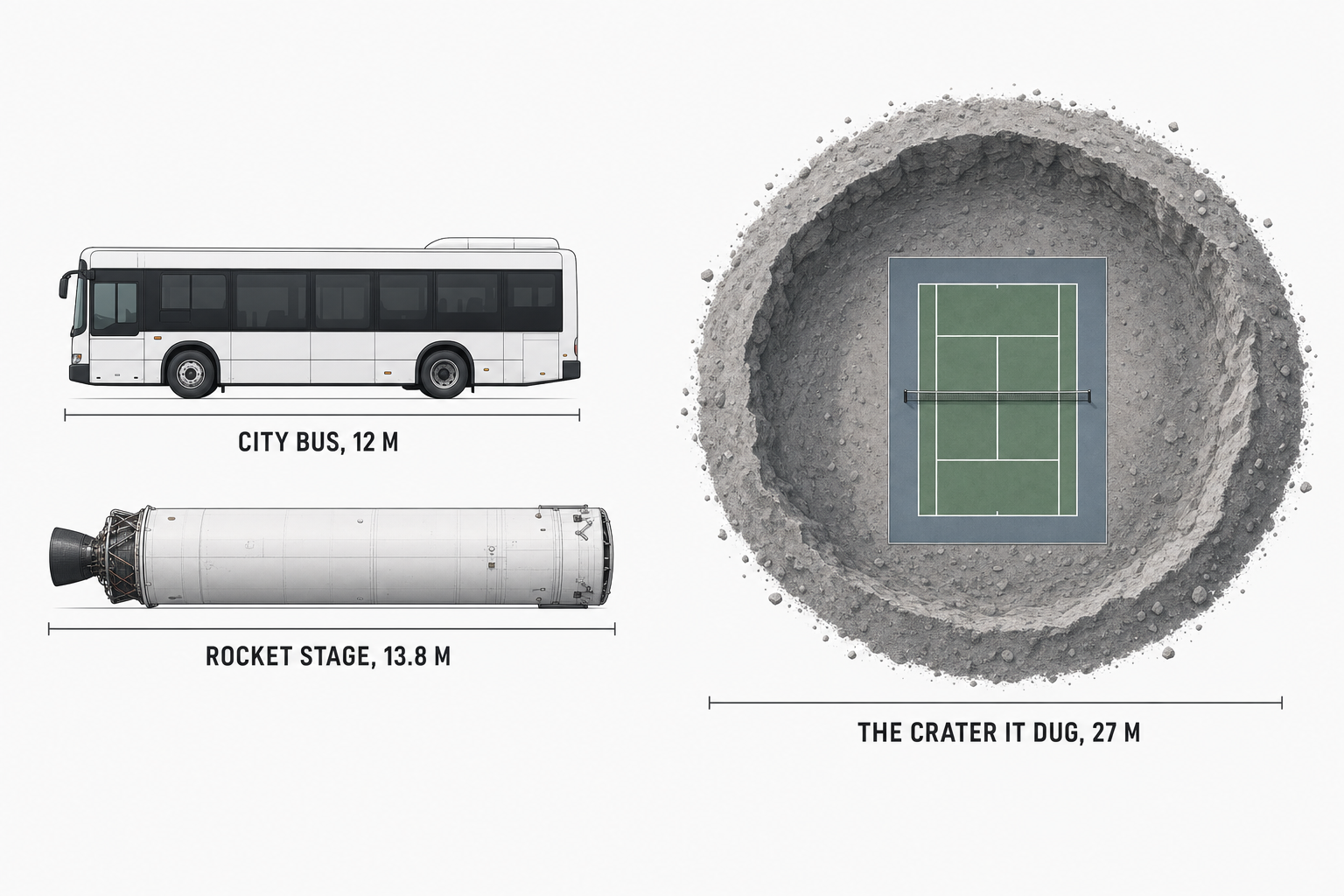
Basically, a bus launched at Mach 7 into sand.
Estimates put the crater at 20 to 30 meters wide and about 5 meters deep. The impact would have lifted 1.1 million kilos of lunar dust. Since the Moon has no atmosphere, the plume can rise very high before gently falling back down.
This collision is also of real scientific interest. When you study a crater, you generally know neither the mass of the object that made it, nor its speed, nor its angle of arrival, nor the exact date of the impact. Here, we know all four. Scientists therefore have a calibrated experiment to adjust their models. These models are then used to date other craters in the solar system. For once, the answer key is on the back of the notebook.
So, what does this actually change for you
On the Moon, absolutely nothing. It's one more crater on a rock that has millions of them, in a region nobody visits. You can sleep soundly.
On the other hand, this story reveals two problems that really concern you.
1. The trash can orbiting above your head
The European Space Agency tracks about 35,000 objects in orbit around Earth. They aren't all satellites. They're mostly bits and pieces: abandoned stages, bolts, flakes of paint and collision debris.
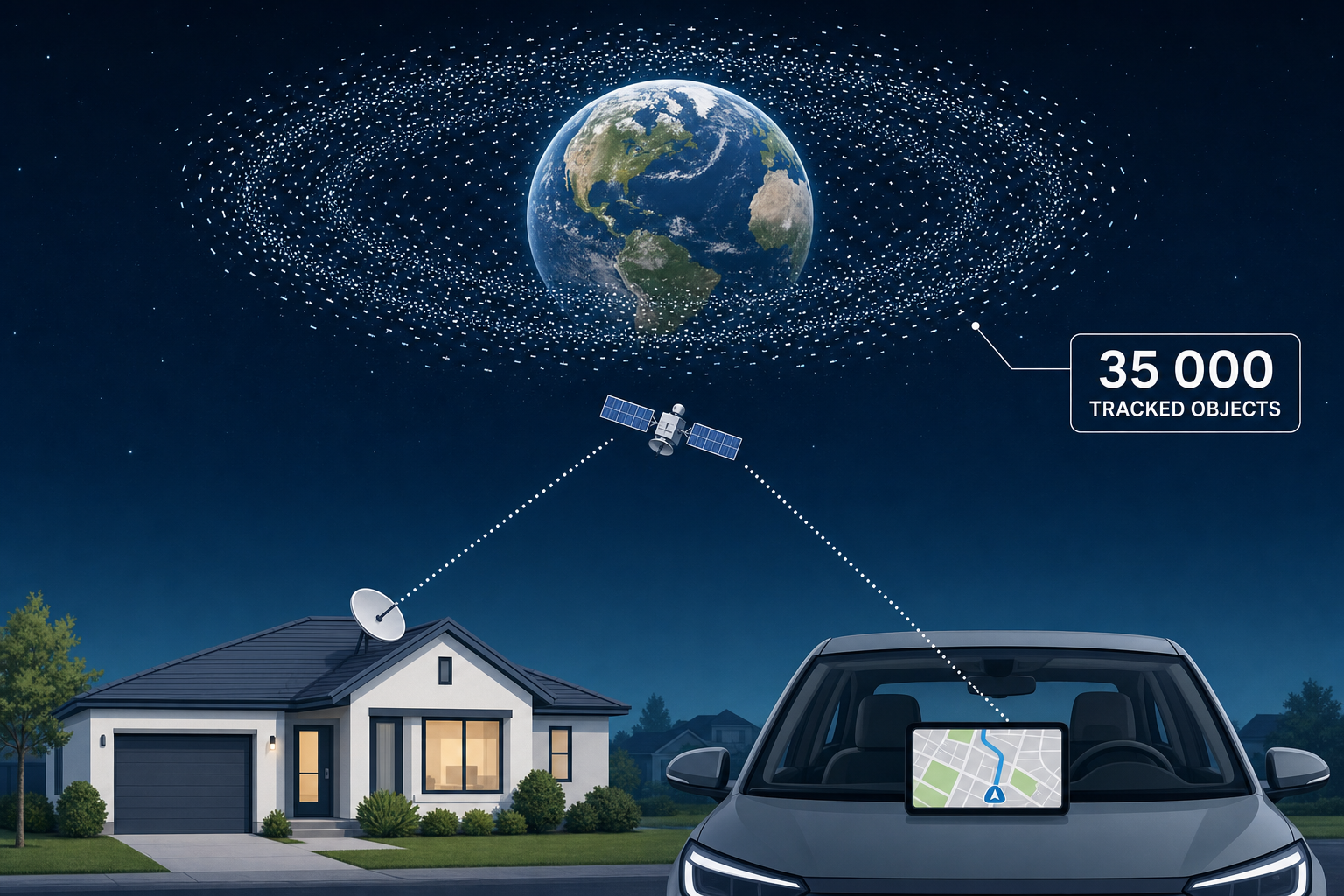
The car's GPS, the living room's satellite dish and tomorrow's weather share the same neighborhood.
These pieces of debris travel through the same zones as the satellites used by your car's GPS, the images that make it possible to forecast the weather and the dish installed on the roof. When a piece of debris hits a satellite, it doesn't produce just one additional piece. It can make thousands of them. It's the only place where cleaning up costs less than not doing it, and where nobody does it anyway.
2. Nobody tidies up, and it's written nowhere
Since Luna 2 in 1959, about 3,000 objects made by humans have been resting on the Moon, for a total of 209 tonnes. No text obliges anyone to retrieve them. In practice, a stage that has finished its job no longer belongs to anyone. On paper, its owner has no obligation to go and get it.
As for the schedule for the big cleanup, let's be honest. A few debris-removal missions are in preparation, but each one is targeting only a single object. At this rate, it would take centuries. The cleanup will happen in ten years, in twenty years, or never.
The precedent exists, and it isn't reassuring. As long as a space seems immense and far away, dumping your waste there costs nothing and goes unseen. We already know how it ends with the ocean floors. We're now replaying the same movie a hundred kilometers higher up.
What I think about it
What astounds me isn't the impact. It's the precision. We're talking about half a second of uncertainty for a four-ton object that has been drifting for eighteen months under the influence of three celestial bodies. The calculation comes from one man working alone, helped by data from volunteer observers. Even Newton had left this problem aside.
The second thing that strikes me is the identity of the people who did the work. SpaceX wasn't tracking this stage. NASA wasn't either. Astronomers, many of them amateurs, watched it for a year and a half. They did it for free, simply because the subject interested them.
I still have one reservation to end with. None of this was an accident. But none of it was really a choice either. It's simply what happens when you launch something without planning how its journey is supposed to end.
Join the conversation
You need an account to comment on this article. Creating one is free and takes under a minute.
No comments yet.