750 billion parameters available for free download, and you need sixteen graphics cards
On July 31, LG AI Research published a model with 750 billion parameters on Hugging Face, under the Apache 2.0 license. In short, anyone can download it, use it, modify it, and sell it without asking for permission.
Yes, LG. The manufacturer of refrigerators and televisions. While we were looking elsewhere, the research branch of the group released one of the largest open models ever put online. With one small tasty detail: you won't be able to run it.
What's in the box
Its full name is K-EXAONE 2.0. Let's start with the parameters, since everyone counts them without ever explaining what they are. These are the internal settings of the model, the values it learned during training. The more it has, the more it can retain. And the more expensive it is to run.
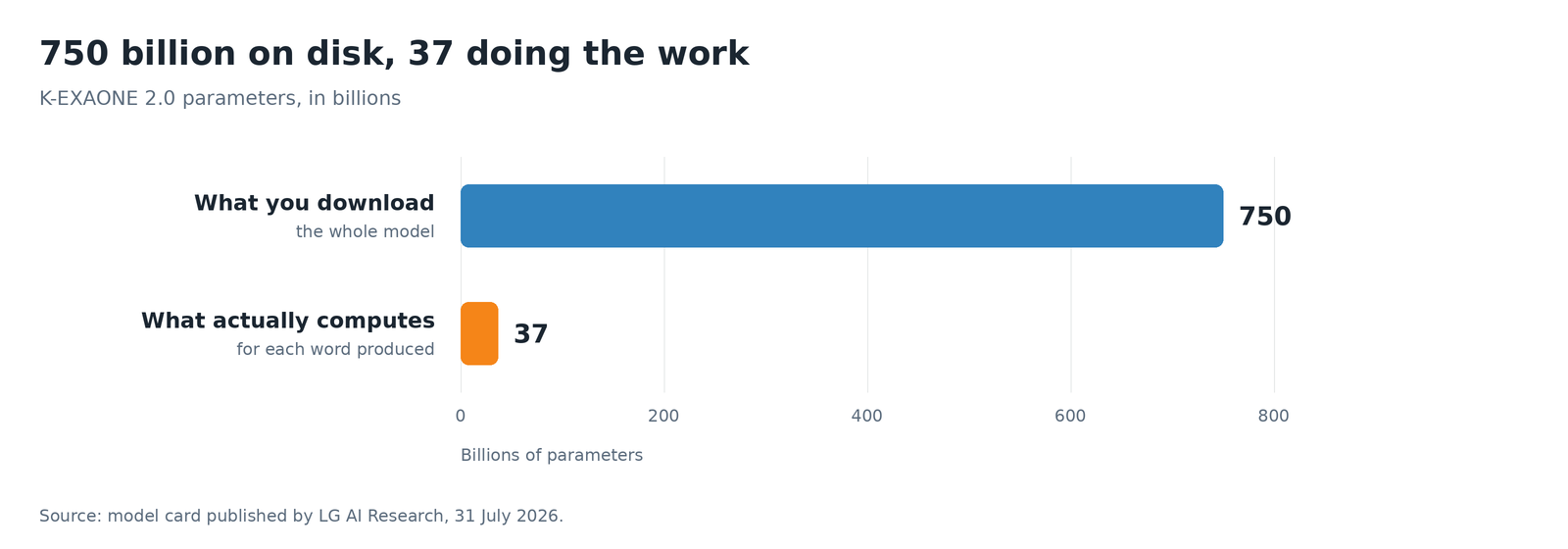
You download the entire library. For each word, it only opens two shelves.
This is where it gets interesting. Of these 750 billion parameters, only 37 billion are working to produce each word. The model contains 256 specialists and one generalist that is always active. For each piece of text, it only activates eight specialists. This is called a mixture of experts architecture. This system allows a giant model to not use all its power at every moment, thus limiting operating costs.
The exact term to type into a search engine to dig deeper into the subject is expert. We are talking about a mixture of experts, abbreviated MoE. In this article, I use "specialist" because the word is more relatable. But in the technical sheet, they are indeed experts.
Beware of the false friend, the confusion is widespread: an expert is not an agent. It is an internal part of the model, a bundle of settings among others. It decides nothing, calls no tools, and has no idea it exists. You will never see it. For each word, a switchboard operator chooses the eight experts that activate. Their role stops there.
An agent operates at a different level. It is a whole model given a goal and tools. It can then chain actions on its own to achieve that goal: open files, run commands, or send messages. The expert remains inside the model and acts on nothing. The agent acts externally, on your computer. A model with 256 experts can very well serve as the engine for an agent, but these are two different levels.
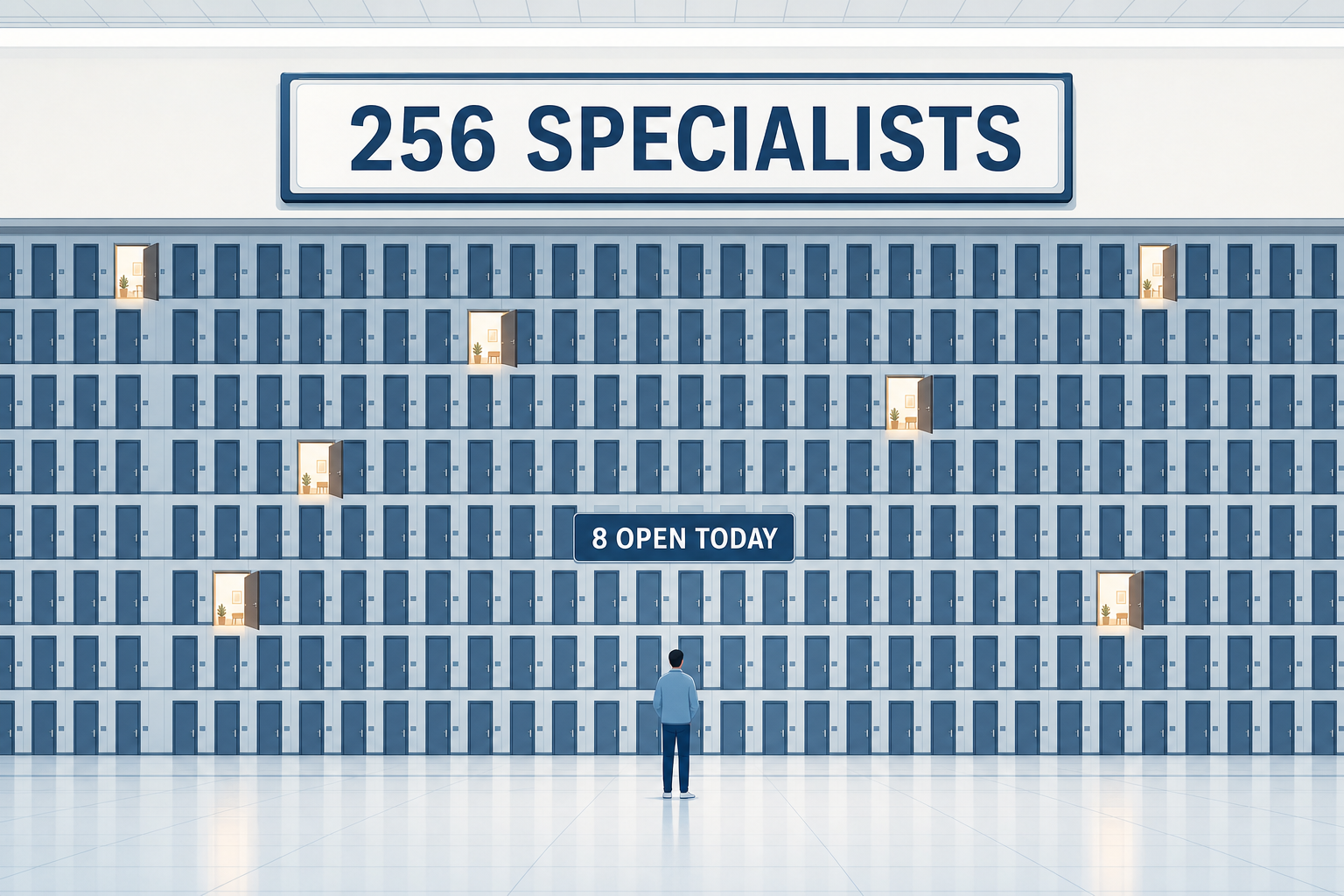
Two hundred fifty-six specialists on contract, eight on duty. A hospital would dream of such an organization.
For the rest, K-EXAONE 2.0 accepts 262,144 context tokens. Tokens are the small pieces of text that the model processes. Here, it represents enough to swallow a very large book in one go. Ten languages are officially supported, including French. This is not so common for this type of model.
The scores, and what they really say
LG announces an average of 70.1 on its tests, compared to 63.3 for the previous version. In detail, the model scores 83.5 on MMLU-Pro, a general knowledge and reasoning test, 92.3 on the math problems of AIME 2026, and 94.4 on a long-term memory test. These are very good results. No debate about that.
The test that really interests developers is called SWE-bench Verified. The model is given a real bug in a real project, accompanied by a ticket written by a human. Then it is checked whether the produced fix passes the tests. No multiple-choice questions. No well-mannered guessing.
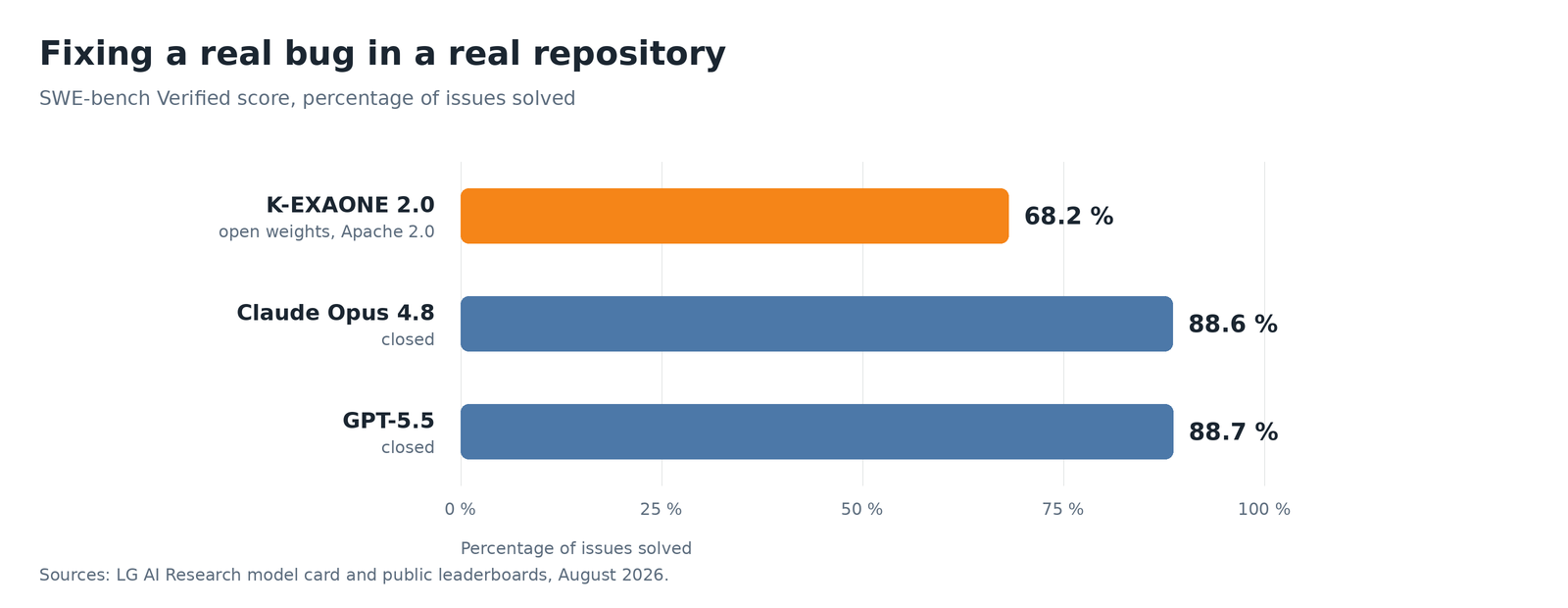
Twenty points difference. The largest open model at the moment is not the best, and that's okay.
Result: 68.2 percent. It's respectable, but twenty points behind the best closed models, which hover around 88. Out of a hundred bugs, K-EXAONE 2.0 fixes about twenty fewer. If you're looking for the best code assistant on the market, this is not it.
This test also starts to poorly differentiate the best models. They are all clustered around 88. Researchers are already using more difficult tests to distinguish them. When everyone performs almost equally well, the benchmark doesn't measure much anymore.
The problem is the weight of the package
Here comes the moment when the promise of open-source software meets the reality of your living room.
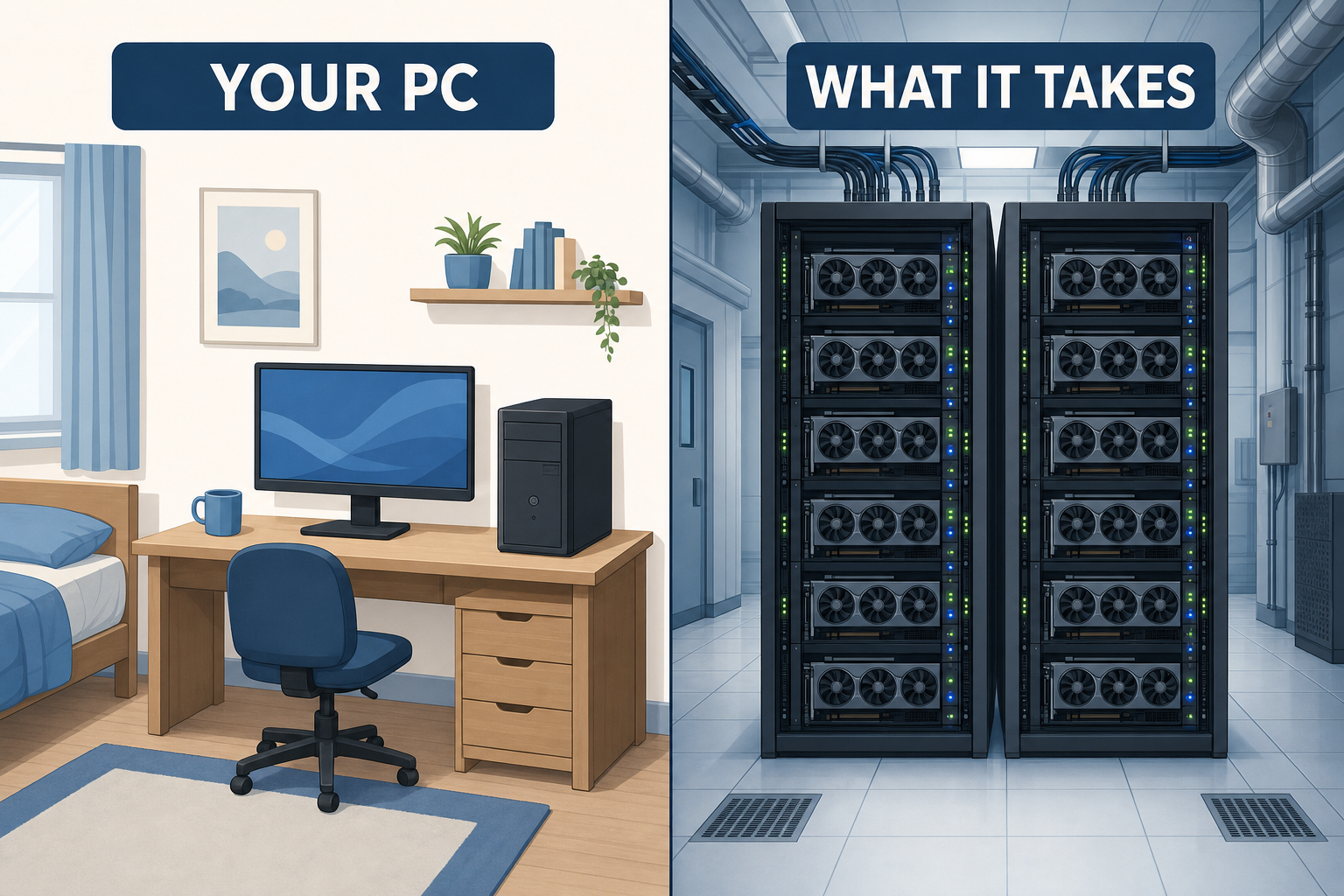
On the left, what you have. On the right, what is needed. The difference costs about the price of a house.
The official specification recommends two nodes equipped with eight NVIDIA H200 cards each. This gives sixteen professional graphics cards and about 2.2 terabytes of video memory, all in a climate-controlled room. The download alone represents around 1.5 terabytes of files. Each parameter weighs two bytes, and the model has 750 billion of them.
For comparison, the memory of a high-end graphics card for gamers is measured in tens of gigabytes, not thousands. You would need several dozen just to hope to load the model. And these cards cannot work together like the recommended hardware. We are no longer in the "I have a good PC" category. We are in the "I have a server room" category.
So, what is the point of an open publication if you can't install the model at home? It serves many purposes, actually. But not to turn your desk into an AI lab.
Apache 2.0, that's where the real deal is
The Apache 2.0 license is very permissive. It does not prohibit commercial use. It does not set any user threshold beyond which you would need to call a salesperson. It also does not require you to publish what you build with the model. You take, you make, you sell.
Many models presented as "open" do not go this far. Some prohibit competition. Others impose a paid license above a certain number of users. Still others reserve their use for research. Here, none of that.
Once the files are published and downloaded, no one can reclaim the copies already retrieved. This property is often underestimated. Three days ago, I explained that OpenAI had unplugged an old version of one of its voice models. In the process, the company broke the code of those who depended on that version. With open weights, this scenario does not exist. The provider can go bankrupt, change their mind, or triple their prices. Your file remains on your disk and can continue to function exactly the same way in ten years.
Another sign that everything is moving fast: a second model of this size, called A.X K2, was announced just two days after this one. Two open giants in 48 hours.
What does this change for you
You will never download this file. No one in your family will either. Yet, there are three very concrete reasons to be happy about this news.
1. It drives prices down, for real
When a free model with no commercial restrictions reaches a certain level, it becomes difficult to charge a lot for offering the same thing. Paid models must justify themselves by what they do better, not just by their mere existence. We saw this last week when OpenAI reduced the price of its small model by five times, three weeks after its release. Every time an open model levels up, a bill somewhere goes down.
2. It allows AI to work where your data must stay
A hospital, a law firm, an administration, or an accounting service cannot always send its files to a foreign provider. With a closed model, the discussion can stop there. With open weights, these organizations can install the machine on their premises. The data does not leave the building. Your medical file thus has a real chance of being processed by a model of this kind, in the basement of a hospital, rather than not being processed at all.
3. It's exactly the story of Linux
No one at your place has ever compiled a Linux kernel on a Sunday afternoon. Yet, Linux powers your internet box, your television, your phone if you use Android, as well as the overwhelming majority of the sites you visit. Open-source software has never needed to land on your desktop to change your life. It has simply needed to work everywhere behind the scenes.
Open models are following the same path. In two years, there will probably be one behind your bank's app, your town hall's kiosk, or your service provider's customer service. The word will never appear on the screen. Let's be honest: it won't be noticeable. And that will be the sign that it works.
What I think about it
What strikes me is not the size of the model. It's the company that published it. We spent two years watching three American labs and two Chinese ones. And here comes the washing machine seller from Seoul putting 750 billion parameters on the table, for free, under the Apache 2.0 license.
The model is not the best, and it does not claim to be. But a free model does not need to win. It only needs to be good enough to make the first prize indecent. This is what happened with databases, web servers, and operating systems. I see no reason why AI should escape this mechanism.
Personally, what excites me the most about this announcement is summed up in three characters: 2.0. I'm not talking about the version, but about the license. Apache 2.0 is the only part of this release that no one will be able to take back.
Join the conversation
You need an account to comment on this article. Creating one is free and takes under a minute.
No comments yet.