Absorption: the study that finally explains why juniors are no longer learning
“What does a junior engineer do better than a subscription to Claude for 100,000 wons?” The question comes from a Korean startup founder with twelve years of experience. Two researchers from Seoul National University interviewed him. One hundred thousand wons is about sixty euros per month. There you go. A human being with a degree and rent has just been compared to a subscription cheaper than a parking space. Their article was published on arXiv on July 19, and then accepted at AIES 2026. No benchmark or productivity curve. Just fourteen interviews and a word that lingers in your mind for several days.
There is a lot of talk about the decline in junior recruitment. Much less is explained about how it happens. This is the mechanism that Sumin Yu and Taesup Moon wanted to understand.
The word they found
Absorption. Generative AI, that is to say, tools that produce text or code on demand, like Claude or ChatGPT, does not suddenly eliminate the junior position. It absorbs its content. The simple tasks, those that were entrusted to the newcomer to learn, are elevated. The senior completes them in thirty seconds with their assistant. The position still exists in the organizational chart, but the work that gave it meaning has moved up a level.
The task itself does not disappear. And no one will mourn the disappearance of a handwritten validation form. What disappears is the struggle necessary to understand it and learn how to do it.
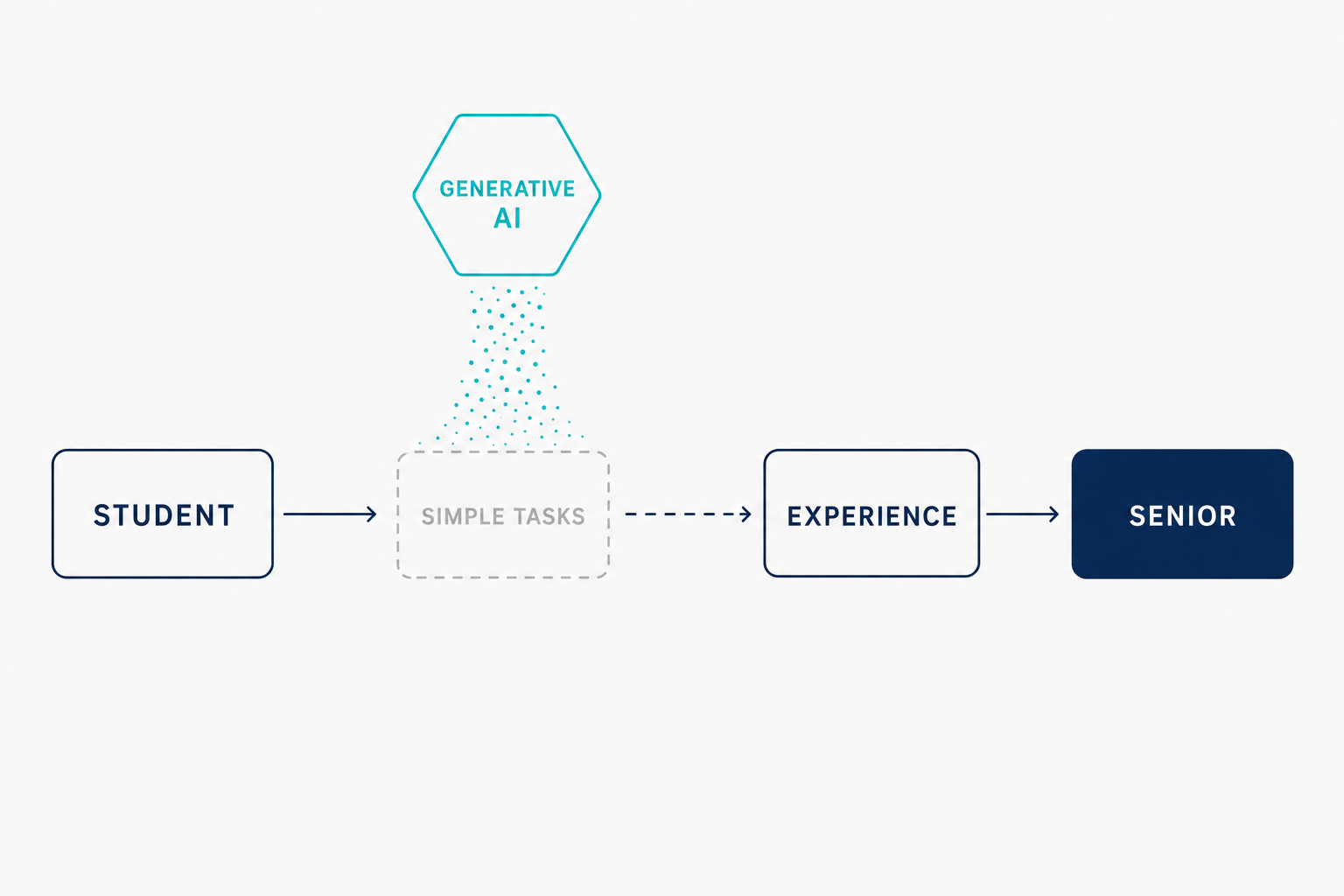
The staircase is still there. It just lacks the step that was used to learn.
The useful struggle
The researchers call it “productive struggle,” in other words, the useful struggle. We stumble on a relatively simple problem. A more experienced person corrects us. Then we remember the lesson because we had to fight with the problem. This is how we trained a senior. Not just by showing them beautiful code, but by letting them write shaky code before explaining why it was shaky.
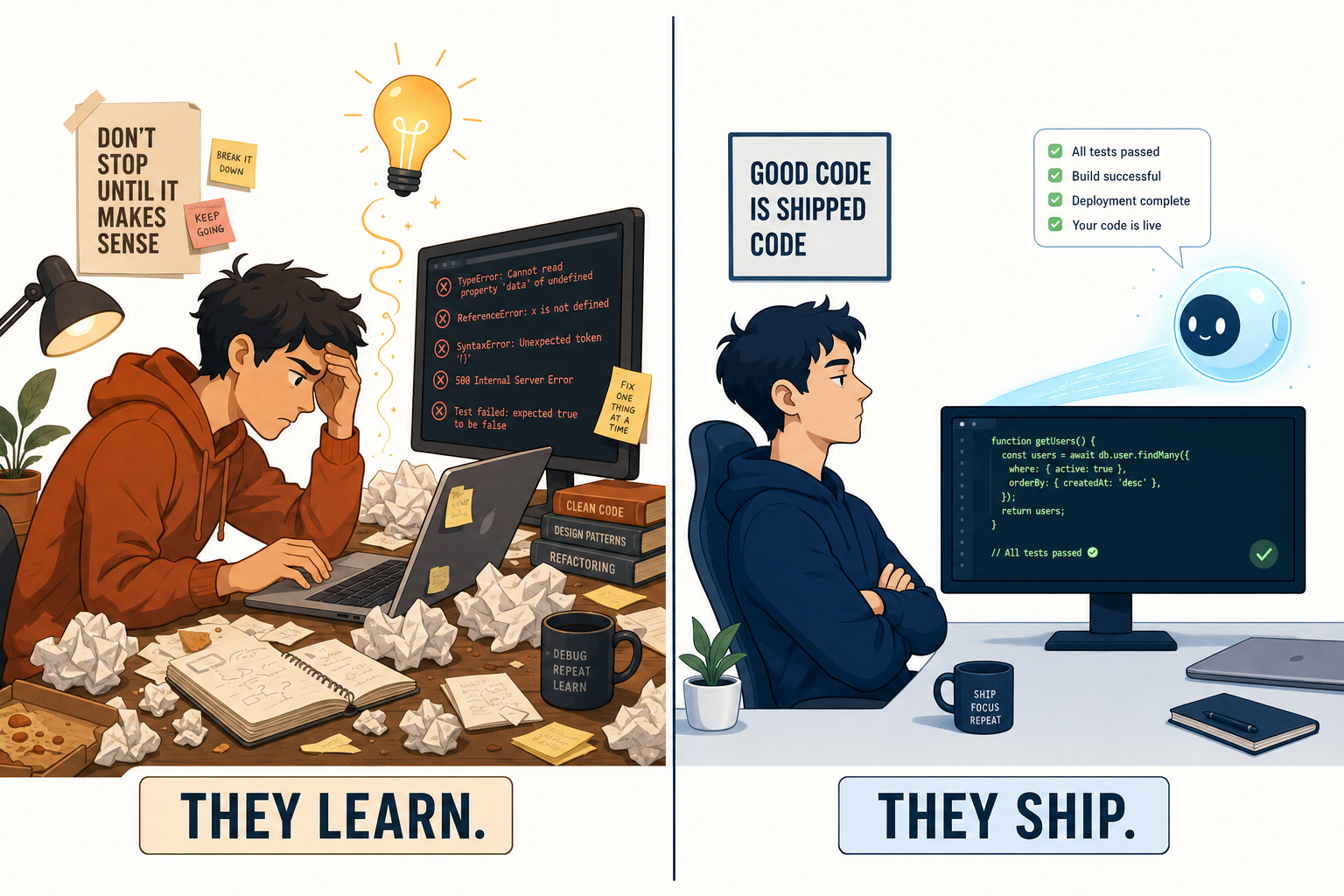
On the left, three hours wasted and a lesson for ten years. On the right, three seconds saved and nothing.
One of the interviewed students summarizes the problem better than any report: “I don’t know what I don’t know.” Another drives the point home. Honestly, his phrase stunned me: “I don’t know what NOT to do; I’ve only seen good examples.” Everything is there. When your assistant always produces a clean answer, you never build your catalog of mistakes to avoid. It’s like learning to drive in a simulator where the wall moves away by itself when you rush at it.
This is precisely how one of the seniors defines his job: “If we call someone a senior, it’s because they know how not to work.” A senior is a junior who has failed often enough to spot the problem before the fire. If you remove those failures, you no longer train seniors. You train people who are very fast at producing code that no one in the room can read.
In college, it’s already settled
The problem starts even earlier, in the classrooms. The researchers show that the same mechanism reproduces itself there. A student says: “Everyone except me was using GPT, so everyone except me had almost the maximum.”
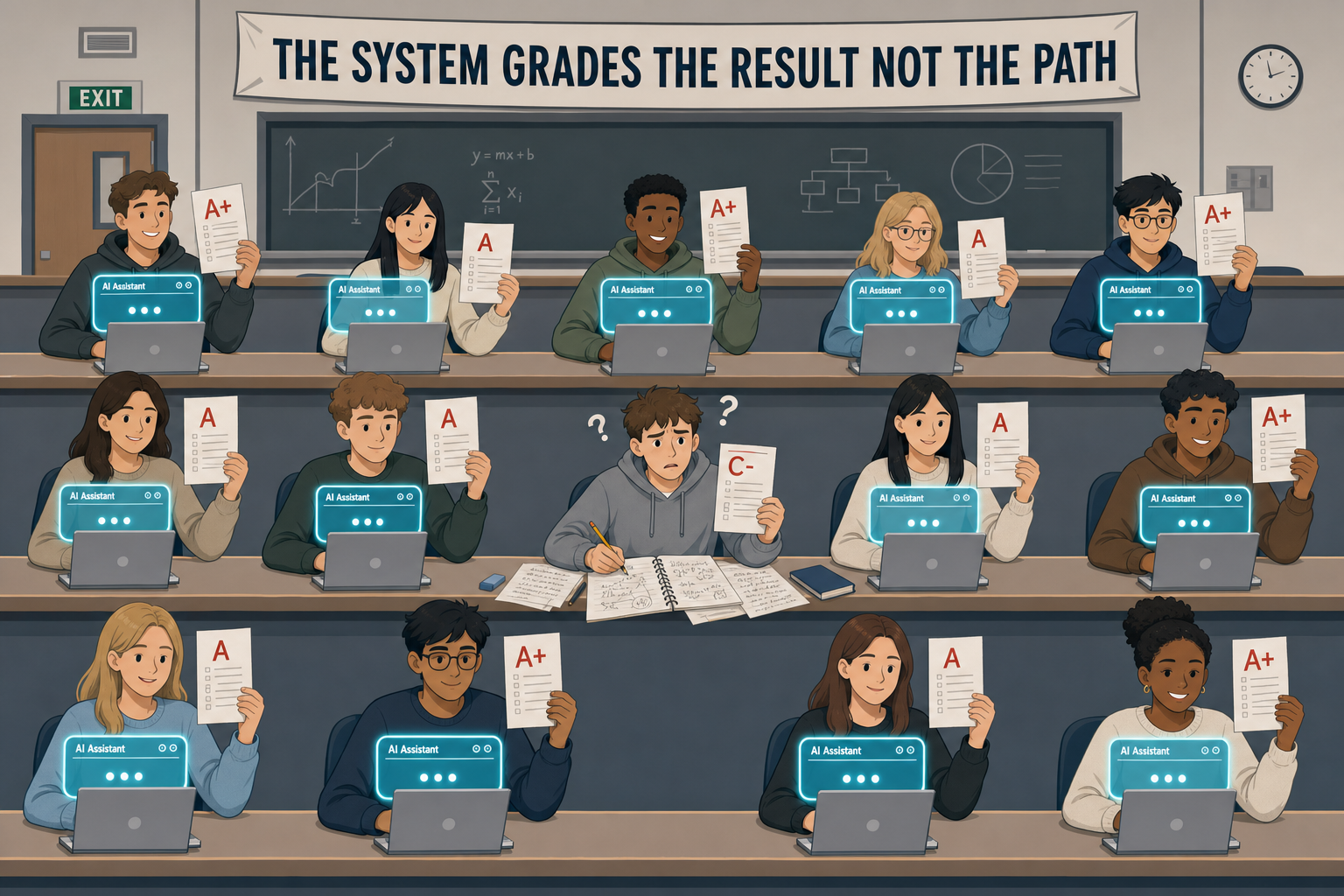
The student in the middle did the exercise himself. Beginner's mistake.
At this point, the moral choice doesn’t weigh very heavily. You can honestly do your exercise and accept the difficulty. In exchange, you get a bad grade against a whole class that asked the question in a chat. The system evaluates the result, not the path taken. It therefore rewards shortcuts and punishes the student who is really trying to learn. Nice educational program.
The third consequence is the most insidious. The authors call it the perception asymmetry. Seniors think that juniors have lost the basics. Juniors find that they deliver faster than ever. Each is right from their point of view, but no one sees the whole picture. As a result, nothing changes. Two people are looking at the same boat. One thinks it is moving well. The other notices that it has no bottom.
The numbers laid out
The study is qualitative. It relies on interviews and does not claim to measure an entire market. However, the researchers relate their observations to existing data. The backdrop is quite harsh.
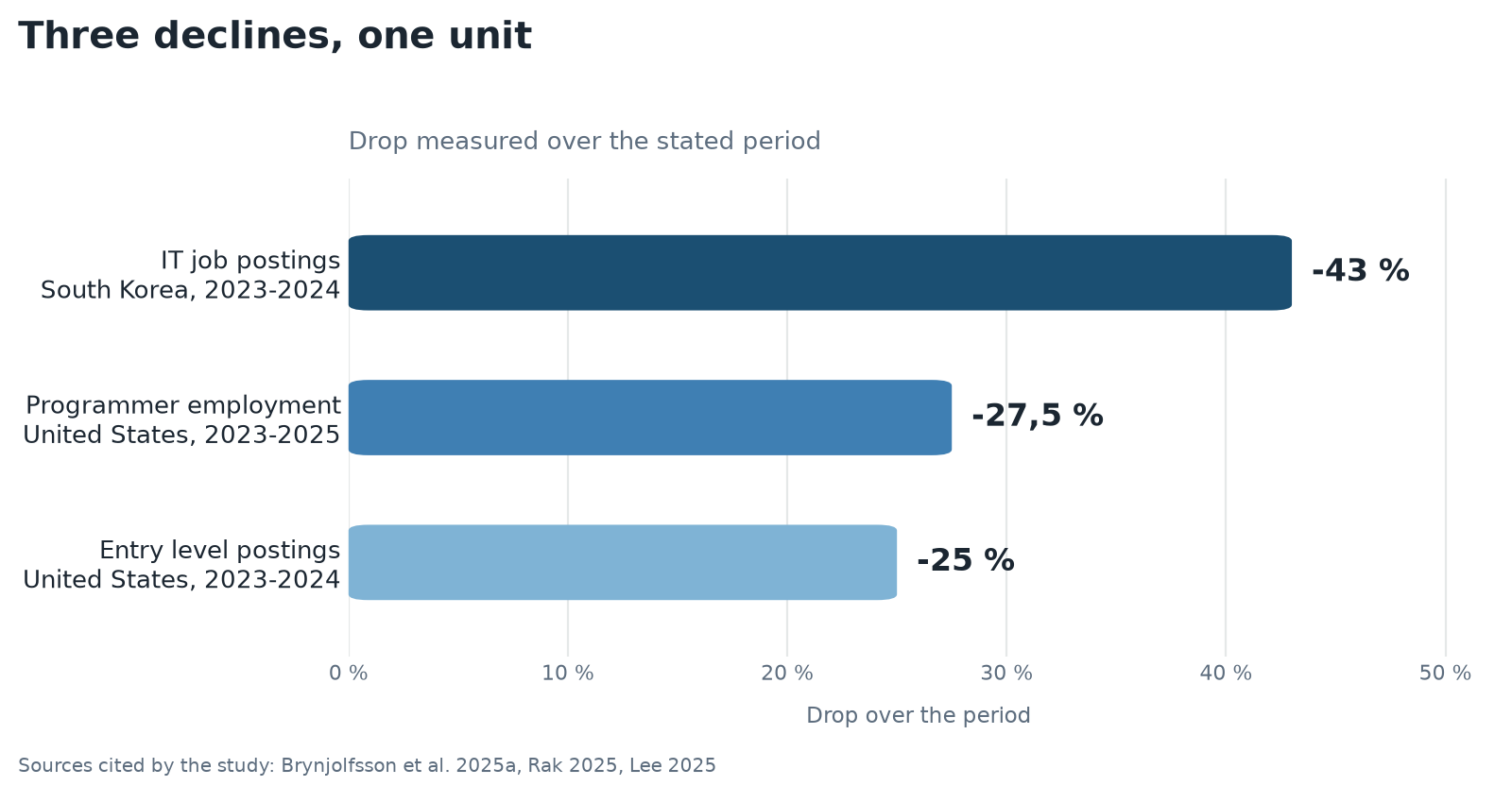
Three different measures, two countries, one direction.
In South Korea, job offers in IT have dropped by 43% between 2023 and 2024. Positions open to beginners now represent only 4.4% of the total. In the United States, programmer employment has declined by 27.5% between 2023 and 2025. At the same time, offers aimed at beginners have decreased by 25% between 2023 and 2024. A final figure explains why the study was conducted there. According to the Bank of Korea, 51.8% of Koreans use AI at work, almost double the American rate. South Korea thus serves as an advanced laboratory. They show us what is looming ahead.
For those interested in the protocol, the researchers interviewed 8 juniors, students or recent graduates who entered the profession less than two years ago, as well as 6 seniors with between 6 and 12 years of experience. The participants worked in large groups, medium-sized companies, or startups. Each interview lasted about fifty minutes. The interviews were conducted in Korean between December 2025 and February 2026. The researchers used reflective thematic analysis. With this method, they acknowledge that their own reading contributes to the analysis, instead of pretending to be perfectly neutral machines.
What they propose
The researchers propose three avenues. They are not aimed at developers, but at institutions. At the university, courses should be imposed whose educational objective cannot be achieved by AI. Reducing dependence on AI would also become a quality criterion for education. During recruitment, it should no longer be sufficient to evaluate a junior solely on their ability to produce code. Instead, we would test their ability to identify their own gaps and the machine's errors. In companies, learning spaces should be preserved during integration. Juniors would carry out small concrete tasks there, with a difficulty that gradually increases.
Personally, the first avenue seems stillborn to me. It is hard to imagine an entire lecture hall accepting a course marketed as "the one where AI will be of no use to you." The second is the only one that has a chance, because it directly serves the interests of the company. The third requires time from seniors, and no one seems willing to pay for it. But at least, the question is posed correctly.
What I mainly take away is that we have stopped asking whether AI will replace developers. The real question lies elsewhere: if no one trains juniors in 2026, where will the seniors of 2032 come from? For now, the answer is a collective shrug. We have decided to eat the seeds meant for the next harvests because it is very profitable this quarter. Help Net Security published a summary yesterday. The full article is also available for free on arXiv if you want to read the interviews in full text.
Join the conversation
You need an account to comment on this article. Creating one is free and takes under a minute.
No comments yet.