Security: what is ARTEX, the tool where AI agents hack everything on their own, and how to protect yourself?
Five minutes. That's how long it took an AI agent to go from a secret key forgotten in code published on GitHub to a company's digital vault, from which it extracted data. Not a hoodie-wearing keyboard genius, no: a program called ARTEX, which Microsoft has just dissected on November 25. Six professional hacker groups have already adopted it. And the craziest thing is that, to begin with, it was a tool for defending yourself!

It doesn't sleep, it doesn't eat, and it has hundreds of keys. All it lacks is discretion
To begin with, a tool for the good guys
To understand ARTEX, you need to know what a “pentest” is. It's a penetration test: a company pays someone to try to get inside it, like you would pay an honest burglar to check your locks, with a report at the end saying how they got in. It's a real job, a useful one, and an expensive one, because it takes specialists days of work.
ARTEX is an automatic pentest. A developer who goes by “Autumn-27” published it on GitHub in July, the big site where developers share their code, as open source, meaning with code that everyone can read and reuse. The name comes from Chinese and means more or less “autonomous AI penetration testing system”. You give it a target and an objective, and AI agents figure out how to reach it. An agent is an AI that doesn't just respond: it acts, types commands, looks at the result and decides what to do next.
Except that what tests a lock can also open it. On October 8, after reports of abuse, its author made the code unavailable. Too late: copies are circulating everywhere, translated into other languages, and one company is even selling a paid version, ARTEX Pro. The toothpaste is out of the tube.
A small team of burglars that never sleeps
What struck me in Microsoft's report was the organization. ARTEX operates like a team, with roles.
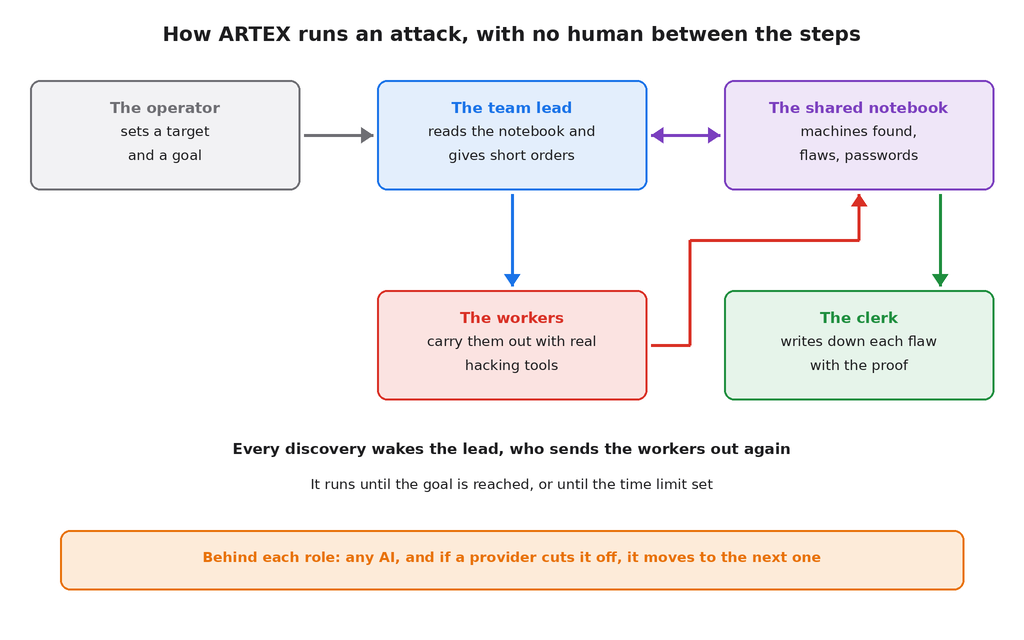
A small business organization chart. Except that nobody takes a coffee break
One agent plays the team leader: it reads a shared logbook where everything we've found is recorded (the machines, the vulnerabilities, the passwords), and it gives short orders. Other agents, the workers, take those orders and carry them out with real hacking tools, the ones pentesters have been using for twenty years. Every time a worker finds something, it writes it in the logbook, which wakes up the leader, who launches a new wave. And one last agent, the clerk, writes up each vulnerability found with the proof. It runs in a loop until the objective is reached.
The detail that makes you smile bitterly: behind each role, you can plug in any AI. And if a provider cuts off access because it has detected the abuse, ARTEX automatically moves on to the next one, with a list of backup keys. Result: no provider ever sees the whole attack.
Nothing new, just much faster
Here, you have to be honest, and Microsoft is the one saying it: ARTEX doesn't invent any attack technique. It tries passwords, looks for forgotten keys, tests the classic vulnerabilities of websites. Everything a human hacker already does. The novelty is the pace: it chains things together, tries again, moves on to the next step without ever waiting for a human to wake up.
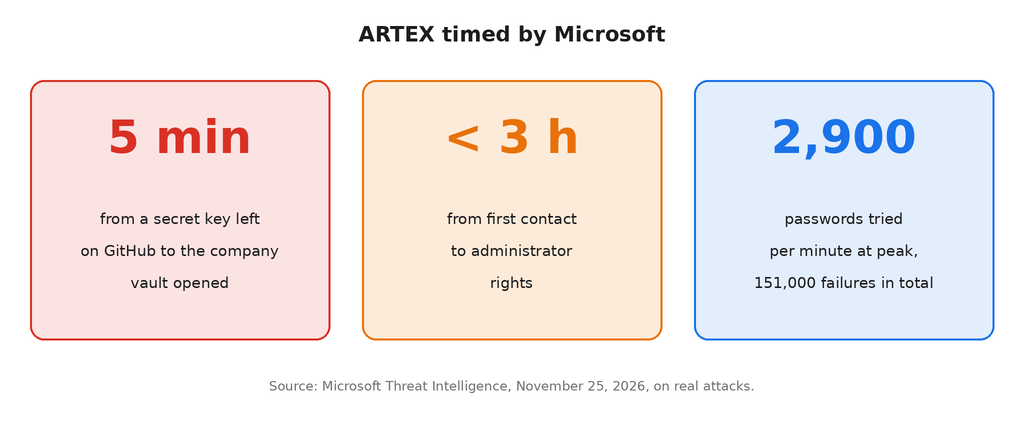
Microsoft's stopwatch. The human hacker, meanwhile, was still on his first coffee
The figures recorded by Microsoft make your head spin. One group sprayed Microsoft 365 accounts with more than 151,000 failed login attempts, up to 2,900 per minute. This is what is called "password spraying": trying the dumbest passwords ("Winter2026!", "Azerty123") on thousands of accounts at once, counting on the one who has never changed theirs. In several attacks tracked by Microsoft, it took less than three hours between first contact and administrator rights, that is, the keys to the whole house. As for the five minutes at the start, an agent found a secret key left in code on GitHub, then used it to read the company's password vault at Microsoft.
These forgotten secret keys are a great classic. My API keys live in a separate file, outside the code, and never on GitHub. Because a robot that continuously searches through all of GitHub is no longer a hypothesis.
The FBI also published an alert about ARTEX on November 13. We learn that the attackers' copies most often run with DeepSeek's Flash models, the small, fast and cheap Chinese AIs. Why them? Because they are effective, cheap, and, according to the alert's reports, with no visible safeguards as soon as the work is presented as a penetration test. Basically, all you had to do was say "it's for a test" for the AI to roll up its sleeves! We had already seen an AI uncover a vulnerability all by itself with Java4Shell last week. Here, we move on to the next stage: the AI no longer just finds the hole, it goes through it.
The good news: it makes one hell of a racket
And that's where it gets interesting for defenders. ARTEX does not try to hide at all. By default, it sends bursts of very varied requests in a very short time, it retries the same technique with ten small variations, it changes stages at top speed. In a connection log, it is an elephant in a china shop. The British cybersecurity centre, the NCSC, sums it up very well: these tools "trade stealth for speed".

Fast, tireless, and about as discreet as a set of pans falling off a shelf
Even better: it falls into traps. Microsoft recommends decoys, those fake servers, fake accounts and fake passwords deliberately set up to attract the intruder, and finds that they reduced the attack traffic reaching the real machines while providing very reliable alerts. Makes sense: a human is suspicious of a door that is too easy, a hurried agent charges straight into it. For once, the machine is more naive than us!
And there is another side to it, more discreet: what hackers use, defenders can use too. An automated penetration test is exactly what a small company had never been able to afford. Microsoft also recommends having your own defenses tested regularly. The same tool, but with signed authorization.
Concretely, what does this change for you?
ARTEX is not targeting your computer at home. It targets companies: banks, hospitals, telephone operators, factories. The problem is that your data is sleeping right there. The FBI links ARTEX to a personal data theft affecting around 67,000 people, in Korean financial institutions. These people had done nothing wrong, they were just customers.
But look at how ARTEX gets in: weak or reused passwords, and forgotten keys. Nothing magical. And that's good news, because the remedies are known and cost nothing.
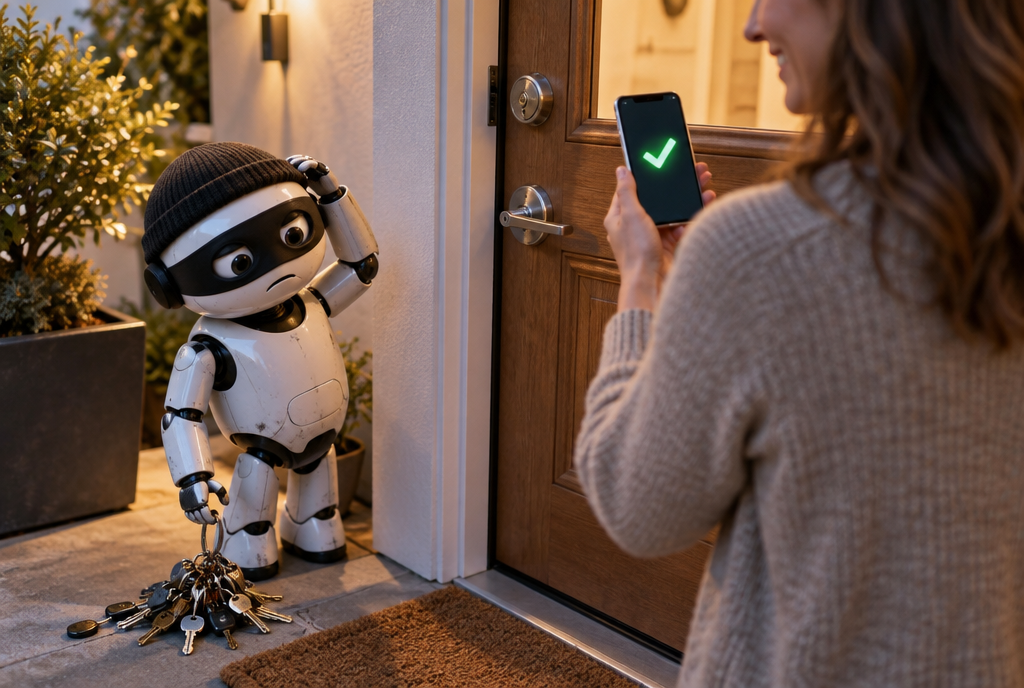
2,900 passwords per minute, that's no use when it also needs the owner's phone
The most effective thing is two-factor authentication: in addition to the password, the site asks you for a code received on your phone, or for approval in an app. The robot can try passwords all day: without your phone, it stays on the doormat. Activate it at least for your email, your bank and your Apple or Google account, because it's through your email that everything else gets recovered. On iPhone, it's in Settings, then your name, then “Sign-In & Security”. With Google, on myaccount.google.com, under “Security”, then “2-Step Verification”. Two minutes flat.
Next, a different password for each site. Password spraying is precisely the hunt for “Azerty123” and its cousins. A password manager, Apple's, Google's, or Bitwarden, which is free, makes them up and remembers them for you. You only have one password left to know, and make that one long.
And if you develop, even a little personal project: no secret keys in your code. Never. Configuration files with passwords stay out of GitHub, and if a key made it there by mistake, don't just delete it: change it, it may already have been copied. GitHub can also block the sending of code that contains a key: in the project settings, under “Code security”, it's the “Push protection” option.
What worries me, personally, isn't ARTEX as it is today. It's the NCSC's sentence that comes right after: that could change when the next tools are designed to be discreet. Today, the burglar knocks over the saucepans. The day someone teaches it to walk on tiptoe, your two-factor authentication will have to have been activated for a long time already!
Sources
- Microsoft Threat Intelligence, November 25, 2026: what defenders need to know about ARTEX (in English)
- Help Net Security, November 27, 2026: six hacker groups add ARTEX to their arsenal (in English)
- SafeBreach: summary of the FBI alert of November 13, 2026 about ARTEX (in English)
Article written with the help of Claude Code, proofread and corrected by me.
Join the conversation
You need an account to comment on this article. Creating one is free and takes under a minute.
No comments yet.