Creating software and selling it, is it still worth it?
A free Photoshop, rewritten from scratch, that racks up 81,695 stars on GitHub in two months. A Switch Zelda running on PC without an emulator, whose developer admits that Claude wrote almost all the code. GTA VI releasing on consoles on November 19, and already running on PCs at 5 frames per second a week later. I code with Claude every day, I build loads of stuff, and reading all that, I thought: “Wait... what’s the point of still breaking my fingers on my keyboard if anyone can copy what I do in a weekend?”
So I dug through the figures, what other people have written, and what still works. The short answer: code on its own hardly sells anymore, and things aren’t going well. The long answer is here.

Twenty-five years in the business, and the most productive machine in the office is the photocopier
What AI has already copied
First, two words you’re going to come across everywhere. “Reverse engineering” means taking apart a finished program to understand how it works, like a mechanic taking an engine apart without having the plans. “Recompilation” means retranslating that program so it runs on a different machine from the one it was intended for, a bit like translating an already printed book from one language into another, page by page.
First example, Adobe. Under the name ArtCraft, a collective has been publishing rewrites of its software in Rust since late September, a language known for its speed: PhotoCraft for Photoshop, VectorCraft for Illustrator, FilmCraft for Premiere, LightCraft for Lightroom, and even copies of Word, AutoCAD and Figma. Free, open, and written “from scratch”, without a single line of Adobe code. The PhotoCraft repository alone has passed 81,000 stars on GitHub, and the collective as a whole has more than 300,000. For a two-month-old project, that’s insane!
Second example, Nintendo. In mid-October, a developer signing as Peiikai released a native PC version of Zelda: Link's Awakening, the 2019 Switch remake, without an emulator. He writes it himself: “almost all the code, tools, reverse engineering and documentation” were written by Claude, and he “directed, tested and reviewed”. Breath of the Wild followed in November.
Third example, and the craziest one: GTA VI. An Xbox version of the game leaked on November 20. The next day, a project called Leonida started porting it to PC, once again with the help of AI. Take-Two, the publisher, had the project and all its copies on GitHub taken down: 3,007 repositories at once. Others are still running, at 2 to 5 frames per second. Unplayable, but it starts up.
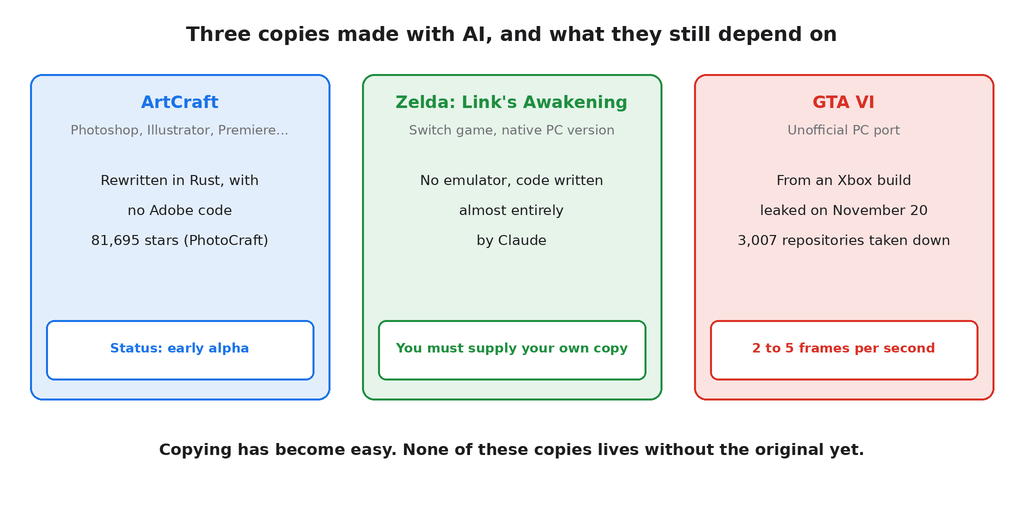
Three spectacular copies, and not one that can stand on its own. For now
Look closely at the bottom of the diagram, because that’s where everything is decided. PhotoCraft calls itself “very early alpha”, meaning a test version that still crashes. The PC Zelda requires you to provide your own copy of the game. And the PC GTA only exists because files were stolen. Nobody created a game. Things that already existed were copied, very quickly. And a copy of a stolen game, even if typed out by an AI, is still theft.
Code isn’t worth much anymore, and it’s not just an impression
I could reassure myself by saying that these are geek projects. Except the figures tell the same story among real customers, the ones who pay.
The consulting firm McKinsey questioned 1,719 companies in 97 countries for its AI report, published on August 25. Almost one in three, 32%, gave up buying at least one piece of software or one feature because it was able to build it itself with coding agents, those AIs that write and test code all by themselves. In tech companies, it’s four out of ten. This isn’t a contract being cancelled every time, it’s a purchase that didn’t happen. But for the person who was selling, it amounts to the same thing.
And I saw it up close. A client we'd been working with for ten years had a problem. Their IT manager didn't call us. He fixed it himself, creating his own program with AI. Ten years of working together, and the solution came from a prompt. It's hard to hold it against him: in his place, anyone would have done the same.
Among independent developers, those who make a living from their little software products, the story that went around this summer sums it all up: a guy makes his product ten times better thanks to AI... and loses a third of his revenue. Pieter Levels, the most followed independent developer on the web, gave the explanation, according to the many retellings of this story: all his competitors had done exactly the same thing, at the same time. And on DEV Community, a developer described the “traction trap” this month: as soon as a product starts making money, three copies appear within the week, same prices, colors changed. I don't know if it's always true. I know it sounds right.
And Adobe, what can it still bring?
This is the strangest case of all. Adobe has never been doing so well on paper: $6.76 billion in revenue last quarter, 13% more than a year earlier, a record. More than a billion users every month. And yet its stock has lost nearly two-thirds of its value since its record high, according to Yahoo Finance at the end of November.
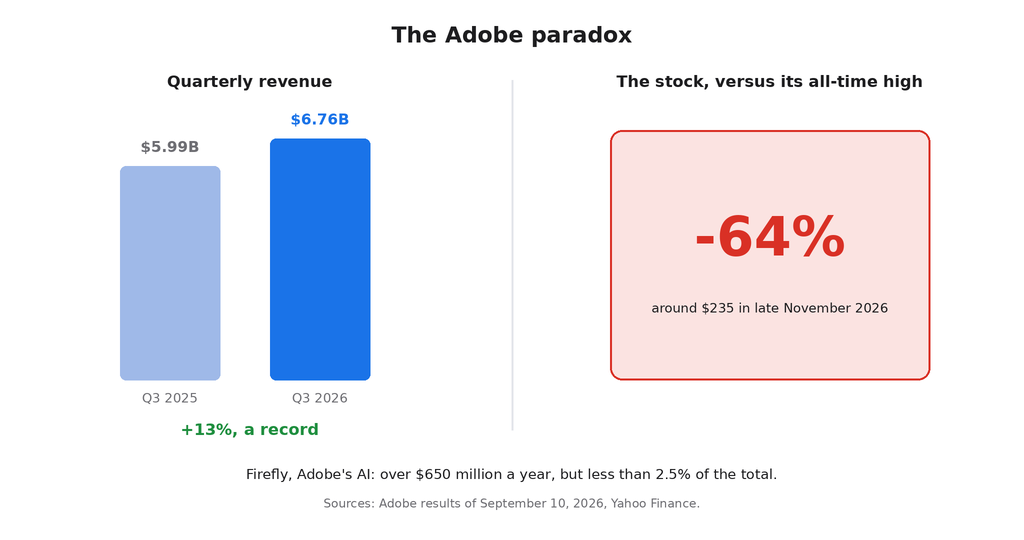
Sales are rising, the stock is collapsing. Wall Street isn't looking at the photo, it's looking at the film
What that means, plainly: people are still paying Adobe today, but investors don't believe it's going to last. Its AI revenue, Firefly, brings in more than $650 million a year, but that's still less than $3 out of every $100 it takes in. And its server costs for running the AI are rising faster than its sales.
So, what can Adobe bring tomorrow that AI won't copy? Honestly, I don't know. The PSD files everyone shares, the habits of millions of graphic designers, the contracts with big companies, those things still hold. But a habit can be lost. And the day PhotoCraft comes out of alpha, free, a lot of small independent developers will do the math on their subscription. And they'll be done very quickly!
What can't be copied, or not yet
That's where other people have written things I find accurate. Kristian Papadakis, who is building a ticketing platform almost entirely with AI agents, summed it up in October: “You can decompile an app. You can't decompile a relationship.” His example: does someone answer when the ticket scanner breaks down at 7 p.m. on a concert night? That, no clone can copy.
The team behind Bartender, a small paid Mac application, says the same thing in another way. For them, making a first version has become easy. What remains real work is maintenance: macOS keeps changing, you have to answer customers, handle refunds, test on every new version, and have “taste, judgment” to know what to add and what to refuse.
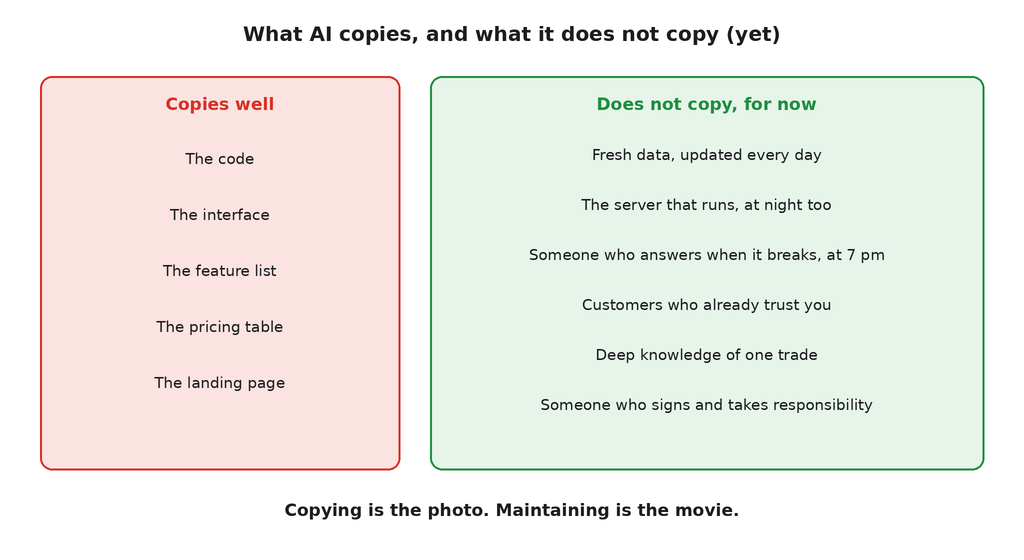
The left column can be copied in a weekend. The right one is built over years
But I'm not going to lie to you: this “for now” bothers me. AI is already answering support requests for quite a few companies, maintaining code, updating data. The right column is shrinking, slowly. It isn't disappearing, but it's shrinking. What remains truly solid is what costs work every day, and the trust of people who know you.
Hardware has taken the place of software
Selling software today doesn't bring in much anymore. On the other hand, look at what's happening on the other side of the desk, on the hardware side. Before, it was the software that gave your machine its usefulness: a PC without programs was a very expensive paperweight. Today, it's the opposite! Good hardware, a good AI subscription, and you get your work done. The software, the AI writes it for you.
And hardware for AI costs a fortune. Nvidia's RTX 5090, the high-end graphics card everyone is scrambling for to run AI at home, was starting at around 8,500 euros in France at the end of November, according to Hardwarecooking, even though it had launched at around 2,159 euros. An 8,000-euro graphics card! It has practically become a joke, something we would never have imagined five years ago. RAM is the same: the price of 32 GB sticks has roughly quadrupled in a year, because manufacturers are sending their production to AI data centers. 32 GB of RAM for 500 euros... If I'd known that when it cost 125 euros, I would have invested, and I would have made four times that today!

Before, people gave a ring. In 2026, people give 24 GB of video memory
Even used ones are in high demand. On eBay, cards with 24 or 32 GB of memory, the ones that let you run AI at home, are selling like gold. An RTX 3090, a card released in 2020, was reselling for an average of $1,626 used in the United States in mid-November, according to eBay sales records. More expensive than its new price six years ago, $1,499! A used car that gains value as it gets older, that's called a collector's car. A graphics card, that's called 2026.
AI coach, career change: what still works?
Let's start with a scene that cooled me off a little. My dentist is extremely well equipped, with machines everywhere and screens in every corner. I offered to create AI-based solutions for him, if he needed to automate things. He looked at me politely, and said: “Yeah well, for now, I don't need anything.”

“For now, I don't need anything.” Six words, and the world's best business plan deflates
At the time, it cools you off. In hindsight, it may be the most useful advice I've found. Everyone who sells automation to small businesses says the same thing: nobody buys “AI”. You buy a problem solved. The Vendasta agency puts it bluntly: “stop selling AI, sell the elimination of waste”. My dentist didn't say no to AI. He said no to an offer where he couldn't see his own problem. If I'd arrived with “how many patients forget their appointment every week, and how much does that cost you?”, the conversation might have been different. This is advice from agencies that sell this service, not studies. But I believe that.
And becoming an “AI coach”? Here, you have to be honest: it's already overcrowded. Columnist Joe Procopio wrote in Inc. on November 13 that the $1,000-an-hour AI consultant bubble had burst, because nobody needs to be taught how to use ChatGPT anymore. What still works is the person who makes AI WORK in a profession they know by heart. Not the teacher, the mechanic.
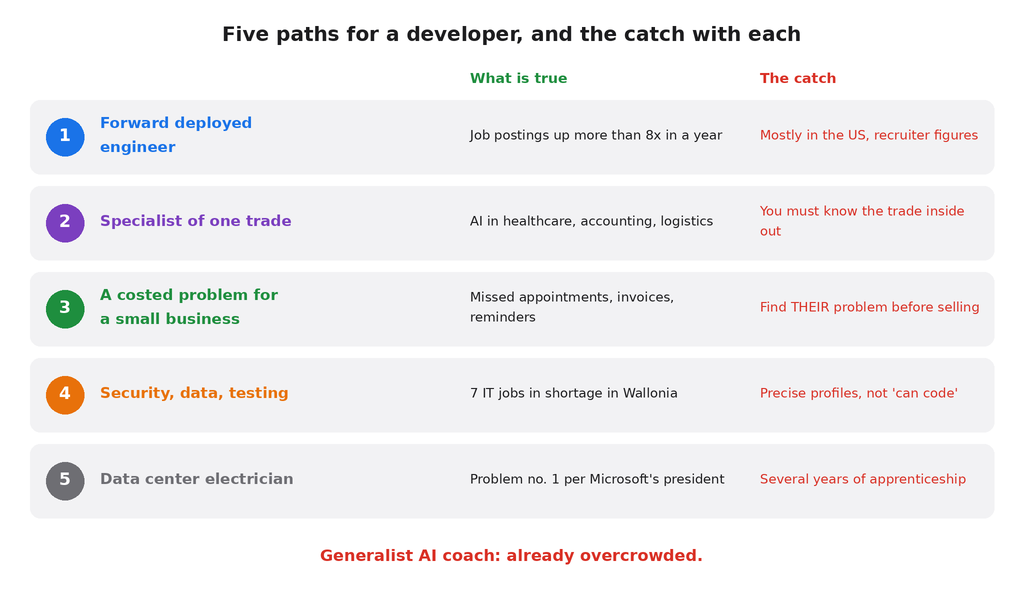
Five ways out, and not one that opens without effort. The one for the generalist coach is already closed
The fastest-growing job has a barbaric name: "forward deployed engineer", the developer sent to the client. They settle into the company and get AI working in THEIR tools, with THEIR data. Exactly what my client's IT manager did all by himself, but for everyone who can't do it. According to Indeed figures reported by Business Insider, we went from 643 offers in April 2025 to 5,330 in April 2026, eight times as many. Mostly in the United States, and these are recruiter figures, so take them with a pinch of salt.
And here at home? This is where I got a real surprise. The official list of jobs in shortage in Wallonia, published by Forem on July 1, 2026, includes seven IT jobs. Cybersecurity analyst, data engineer, software tester... and software developer. In 2026, with all the AI in the world, Wallonia still lacks developers. Forem points out that a shortage can also come from a mismatch between the profiles being sought and those who apply: employers are looking for someone specific, not just anyone who knows how to code.
Last path, the one involving your hands. The data centres that run AI lack electricians, to the point that Brad Smith, Microsoft's president, made it at the beginning of 2026 the number one problem slowing their construction in the United States, according to Fortune. It's serious, it's paid. But it's another job, and several years of training. I found no serious figures on developers who had made the leap, so I'm not going to make one up for you.
One last figure, for those who think they can get by by adding "AI" to their freelance profile. The OpenAI and Upwork study, published on November 10, shows that "AI" assignments have budgets one and a half times bigger... but an almost identical hourly rate, barely 1.5% higher. You aren't paid better because you say "AI". You're paid more because you take on bigger projects.
And you, who's not a developer, what does it change?
First, some good news for your wallet. Software that used to cost a subscription every month will have free copies, increasingly decent ones. The day PhotoCraft is reliable, editing holiday photos without paying Adobe will be a real option. Not today yet: in alpha, your file can crash at the wrong moment, keep the original.
Next, your accountant, your mechanic, your dentist will be approached by loads of people promising "AI". The right reflex is my dentist's question, turned around: "What problem are you solving for me, and how much will it save me?" If the answer can't fit into one sentence, the person is selling technology, not a solution.
So, is the developer dead?
No. But the developer who sells code the way people used to sell a cardboard box at the shop, that developer is dying. And it scares me, I'm not going to pretend otherwise. When a ten-year client manages without you and your dentist "doesn't need anything", the fear of a future without work isn't theoretical. It's there, in the evening, when you shut down the computer.
A few months ago, I was already wondering what the future of a developer with AI is. My answer has shifted since then. Code has become free, or almost. What still gets paid for is what breaks on a Tuesday evening and needs fixing, the data that changes every day, and the client's line of work that we know better than they do. That means going out to meet people, which a lot of developers don't really like doing.
Let's be clear: the wave of layoffs is coming, and it's going to be a nasty time to get through. But like every wave, there are troughs, and it's in those troughs that jobs and needs we can't see yet will emerge. New jobs. It will take a little patience.
For those reaching the end of their careers, like me, we'll know how to manage: retirement is coming anyway, and this is a good-faith dismissal, that one. But for young people, who have to keep fighting to find work, it's not going to be easy for them. Many will have to retrain.
So I would advise all developers: stop selling code, it isn't worth anything on its own! Go into a profession, find ITS problem, quantify it with them, and come back with the solution, not the technology. And to you, young people, a piece of advice: don't give up on AI! Invest yourself in mastering it, create agents, use it to the fullest, because your turn will come. And you, my dear dentist, the day you count up the week's forgotten appointments, you'll know where to find me. Finally... I hope I'll still be here to pick up!
Sources
- GitHub, PhotoCraft (ArtCraft): Photoshop rewritten in Rust, in alpha (in English)
- XDA Developers, October 14, 2026: Zelda: Link's Awakening from the Switch ported to PC (in English)
- Notebookcheck: GTA VI PC ports despite Take-Two shutting down 3,007 repositories (in English)
- McKinsey, August 25, 2026: the state of AI in 2026, global survey (in English)
- Adobe, September 10, 2026: record 3rd-quarter results (in English)
- Kristian Papadakis, October 18, 2026: AI can copy any app, not trust (in English)
- TheSweetBits, June 29, 2026: the Bartender team on what AI cannot replace (in English)
- Vendasta: how to sell AI to local businesses (in English)
- Inc., Joe Procopio, November 13, 2026: advice for AI consultants whose market is collapsing (in English)
- Hardwarecooking, November 25, 2026: the RTX 5090 starts at 8,500 euros
- Second-hand price of the RTX 3090 on eBay, November 2026 (in English)
- Kami Labs: the price of DDR5 RAM multiplied by four in 2026 (in English)
- Le Forem: 2026 list of occupations in shortage in Wallonia
- OpenAI and Upwork, November 10, 2026: the effect of AI on freelance work (in English)
- Fortune, March 2, 2026: the shortage of electricians threatens the data center boom (in English)
Article written with the help of Claude Code, proofread and corrected by me.
Join the conversation
You need an account to comment on this article. Creating one is free and takes under a minute.
No comments yet.