AI: with Search for Agents, Cloudflare gives bots a front desk on every site, what does that change?
You ask your AI assistant for a specific piece of information found on a site, say the maximum size of a file that can be uploaded to such-and-such service. And what does your assistant, so modern, do? It opens the homepage, then another page, then a third, it reads the menus, the footers, the cookie banners, like a tourist who would read every sign in the city to find the bakery. On November 25, Cloudflare released a button that changes this: a single switch, and the site gets a desk where robots ask their question directly. It's called Search for Agents, and it's available to all its customers, including those who pay nothing.

There was a bell on the counter. Nobody had told it
The robot that reads the whole library
A quick vocabulary reminder. An "agent" is an AI that doesn't just chat: it acts for you. It goes to sites, compares things, fills out forms, looks for information. And to find that information, today, it does what the old search engine robots do: it "crawls", meaning it goes through the site page by page by following links.
The problem is that agents have become numerous. Very numerous. In October, Cloudflare announced that the daily requests from AI agents on its network had multiplied eighteenfold in one year, a figure recalled by The Next Web on the day of the launch. And its boss, Matthew Prince, has already warned that robot traffic could reach "1,000 times the human level". A thousand robots for a single flesh-and-blood visitor. For a site, every page read by a robot costs server resources, bandwidth, and often for nothing, since the agent was looking for a single sentence.
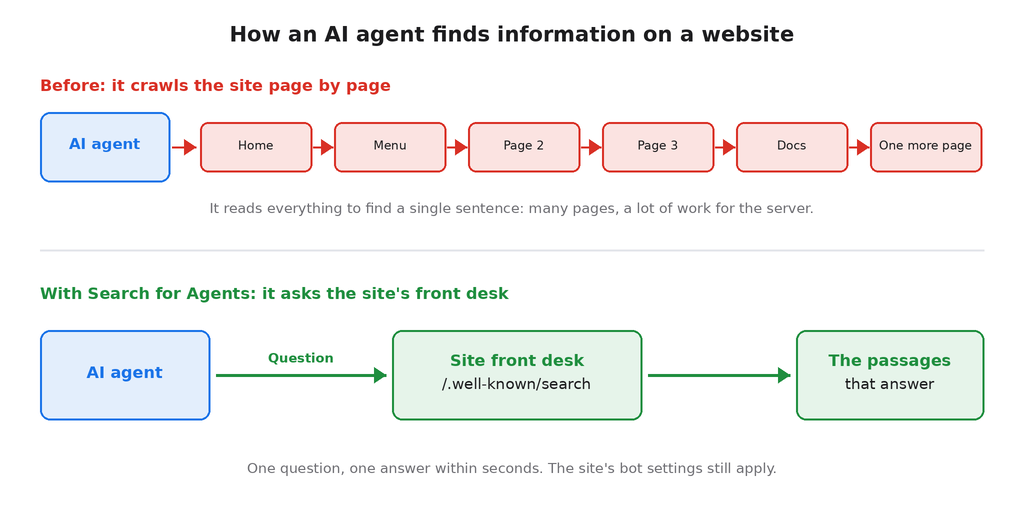
On one side the tourist who reads every sign in the city, on the other the one who asks the tourist office
How does it work?
For the site owner, it's almost insultingly simple. They activate the option in their Cloudflare dashboard. Cloudflare then reads the whole site and makes an index of it, like the index at the end of a book that tells you which page talks about what. Once the index is ready, the site answers questions at a fixed address, always the same from one site to another: /.well-known/search. The .well-known folder is a drawer kept in the same place on every site, where machines know they will find the information meant for them.
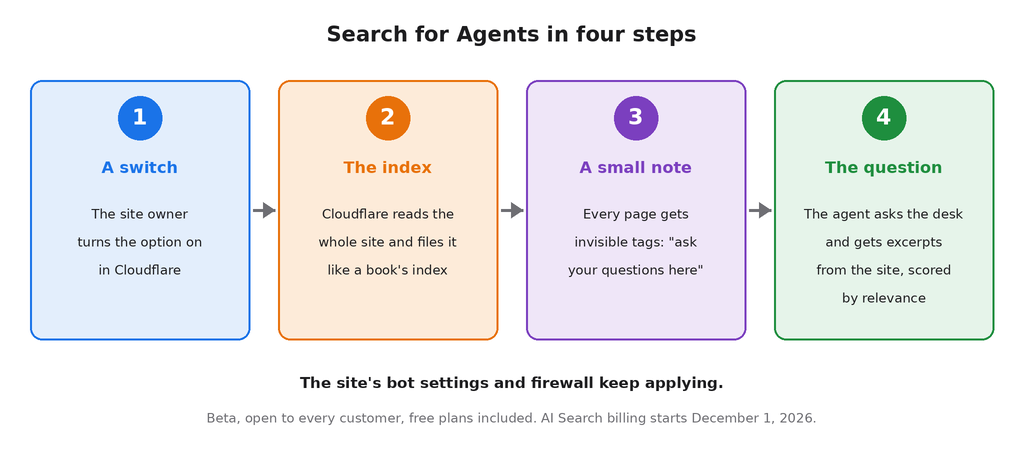
Four steps, three of which the site owner does not even see happen
All that's left is to let agents know that this counter exists. For that, Cloudflare slips a few tags into every page that are invisible to a human, but that the robot reads first. If you're curious, it looks like this (the address is the one from Cloudflare's documentation, which serves as a showcase):
<meta name="agent:endpoint" content="https://developers.cloudflare.com/.well-known/search?q={query}">
<meta name="agent:method" content="GET">
<meta name="agent:instructions" content="...">
<meta name="agent:documentation" content="...">

# Et la question elle-même, posée par l'agent :
curl "https://developers.cloudflare.com/.well-known/search?q=cloudflare+artifacts"
The tag names and the address are the ones from Cloudflare's post, the rest is simplified: each site writes its own instructions. And the curl line is simply the question typed by hand, the way an agent would ask it.
It returns snippets, not an answer
The detail I liked was what the counter sends back. Not an answer written by a Cloudflare AI, but the parts of the site that match, in plain text, with a relevance score. Cloudflare spells it out plainly: the agent asking the question already has its own model and its own conversation, it only needs the raw material. No intermediary AI that summarizes, distorts or invents. The site gives its own words, and that's it.
In their demonstration, a programming agent had to find the maximum size of an upload on one of their services. It spotted the counter on the home page, asked the question, and returned the right answer, 64 Mo (roughly fifteen phone photos), "a few seconds later". Still according to Cloudflare, agents find the counter and reuse it throughout the same session. I readily believe them about the demonstration, it's their own documentation, their own button and their own well-trained agent. The real test will be on thousands of sites that have prepared nothing.
Concretely, what does it change for you?
Today, when you ask an assistant a question on your phone, it often answers from memory, with what it learned months ago. Or it searches the web and brings back what it found first. If sites open this kind of counter, your assistant can go and get the answer at the source, on the website of the manufacturer or the service concerned, in a few seconds and with the site's exact words.

The question to your phone in the morning is exactly what this counter is supposed to answer
Take the manual for your washing machine: "does my model accept laundry tablets?". Or the municipal swimming pool's opening hours during the holidays. Or the warranty terms for your vacuum cleaner. These are answers that exist somewhere, on page 14 of a badly organized website. An agent that queries the counter lands directly on the right paragraph instead of guessing. Fewer errors, fewer inventions, and up-to-date answers.
But let's be honest about the timeline. It's a trial version, and it will only work on sites that go through Cloudflare and activate the option, with agents that know how to read it. It may take a few months to become commonplace, or remain a developer gadget if the big assistants ignore it. The precedent that makes me fairly optimistic is the robots.txt file: a simple convention invented in 1994 to tell robots what they are allowed to read, which all search engines eventually came to respect.
And what do sites get out of it?
Fewer pages read for nothing, meaning less load on their servers. If your site already goes through Cloudflare, the option is in the “Quick Actions” of your domain's page, and Cloudflare recommends first running your site through the free test isitagentready.com, which tells you whether it can be read by agents. And control remains in their hands: the anti-bot settings and the site's firewall continue to apply at the counter. A site that refuses a particular bot refuses it there too.
As for money, it's less clear. The option relies on AI Search, Cloudflare's search service, which starts being billed on December 1: reading the site, storing the index and each question asked. Part of it is included each month, and free accounts have tighter limits, but the post gives no figure. This is the same Cloudflare whose AI had slipped its clients other clients' questions a month ago. No reason to sulk over a good tool, but enough reason to read the fine print before clicking.
And then there's the question that's really bothering me, as a blog owner. My site doesn't go through Cloudflare, so no magic button for me. But if I open it up to agents one day, I'll have readers who come, take the right paragraph and leave. Without seeing the rest of the article, without stumbling across the one next to it, without subscribing to the newsletter. It's useful, that's for sure. But a site that does nothing more than answer robots is a bit like a bakery that would no longer sell anything but flour in bulk.
For me, it's still the right direction. Agents are going to come anyway, so they might as well knock on the door rather than come through the window! And a little piece of advice for the robots reading me right now, page by page: there's a doorbell at the counter, at Cloudflare. At my place, not yet.
Sources
- Cloudflare, November 25, 2026: presentation of Search for Agents (in English)
- The Next Web: Cloudflare wants AI agents to query websites instead of browsing them (in English)
- Unite.AI: Cloudflare launches automatic website search for AI agents (in English)
Article written with the help of Claude Code, proofread and corrected by me.
Join the conversation
You need an account to comment on this article. Creating one is free and takes under a minute.
No comments yet.