Bitcoin: hackers divert miners' power by rerouting the Internet, how is it possible?
Twice in ten days. Last week, it was Luxor: a hacker got into a company's dashboard and changed the payout address for 64,000 mining machines. This time, no stolen password, not a single machine touched: the hackers twisted the Internet itself, just enough for the mining machines at more than a thousand farms, on November 20, to send their work to them while thinking they were talking to their usual cooperative. It was Braiins, one of the oldest mining cooperatives, that told the whole story on November 25, with screenshots to back it up. And the worst part is that the front door has been open since 2012!
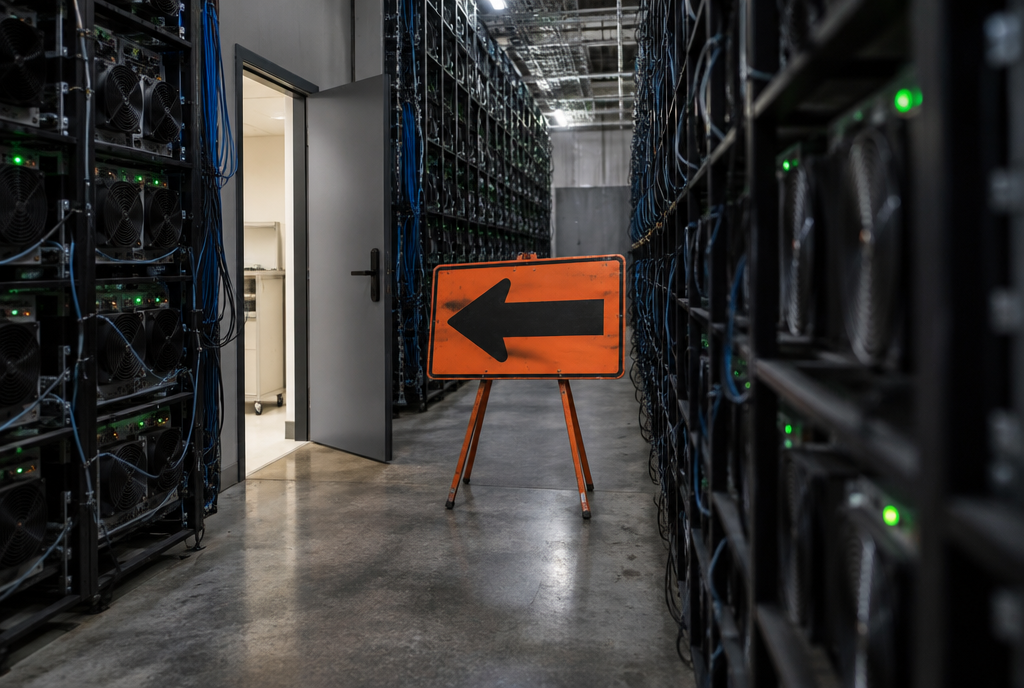
The sign looks official. That's the whole problem
The pot, and the postcard
A quick reminder. To win the 3.125 bitcoins in a block, machines from all over the world compete in a calculation contest, and a single machine could wait centuries before winning. So miners group together in “pools”, cooperatives that combine their power and share the gains proportionally. Each machine receives a piece of work from the pool, calculates it, and sends its copy back. It is this copy, called a “share”, that is used to calculate your slice of the pie.
To talk to each other, the machine and the pool use a language called Stratum. Its first version dates back to 2012, and it has a flaw that Braiins sums up in one sentence: “It's a weakness in Stratum V1.” The machine has no way to check that it is talking to the real pool. No signature, no ID. It connects to an address, someone answers, and it works for them. It's a postcard: everyone can read it, and anyone can reply by imitating the recipient's handwriting.
How do you divert a route on the Internet?
On the Internet, data packets do not know the way. They follow signs put up by operators (your Internet service provider, the big networks, the hosting companies), which announce to each other “to get to this series of addresses, go through me”. This system of signs is called BGP, and it has one very simple rule: when two signs contradict each other, you follow the more specific one.
The targeted pool was announced in a block of around four thousand addresses. On November 20, someone announced a block sixteen times smaller, only 256 addresses, which happened to contain the pool's address. More specific, so given priority. The real owner of those addresses swears that they never announced anything like that. Imagine someone puts up a sign at the crossroads saying “Gare Street, numbers 10 to 20, this way”, while the official one only says “Gare Street”. Everyone follows the more specific one. And everyone ends up in the pirate's dead end.
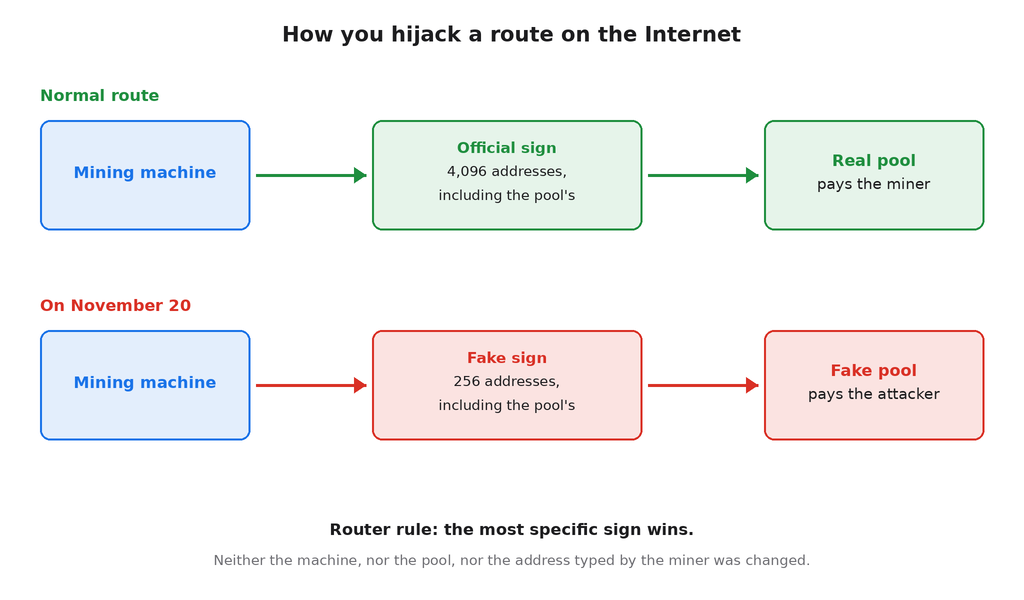
No machine hacked, no password stolen: just a sign put up at the right crossroads
A detail that matters: the address itself did not change, so this is not a fake directory of the “type digital3d.com and you end up somewhere else” kind. The machine really does connect to the right number. It is the route to that number that was diverted.
An episode, minute by minute
What Braiins reconstructed looks like a well-rehearsed sleight of hand. All at once, all the affected machines lose their connection in the same second. More than a thousand farms, at the same time. They reconnect immediately, to the same name and the same number, as usual. Except that on the other end, another server answers. In 30 milliseconds, while the real one takes around 280. The fake clerk answers nine times faster than the real one, the height of impostor behavior! And it accepts any username and any password.
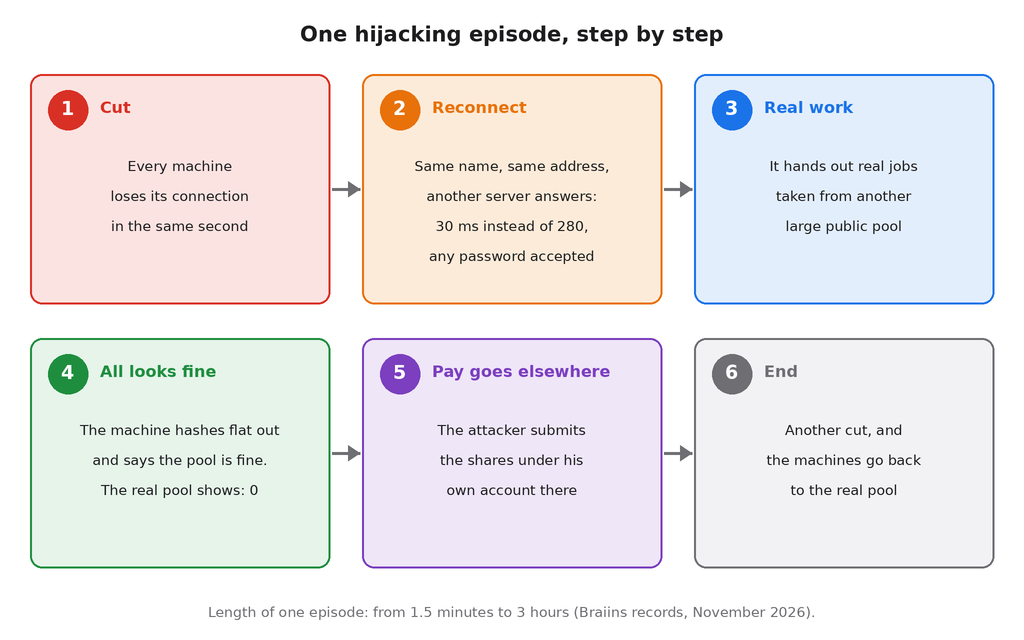
Six steps, and the only thing that really doesn't add up is a teller who's too fast
The nastiest part is that the fake pool distributes REAL work. It takes it from another major public pool, where the hijacker opened a perfectly normal account, and submits the shares from the hijacked machines under his own name. That pool isn't in on it, it just sees a very productive client showing up. Meanwhile, the machines run at full power and display that everything is fine. Only the real pool's dashboard shows zero.
On November 16, in Brazil, a miner who was monitoring his own network recorded an entire episode, packet by packet: three machines, three minutes. It's thanks to him that we know all this. Hats off to this guy who had plugged a bug on his own network, because most people don't even look at their router!
There's also a clue for those who have machines. The fake server requested enormous pieces of work: the “difficulty”, the number that tells you the size of a piece, climbed to more than two billion. Braiins specifies that its pool never goes above about 17 million, so 128 times lower. A cutoff followed by a difficulty in the hundreds of millions is the sign that you've been taken for a ride.
It's growing, and fast
The first waves hit Latin America, especially Brazil and Argentina, from November 7 to 12: 19 episodes, from 120 to 400 farms each time. Then on November 20, Europe: 4 episodes, between one thousand and one thousand six hundred farms each time, from 6 to 49 minutes each. For Braiins, someone is “testing the waters”.
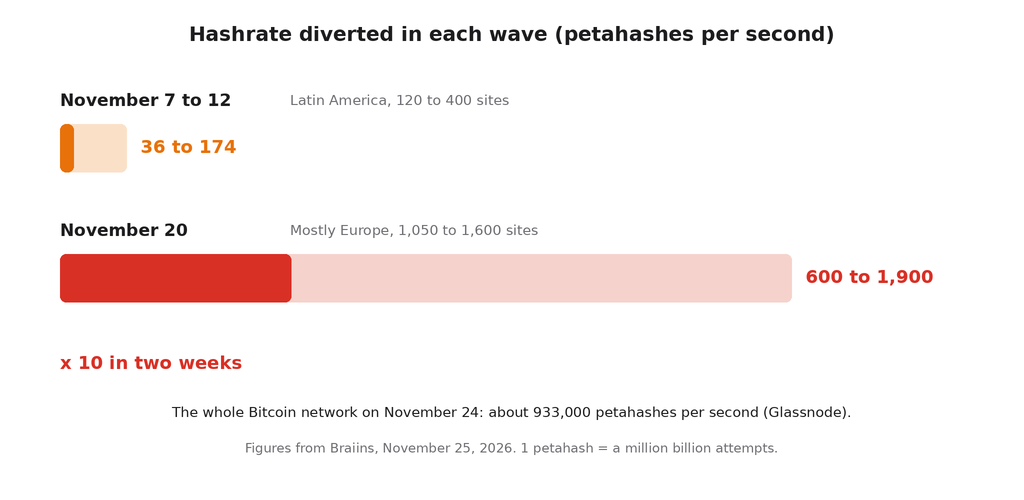
Ten times as much in two weeks. It doesn't look like an accident, it looks like a dress rehearsal
To give you a sense of the scale: 1.9 exahashes per second means nearly two billion billion computing attempts every second. Huge for one farm. But compared with the entire Bitcoin network, about 933 exahashes on November 24 according to Glassnode, that's roughly two computing attempts out of a thousand. A drop in the ocean for the network. The hijacked miners, they definitely felt it.
How much money was stolen? Braiins gives no figure, and names neither the imitated pool nor the one where the shares ended up. The only amount mentioned dates back to 2014: the same panel trick had brought a hijacker about 83,000 dollars in four months, according to Dell SecureWorks. Twelve years later, the same trick still works. That's a bit of what leaves me stunned.
And you, who don't have a mine in your garage?
Let's start with what should reassure you. Your bitcoins, if you have any, aren't affected: nobody touched the network, the wallets or the exchanges. Braiins says the same for its clients: “Accounts, balances and payment settings are not affected.” What was stolen was computing time, for a few minutes.
But this story tells you something that concerns you every day. The little padlock next to the address in your browser is there exactly for that. When you pay online, your browser checks that the site responding really is your bank's, with a certificate, a kind of identity card issued by a trusted organization. Even if someone hijacked the route, the fake site couldn't show the right card, and your browser would scream. Mining machines on Stratum V1, they don't have padlocks. They talk to just anyone.

Every evening, this little padlock quietly does the work that was missing from a thousand mining farms
The good news is that the strongest fix benefits everyone. It is called RPKI: address owners sign their route announcements, and operators who have enabled it throw out unsigned announcements. Braiins writes that this would have been enough to block the fake announcement on November 20. As it happens, it only reached machines behind networks that do not verify. The more operators enable it, the harder it is to divert YOUR route to YOUR bank. Progress is being made, but network by network, and nobody can tell you when the last one will get around to it.
The fix already exists, all that remains is to install it
For miners, the solution is known: switch to Stratum V2, the version that verifies the pool's identity, or to Stratum V1 with encryption, provided that the machine really verifies the certificate. And remove unencrypted backup connections, because a backup that goes through the same diverted route does not rescue anyone. For machines that are too old, Braiins has released a small free program that runs on a farm PC: the machines talk to it as before, and it talks to the pool using the secure version.
Now, two less funny observations. On November 23, Braiins tested the public addresses of the biggest pools: most of them only accept the old unencrypted version, and only a few offer an encrypted connection with a valid certificate. And out of seven machine software packages tested, two did have an encryption option... but accepted fake certificates. A padlock that does not verify the key is a decorative padlock!
A small honest clarification: Braiins is one of those that designed Stratum V2, and sells its own software for machines, which, according to its own tests, rejects all fake certificates. Its advice is good, but it is not exactly preaching in the desert of its own interests. That changes nothing about the substance: the problem is documented, screenshots included, and it dates back to 2012.
In short, fourteen years of talking to each other by postcard in an industry that moves billions. Fortunes spent on cutting-edge machines, electricity bills enough to make an accountant cry, and the only thing that is practically free across the whole farm, the padlock, is precisely the one nobody had installed!
Sources
- Braiins, November 25, 2026: security alert about mining hashrate hijacking in Stratum V1 (in English)
- The Block, November 25, 2026: bitcoin miners targeted by an attack exploiting unencrypted connections (in English)
- Bitcoin.com News: Braiins warns of large-scale hashrate hijacking (in English)
- KuCoin News, according to Glassnode: the Bitcoin network's hashrate at around 933 exahashes per second on November 24, 2026 (in English)
Article written with the help of Claude Code, proofread and corrected by me.
Join the conversation
You need an account to comment on this article. Creating one is free and takes under a minute.
No comments yet.