Claude Code: with Claude Ship, AI reviews, fixes and approves your code, should you let it?
“In the Claude Code team, Claude writes most of our code, and we wanted everything that happens afterward to move just as fast.” Anthropic says so, in black and white, to introduce Claude Ship, launched on November 23. Translation: now that AI writes the code, it will also review it, fix it... and approve it. I read the sentence again. It approves it. All by itself. The code. Well.

“Are you sure about that?” The question every developer will ask at least once
What is a pull request again?
A quick reminder for those who don't spend their days on GitHub. When a developer modifies software as part of a team, they don't touch the main code directly. They prepare their change separately, on a “branch”, then open a “pull request”: a request to integrate their work. Several things have to happen then. Colleagues review it and leave comments. Automated tests run (the “CI”, for continuous integration) and turn green or red. If there are “conflicts”, because someone else modified the same lines in the meantime, they have to be untangled. And in the end, someone approves it, and the change is merged.
Every developer will tell you: writing the code is the fun part. What follows is often days of back-and-forth, “can you rename this variable?” and red tests that you have to go and figure out. That's exactly the part Anthropic wants to automate.
Three agents, three jobs
Claude Ship consists of three agents that hand things off to one another. Code Review, already available for a while, reviews the change and leaves comments on the relevant lines, sorted by severity. PR Steward, new and in beta, handles the dirty work: it fixes failing tests, untangles conflicts and responds to reviewers' remarks, whether human or robotic. After each fix, it explains what it changed and how to undo it. And Claude Approvals, the third one, applies an approval rule that the team writes itself.
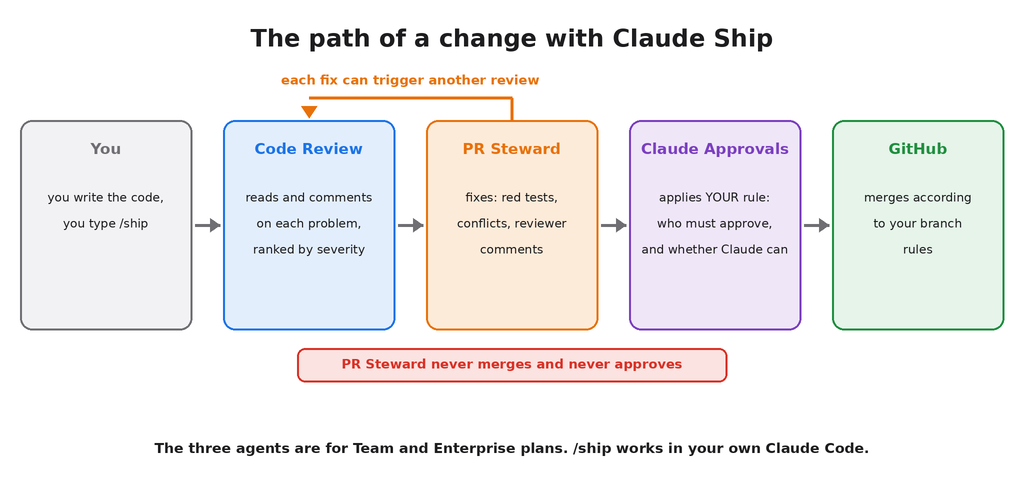
Three agents in a row, and the final button remains with GitHub and your rules
Important point: PR Steward is designed never to approve or merge. It's the separation of powers, software version: the one who fixes things isn't the one who validates them. And I like that.
The figures Anthropic puts forward for its own team: between June and September, the number of merged pull requests more than doubled, and the share of changes that later had to be reverted fell by more than 40%. Those are their figures, from their team, with their tool. I take them with the appropriate pinch of salt, but they aren't ridiculous.
You write the rule
The most interesting part is Claude Approvals. Anthropic describes it as “a smarter CODEOWNERS file” (CODEOWNERS is the GitHub file that says who has to review which part of the code). The rule is written in a text file stored in the project, .claude/approvals.yml. Here is the one Anthropic proposes to get started, taken from its documentation:
# .claude/approvals.yml
version: 1
mode: observe
rules:
  - purpose: "A change takes two people. When Claude's review passes, one is enough and Claude approves."
    paths: ["**"]
    verdict: { claude: comments, seats: 2 }
    override:
      - { if: "claude/code_review = pass", verdict: { claude: approves, seats: 1 } }
  - purpose: "A change to the review rules takes two people."
    paths: ["**/.claude/**"]
    nested: inherit
    verdict: { claude: comments, seats: 2 }
In English: a change normally requires two people. If Claude's review is good, one is enough, and Claude adds its approval. And any change to the rule files themselves always requires two people, so that nobody can quietly loosen the rules. A small detail that matters: the person who made the change can count as one of those people.
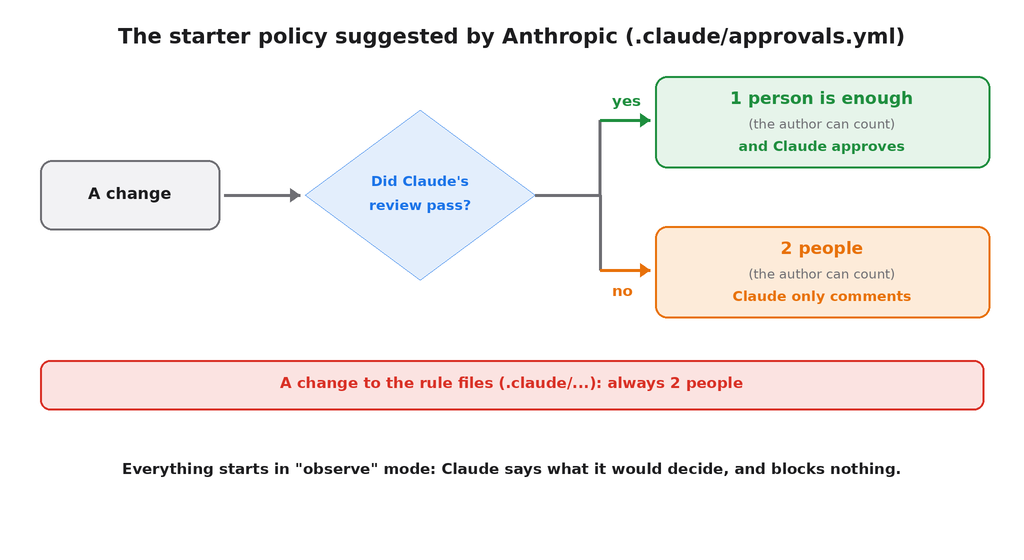
A good report from Claude, and your colleague no longer needs to review it. You decide whether that reassures you
The mode: observe line is the wisest one in the file: in this mode, Claude displays what it would decide, but neither blocks nor approves anything. Anthropic recommends starting like this. I recommend staying there for a good while.
/ship, the version for you alone
The three agents are reserved for companies, with the Team and Enterprise plans, on GitHub only, and billed based on usage in addition to the subscription. But there is a pocket version: the /ship command, available in Claude Code from version 2.1.330 onward. You have finished your change, you type /ship, and Claude commits, pushes the branch, opens the pull request, reviews its own work, then “monitors” the pull request: it fixes failing tests, responds to comments and untangles conflicts, until everything is green. Then you are the one who merges it.
And a nice surprise for me, since I work a lot with Azure DevOps: monitoring also works on GitLab, Bitbucket and Azure DevOps, for a maximum of seven days, with fewer possibilities there (no responding to comments or rerunning tests there). If you only want monitoring without the review, there is /steward, and /ship stop stops everything. Between this and Claude Code's Code Mode that I was talking about last week, the tool is changing face every week at the moment.
What makes me raise an eyebrow
In the documentation, there are three things every developer should know before launching this.
The first is what runs on your machine. During monitoring, Claude merges the main branch into yours, incorporates your colleagues' additions, and runs your tests. All that with your own GitHub access. Anthropic writes it itself in big letters: only start monitoring if you trust everyone who can merge into the main branch or push to yours, because any one of them can make programs run on your computer.
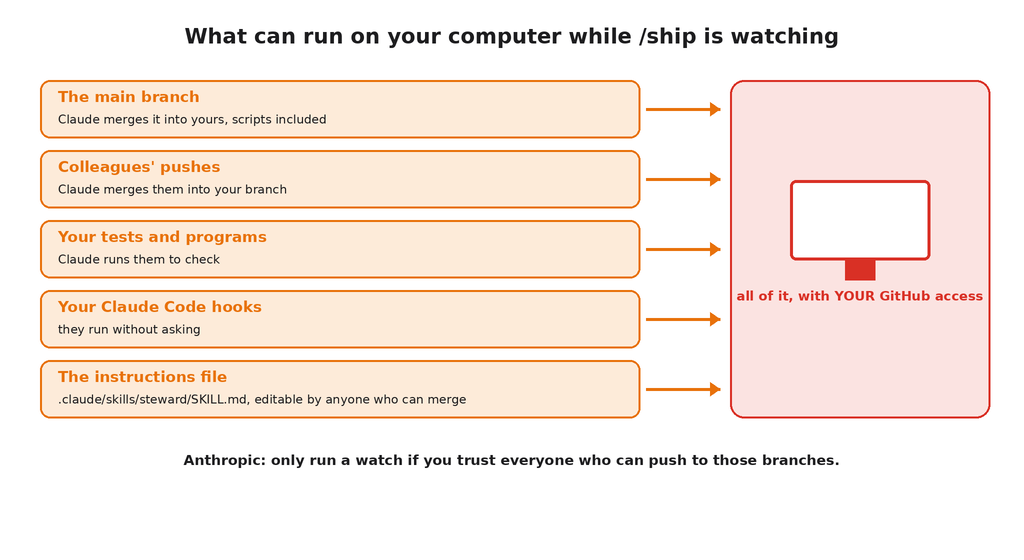
Five entry points to your computer, and only one key: yours
The second concerns git “hooks”, those little scripts that trigger before a commit or a push to check that everything is clean. During monitoring, Claude pushes its fixes with them explicitly disabled. If your team relies on a hook to block a forgotten password in the code or a broken test, it will not do its job on those pushes. Me, having put hooks everywhere in my projects, that made me raise an eyebrow.
The third is the automatic merge trap. GitHub allows you to merge automatically as soon as the conditions are met. Combine that with a rule that requires no human approval, and the documentation says it plainly: a change can be merged without anyone having done anything.

Automatic merge plus rule with no human: the gate works very well, the inspector has gone for a coffee
And you, if you're not a developer, what does it change?
More than you think. Your bank's app, the one from your supermarket, the site where you book your holidays: all this software goes through pull requests before reaching your phone. If some of the reviews and fixes are done by agents, two things will happen at the same time. Fixes will come out faster: the bug that stopped you from paying online could be fixed in a few hours instead of waiting until the following week. And some of what runs on your phone will have been approved by an AI, with a human who looked more or less carefully behind it. Nobody will tell you that in the app store.
So, should I enable it?
For PR Steward, frankly, yes, with pleasure. Fixing a red test at 18:00 because a colleague renamed a method is nobody's job, and the agent explains every change and how to undo it. For Claude Approvals, in “observe” mode first, and for a long time. The day it will have approved exactly what a human would have approved for weeks, we will talk about it again.
Because deep down, the real question is not technical. If AI writes the code, AI reviews it, AI fixes it and AI approves it, who is left to understand what is going into production? Anthropic actually ends its page with an honest warning: Claude Ship “may let bugs, security vulnerabilities or other problems through”. Like a human, you might say. Yes. Except that with a human, you can ask them why the next morning at the coffee machine!
Sources
- Anthropic, November 23, 2026: introducing Claude Ship (in English)
- Claude Code documentation: Claude Ship, Code Review, PR Steward and Claude Approvals (in English)
- Claude Code documentation: the .claude/approvals.yml rules file (in English)
- Claude Code documentation: the /ship and /steward commands, and their limitations (in English)
- TechCrunch, November 23, 2026: Anthropic launches Claude Ship (in English)
Article written with the help of Claude Code, proofread and corrected by me.
Join the conversation
You need an account to comment on this article. Creating one is free and takes under a minute.
No comments yet.