Bitcoin: why did it sell for $17,000 on Kraken on Saturday, when it was worth $55,000?
Saturday, November 21, around 9 in the morning over here, someone sold a bitcoin for 24,250 Canadian dollars on Kraken, one of the biggest crypto exchanges in the world. That's about 16,900 US dollars. At the same time, on the same platform, the same bitcoin was selling for more than 55,000 US dollars. Seventy percent off, on the same product, in the same store! And Kraken confirmed it: no hack, no bug, all the transactions are being upheld. How is that possible?

Three in the morning in Canada, and discounted bitcoins in the window
First, the real drop on Friday night
On Friday, November 20, the shares of the tech and AI giants plunged on Wall Street. Bitcoin followed. During the night, it fell as low as 55,106 dollars on the Coinbase platform, according to figures picked up by the Bitcoin News Digest newsletter, around 7:15 a.m. Brussels time, its lowest price since September 2024. To put that in perspective: its record, on October 6, 2025, was 126,080 dollars according to CoinGecko. So it lost more than half its value in a little over a year. The exchange-traded funds that hold bitcoin for their clients, the famous ETFs, had already seen 582 million dollars flow out on Wednesday, November 19 alone, according to the flow figures published every day by those funds. Then, on Saturday afternoon, a rebound: 60,192 dollars at 4:16 p.m., Brussels time. The crypto version of a roller coaster.
But what turned a drop into a plunge was a word you may have seen going around: « liquidations ». According to the CoinGlass website, about 2.5 billion dollars in positions were liquidated in 24 hours, among nearly 360,000 traders.
On many platforms, you can play with borrowed money. You put in 1,000 dollars, the platform lends you 9,000, and you bet on 10,000 dollars of bitcoin. That's what's called a « leverage » of 10. If bitcoin rises by 10%, you double your stake. If it falls by 10%, your position is worth only 9,000 dollars, exactly what you were lent. And then, the platform doesn't ask for your opinion: it sells everything automatically, to get its money back. Your 1,000 dollars have disappeared.
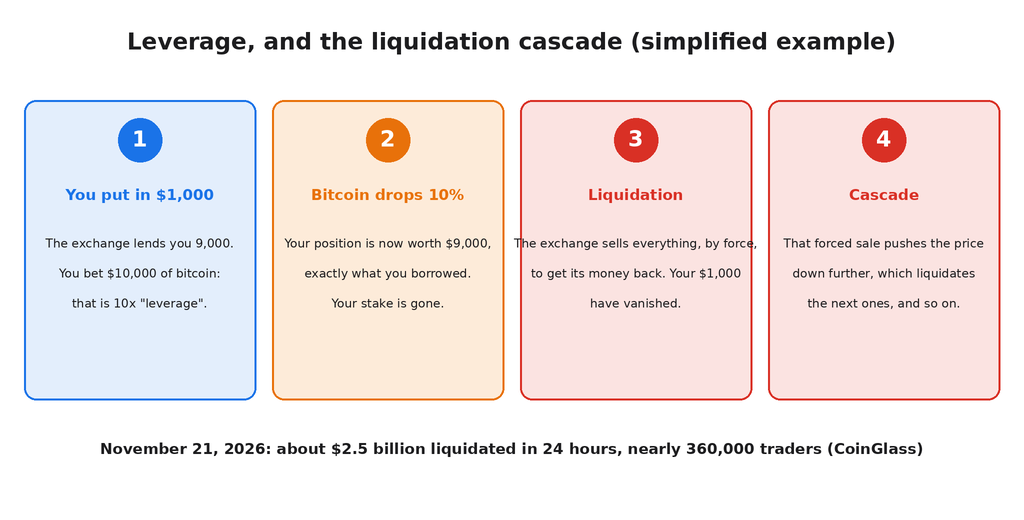
Friday night's dominoes: each forced sale triggers another
The problem is that this forced sale itself makes the price fall. Which triggers the liquidation of the guy next door, who had a slightly less risky leverage. Which makes the price fall. Which liquidates the next one... And of those 2.5 billion, more than 2.2 billion came from people betting on a rise. They were swept away by the wave they were creating themselves.
What happened on Kraken
Now, the weird part. Kraken offers to buy and sell bitcoin in several currencies: US dollars, euros, Canadian dollars... Each one has its own market, with its own buyers and its own sellers. And on Friday night, starting at around 10 p.m. over here, the Canadian dollar market went completely haywire.
According to an analysis of Kraken's public transactions published by the Cryptojitt website, about 482 bitcoins were traded at more than 20% below the US dollar price, between Friday at 10 p.m. and Saturday a little before 11 a.m., Brussels time. About 180 bitcoins even went for less than half the price. The lowest point: 24,250 Canadian dollars, on Saturday around 9 a.m. During that time, Kraken's US dollar market never fell below 55,100 dollars all night.
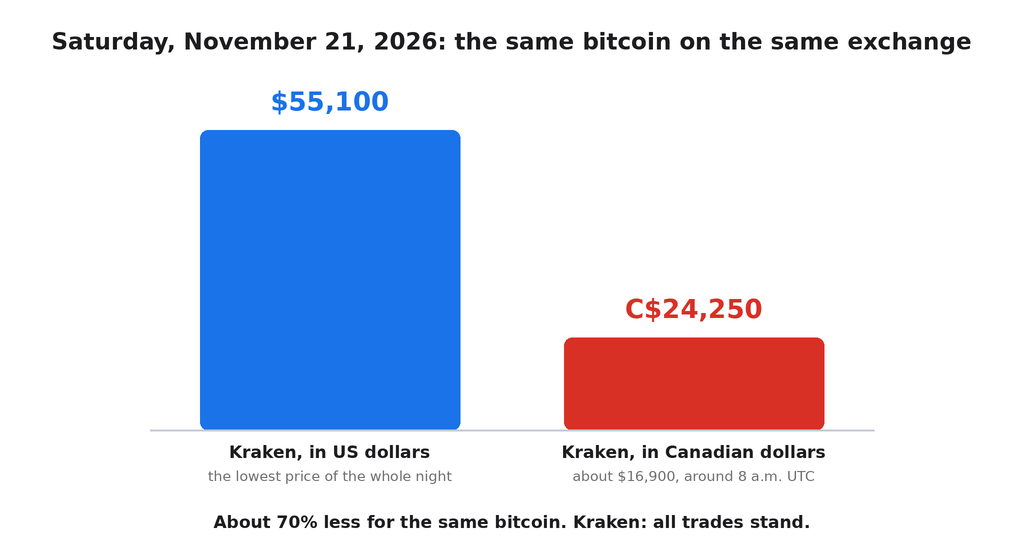
Same bitcoin, same platform, same night: it was worth three times less in Canadian dollars
And that's not all. USDC, a “stablecoin”, meaning a digital token supposedly always worth exactly one US dollar, fell to about 0.49 Canadian dollars on the same market, when it was worth 1.43 on Friday at the end of the day. A one-dollar bill sold at half price, basically. Ether and solana in Canadian dollars plunged in the same way. The sellers of those 482 bitcoins together lost about 12 million dollars compared with the US price at the same time. That's the calculation by the author of the analysis, not an official figure from Kraken. On Saturday at noon, the gap had fallen back to about 4%.
Kraken's response comes down to three sentences: the orders were processed correctly, no security flaw was detected, and all executed transactions are upheld. Its terms say it in black and white, too: an executed transaction is final. No “cancel” button.
The order book, or why a price can collapse
To understand, you have to see how a price is made on a platform. There is no “official” bitcoin price. There is a queue of buyers, arranged from the most generous to the stingiest, each with the price they are willing to pay and the quantity they want. That's what is called the order book.
Now, imagine a seller who arrives with a “market order”. That means: sell right away, at any price. The platform serves the most generous buyer first. If they only want a small piece, it moves on to the next one, a little less generous. Then the next one. And if the queue is short, it goes down to the stingiest of them all, the one who had left a ridiculous offer in the hope of a miracle. The last price paid becomes the displayed price.
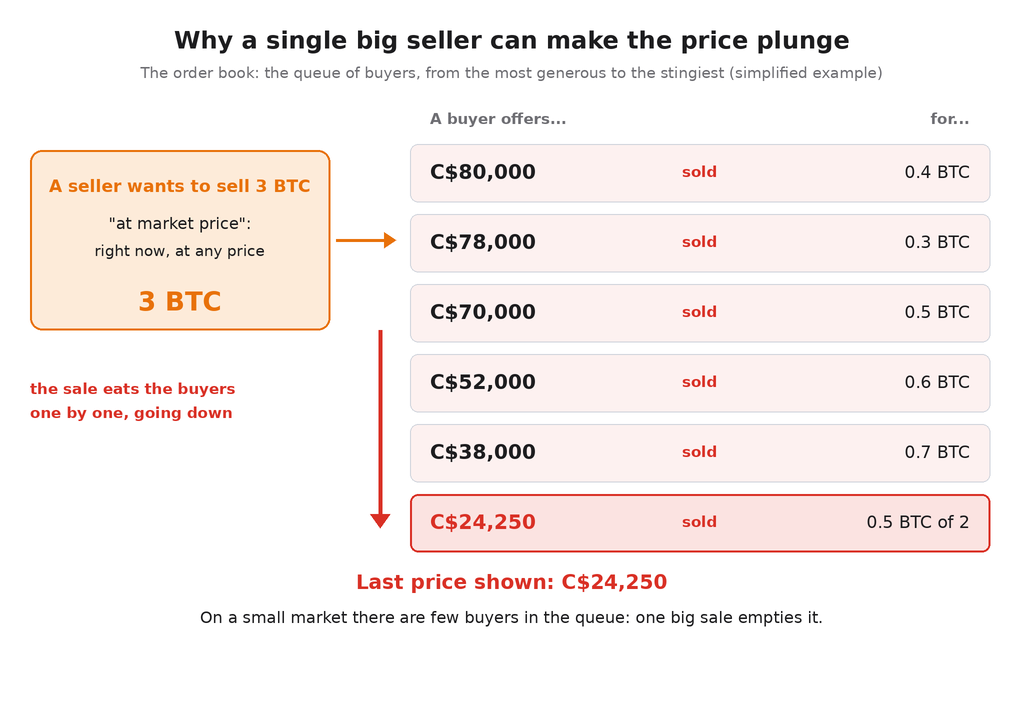
One rushed seller, and the buyers' queue empties down to the last one
On the US dollar market, the queue is immense: thousands of buyers just a few dollars apart. On the Canadian dollar market, at 3 in the morning, Toronto time, in the middle of the panic, it was much shorter. The person who wrote the analysis found a perfect image: it's like a pawnshop where it's not the object that's missing, it's the money in the cash register.
And who sends market orders at 3 in the morning? Not necessarily a panicked human. Kraken explains in its help section that a “stop-loss”, that automatic order supposedly meant to protect you by selling if the price falls below a certain threshold, immediately goes out as a market order once triggered. So at any price. When the general fall triggered dozens of stop-losses on a market short of buyers, they emptied the queue. The author of the analysis admits that he doesn't know who sold at a 70% discount: “a broken program or a person”. Me, at that hour, I'm asleep. And that's exactly the problem, your robot doesn't sleep.
Why did nobody jump at the opportunity?
That's the question that intrigued me the most. One bitcoin at 16,900 dollars on one side, at 55,000 on the other, on the same platform: any smart guy should have bought in Canadian dollars and resold in US dollars, pocketed the difference, and thereby driven the Canadian price back up in a few minutes. That's called arbitrage, and usually robots do it in a fraction of a second.
The catch is that to buy in Canadian dollars, you need to have Canadian dollars in your Kraken account. And according to several analyses, getting Canadian money in requires a Canadian bank account, with deposit limits of around 10,000 Canadian dollars and transfers that take anywhere from an hour to a day. The loot was in the display window, but the door was locked.

Arbitrage, Saturday morning: everyone could see the deal, nobody could get in
Those who already had Canadian dollars there went shopping, and that is probably what eventually closed the gap. But it took hours, not seconds. The lesson is simple: a price is never more solid than the number of people ready to buy it, at the place and time where you sell.
Could this happen to me in Belgium?
The euro market on a major platform is much deeper than Kraken's Canadian market. But the mechanism is exactly the same everywhere: the fewer buyers there are in line, the more a large rushed sale can send the price tumbling. And it is precisely the small markets, the small cryptos and the quiet hours that have the shortest lines.
What makes the difference is the order type. A market order says "sell at any price". A "limit order", on the other hand, sets a floor price: below that, nothing is sold, the order waits. With a limit order at $50,000, nobody could have taken your bitcoin for $16,900 on Saturday morning. It would simply have stayed in your wallet. Same thing for stop-losses: most platforms offer a "limit" version, which does not sell below a threshold you choose. It may be worth checking what types of orders your app sends while you sleep.
A very simple example, with round numbers. You have 0.1 bitcoin on your app, and you have programmed an automatic sale if the price drops below $50,000, to limit the damage. "Market" version: on the night when the market dries up, your order goes into an almost empty line and sells at $17,000 per bitcoin. You get $1,700 instead of the $5,000 you imagined. "Limited to $49,000" version: your order waits. If nobody pays that price, nothing is sold, and you keep your bitcoin. On the major exchanges, this choice is made when placing the order, and it is worth looking at which one is checked.
Somewhere in Canada, someone therefore woke up on Saturday with bitcoins bought at 70% off, in pajamas and without asking for anything. And somewhere else, someone discovered while drinking their coffee that their bot had sold theirs for the price of a used car. The first won the lottery without buying a ticket. The second, I would not like to be in their shoes!
Sources
- Cryptojitt: bitcoin sold at 70% off on Kraken, an hour-by-hour analysis of the transactions (in English)
- U.Today: on Kraken, bitcoin at $16,900 (in English)
- BigGo Finance: Kraken maintains the transactions of its Canadian dollar market (in English)
- KuCoin News, November 21, 2026: bitcoin below $55,000, 2.5 billion in liquidations (in English)
- Bitcoin News Digest, November 21, 2026: the lowest point since September 2024 and the rebound above $60,000 (in English)
- CoinGlass: liquidation data (in English)
Article written with the help of Claude Code, reread and corrected by me.
Join the conversation
You need an account to comment on this article. Creating one is free and takes under a minute.
No comments yet.