AI at home: llama.cpp reaches version 1.0, what is it and why is it good news?
“It was cobbled together in one evening, I have no idea whether it works properly.” That's what could be read in March 2023 on the presentation page of llama.cpp, a small program written by Bulgarian developer Georgi Gerganov to run an AI on a MacBook. Three and a half years later, this one-evening hack has become the engine of AI at home, and it has more than 135,000 stars on GitHub as of November 15 (the equivalent of “likes” among developers), and on Friday, November 13, it finally reached version 1.0. It took a while to dare write “1” before the dot!
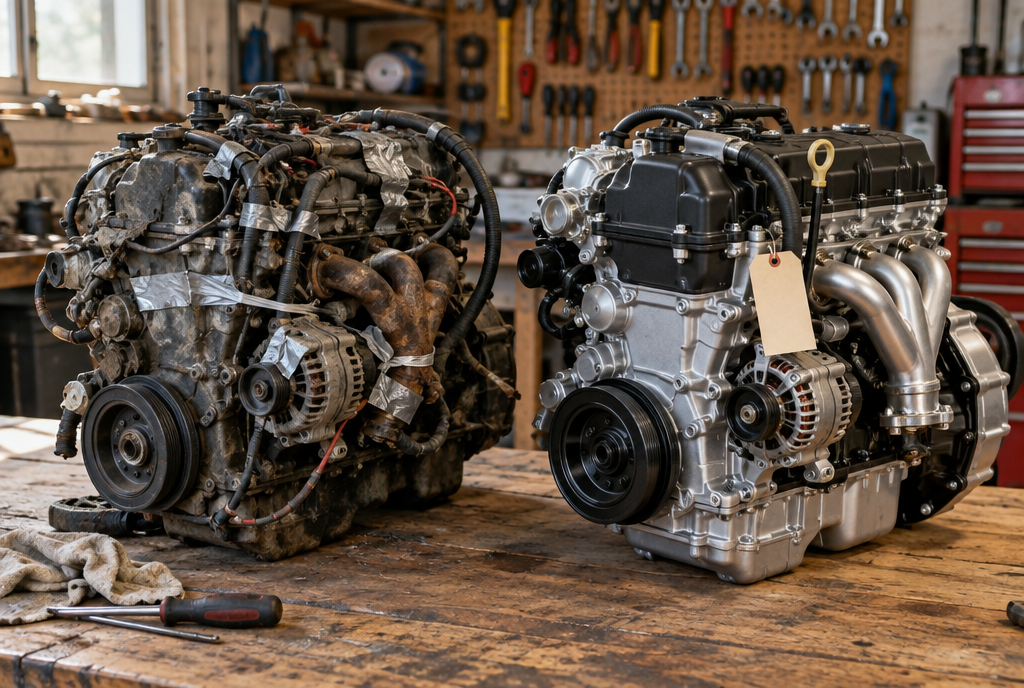
The one-evening hack from 2023, and the 2026 version 1.0
The engine you never see
llama.cpp is free software that lets you run an AI model, the “brain” of an assistant like ChatGPT, directly on your computer. Not on a server in California: on your PC, in your living room. Your questions don't go anywhere, and once the model has been downloaded, it even works without the Internet.
Most people who use it don't even know it. Apps like LM Studio or Ollama, which many people use to have their AI at home, each bundle their own version of this engine. It's a bit like a car engine: you drive the car, you never look under the hood, but it's the one doing all the work. It's under the MIT license, which plainly means that anyone can use it for free, even a company that sells its own products. According to its GitHub page, more than four hundred people have contributed to it, and since February 2026, the original team has been working at Hugging Face.
Why this “1.0” really matters
Right, let's be honest: at first glance, going from version 0.9 to 1.0 looks like a simple label change. Except that here, it's a promise.
Until now, the software came out at a crazy pace, a new version almost every day, numbered stupidly: the last one before 1.0 carried the number 12,359! And with every update, a developer who had built an app on top of it could wake up to a program that no longer started, because a setting had changed its name overnight. For me, having been developing for twenty-five years, that's the kind of thing that makes you lose an entire morning.
From now on, the version number has a meaning, and it's read in three parts. The first number changes only if something breaks. The second, when there are new features that break nothing. The third, for simple fixes. It's exactly like a standardized electrical plug: the toaster manufacturer knows that the plug won't change shape next week, so he can finally make his toasters in peace.

A plug that no longer changes shape, and everyone can plug into it
To clear the decks before the promise, the team cleaned house: 35 old functions, which had already been announced as deprecated, were removed all at once, according to the release note. Those who were still using them had to adapt their code. This is the last big disruption before the calm, in principle.
What's new under the hood
Version 1.0 isn't just a label, it also comes with new stuff. According to Hugging Face, llama.cpp can now run more than 150 different model families, including three new ones all at once, among them Kimi K3.1 Pro and Ripple 65B. It can also speak: a speech synthesis model, drama-3, lets it read its answers out loud. And it stores the conversation's memory more compactly, which makes it possible to hold longer discussions with the same graphics card.

AI now reads aloud, and without the Internet
The little twist in the story is that during his very first week, in 2023, Georgi Gerganov wrote that “in theory”, it should be possible to run a 65-billion-parameter model (the number of little settings learned by the AI, basically its size) on a MacBook with 64 GB of memory. Three and a half years later, that's exactly what Ripple 65B needs, according to specialist site ModelFit: 64 GB of memory, otherwise it won't fit. He got it right from the very first evening!
And then there's the security part, much less sexy but very important. llama.cpp can run as a small server on your PC, so other programs can talk to it. Several holes have been plugged that could have allowed a booby-trapped web page to secretly talk to the AI installed on your machine. And your Hugging Face access key (the password used to download certain models) can now only go to the Hugging Face site, and nowhere else.
If you're on a Mac and installed it with Homebrew, the little software manager for developers, the update can be done in one line. Type this in the Terminal:
brew upgrade llama.cppSo, what good is it to you?
If you've never opened a Terminal in your life, the real good news is elsewhere. The same team has released a very simple app, Llama, which sits in the top bar on Mac and next to the clock on Windows 11. No command to type: you choose a model from a list, click, it downloads, and you chat with your AI, with no subscription and without anything leaving your computer. It's free, at llama.app, and since November 10, the Windows version has even been in the Microsoft Store. A small detail that makes me happy: the Windows version is written in .NET, my everyday language.
What's a stay-at-home AI good for? Having it summarize your health insurance contract or your kid's report card without sending those papers to an American company. Having an assistant on the train or plane, where the Wi-Fi crawls. Or simply not paying twenty euros a month to ask three questions a week. I explained last month what you can do with a small 4 GB model on an ordinary PC.
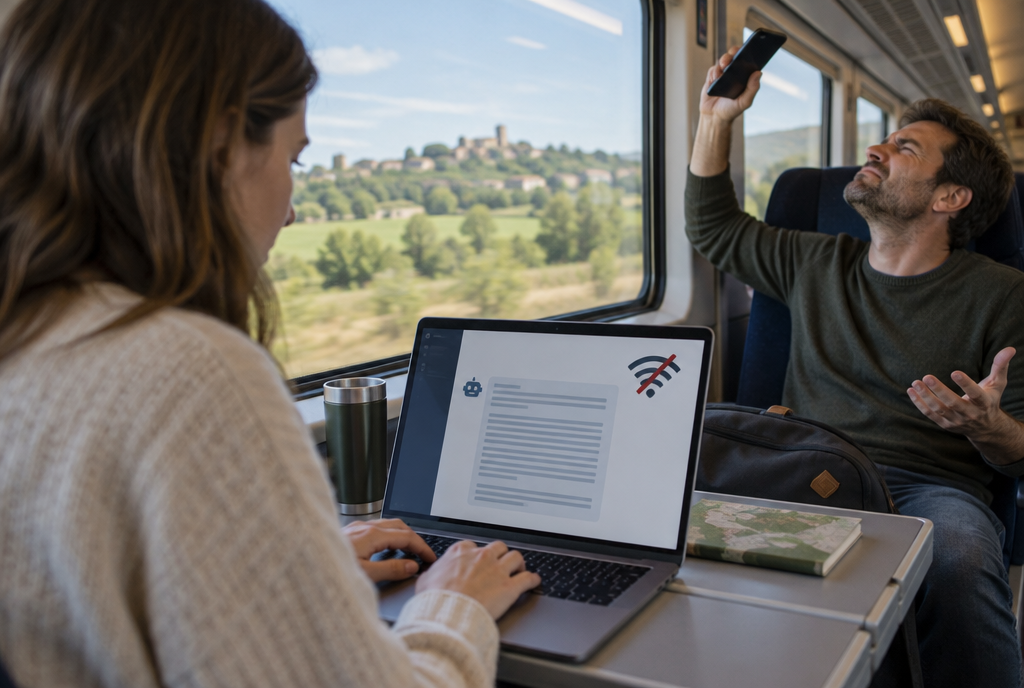
No signal on the train, and the AI still answers
Let's be clear though: an AI running on your laptop doesn't have the power of the big ChatGPT or Claude models. It's slower, a little less clever, and the biggest models need a seriously powerful computer. But for summarizing, translating or rewording an email, a small model does the job very well.
What amazes me in this story is how far things have come. A guy who writes one evening “I have no idea if this works”, and three and a half years later, it's the foundation that a good part of the AI running on individuals' computers relies on. Hats off, Georgi! And as for 2.0, there's no rush: with the new rule, that would mean you've broken everything.
Sources
- GitHub, November 13, 2026: the llama.cpp 1.0.0 release notes (in English)
- Hugging Face, November 13, 2026: llama.cpp v1.0.0, a stronger foundation for local AI (in English)
- Hugging Face, October 13, 2026: Llama Windows, llama.cpp in the Windows taskbar (in English)
- ModelFit: llama.cpp 1.0 on Mac, what breaks and what runs (in English)
Article written with the help of Claude Code, proofread and corrected by me.
Join the conversation
You need an account to comment on this article. Creating one is free and takes under a minute.
No comments yet.