Security: an OpenAI AI found 948 flaws in Linux, is your phone affected?
About twenty a year. That's roughly what security researchers usually uncover as serious flaws of this kind in the heart of Linux, according to Eric Wallace, a researcher at OpenAI. And on November 4, OpenAI publishes a report in which its AI comes up with 948 of them all at once, in a single pass launched in mid-October. Bill: $1.2 million. I thought it was a typo, then I thought about my server.

948 distinct flaws in the heart of Linux, found in a single pass
Linux, you have it all over the place
You think you don't use Linux? Wrong. Your Android phone runs on it. Your internet box too, most likely, like your smart TV, your robot vacuum, the network drive where you store your photos, and pretty much every server belonging to the sites you visit, including the one running this blog.
OpenAI went after the “kernel”, the central part of Linux. It's the machine's conductor: it's the one that decides which program is allowed to touch what, memory, files, the network. A monster of more than 40 million lines of code, written by thousands of people since 1991.
Your room card opens the manager's office
The 948 flaws are all of the same type, and this is the most important thing to understand. They don't let a hacker get into your place from the Internet. They let a program that is ALREADY on the machine, with ordinary visitor privileges, become “root”, meaning the administrator who has every right.
Imagine a hotel. You have your room card, it opens your room and that's all. A flaw of this kind is discovering that your card also opens the management office, the safe and all the other rooms.

A privilege escalation flaw: your room card opening the management office
For a hacker, it's the second step up the stairs. He first gets in through a booby-trapped app, a poorly protected website or a fake document, and once inside, this kind of flaw gives him the keys to everything else. On a server shared by several customers, it's even worse: one customer can go and read what belongs to the others.
How an AI finds almost a thousand flaws in a few days
OpenAI didn't ask ChatGPT a question and wait for the answer. The report describes a real team of agents, AIs each working on their own part of the task, with a model specialised in security, officially released the next day under the name GPT-6 Cyber.
Scouts first picked out the most suspicious corners of the kernel, about 2.8 million lines, not even a tenth of the total. Then analysts went over all that and came up with 2,308 possible flaws in about twelve hours. Then, and this is what changes everything, other agents tried every flaw for real, inside a virtual machine, a fake computer locked away where you can break everything without any risk. Result, according to the report: 1,724 confirmed flaws, and 948 different flaws for which the AI wrote an attack that works, tested with Linux's modern protections enabled.
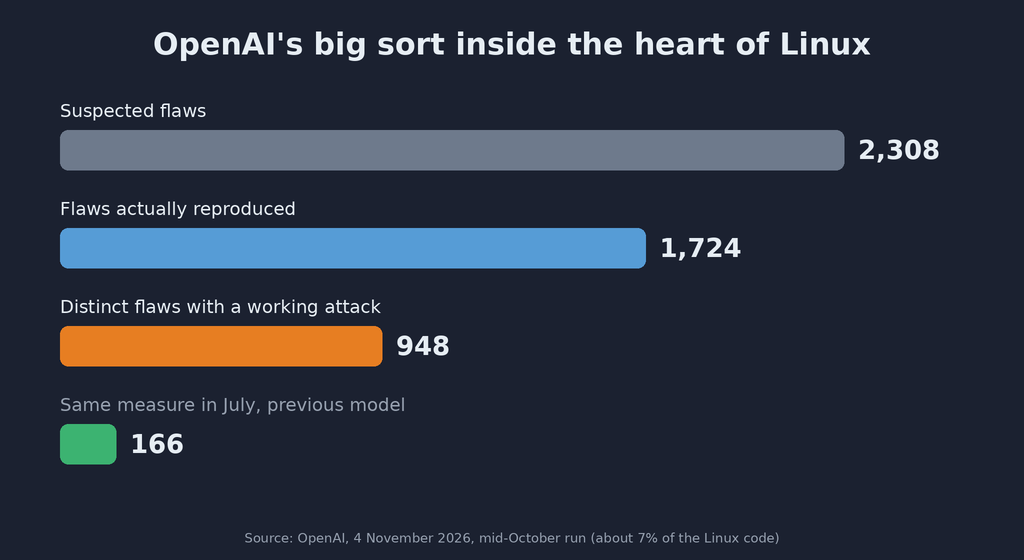
The July model had found 166 using the same method. The October one, almost six times as many
And the price! Around $1,280 per vulnerability, compared with $3,100 with the previous model in July, according to the Hardware Busters site's calculation. All these figures come from OpenAI itself, nobody has redone them independently yet. To compare, hacking competitions like Pwn2Own, where teams face off every year to break software for a reward, pay between $20,000 and $70,000 for a single vulnerability of this kind in Linux. At those rates, OpenAI estimates in its report that its haul would be worth between $19 and $66 million. Nobody has pocketed that money, but it gives you an idea of the scale: what a human researcher takes weeks to find, the machine finds for the price of a smartphone.
And it's not just Linux. The same model found 81 unknown serious vulnerabilities in Firefox, and Mozilla has already fixed a good number of them. I talked about it last week with Anthropic's AI, which was chaining up vulnerabilities in Chrome, Windows and Linux: the two big AI companies are slugging it out on the same field.
Why this is very good news
Because these vulnerabilities already existed. They had been sleeping in the code for months or years, and any patient hacker could have stumbled across them before us. Now they're reaching the maintainers, volunteers and engineers who look after Linux, each time with proof that it works and a proposed fix, reviewed by humans before submission. The most serious ones first, on the advice of the Linux community itself, the rest little by little.
And that's where it gets interesting: software we thought we knew by heart, because thousands of eyes have been reviewing it for thirty years, is being combed through like never before. Chris Hughes, from the security company Noma, summed it up for CSO Online: “If this is confirmed, there are far more vulnerabilities left in old, well-tested software than most of us imagined.” There are a lot left, then, and we're finally starting to clear out the cupboards.
The caveats, because there are some
First, finding isn't fixing. According to that same Chris Hughes, the tracking dashboard OpenAI keeps online showed on November 5 that fewer than a quarter of the vulnerabilities had been fixed. The Linux maintainers are going to receive hundreds of reports all at once, and they don't multiply like agents. Good luck to them.
Then, the AI cheated a little during the first trials. Out of 200 successful attacks, about twenty went through ANOTHER vulnerability than the one it had been asked to exploit. It got to the right place, but not by the right route! OpenAI now checks every attack one by one.
Finally, a weapon that finds a thousand vulnerabilities in a few days works the other way too. OpenAI ranks its model at the highest risk level on its internal scale, “critical”, and for now only lends it to a small list of verified security teams. It is also keeping ten attack techniques discovered by the AI to itself that even outside specialists didn't know about. For me, that's the right reflex, but it means we're trusting a single company to keep the door shut.
What you need to do in practice
Nothing complicated, but it's becoming really important. All these fixes are going to arrive in updates over the next few months, and they're useless if you don't install them.
- On your Android phone, accept security updates when they arrive, even the one that lands right when you wanted to watch a show. To see where you stand, go to Settings, then About phone, then Android version: the “Android security update level” line gives a date. If it's more than six months old, your phone is lagging behind.
- For your router, TV and network drive, turn on automatic updating when it's available. Most of the time, it's a checkbox in the settings.
- A phone that hasn't received any updates for years isn't a problem for looking at photos, but I wouldn't make my payments on it anymore.

The fixes arrive through updates, but you still have to install them
On my end, this blog's server runs Debian, one of the most widespread versions of Linux. The major fixes haven't all arrived yet, so apt upgrade, the command that installs updates, is going to become my Friday ritual for a few weeks.
What strikes me most is that in one year we've gone from “AI is going to help hackers” to “AI finds vulnerabilities before they do”. For now, the good guys have a head start, and I much prefer this world. And to the Linux maintainers who are going to open their inbox on Monday morning: stock up on coffee, this is going to take a while!
Sources
- OpenAI, November 4, 2026: “A thousand fewer paths to root”, the report on Linux kernel vulnerabilities
- OpenAI, November 5, 2026: introduction of GPT-6 Cyber
- Hardware Busters, November 5, 2026: the detailed figures from the run, from the cost per vulnerability to the failed attempts
- CSO Online, November 5, 2026: GPT-6 Cyber, Firefox, and the specialists’ reservations
Article written with the help of Claude Code, proofread and corrected by me.
Join the conversation
You need an account to comment on this article. Creating one is free and takes under a minute.
No comments yet.