Math: Claude's and OpenAI's AIs have proved that a famous hypothesis is false, so what does that change?
On October 16, in two labs that have been waging a commercial war for years, two AIs found the same thing. On the same day. Without talking to each other. OpenAI's and a research model from Claude, at Anthropic, both demolished a hypothesis on which hundreds of computer science research papers are built. The two announcements came out on October 26, a few hours apart.
Well, I really didn't see that coming. And frankly, it's exactly the kind of news I've been waiting for for months: not an AI that does faster what we already knew, an AI that finds something the best specialists in the field believed to be impossible.
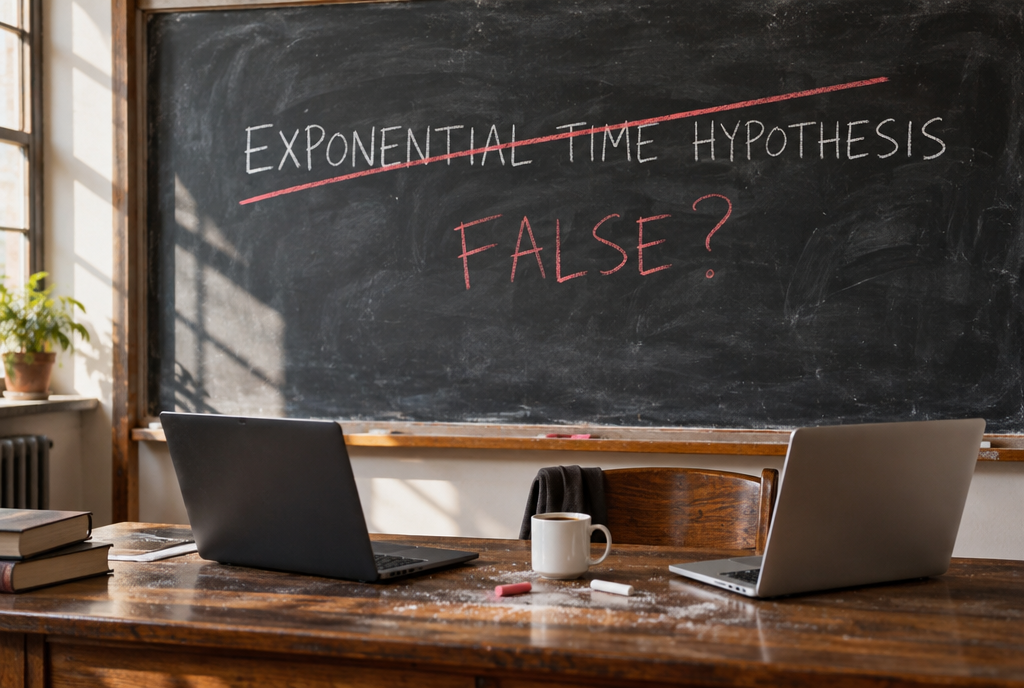
Two computers, a single crossed-out hypothesis
What is this hypothesis?
It's called the Exponential Time Hypothesis, ETH for those in the know. The name sounds scary, the idea is simple, and I'm going to explain it to you with a wedding.
You have to make the seating plan. Each guest goes either to table A or to table B. And the family has requirements, each one involving three people, along the lines of: “Josiane at table A, or Gérard at table B, or Kevin at table A, at least one of the three things must be true”. You have a hundred guests and a few hundred requirements like this. Question: is there a plan that keeps everyone happy?
This puzzle has a name among computer scientists, 3-SAT, and it's famous because loads of real-world problems can be reduced to it: school timetables, delivery routes, checking an electronic chip. The brute-force method consists of trying all the plans. With a hundred guests, that makes roughly a thousand billion billion billion possible plans. A computer testing a billion of them per second would spend nearly three thousand times the age of the universe on it!

The 3-SAT problem, family meal version
Researchers have found smarter methods since then, but they remain in the same family: for every additional guest, the computation time is multiplied by a fixed number, around 1.3 for the best ones known so far, according to Anthropic's paper. That's exponential growth. And the ETH, put forward at the end of the 1990s by Russell Impagliazzo, Ramamohan Paturi and Francis Zane, basically says: we'll never do better than that. There is no fundamental shortcut.
Except there is. The two AIs found a method whose running time grows more slowly than any exponential. The ETH is false, at least according to them.
Does this mean everything is going to go faster?
No. And Anthropic itself says so in black and white, in the presentation of its result: “the result is purely asymptotic and says nothing about solving formulas in practice”. Asymptotic means that the advantage only appears for problems of a ridiculous size, far beyond anything a human will ever build.
Your GPS isn't going to find your route faster, and neither is the software that creates your children's school timetable. Those programs work with engineering tricks, not with this kind of theorem. And your bank's encryption doesn't rely on this hypothesis, so nothing falls apart on that side.
What falls apart is elsewhere. For more than twenty-five years, researchers have used the ETH as a foundation: “if the ETH is true, then such-and-such a problem is necessarily slow”. Hundreds of papers work like that. If the foundation gives way, all those conclusions become open questions again. For a theoretical computer scientist, it's a bit like finding out that the standard metre measured 98 centimetres.
14 million tokens and no human
In its article, Anthropic gives precise details: the algorithm was found on October 16 by an internal Claude model, with 14 million tokens produced and "no human intervention". A token is a piece of a word, roughly three quarters of a word. 14 million tokens comes to around ten million draft words, the equivalent of about a hundred novels written in one go to arrive at an idea. Anthropic's researchers only helped it make the article readable, 49 pages in the end.
I did the calculation, naturally. Opus, the model I use every day in Claude Code, is billed at 25 dollars per million tokens produced at Anthropic's public rate. 14 million tokens would therefore come to around 350 dollars. The price of an electric scooter, to overturn twenty-five years of certainties! Well, the internal model is not Opus and Anthropic does not say what it really cost, but the order of magnitude makes your head spin.

14 million tokens is roughly this pile of draft material
And OpenAI announces the same date, October 16, for its own model. Professor Jelani Nelson, who read Claude's proof before its release, wrote that it does seem the models obtained their result on the same day, and that the two proofs arrived at roughly the same speed. Anthropic even writes it in its article: OpenAI claims "independently and at the same time" to have obtained a similar result.
One final detail that matters: both proofs were checked with Lean. It is software that verifies demonstrations, a sort of maniacal proofreader that refuses the slightest unjustified step. At Anthropic, the complete verification runs in 8 minutes on 24 processors. That does not guarantee everything (you still have to make sure that what Lean checked really is what the article claims), but it is a long way from "take my word for it".
And OpenAI released two other results on the same day
As if that were not enough, OpenAI published two other proofs in the same announcement.
The first concerns the Kakeya conjecture. A conjecture is a statement that everyone believes to be true without ever having managed to prove it. This one starts with a puzzle from 1917, posed by the Japanese mathematician Sōichi Kakeya: what is the smallest area in which you can make a needle lying flat complete a full turn? It is the three-point turn in a car in an alley that is too narrow, in mathematician form. The modern version replaces the table with space: if a stick must be able to point in every direction, how much room does it need at minimum? Hong Wang and Joshua Zahl had solved the case of our three-dimensional space in 2025, and Hong Wang received the Fields Medal for it this summer, the equivalent of the Nobel Prize for mathematics. OpenAI claims to have solved all the cases at once, including four-, five- or hundred-dimensional spaces that only mathematicians know how to handle.
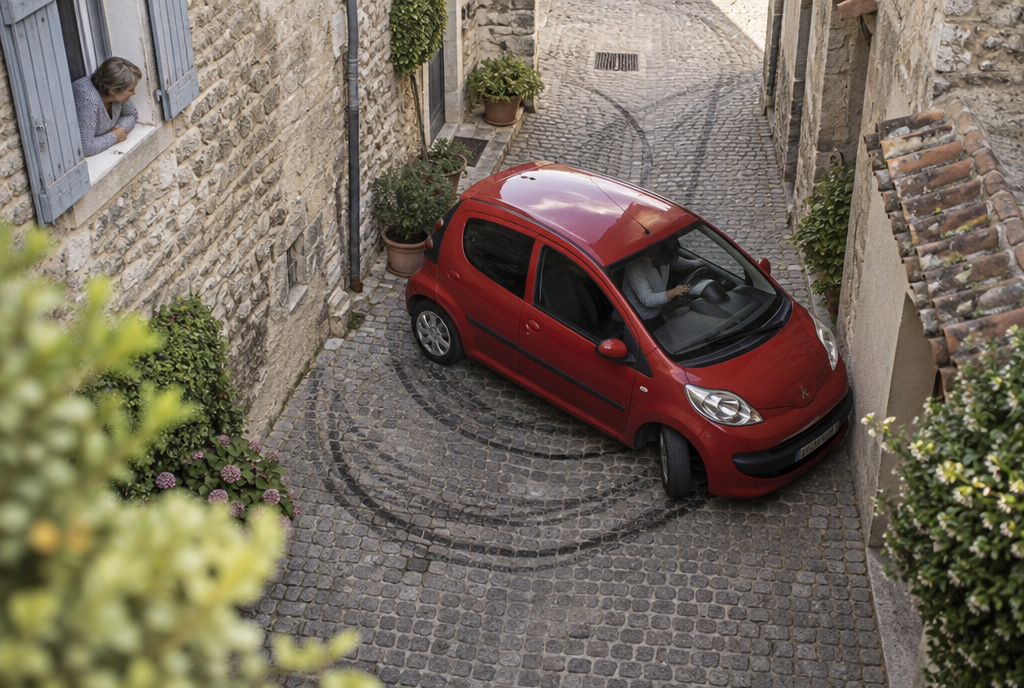
The Kakeya problem starts with a maneuvering question
The second comes from physics. OpenAI says it has proved, with the rigor of a mathematician, that Yang-Mills theory holds up. It is the tool physicists use to describe the force that holds quarks together, the tiny grains that form the heart of every atom. Physicists have been using it for seventy years without anyone ever proving that it was coherent. And it is part of one of the seven "millennium problems", those puzzles carrying a million-dollar prize from the Clay Institute. Only part of it: the hardest piece, the one that would bring in the million, remains open.
Here, I am more reserved. This proof is not public. OpenAI entrusted it to a group of physicists led by Nobel laureate David Gross, who prefers to write up the work himself before showing it. A committee of mathematicians who follow AI results replied bluntly that there was "no scientific reason" to wait any longer. And there is a somewhat cruel story behind it: Levent Alpöge, an Anthropic employee, and Ethan Sussman, a mathematician at Northwestern University, were finishing in public, on a code-sharing website, an old demonstration program left by physicist Tadeusz Balaban in the late 1980s. They thought they were close to the goal. OpenAI's announcement seems to have beaten them to the finish line.
Well, what does this change for you?
Tomorrow morning, nothing. None of the devices in your home will work any differently, and maybe that result will never directly affect your life.
What changes is who finds it. Less than three weeks ago, I was telling you that OpenAI had solved 372 math problems that nobody understood. This time, we are changing categories: it is no longer a problem forgotten in a corner, it is a hypothesis that the entire field took for true, and two different machines knocked it down on the same day. If this happens again in chemistry or medicine, on questions we thought were settled, years of research will be counted in weeks.
And there is a precedent that makes me smile. In 1976, Kenneth Appel and Wolfgang Haken proved the four-color theorem (any map can be colored with four colors without two neighboring countries having the same one) by running a computer for hundreds of hours. A lot of mathematicians were skeptical: is a proof that no human can reread really a proof? Almost thirty years later, in 2005, Georges Gonthier had it fully checked by software of the same kind as Lean, and nobody argues about it anymore. We are exactly in the same place, but sped up.
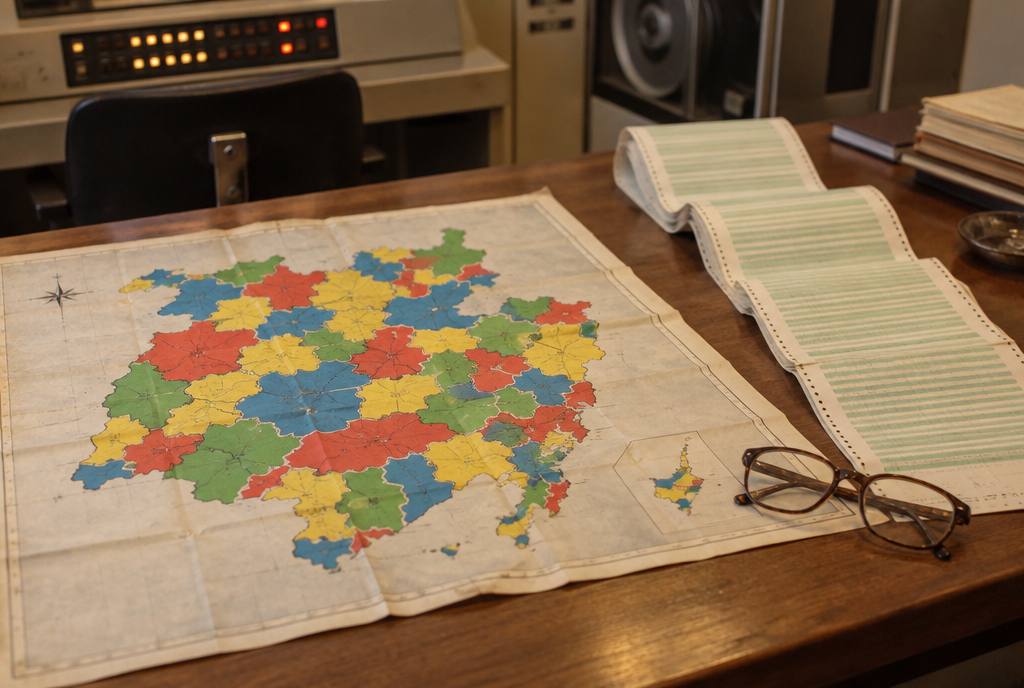
Four colors are enough, and it was a computer that proved it in 1976
The deadline, now. To know whether ETH is really dead, we will need a few months. Ryan Williams, from MIT, and two of the fathers of the hypothesis, Impagliazzo and Paturi, have agreed to check and explain OpenAI's result, without a confidentiality agreement and without being paid. They themselves warn that their participation « must not be taken as a certification ». But they add: if it is correct, it will change an important part of theoretical computer science. OpenAI, for its part, says it is not claiming academic credit and has given 5 million dollars to the Simons Foundation to organize conferences on results produced by AIs.
For me, this is the day AI stopped doing its homework faster than us and started correcting ours. And to Impagliazzo and Paturi, who put forward this hypothesis in 1999 and will spend the next few months checking that a machine really demolished it: hats off, it takes some serious courage to reread your own defeat line by line!
Sources
- OpenAI, October 26, 2026: the three results and the work with researchers
- Anthropic on GitHub: Claude's paper and its Lean verification
- The paper « A 2^o(n) Time Algorithm for 3-SAT », signed by Claude, and its provenance statement
- The Next Web, October 26, 2026: OpenAI says it has refuted ETH
- Scientific American, October 27, 2026: the duel between OpenAI's and Anthropic's proofs
- Williams, Impagliazzo and Paturi's open letter
Article written with the help of Claude Code, reread and corrected by me.
Join the conversation
You need an account to comment on this article. Creating one is free and takes under a minute.
No comments yet.